Mimic Octopus
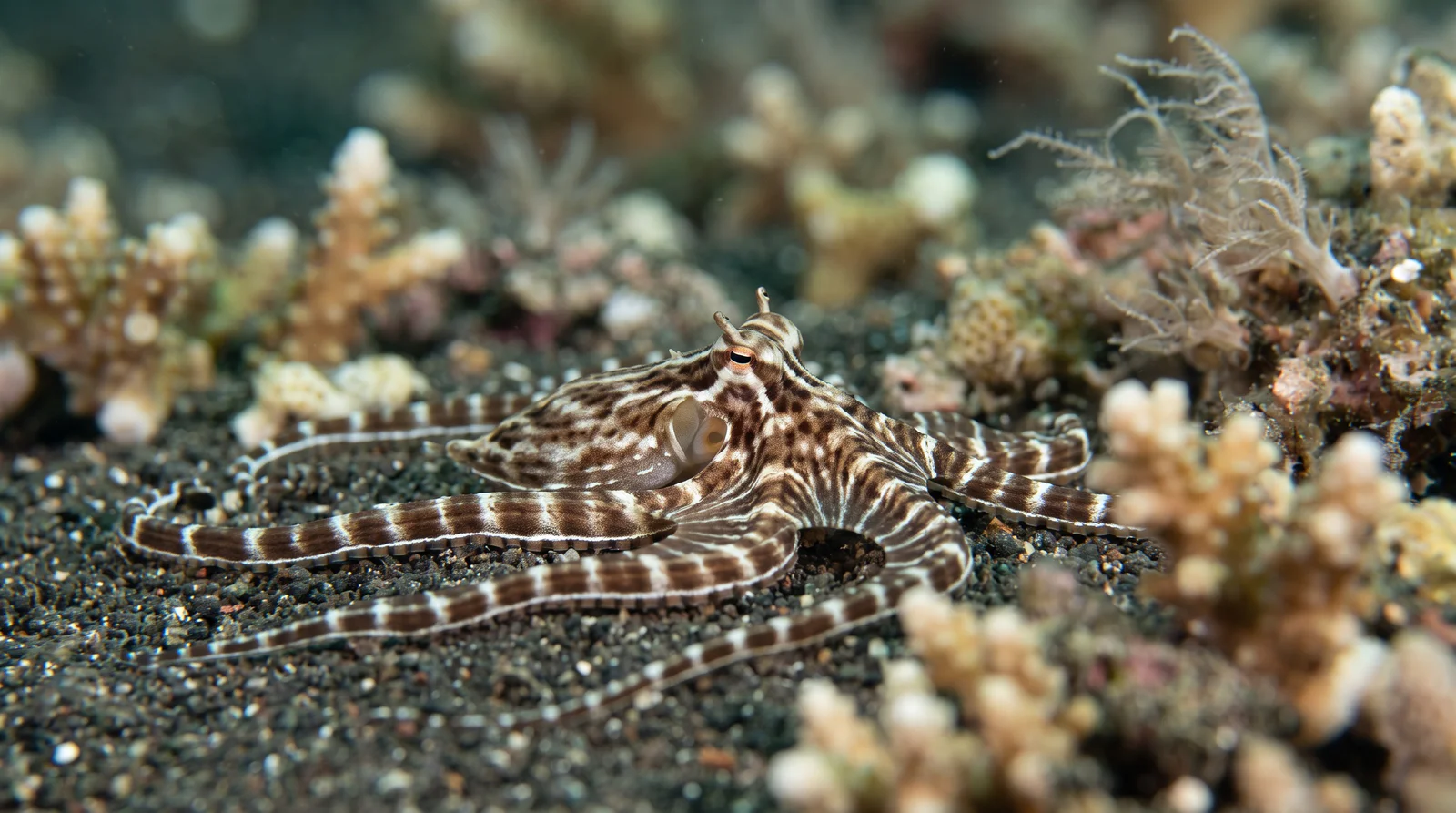 AI-generated
Image credit: AI-generated illustration · Diveity
Thaumoctopus mimicus
About Mimic Octopus.
The mimic octopus is a slender, long-armed octopus of shallow Indo-Pacific sand and silt that imitates soles, lionfish and sea snakes.
Names and classification
Mark Norman and F. G. Hochberg described the species in Molluscan Research in 2005 (volume 25, pages 57 to 70) and set up a new genus, Thaumoctopus, for it; their abstract says a combination of unique anatomical characters justified the new genus. WoRMS, taking its entry from MolluscaBase, accepts Thaumoctopus mimicus M. Norman & Hochberg, 2005 in the family Octopodidae, order Octopoda, class Cephalopoda, and returns no synonyms. Its list of vernacular names has mimic octopus in English, Mimik-Oktopus in German and ミミックオクトパス in Japanese.
Identification
The 2005 abstract sets out what distinguishes it: long, narrow arms that can be shed at a fixed level near their base, no enlarged suckers in either sex, no calamus on the male's copulatory organ, and a colour pattern whose base components include a white teardrop-shaped ring at the centre of the mantle's upper side, plus a distinct white U-shaped patch nearer its rear. Wikipedia says a small horn protrudes from each eye and that at its widest the animal is roughly as thick as a pencil. Its natural colour is light brown or beige in that account, though it usually shows a bolder pattern of white and brown stripes, which the article ties to imitating poisonous species.
Size
Its largest length in SeaLifeBase is 48.0 cm TL, a figure given for males or animals of unknown sex, with a mantle 5.8 cm long; Wikipedia's figure is larger, about 60 cm including the arms. The page leaves the gap between the two maximums open.
Conservation
For the IUCN Red List, SeaLifeBase and Wikipedia both record Least Concern. SeaLifeBase gives 13 July 2016 as the date assessed, quoting version 2025-2 of the list; the reference Wikipedia gives is a 2019 Red List account by Allcock. SeaLifeBase adds that neither CITES nor CMS has evaluated it and that it is harmless to people.
Where it lives.
The mimic octopus lives on open sand and silt in shallow water across the Indo-West Pacific, mostly in the upper 15 m, often near river mouths.
Range
The original description reports it chiefly from the Indo-Malayan Archipelago, from New Caledonia to Indonesia, Malaysia and the Philippines, and says photographs from the Red Sea extend its known range to the western Indian Ocean. Wikipedia draws a wider outline: the Gulf of Oman and the Red Sea in the west, New Caledonia in the east, the Gulf of Thailand and the Philippines in the north and Australia's Great Barrier Reef in the south, with most documented observations from Indonesia. In the same article it was first found in 1998 off Sulawesi, on the bottom of a muddy river mouth. SeaLifeBase names the Indo-West Pacific.
Depth and bottom
Each source gives a different depth. Norman and Hochberg record it at 0.5 to 7 m. Wikipedia, citing an article by the dive travel company Dive The World, finds it mainly on sand or silt shallower than 15 m. SeaLifeBase gives 0 to 37 m and classes it as benthic. The 2005 abstract and Wikipedia both put it on soft bottoms: the abstract speaks of soft sediment, and Wikipedia says it prefers river mouths and estuaries to the reefs where other octopuses usually take shelter. In WoRMS its marine flag is set and its freshwater flag is not.
How it behaves.
The mimic octopus hunts by day over sand for small fish and crustaceans, and changes its shape, colour and movement to pass for other animals.
Mimicry
According to SeaLifeBase, which cites a field study, it is known for copying toxic animals that share its habitat, namely banded soles, sea snakes and lionfish, while the meaning of its other postures remains open to interpretation. Wikipedia explains the guises one by one: for a lionfish it holds its arms out radially like the fish's spines; for a sea snake it hides six arms and holds the other two parallel; for a jellyfish it inflates its mantle and trails its arms; and for a zebra sole it draws all eight arms behind it while swimming with its siphon. It cites a 2008 study in which nearly 500 instances of flatfish mimicry were seen in one individual over five days, and describes an octopus that, harassed by damselfish, took on the look of a banded sea snake, a predator of damselfish. The article also mentions imitation of sessile animals such as small sponges, tube-worm tubes and colonial tunicates, and says that this octopus and its close relative the wunderpus are the only animals known to imitate several others to escape predators. The 2005 abstract notes that the paper explores links between its habitat preference and the origins of the mimicry.
Foraging and lairs
Norman and Hochberg call it day-active, foraging for small fish and crustaceans, and SeaLifeBase lists the same diet. Wikipedia says it glides over the sand on a jet of water from its funnel and reaches with its slender arms into holes in the sand and crevices in coral; it names small fish, crabs and worms as most of its prey. SeaLifeBase, citing the same field study, says it often moves into burrows other animals have left and keeps one hole for one to four days; some individuals left a hole at first light, foraged all day in and out of other burrows, spent the night in the last one entered and came out of it at first light the next day.
Life cycle
For breeding, SeaLifeBase gives only the general pattern of cephalopods: the sexes are separate, the male inserts his modified arm, the hectocotylus, into the female's mantle cavity, the hatchlings drift as plankton before settling on the bottom, and males usually die soon after spawning and females after brooding.
Where to see it.
Evidence for visayas · 1 dive site
General range is not evidence of occurrence at a specific dive site.
Gallery.
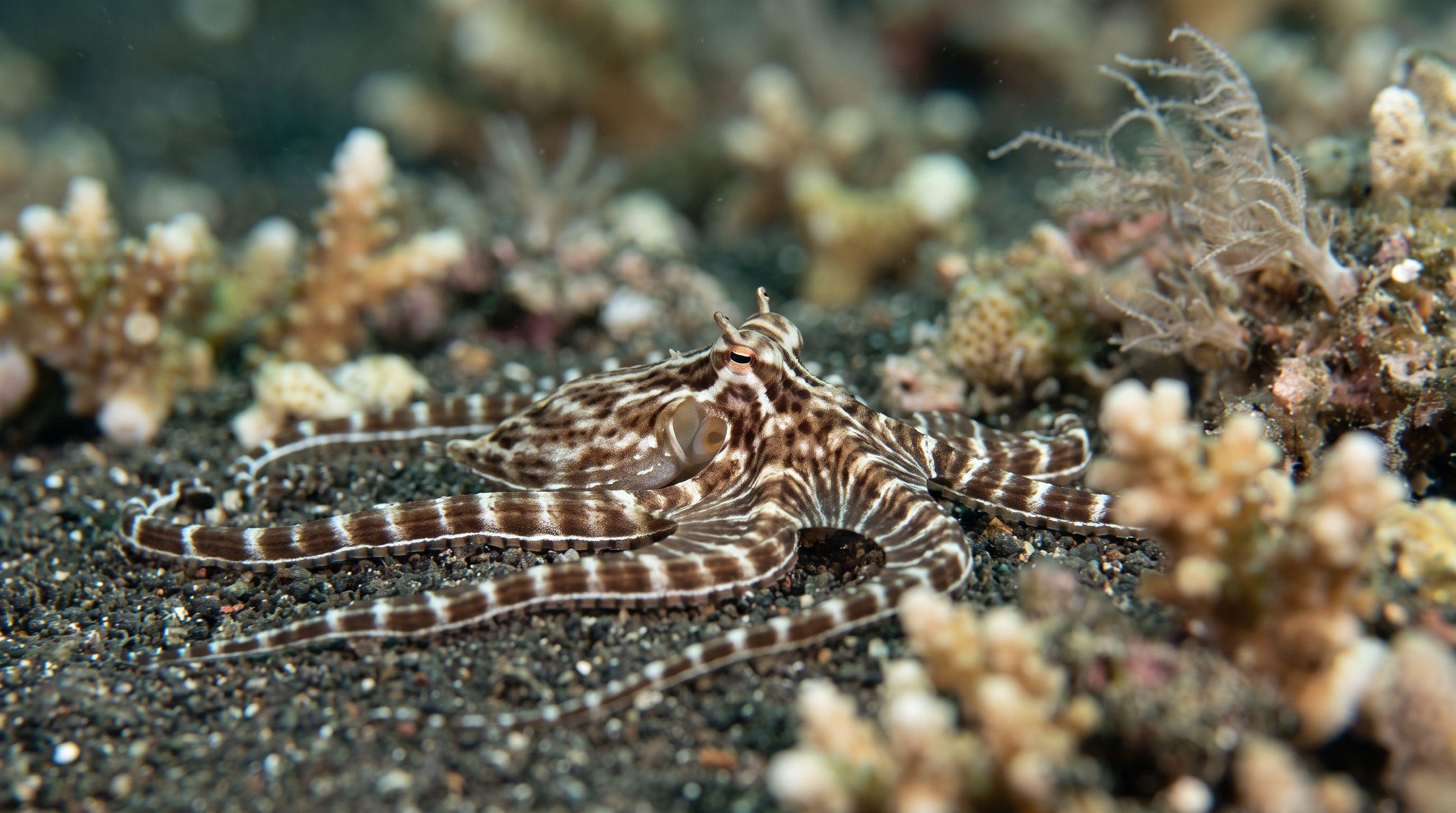 AI-generated
 illustration
Image credit: AI-generated illustration · Diveity