Ocean Sunfish (Mola mola)
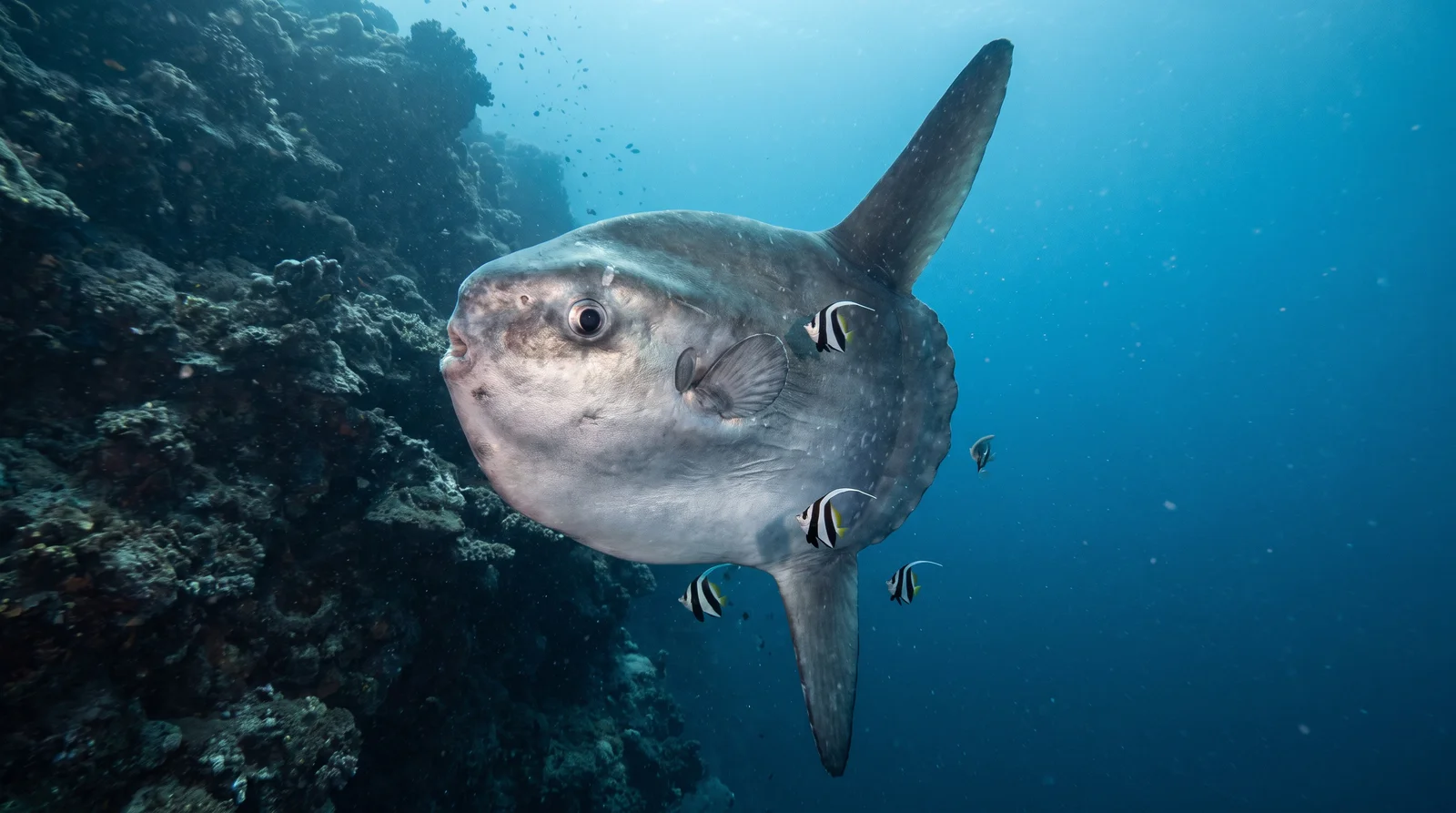 AI-generated
Image credit: AI-generated illustration · Diveity
Mola mola
About Ocean Sunfish (Mola mola).
The ocean sunfish (Mola mola) is a huge, flat, disc-shaped fish of the open ocean with no true tail, found in tropical and temperate seas worldwide.
FishBase lists the ocean sunfish in tropical and temperate waters of all oceans, with a maximum length of 333 cm and a maximum published weight of 1.3 tonnes, and gives its IUCN Red List status as Vulnerable (assessed on 7 June 2011). FishBase also notes that the Guinness Book of World Records registers the sunfish as the heaviest bony fish.
Sawai and colleagues (Ichthyological Research, 2018) re-identified the heaviest bony fish on record, a 2,300 kg, 2.72 m female caught off Kamogawa, Japan, in 1996, as the bump-head sunfish, Mola alexandrini, and not Mola mola.
Identification
According to FishBase, the scaleless body is covered in extremely thick, elastic skin, and the tail fin is replaced by a rudder-like structure called the clavus. The dorsal and anal fins are very high with a short base and are flapped together from side to side; the pectoral fins are small, rounded and directed upward, and the small mouth has teeth fused into a parrot-like beak. Females are larger than males.
Fishes of Australia (Bray, 2024) tells the bump-head sunfish, Mola alexandrini, apart from other Mola species by a bump on the head and another on the chin, rectangular body scales and a rounded clavus.
Sunfish in Bali
The sunfish divers meet at Nusa Penida's cleaning stations have been identified as the bump-head sunfish, Mola alexandrini, rather than Mola mola. Fishes of Australia (Bray, 2024) writes that in Bali bump-head sunfish often gather at cleaning stations to have parasites removed by schooling bannerfish, and shows Mola alexandrini in Crystal Bay, Nusa Penida. Mongabay Indonesia (2018) quotes Wira Sanjaya of the Coral Triangle Center saying that the fish long called mola mola at Penida is Mola ramsayi, now named Mola alexandrini.
The Coral Triangle Center, which still uses the local name mola-mola, says that nutrient-rich upwelling around Nusa Penida is strongest between July and October, when plankton draws the sunfish to the cleaning stations.
Nobody has verified this record in person; it was researched and written by an automated process from the sources named here.
Where it lives.
FishBase describes the ocean sunfish as a fish of the open ocean, found in tropical and temperate waters of all oceans at 12–25 °C. It adds that adults come to slopes next to deep water for shelter and to seek out cleaner fishes.
Depth
FishBase gives a depth range of 30–1,515 m, usually 30–70 m, and records that one was filmed at 480 m by a baited camera. Thys and colleagues (2015), who tagged ocean sunfish off southern California, found that they made occasional dives deeper than 500 m.
Where divers find them
At Nusa Penida, Bali, the sunfish that come up to reef cleaning stations are identified by Fishes of Australia (Bray, 2024) as the bump-head sunfish, Mola alexandrini. The Coral Triangle Center places their visits between July and October, when upwelling brings plankton.
How it behaves.
FishBase describes ocean sunfish as usually shy, though they may become familiar with divers in some places. They often drift at the surface lying on one side, but can swim actively and in a chosen direction, and the dorsal fin often shows above the water.
Feeding
According to FishBase, adults eat fishes, molluscs, zooplankton, jellyfish, crustaceans and brittle stars.
Movements
Thys and colleagues (2015) tracked tagged ocean sunfish off southern California and northern Baja California, Mexico. The tags showed diel vertical migration, the daily movement between deeper and shallower water, with occasional dives deeper than 500 m.
Where to see it.
Evidence for visayas · 1 dive site
General range is not evidence of occurrence at a specific dive site.
Gallery.
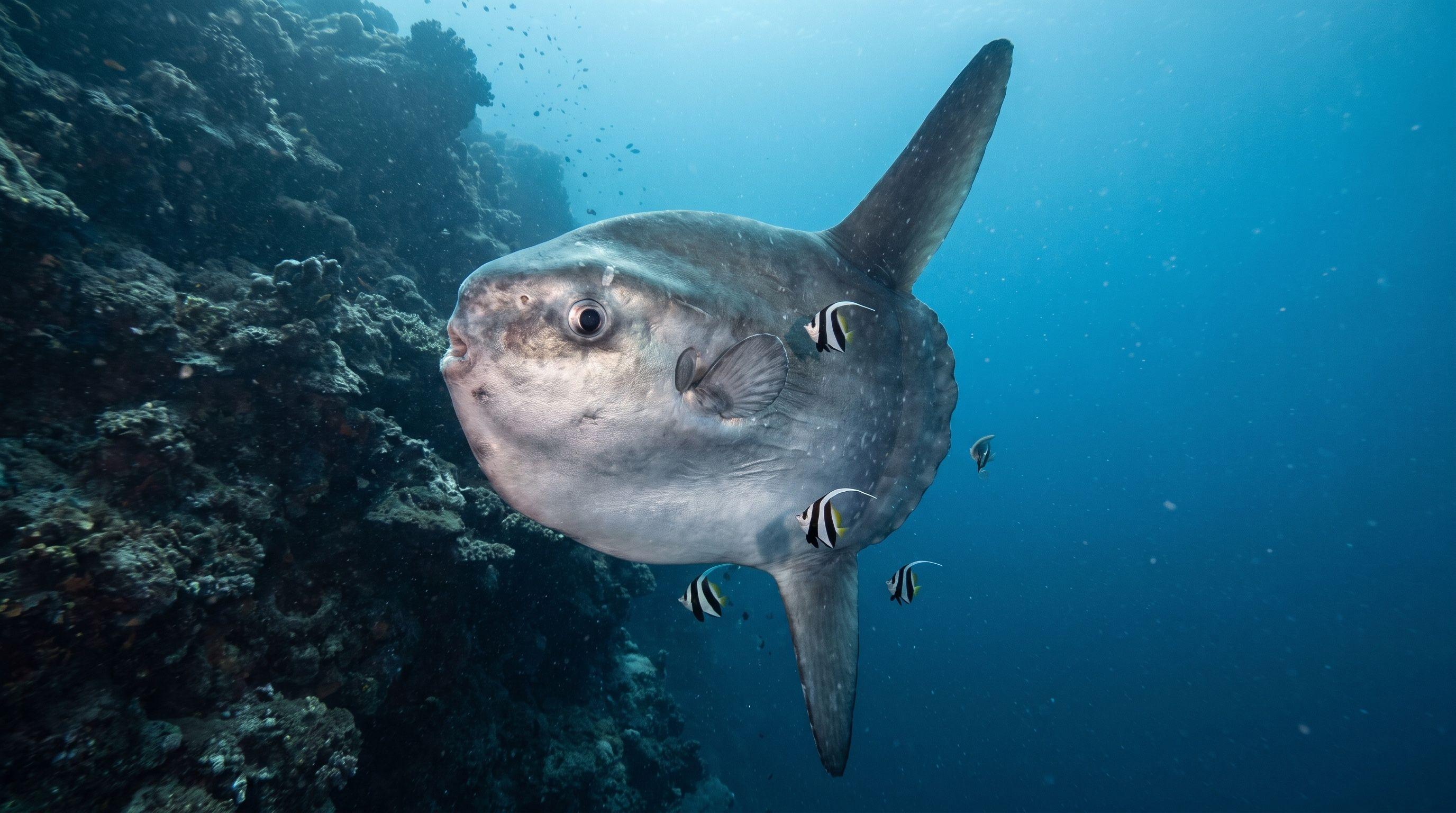 AI-generated
 illustration
Image credit: AI-generated illustration · Diveity