Ocean Triggerfish
 AI-generated
Image credit: AI-generated illustration · License unspecified · Source unspecified
Canthidermis sufflamen
About Ocean Triggerfish.
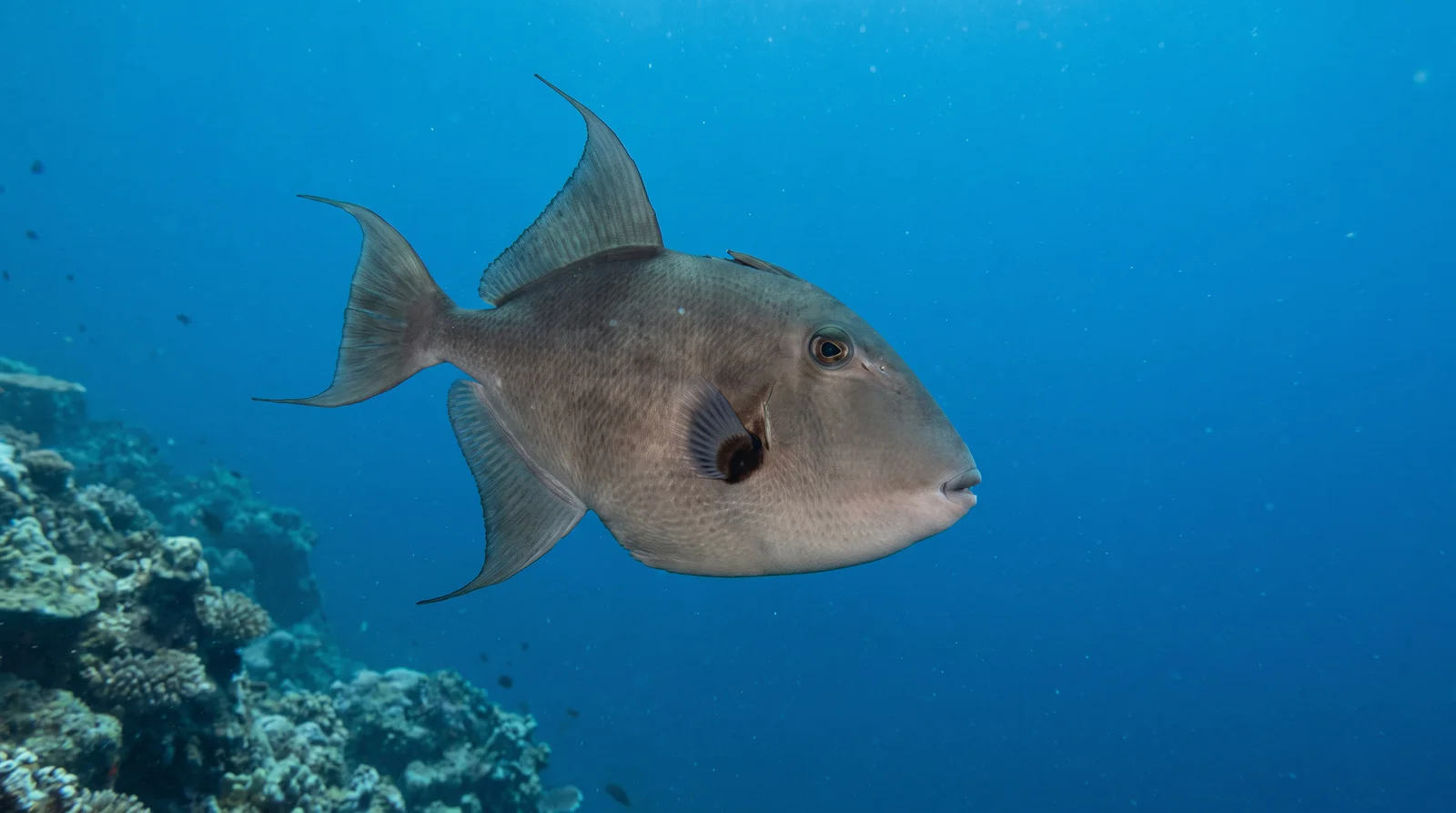
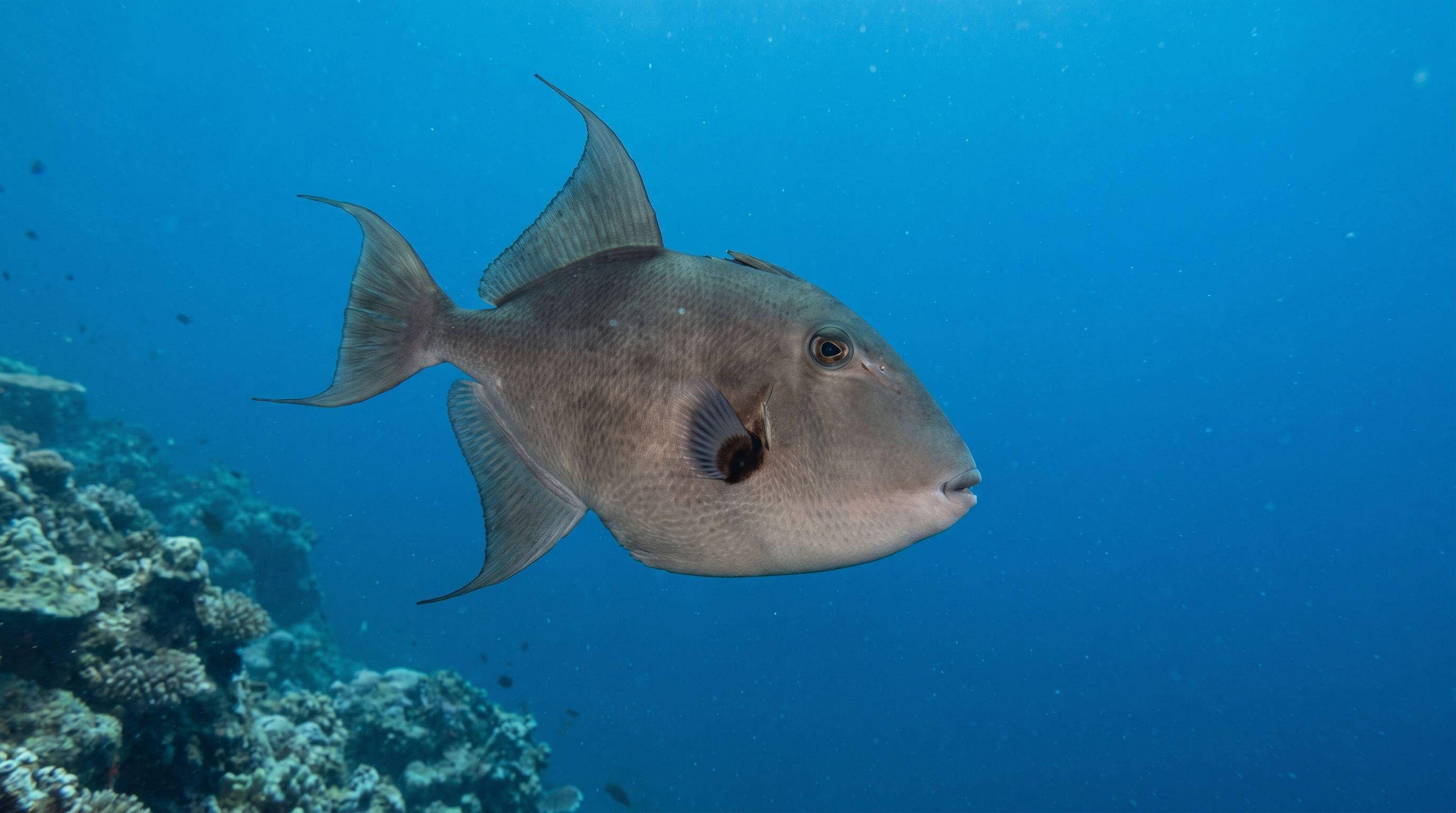
The Ocean Triggerfish, known scientifically as Canthidermis sufflamen, is a robust and distinctive marine species within the Balistidae family. These fish exhibit a light grey to brownish-gray coloration, often presenting a dense, oblong body that tends to elongate as they mature. A key identifying feature is a distinct dark spot located at the base of each pectoral fin, which helps differentiate it from the similar-looking Gray Triggerfish (Balistes capriscus). Their head is characterized by a pointed profile, a rounded snout, and a small but powerful mouth armed with large, uneven teeth. These formidable jaws contain eight heavy outer teeth on both upper and lower jaws, designed for crushing hard-shelled prey. The body is fully scaled with tough, leathery skin, and a lateral line that is barely visible.
Notable physical attributes include their long, soft dorsal and anal fins, which gradually increase in height, with the longest rays nearly as extensive as the head. The first dorsal fin is composed of three spines, the primary of which is thick and strong, capable of being locked into an erect position by a smaller, secondary 'trigger' spine. This unique mechanism serves both as a defense against predators, allowing the fish to wedge itself firmly into rock crevices, and as an anchoring system. The second dorsal fin typically has 26 to 27 rays, while the anal fin features 23 to 25 rays. The caudal fin is double-emarginate in adults, though it appears more rounded in juveniles. Juveniles also display a relatively deeper body, with a depth ranging from 56% to 60% of their standard length, a proportion that can decrease to as low as 44% in adults.
Where it lives.
The Ocean Triggerfish is a widely distributed pelagic species found throughout the tropical and subtropical waters of the Atlantic Ocean. Its range in the western Atlantic extends from Nova Scotia down to Argentina, encompassing regions such as Bermuda, the Gulf of Mexico, Florida, the Bahamas, and the Caribbean islands. In the eastern Atlantic, populations are found around St. Paul's Rocks, Ascension, Cape Verde, St. Helena, and Sao Tome Island.
This species primarily inhabits open water, frequently observed off reef edges and near sharp drop-offs. While typically an offshore dweller, it can occasionally be found in shallower waters. Ocean Triggerfish are often associated with floating objects, including expansive mats of Sargassum seaweed, which provide both shelter and foraging grounds. They are also common near the steep walls of seaward reefs and adjacent to various reef structures. Furthermore, these adaptable fish may congregate around artificial structures such as wrecks and flotsam. They are usually found at depths ranging from 6 meters (20 feet) to 73 meters (240 feet), although they are most commonly observed between 5 and 30 meters. Loose schools have been noted at depths of 35 to 100 feet above reefs or near drop-offs.
How it behaves.
The Ocean Triggerfish is primarily a midwater plankton feeder, actively foraging during the day. However, its diet is quite diverse, also including a variety of crustaceans, invertebrates, zooplankton, and even sea urchins. Equipped with powerful jaws and strong, specialized teeth, they are adept at crushing the hard shells of their prey. They have been observed employing a unique hunting technique where they squirt jets of water to expose buried prey from sandy bottoms.
While generally considered laid-back and not particularly fast swimmers, Ocean Triggerfish possess a distinctive mode of propulsion. They use rapid undulations of their enlarged anal and dorsal fins to achieve precise, slow-speed maneuvers, only resorting to their small caudal fin for short bursts of speed when necessary. Although typically solitary, they may form loose aggregations or schools of up to 50 individuals.
A notable aspect of their behavior, particularly for divers, is their territoriality, especially during the breeding season. During this period, both males and females fiercely guard their nest sites, which are typically located in sandy areas. Males are known to establish and defend multiple territories. When divers or other potential threats approach too closely, Ocean Triggerfish will exhibit aggressive behavior, including circling, flaring their dorsal fins, and even nipping. Their territory is often described as a cone-shaped area extending from the nest on the seafloor all the way to the water's surface. Should a diver find themselves in such a situation, it is advised to remain calm and swim horizontally away from the area, rather than ascending, as swimming upward may keep them within the defended zone. Warning signals, such as a sideways glare, jerky movements, or persistent following, should be heeded. While their bites can be painful due to their strong teeth, they are generally not considered life-threatening.
Where to see it.
Evidence for philippines · No dive sites
General range is not evidence of occurrence at a specific dive site.
No documented dive-site associations in this destination yet.
Gallery.
 AI-generated
AI-generated illustration
Image credit: AI-generated illustration · License unspecified · Source unspecified