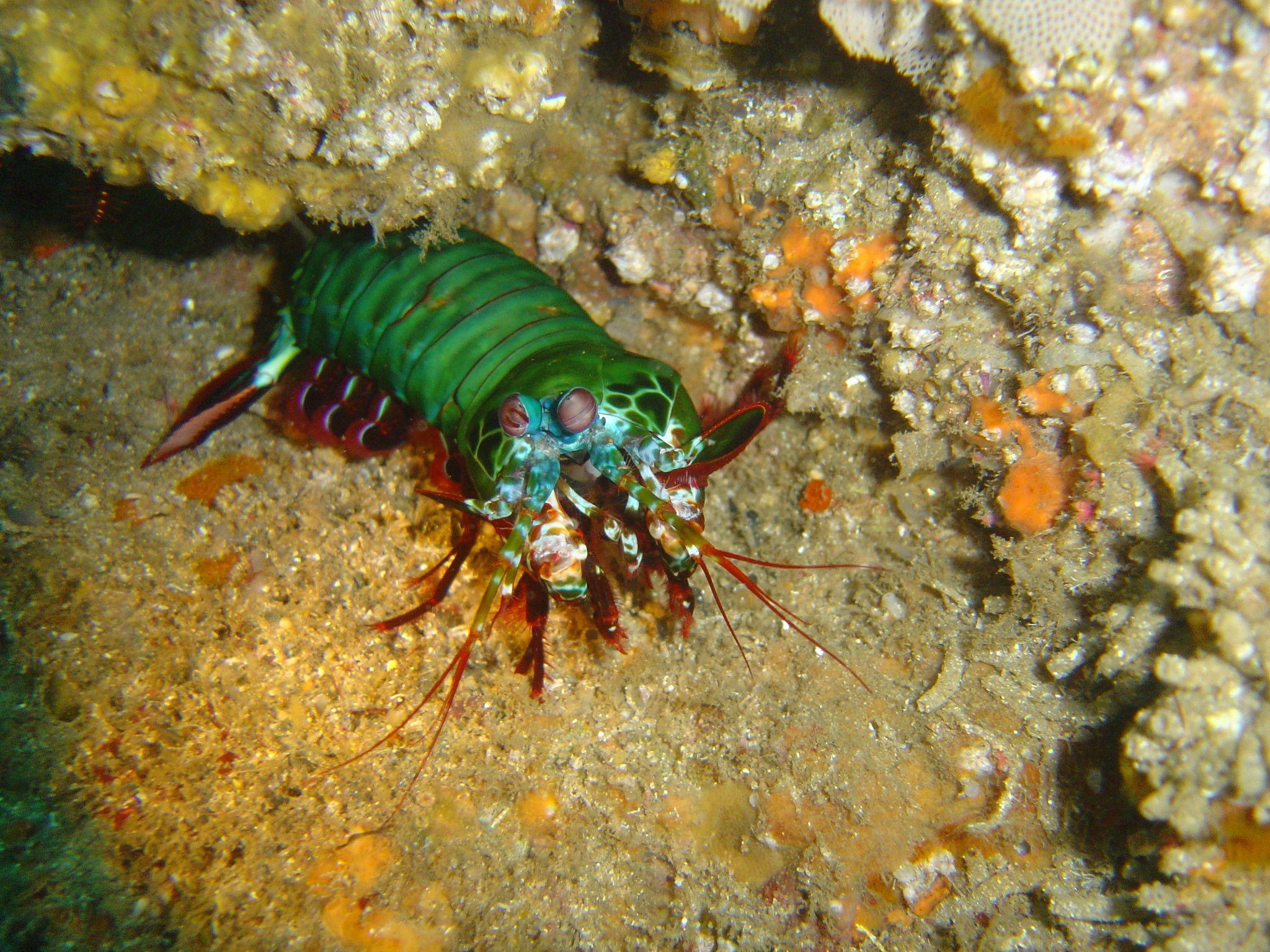
Peacock Mantis Shrimp
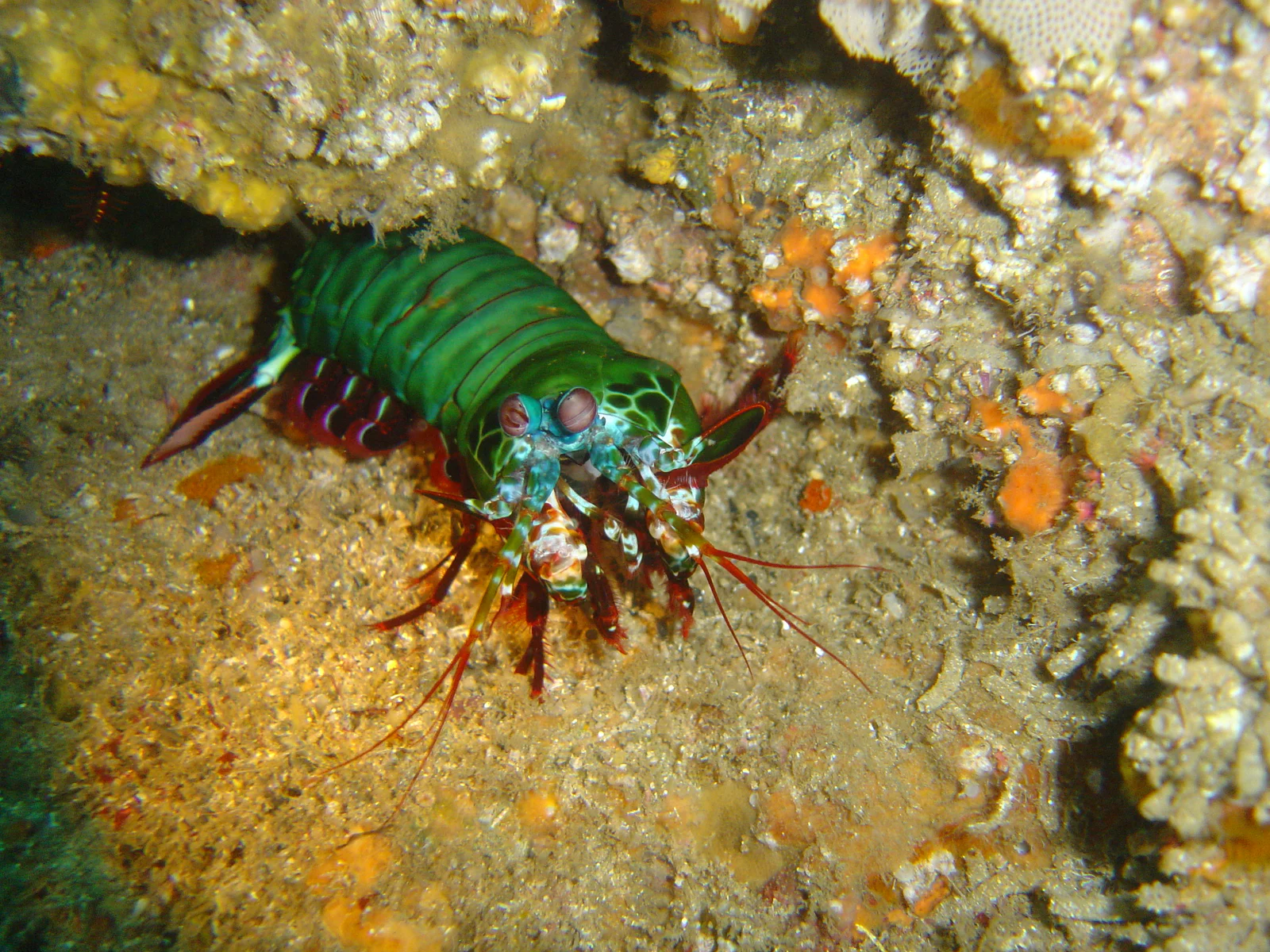
Odontodactylus scyllarus
About Peacock Mantis Shrimp.
The Odontodactylus scyllarus, commonly known as the Peacock Mantis Shrimp, is a captivating and highly sought-after macro subject for divers due to its extraordinary coloration and formidable hunting prowess. Despite its vibrant appearance, this crustacean is a powerful predator, renowned for one of the fastest and most forceful strikes in the animal kingdom.
Found in the warm, shallow waters of the Indo-Pacific Ocean, from East Africa to Guam, and as far south as Northern KwaZulu Natal, South Africa, the Peacock Mantis Shrimp typically inhabits depths of 3–40 m, though it is most commonly observed at 10–30 m. It thrives in waters of 22–29°C. These solitary and territorial creatures construct distinctive U-shaped burrows in sandy or gravelly areas, often near the bases of coral reefs, which they use for shelter and as ambush points for prey. Classified as "Least Concern" by conservation bodies, the species can reach a maximum size of 18 cm (7 in).
As a "smasher" type of mantis shrimp, its diet primarily consists of hard-shelled prey such as gastropods, crabs, and mollusks, which it pulverizes with its specialized appendages.
Identification
The Peacock Mantis Shrimp is arguably the most colorful of all mantis shrimp species, making it instantly recognizable. Key identification features include:
- Coloration: Its body is a stunning kaleidoscope of colors, predominantly vivid green, adorned with shades of orange, red, and blue. The legs are often orange, and the anterior carapace may feature leopard-like spots. Males tend to exhibit more varied and brighter coloration than females, which are often redder.
- Raptorial Appendages: The most distinctive feature is its pair of large, club-like forelimbs, folded beneath its body. These "smashers" are heavily calcified and used to deliver incredibly fast and powerful blows. The strike can reach speeds of up to 80 km/h (50 mph), generating forces strong enough to shatter mollusk shells, crab carapaces, and even aquarium glass. This rapid movement also creates cavitation bubbles, which collapse with an additional shockwave that can stun or kill prey, even if the initial strike misses.
- Eyes: Its prominent, purple, stalked eyes are remarkably complex, capable of moving independently. They possess between 12 and 16 types of photoreceptors (compared to three in humans), allowing them to perceive ultraviolet, visible, and polarized light, offering an unparalleled visual system in the animal kingdom.
- Body Shape: The Peacock Mantis Shrimp has an elongated, narrow, hard-shelled body with a segmented carapace that covers only the lower half of the head, leaving the eyes exposed. Its body terminates in a fan-cut tail (uropods and telson).
Where it lives.
This species is primarily found across the vast Indo-Pacific region, extending from the Red Sea and East Africa, through Southeast Asia, and as far east as Hawaii and Guam, reaching south to northern Australia and Japan. Divers frequently encounter them at popular dive sites such as Secret Bay, Bethlehem, and Monkey Beach.
Peacock Mantis Shrimp typically reside in shallow, warm ocean waters, preferring temperatures between 22–28°C (72–82°F). They are most commonly observed at depths of 3–40 m, with a higher abundance often noted in the 10–30 m range where coral diversity is rich. While some sources indicate a broader depth range, including occasional sightings at greater depths, their preferred habitat remains within the shallower, sunlit zones.
As master burrowers, Odontodactylus scyllarus constructs intricate U-shaped burrows in the substrate. These burrows are crucial for shelter, ambush hunting, and protection during molting. They show a strong preference for:
- Sandy and gravelly areas: Often near the bases of coral reefs.
- Coral rubble: Utilizing broken coral fragments for burrow construction and reinforcement.
- Muck and mixed sand/shell bottoms: Providing suitable material for their elaborate homes.
- Rocky substrates: Also used for burrowing, especially by smashing species.
These mantis shrimp are integral to various marine ecosystems, including:
- Coral reefs: Where they contribute to the health and diversity of the reef community by controlling populations of crabs and snails.
- Sandy flats: Often adjacent to reef structures, providing ample space for burrowing and foraging.
- Muck dive sites: Areas with soft sediment and detritus, offering a rich hunting ground and burrowing opportunities.
Their burrowing activities are considered to make them "ecosystem engineers," as they constantly create and abandon burrows, thereby generating new habitats for other marine organisms within the reef environment. This behavior, combined with their role as predators, highlights their significant ecological importance.
How it behaves.
Underwater Encounter Behavior
Peacock Mantis Shrimp are primarily found in sandy and gravelly areas near coral reefs, where they construct intricate U-shaped burrows that can extend up to a meter in length with multiple chambers and escape routes. Divers often spot them peeking out from these burrows, which serve as both shelter and ambush points. Their striking appearance, featuring iridescent greens, blues, oranges, and reds, makes them easily recognizable. While generally solitary and territorial, they are known for their active and curious nature, making them a fascinating subject for observation. However, divers should maintain a respectful distance. The Peacock Mantis Shrimp possesses raptorial appendages capable of delivering one of the fastest and most powerful strikes in the animal kingdom, accelerating at speeds over 20 meters per second. This "smasher" punch is strong enough to break mollusk shells, crab carapaces, and even aquarium glass, generating cavitation bubbles that create a secondary shockwave. Though not aggressive towards divers, injuries can occur if they feel threatened or are handled. Their complex visual system, with at least 12 to 16 photoreceptors, allows them to perceive a spectrum of light far beyond human capabilities, including ultraviolet and polarized light, which they use for communication and hunting.Feeding Habits
As voracious ambush predators, Peacock Mantis Shrimp are carnivorous and primarily feed on hard-shelled prey such as gastropods, crabs, and bivalves. They typically wait at the entrance of their burrows, launching explosive attacks when unsuspecting prey ventures within striking distance. Their powerful clubs are used to stun or smash open the shells of their prey, allowing them to access the soft bodies inside. They are active both day and night, using their exceptional vision to detect and track potential meals.Social Structure
Peacock Mantis Shrimp are largely solitary creatures, fiercely defending their elaborate burrows and territories from intruders, including other mantis shrimp. When encountering rivals, they may engage in territorial displays, sometimes resorting to physical combat using their powerful smashers, often targeting the heavily armored telson (tail section) of their opponent. Despite their solitary nature, they exhibit a unique and complex mating system. They are often monogamous, with pairs sometimes sharing a burrow for extended periods, particularly during breeding. Courtship involves elaborate visual displays, with males showcasing their vibrant colors.Seasonal Patterns
In tropical regions, Peacock Mantis Shrimp can breed year-round, though reproductive activity typically peaks during warmer months when food availability is higher. Females are oviparous, laying eggs within their burrows and carrying the egg mass on their front appendages. She diligently cleans and aerates the eggs, often refraining from eating during this brooding period. Larval development can take several months, with the young mantis shrimp undergoing multiple molts before reaching maturity. While there are no significant seasonal migration patterns, divers may observe increased activity around burrows during peak breeding times. The Peacock Mantis Shrimp is a truly remarkable inhabitant of tropical dive sites, offering divers a glimpse into a world of vibrant color, complex vision, and astonishing power.Where to see it.
Evidence for philippines · 6 dive sites
General range is not evidence of occurrence at a specific dive site.
Anilao Pier
Anilao
Site occurrence not yet documented
Season not yet documented
No dated observations available.
Bethlehem
Anilao
Site occurrence not yet documented
Season not yet documented
No dated observations available.
Daryl Laut (Wreck)
Anilao
Site occurrence not yet documented
Season not yet documented
No dated observations available.
Monkey Beach
Puerto Galera
Site occurrence not yet documented
Season not yet documented
No dated observations available.
Secret Bay
Anilao
Site occurrence not yet documented
Season not yet documented
No dated observations available.
Twin Rocks
El Nido
Site occurrence not yet documented
Season not yet documented
No dated observations available.
Gallery.