Pelagic Thresher Shark
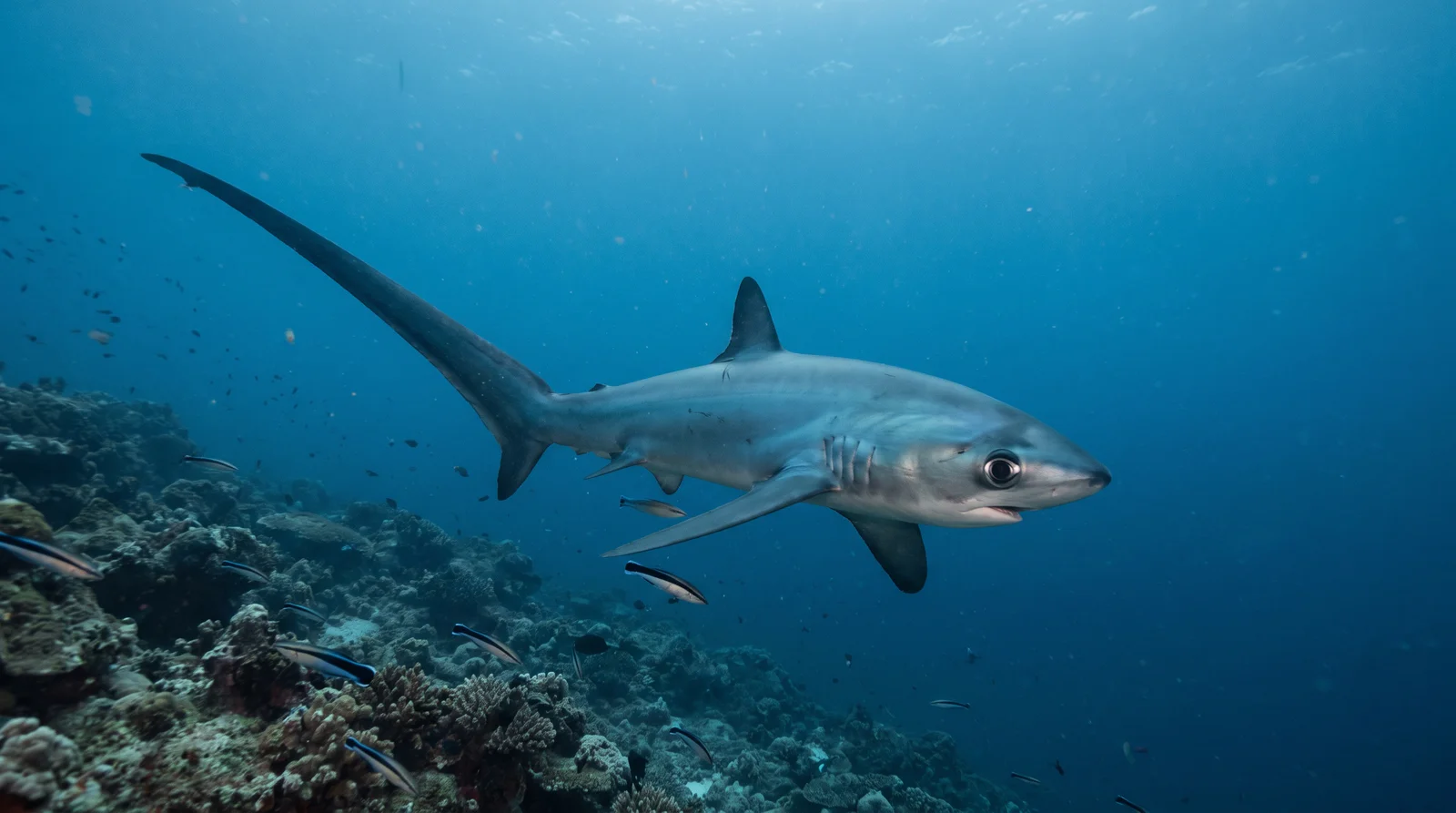 AI-generated
Image credit: AI-generated illustration · Diveity
Alopias pelagicus
About Pelagic Thresher Shark.
The pelagic thresher (Alopias pelagicus) is the smallest thresher shark, an open-ocean species of the Indo-Pacific usually about 3 m long.
Names and classification
Following FishBase, WoRMS accepts Alopias pelagicus Nakamura, 1935 in the thresher shark family Alopiidae, order Lamniformes, and lists no synonym for it. Wikipedia explains that the Japanese ichthyologist Hiroshi Nakamura described it in a 1935 paper on two thresher sharks from Formosan waters, from three large specimens, and that the epithet comes from the Greek for "of the sea". Besides pelagic thresher, Wikipedia gives smalltooth thresher as an English name, and WoRMS lists fox shark and whiptail shark.
Identification
Wikipedia describes a spindle-shaped body and a very slender upper tail lobe nearly equal in length to the shark's body; FishBase calls that lobe strap-like, with a short but strong lower lobe. The pectoral fins are long and straight with broad, rounded tips, and the head is narrow, with a short conical snout and a "pinched" outline seen from below. The back is an intense dark blue and the belly white, and the white does not reach above the pectoral fins. That dark colour over the pectoral fin bases, the rounded fin tips and the lack of furrows at the corners of the mouth separate it from the common thresher (Alopias vulpinus), with which, the article notes, it is often confused even in professional publications. The eyes are very large in the young and smaller in proportion with age.
Size
According to Wikipedia, it is typically 3 m long and 69.5 kg, usually no more than 3.3 m and 88.4 kg, with known maxima of 3.5 m for males and 3.8 m for females; a 5 m record is doubted. FishBase gives 383 cm total length for females, close to Wikipedia's figure, but 428 cm for males and fish of unrecorded sex, with a common length of 276 cm for the same group. The sources differ on the largest male, and this page does not choose between them.
Conservation
FishBase and Wikipedia both place the species in the Endangered category of the IUCN Red List. FishBase (Red List version 2025-2) lists criteria A2bd and an assessment date of 6 November 2018, while Wikipedia cites the assessment by Rigby and colleagues published in 2019. FishBase lists it on Appendix II of both CITES and CMS, and Wikipedia also gives CITES Appendix II. Wikipedia reports that it is fished for its meat, skin, fins and liver oil, makes up over 12% of Taiwan's annual shark landings, and is often taken as bycatch on longlines and in driftnets set for tuna; FishBase calls it a very common catch in those fisheries.
Where it lives.
The pelagic thresher lives mainly in the open ocean of the tropical and subtropical Indo-Pacific, from the surface to a depth of at least 150 m.
Range
Wikipedia lists scattered records from South Africa, the Red Sea and the Arabian Sea to China, southeastern Japan, northwestern Australia, New Caledonia and Tahiti, and on to the Hawaiian Islands, California and the Galápagos. It adds that the range may be wider than known, because the species is confused with the common thresher, and that the North Pacific population shifts north in warm El Niño years. FishBase heads its range "circumglobal" but lists only Indo-Pacific and eastern Pacific places, adding the Maldives and the Gulf of California, and notes that reliable records are lacking partly because of the same confusion.
Depth and water
FishBase records depths of 0 to 300 m, usually 0 to 150 m, and describes it as mainly oceanic, epipelagic, and mesopelagic in the tropics. Wikipedia gives the surface to at least 150 m. FishBase classes it as tropical; the captured sources give no water temperature range.
Near coasts and reefs
Wikipedia says it occasionally comes close to shore where the continental shelf is narrow, and has been seen near coral reef drop-offs or seamounts in the Red Sea and the Gulf of California and off Indonesia and Micronesia; it is also known to enter large lagoons in the Tuamotu Islands, and FishBase likewise notes that it may enter atoll lagoons. The article suggests that its visits to cleaning stations at Malapascua Island in the Philippines may be why it is sometimes met in shallow water. The captured sources give neither the depth of those stations nor the months of the visits.
How it behaves.
The pelagic thresher is an active, strong swimmer that stuns small fish with strikes of its long upper tail lobe, and it tends to flee from divers.
Feeding
Wikipedia says little is known of its diet. Its slender tail and fine teeth suggest small open-water prey, and stomach contents show mainly barracudinas, lightfishes and escolars, fishes of the mesopelagic zone, so it competes little with tunas and billfishes nearer the surface. Citing a 2013 study in PLOS ONE, the article says it strikes prey sharply with the upper lobe of its tail and can take more than one fish at a time, which is why it is often hooked on longlines by the tail. FishBase likewise records that it stuns prey with its tail, presumably small fishes and cephalopods.
Cleaning stations
Citing a 2011 study in PLOS ONE, Wikipedia reports that at Malapascua Island in the Philippines pelagic threshers regularly visit cleaning stations held by the cleaner wrasses Labroides dimidiatus and Thalassoma lunare. The sharks swim slowly in circles close to the sea floor while being cleaned, the visits are more frequent early in the morning, and the cleaners feed most on the pelvic fins and the tail.
Divers and other animals
Wikipedia states that it has never been implicated in an attack on people: its jaws and teeth are small for its size and it tends to flee from divers. FishBase lists it as harmless. The article adds that it has been seen to leap clear of the water, once five times in a row, and that its predators include larger fishes, other sharks among them, and toothed whales.
Reproduction and growth
Wikipedia describes it as ovoviviparous: a female bears two pups at a time, rarely one, one in each uterus, with no defined breeding season, and most adult females are pregnant all year. The embryos live on their yolk sac until about 12 cm long and then feed on egg capsules the mother produces. The article gives a birth length of up to 1.6 m, or 43% of the mother's length; FishBase gives about 100 cm from one reference and 130 to 160 cm from another. Females mature at 2.8 to 2.9 m and eight to nine years, males at 2.7 to 2.8 m and seven to eight years, according to Wikipedia, which gives 16 and 14 years as the oldest confirmed ages and over 28 years for females by extrapolation; FishBase gives a maximum reported age of 29 years. The captured sources do not say how often divers meet it at any one site, or in which months.
Where to see it.
Evidence for visayas · 3 dive sites
General range is not evidence of occurrence at a specific dive site.
Kimud Shoal
Malapascua
Documented site occurrence
Season not yet documented
Source reviewed on 2026-09-27 · Sources: IUCN SSC Shark Specialist Group, Thresher Shark Divers · Observation date not documented
Monad Shoal
Malapascua
Documented site occurrence
Season not yet documented
Source reviewed on 2026-10-05 · Sources: IUCN SSC Shark Specialist Group, Malapascua MBI Dive Center, Thresher Shark Divers · Observation date not documented
Sardine Run
Moalboal
Site occurrence not yet documented
Season not yet documented
No dated observations available.
Gallery.
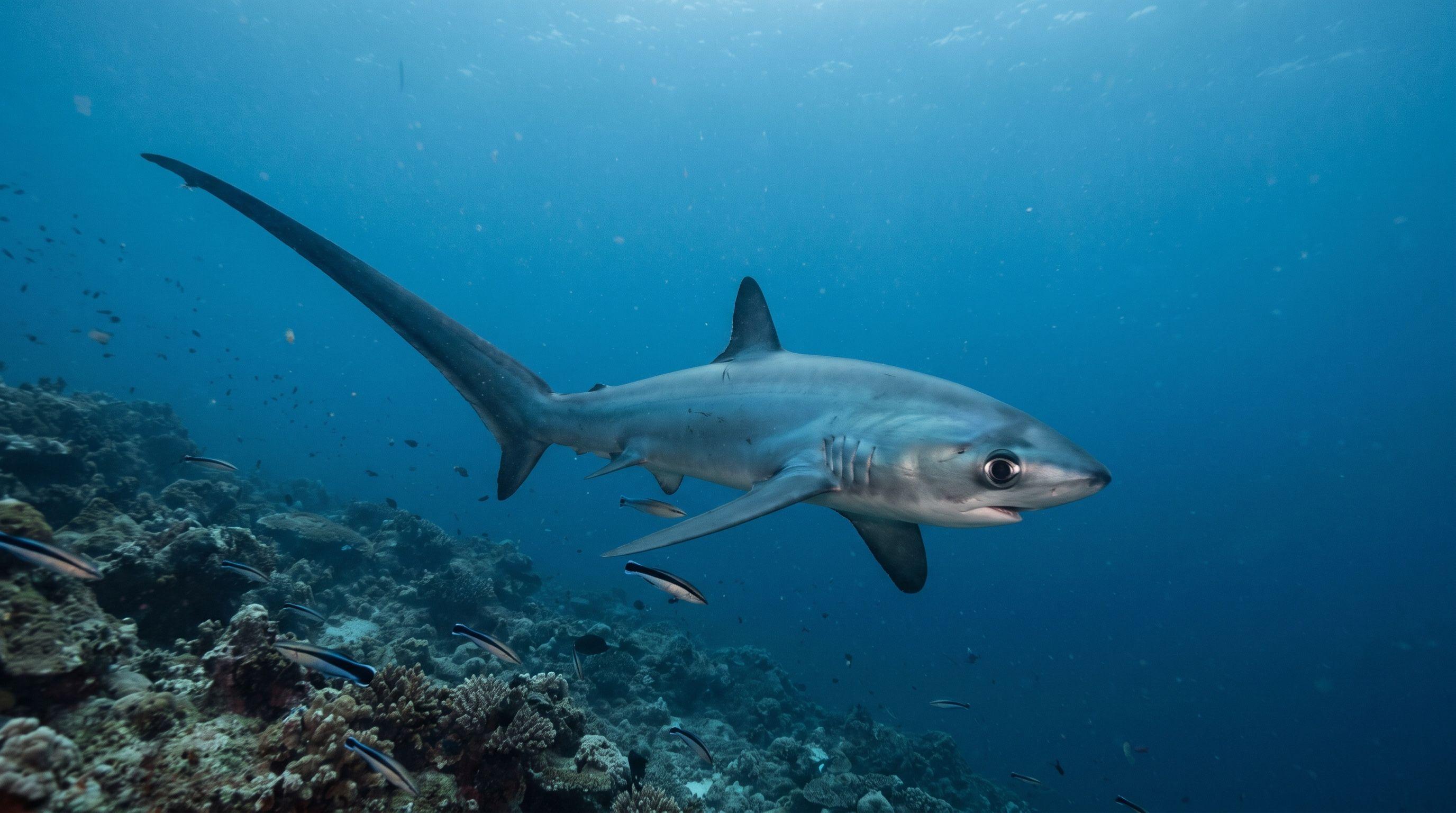 AI-generated
 illustration
Image credit: AI-generated illustration · Diveity