Pharaoh Cuttlefish
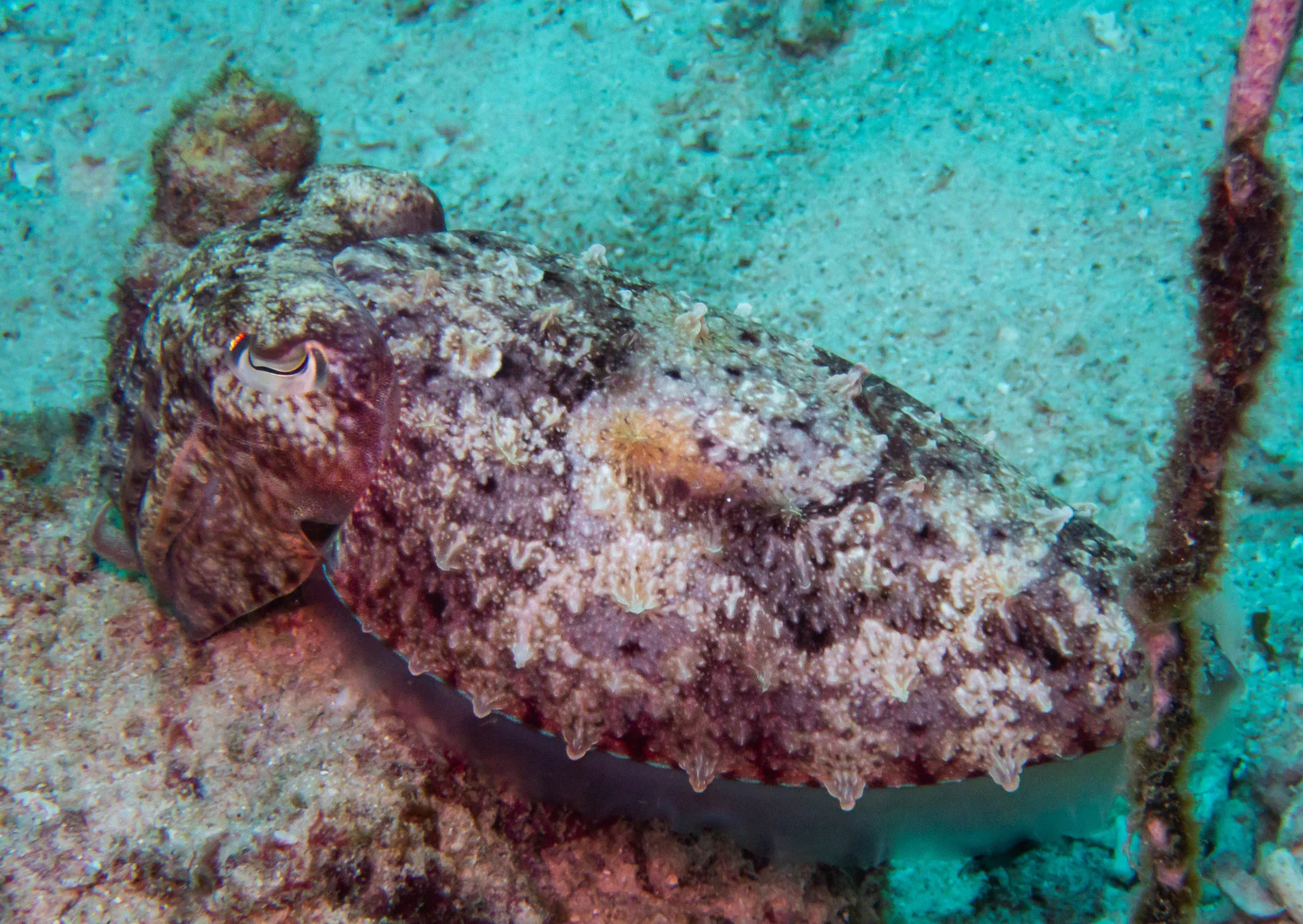
Image credit: portioid · CC BY · iNaturalist, cropped by this page
Acanthosepion pharaonis
About Pharaoh Cuttlefish.
The pharaoh cuttlefish is a large cuttlefish. The World Register of Marine Species (WoRMS) lists Acanthosepion pharaonis (Ehrenberg, 1831) as the accepted name in the family Sepiidae, and records Sepia pharaonis, the name SeaLifeBase still uses, as a superseded combination.
Wikipedia says it is likely a complex of at least three species: one in the Red Sea and Persian Gulf, one from Japan to the Gulf of Thailand and northern Australia, and one from the Indian Ocean to the Andaman Sea. Which of them occurs in Bali is not stated in the sources cited here. Wikipedia gives a mantle length of up to 42 cm and SeaLifeBase 43 cm, both with a weight of up to 5 kg. At rest it often shows a solid colour from pale white to dark brown, or a mottled white and brown pattern.
SeaLifeBase lists the species as Data Deficient on the IUCN Red List (version 2025-2, global, assessed 18 March 2009).
Where it lives.
SeaLifeBase calls it a benthic, coastal cuttlefish of the Indo-West Pacific, from the Red Sea to Japan and Australia, also recorded in the Mediterranean Sea; it gives a depth range of 0 to 130 m, usually to 40 m, and says it is most common in shallow coastal waters and commonly found over sand and seagrass beds. Wikipedia says it is thought to have reached the Mediterranean through the Suez Canal.
Where Divers Find Them
At Padang Bai, Bali, a 2012 reader comment by Geko Dive on Divezone's Bias Tugel page says large pharaoh cuttlefish laying eggs or disputing territory can be frequently spotted there. That is a dive operator's statement, not a survey, and gives no season.
How it behaves.
SeaLifeBase calls it an active predator that feeds on crustaceans, small fish and other cephalopods, can change colour rapidly and forms groups during spawning at depths of at most 20 m. Wikipedia says it uses chromatophores for camouflage with uniform, mottled or disruptive patterns, hunts by ambush, lunging its two feeding tentacles at prey, and has been seen raising and flapping its arms in a display thought to mimic a hermit crab. Wikipedia says males compete with displays of colour and tentacles, and that a male guards the female until she lays her eggs.
Underwater Encounter Behavior
The sources cited here do not describe how the pharaoh cuttlefish reacts to divers.
Where to see it.
Evidence from all destinations · 1 dive site
General range is not evidence of occurrence at a specific dive site.
Gallery.
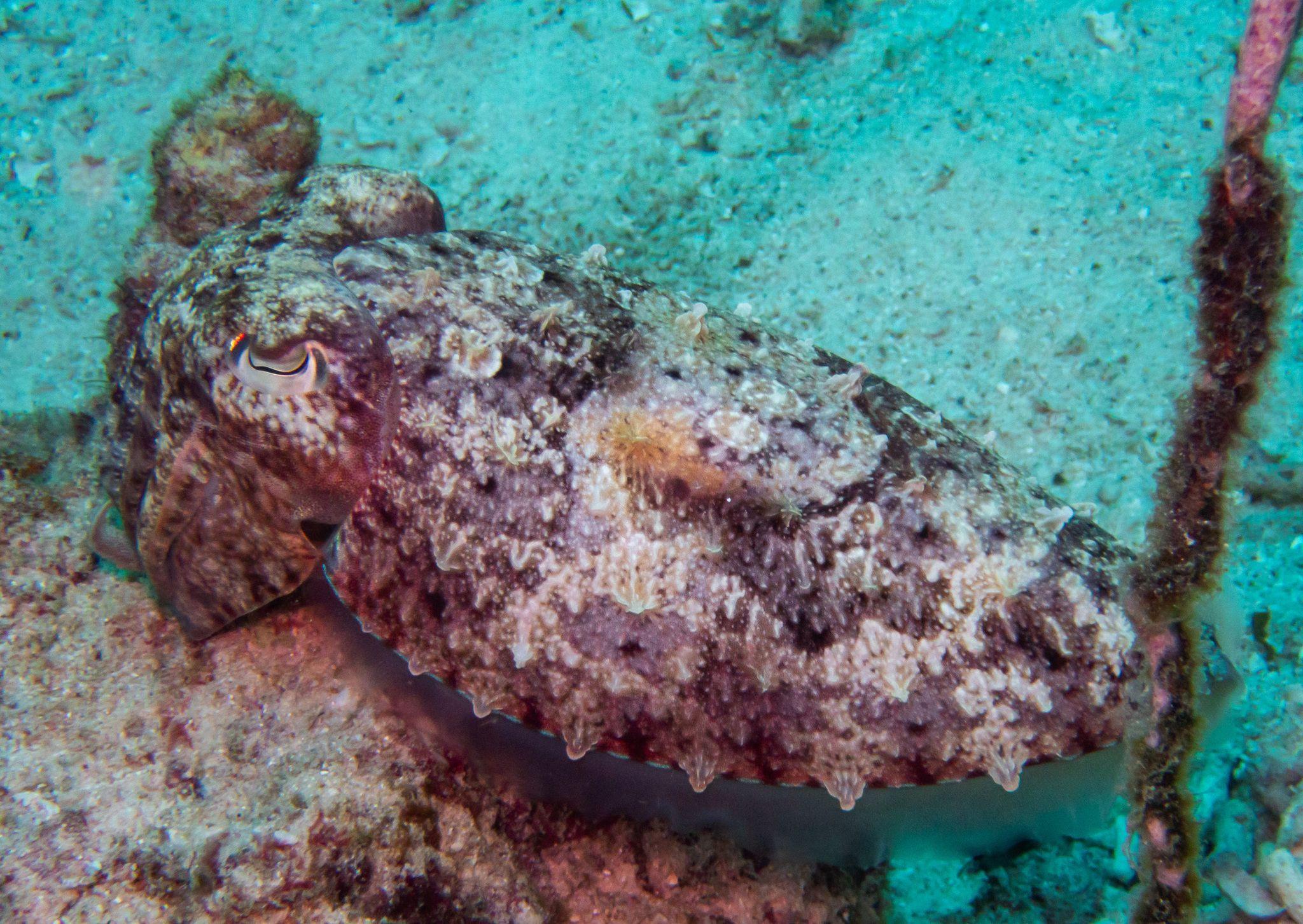
A pharaoh cuttlefish, Acanthosepion pharaonis (formerly Sepia pharaonis), resting on sand beside a rocky patch. Photographed at Ko Ha Yai, Thailand, in December 2023, as recorded on its iNaturalist observation, where two identifiers agree on the species; not at Padang Bai. This page's frame crops the photograph.
Image credit: portioid · CC BY · iNaturalist, cropped by this page