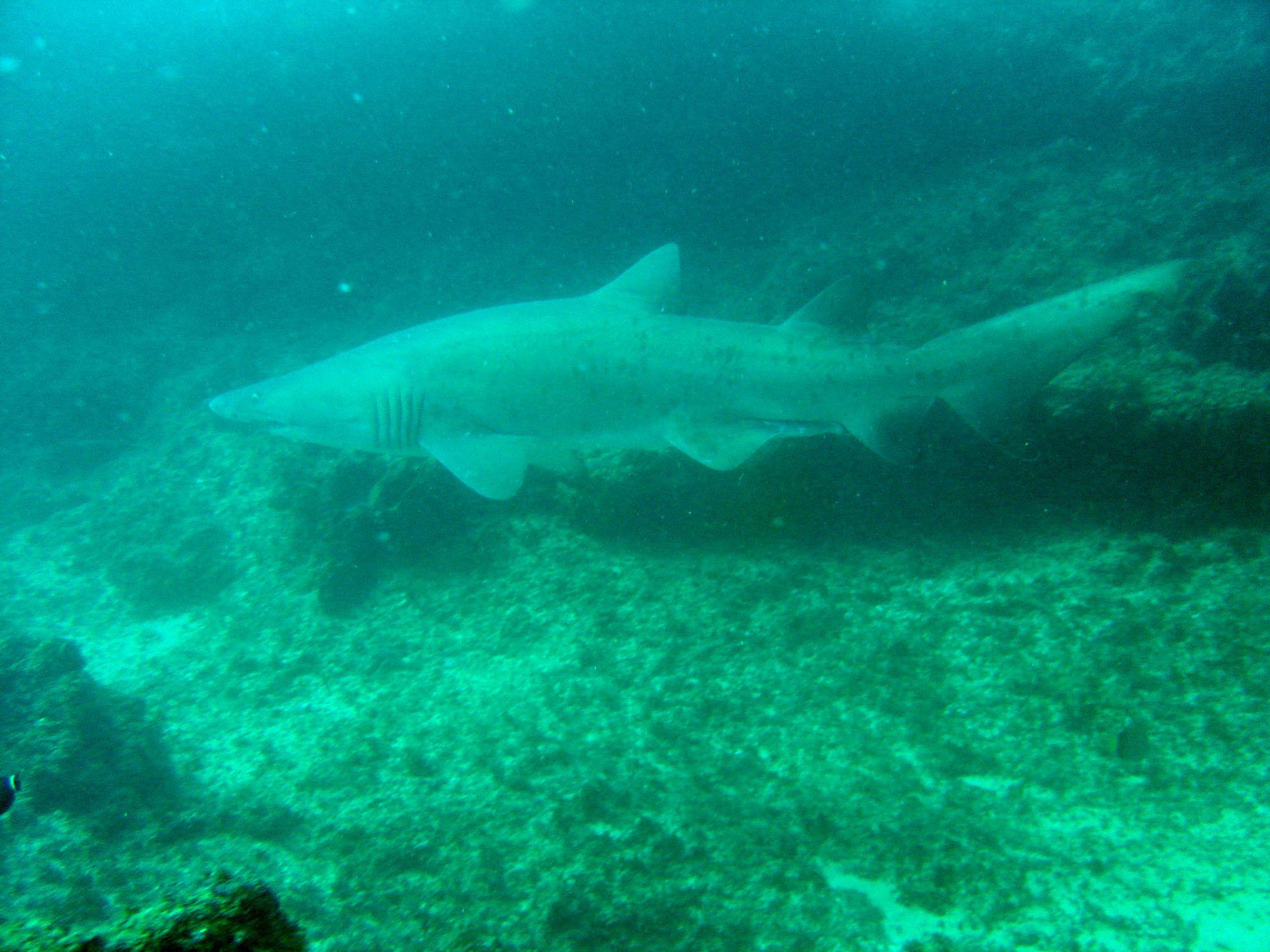
Ragged-tooth Shark
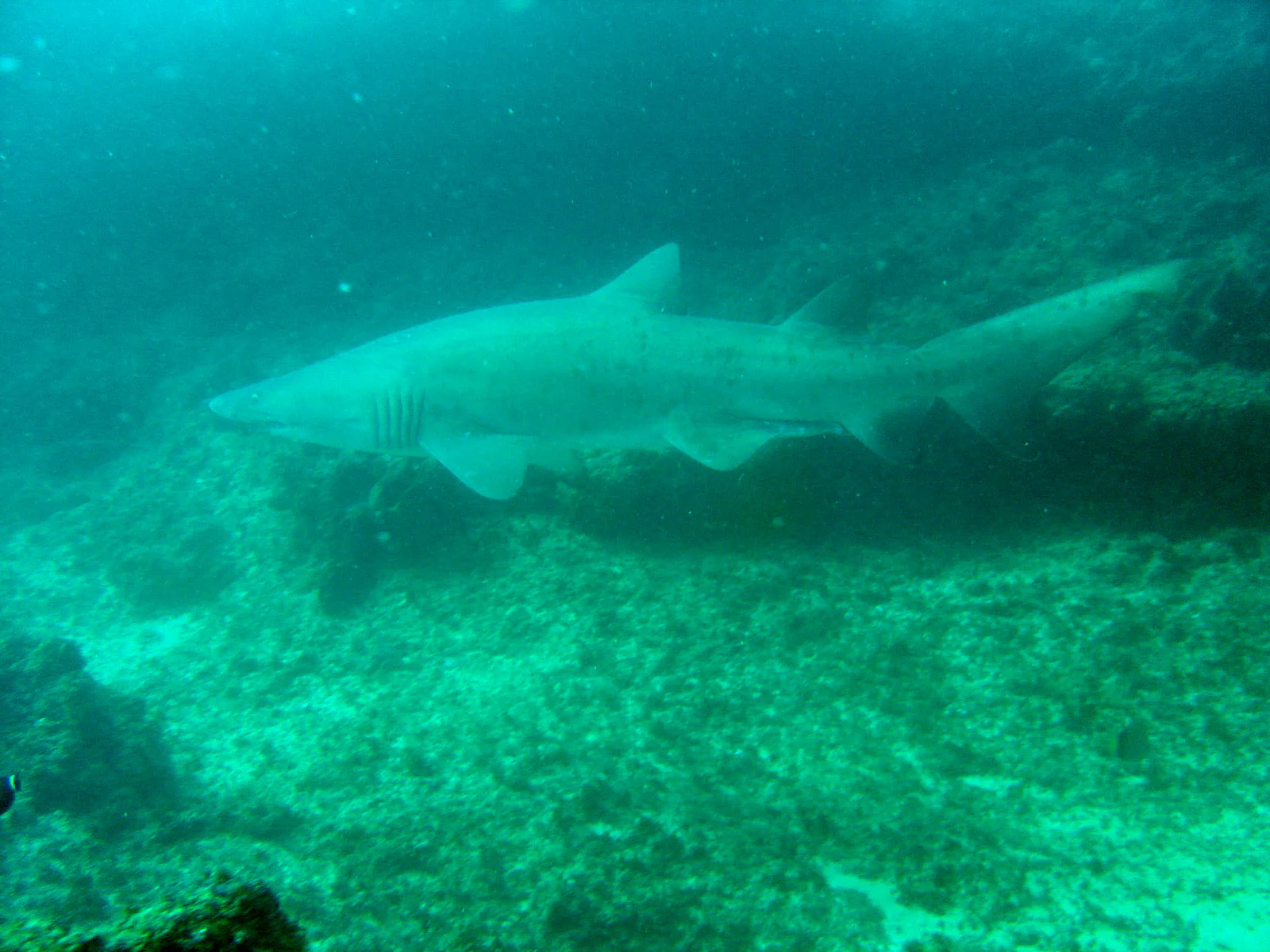
Carcharias taurus
About Ragged-tooth Shark.
The Ragged-tooth Shark, scientifically known as Carcharias taurus, is a fascinating and often misunderstood species that captivates divers worldwide. Known by various common names, including the Sand Tiger Shark in the USA and the Grey Nurse Shark in Australia and the UK, this species is affectionately called "Raggies" in South Africa.
Despite its formidable appearance, characterized by a mouth full of sharp, protruding teeth, the Ragged-tooth Shark is remarkably docile and slow-moving, posing little threat to humans unless provoked. These sharks are found in subtropical and temperate waters globally, inhabiting the continental shelf from sandy shorelines and submerged reefs to estuaries and shallow bays. They are typically observed at depths of 10–40 m, though they can range down to 190 m, in waters with temperatures between 15.3–28.2°C. A unique adaptation of this species is its ability to gulp air from the surface, storing it in its stomach to achieve neutral buoyancy, allowing it to hover effortlessly in the water column.
Unfortunately, the Ragged-tooth Shark is listed as Critically Endangered by the IUCN Red List, primarily due to its slow reproductive rate and vulnerability to overfishing. They are ovoviviparous, with embryos exhibiting intrauterine cannibalism, meaning the strongest pup consumes its siblings and unfertilized eggs within the womb, resulting in only one or two live pups per litter. Divers often encounter these sharks aggregating at specific dive sites, such as Aliwal Shoal and Protea Banks in South Africa, particularly during their winter mating season.
Identification
Divers can identify the Ragged-tooth Shark by several distinctive physical characteristics:
- Size and Body Shape: They are large, bulky sharks, reaching a maximum size of 3.2 m (10.5 ft) in length. They possess a stout, cylindrical body with a noticeable hump on their back.
- Head and Snout: The head is sharp and pointy, with a flattened snout. Their eyes are relatively small and lack eyelids.
- Mouth and Teeth: A prominent feature is their long mouth, which extends behind the eyes and often remains slightly ajar, revealing multiple rows of their characteristic protruding, needle-like teeth. These awl-shaped teeth are smooth-edged with small lateral cusplets, designed for gripping prey rather than cutting.
- Coloration: Their dorsal surface ranges from grey-brown to bronze, with a pale underside. Many individuals, especially juveniles, display reddish-brown or darker spots scattered across their body, which tend to fade with age.
- Fins: They have two dorsal fins that are almost equal in size. The first dorsal fin is set back on the body, positioned closer to the pelvic fins than the pectoral fins. The caudal fin is asymmetrical, featuring a strongly pronounced upper lobe.
Where it lives.
The Ragged-tooth Shark (Carcharias taurus), also known as the Sand Tiger Shark or Grey Nurse Shark, is a fascinating species found in a variety of coastal environments across the globe. These impressive sharks inhabit subtropical and temperate waters worldwide, primarily across the Atlantic, Indian, and Western Pacific Oceans. While historically present in the Mediterranean and Adriatic Seas, their presence there is now considered extremely rare, with some populations presumed extirpated since 2003.
Divers are most likely to encounter Ragged-tooth Sharks in relatively shallow, inshore waters, typically ranging from the surf zone down to about 60 meters. However, they are known to frequent the continental shelf and have been observed at depths reaching up to 191 meters. There are even exceptional records of individuals found much deeper, such as one observed at 2,400 feet (approximately 731 meters) in the North Atlantic, though this is not typical habitat. They prefer water temperatures generally above 16°C, with observed ranges between 15.3–28.2°C. Seasonal migrations occur in many populations, with sharks moving to warmer waters during colder months and returning poleward in summer to maintain preferred temperatures.
Their preferred ecosystems and substrates include:
- Reefs: Ragged-tooth Sharks are strongly associated with both rocky and coral reefs, where they often seek shelter.
- Sandy Bottoms and Gullies: They are frequently found over sandy shorelines and bottoms, often resting motionless just above the seabed in large sandy gutters.
- Caves and Overhangs: During daylight hours, these sharks commonly aggregate in underwater caves, crevices, and overhangs, using these features for shelter from currents and potential predators.
- Shallow Bays and Estuaries: Juveniles and adults alike can be found in shallow bays and even estuaries, particularly in coastal areas.
- Continental Shelf: While often inshore, they utilize the broader continental shelf, including deeper areas around the outer shelves.
Ragged-tooth Sharks are primarily nocturnal hunters, spending their days in these sheltered reef and sandy bottom areas. A unique adaptation allows them to gulp air at the surface and store it in their stomachs, providing neutral buoyancy to hover effortlessly in the water column, a behavior often observed by divers at popular dive sites like Aliwal Shoal.
How it behaves.
The Ragged-tooth Shark (Carcharias taurus), also known as the Sand Tiger Shark or Grey Nurse Shark, is a large, slow-moving species renowned for its distinctive, protruding, needle-like teeth. Despite their formidable appearance, these sharks are famously docile and non-aggressive towards humans, making them a popular and generally safe encounter for divers worldwide.
- Underwater Encounter Behavior
Ragged-tooth Sharks are typically placid and slow-moving, often observed swimming deliberately or hovering almost motionless in the water column. They achieve this effortless buoyancy by gulping air at the surface and storing it in their stomachs, acting as a pseudo-swim bladder. Divers can often approach within a meter or two, as these sharks generally show no interest in divers or their equipment. During the day, they frequently rest in sheltered areas such as caves, gullies, overhangs, and near rocky reefs, often close to the seabed at depths typically between 10–40 m, though they can be found from the surf zone down to 191 m. While generally inoffensive, divers should avoid provoking them or blocking their exits from confined spaces. - Feeding Habits
Ragged-tooth Sharks are primarily nocturnal hunters and opportunistic feeders. Their diet consists mainly of bony fishes, small sharks, rays, squids, crabs, and lobsters. Their long, pointed teeth are adapted for gripping slippery prey, which they typically swallow whole, rather than tearing or aggressively biting. They utilize their stealthy movements and buoyancy control to approach prey. Observations suggest that schools of Ragged-tooth Sharks may sometimes engage in cooperative feeding, surrounding and concentrating schooling prey before attacking. - Social Structure
While often encountered alone, Ragged-tooth Sharks can also be found in small to large schools. Research indicates they exhibit a more complex social structure than previously thought, forming temporary groups for migration or reproduction.
Where to see it.
Evidence for philippines · No dive sites
General range is not evidence of occurrence at a specific dive site.
No documented dive-site associations in this destination yet.
Gallery.