Redtoothed Triggerfish
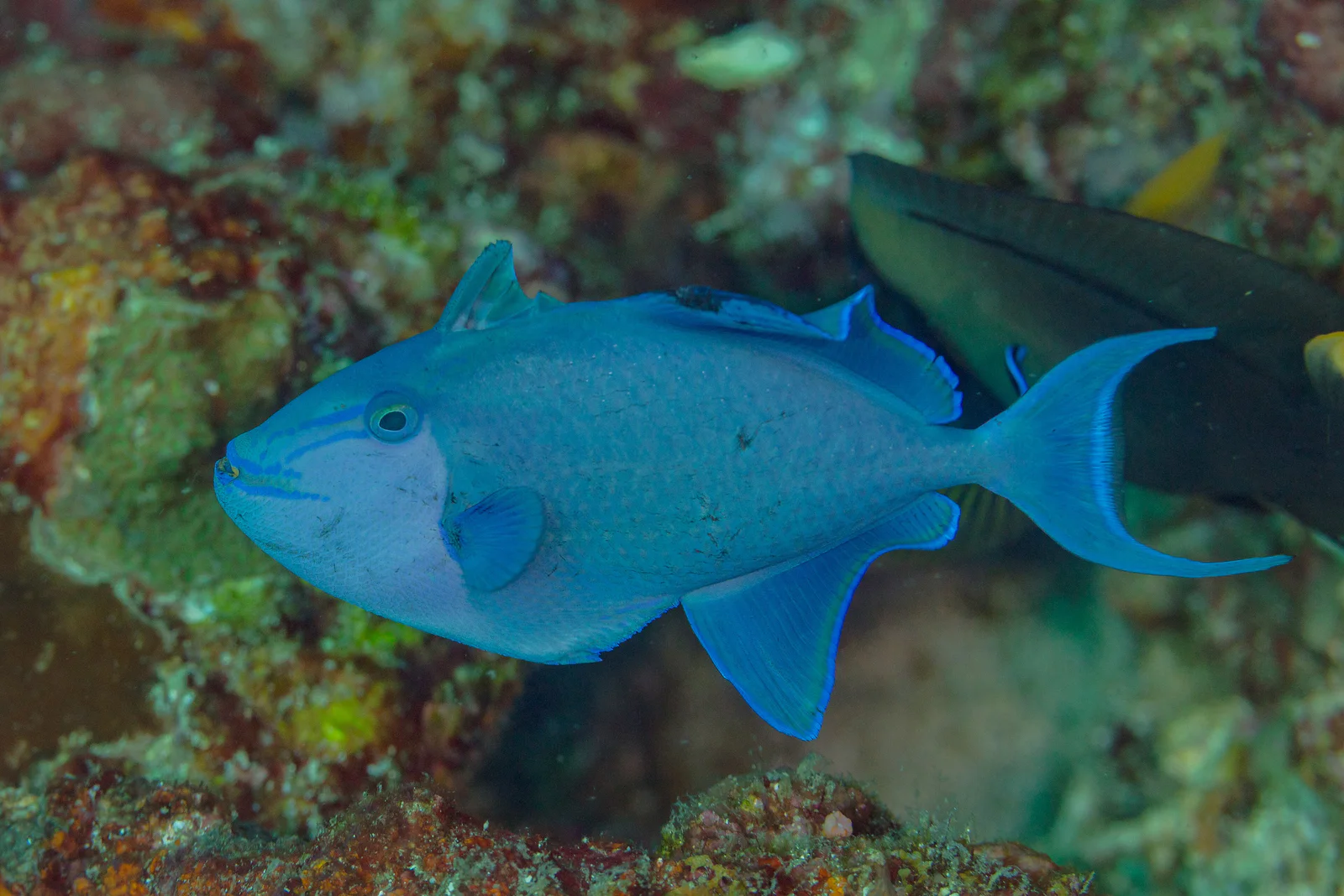
Image credit: Diego Delso, delso.photo · CC BY-SA 4.0 · Wikimedia Commons (Commons-rendered 3840 px version), cropped by this page
Odonus niger
About Redtoothed Triggerfish.
The redtoothed triggerfish (Odonus niger) is a blue triggerfish with red teeth that schools over current-swept Indo-Pacific reefs, recorded at 5 to 110 m.
Names and classification
WoRMS gives Odonus niger (Rüppell, 1836) as the valid name, in the triggerfish family Balistidae, order Tetraodontiformes, and records that Rüppell first named it Xenodon niger; Balistes erythrodon Günther, 1870 and Odonus erythrodon are among its unaccepted names. Wikipedia says it is the only species of its genus and lists Niger triggerfish, redtooth triggerfish, blue triggerfish, redfang triggerfish and redtooth filefish as other English names, while WoRMS and FishBase use red-toothed triggerfish.
Identification
Wikipedia describes a deep blue or purple fish with a light blue head, bluish-green markings on the head and bright light blue edges to the fins and tail lobes, and a lyre-shaped tail like other members of Balistidae. Its small red teeth are needle-sharp, and two in the upper jaw show even when the mouth is closed, so that the fish seems to grin. The same article says its colour shifts between purple, blue and bluish-green with mood, food and water quality. FishBase counts 3 dorsal spines, 33 to 36 dorsal soft rays, no anal spines and 28 to 31 anal soft rays, on a body it calls short and deep.
Size
In FishBase the species reaches at most 50 cm and commonly measures 30 cm, both as total length. Wikipedia gives an average length of 23 to 30 cm (9 to 12 in).
Conservation and fisheries
The IUCN Red List category is Least Concern, from an assessment dated 13 January 2022, according to FishBase (Red List version 2025-2), which also lists the species as Not Evaluated under CITES and CMS. FishBase calls it harmless to people and notes a minor commercial fishery, with fish marketed fresh or dried and salted, some taken in drive-in nets, and a commercial aquarium trade. On FishBase's modelled scale its vulnerability to fishing is 39 of 100, which it calls moderate, and it rates resilience as medium, estimating that a population needs at least 1.4 to 4.4 years to double.
Where it lives.
The redtoothed triggerfish lives on current-swept reefs, channels and slopes between the Red Sea, East Africa and the central Pacific, at 5 to 110 m.
Range
FishBase gives an Indo-Pacific range that starts in the Red Sea and East Africa and runs east through northern Australia to the Line, Marquesas and Society Islands, and north to southern Japan, between about 32° N and 24° S. Wikipedia describes the same span from the African east coast to the Marquesas and Society Islands, and adds the Great Barrier Reef as its southern limit.
Depth and setting
FishBase records a depth range of 5 to 110 m for a marine, reef-associated and non-migratory tropical fish, found in reef channels, along slopes subject to strong currents and on current-swept seaward coral reefs. Wikipedia mentions coastal shallow inshore waters at about 9 to 30 m (30 to 100 ft), and says the fish shelters under or between rocks and in crevices so that the current does not sweep it away. Juveniles, in FishBase's account, keep to isolated patches of rubble or to crevices with shelter holes of the right size.
How it behaves.
The redtoothed triggerfish usually gathers in aggregations and schools in current-swept water to feed on zooplankton, and pairs to breed in guarded nests.
Schools and temperament
FishBase says it usually forms aggregations, and large schools when it feeds on zooplankton. Wikipedia calls it one of the more peaceful triggerfishes, though it can become threatening with age, and says it can make a grunting sound. Its pectoral fins are small, so according to Wikipedia it steers mostly with its dorsal and anal fins, which makes it very manoeuvrable.
Diet
The two accounts differ on its main food. FishBase names zooplankton and sponges. Wikipedia, citing a 2021 study from the south-eastern Arabian Sea, calls it an omnivorous, mostly opportunistic feeder whose primary food is crustaceans, which also takes zooplankton and algae, and in whose stomachs remains of cephalopods and fish have been found.
Reproduction
FishBase records distinct pairing and egg-laying, with only the females tending the eggs while both parents keep guard. Wikipedia says pairs meet on mating grounds where the males hold territories, and that the eggs are laid in nests the fish build. Neither account gives a spawning season, and neither says how often divers meet the species at a particular site or in which months.
Where to see it.
Evidence for visayas · 3 dive sites
General range is not evidence of occurrence at a specific dive site.
Pescador Island (The Cathedral)
Moalboal
Regional evidence — occurrence at this site is not confirmed
Season not yet documented
Source reviewed on 2026-10-02 · Source: Master Liveaboards — Pescador Island; island-wide context, not Cathedral-specific · Observation date not documented
Punta Bunga
Boracay
Documented site occurrence
Season not yet documented
Source reviewed on 2026-10-14 · Source: New Wave Divers Boracay (dated dive log) · Observation date not documented
Yapak
Boracay
Documented site occurrence
Season not yet documented
Source reviewed on 2026-10-14 · Source: New Wave Divers Boracay (dated dive log) · Observation date not documented
Gallery.
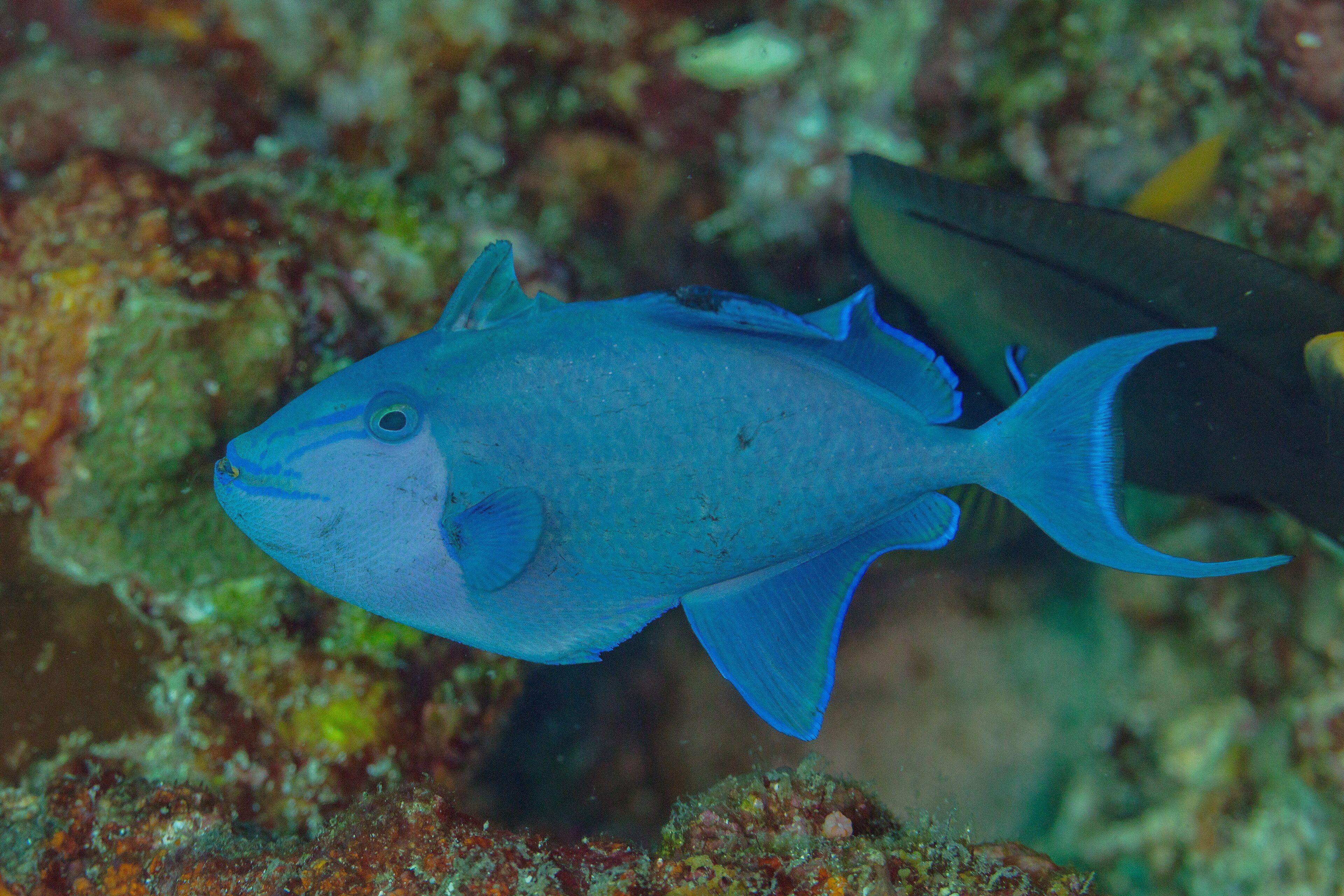
A redtoothed triggerfish (Odonus niger) swimming over a reef at Anilao, Philippines, photographed on 25 August 2023. It illustrates the species and is not from any Diveity dive site. This page's frame crops the photograph.
Image credit: Diego Delso, delso.photo · CC BY-SA 4.0 · Wikimedia Commons (Commons-rendered 3840 px version), cropped by this page
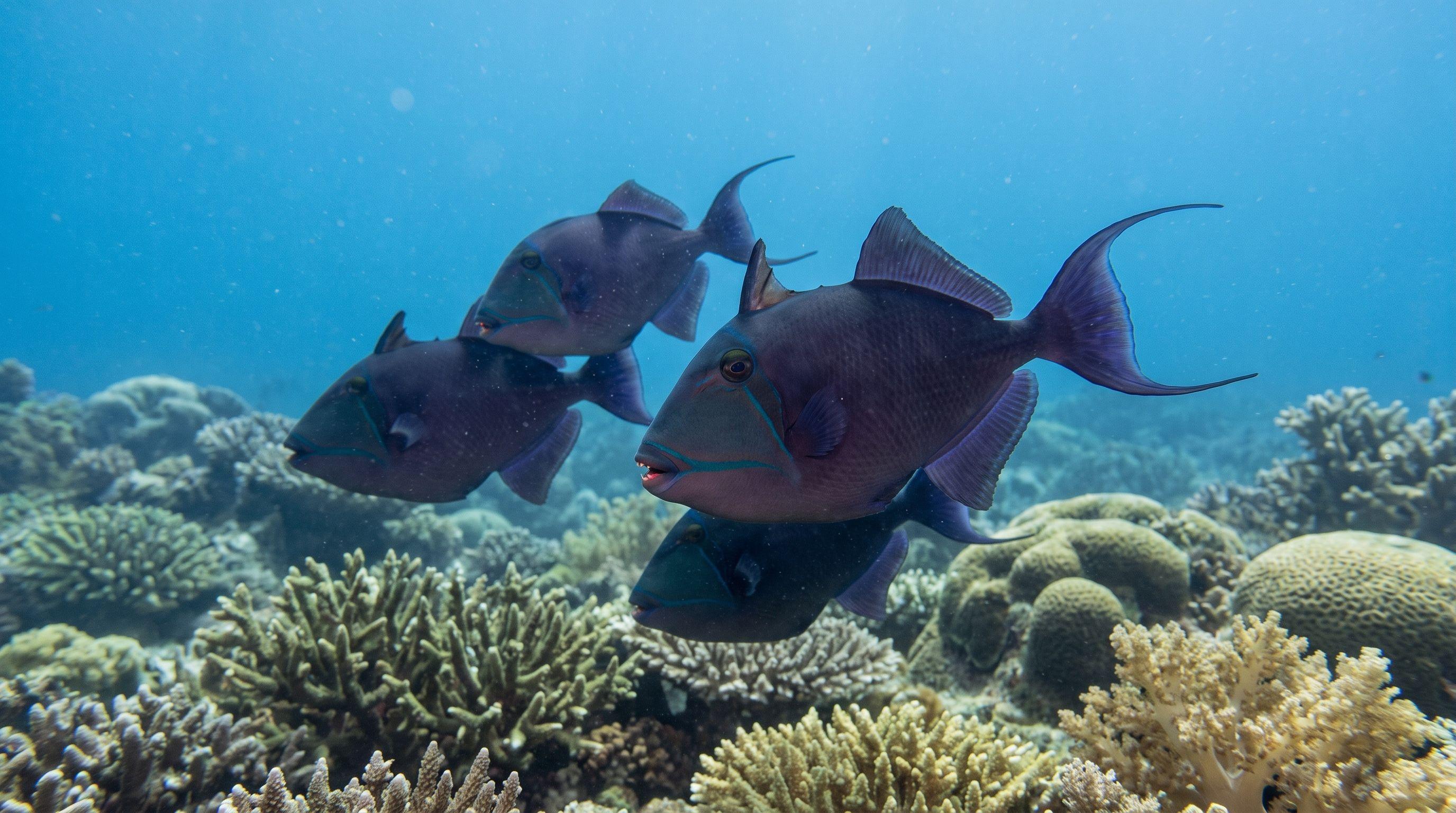 AI-generated
 illustration
Image credit: AI-generated illustration · Diveity