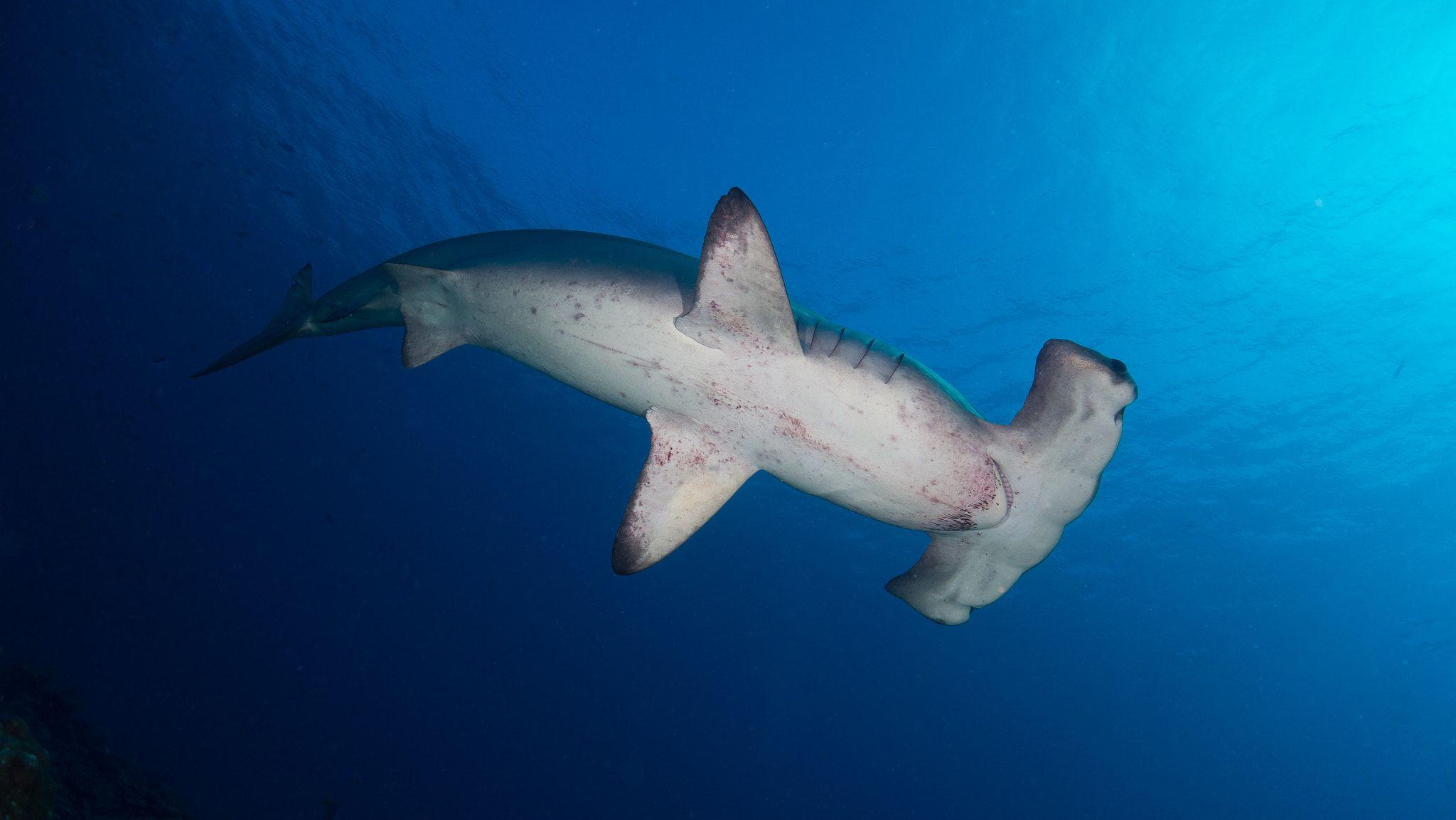
Scalloped Hammerhead Shark
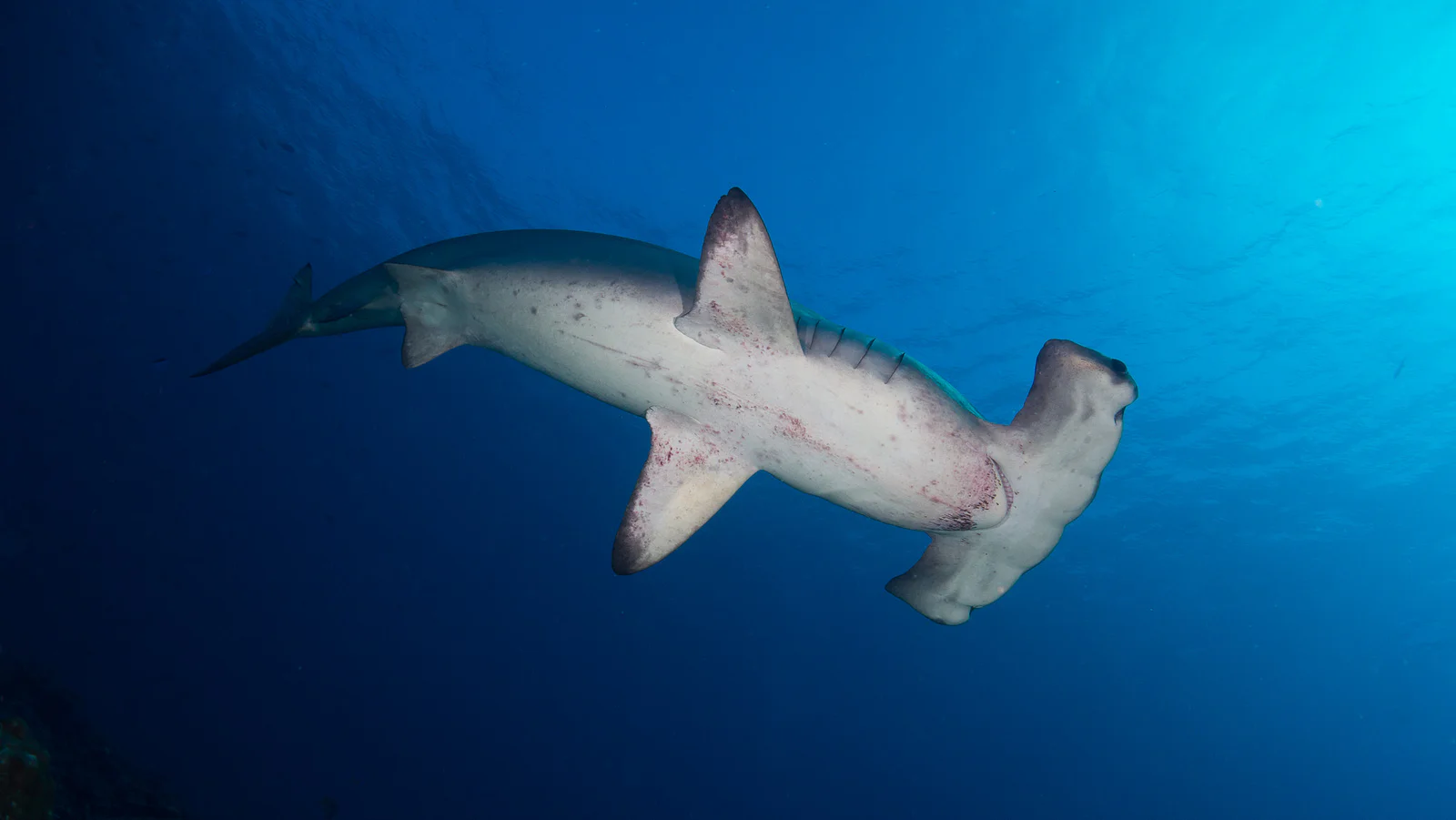
Sphyrna lewini
About Scalloped Hammerhead Shark.
The Scalloped Hammerhead Shark (Sphyrna lewini) is a truly iconic species, renowned for its distinctive head shape and impressive schooling behavior. Belonging to the family Sphyrnidae, these magnificent sharks are a highlight for divers in many parts of the world. Unfortunately, their global population faces severe threats, leading to their classification as Critically Endangered by the IUCN (International Union for Conservation of Nature). This status underscores the urgent need for conservation efforts to protect this highly migratory and vulnerable species.
Found in warm temperate and tropical coastal pelagic waters worldwide, from latitudes 46°N to 36°S, Scalloped Hammerheads inhabit continental and insular shelves, often venturing close inshore into bays and estuaries, as well as adjacent deep waters. While typically observed in surface waters down to 275 m, they are known to perform remarkable nocturnal dives to depths exceeding 500 m, with some recorded at over 1,250 m in waters as cold as 3°C, likely in pursuit of prey. They are rarely found in waters cooler than 22°C.
One of the most captivating aspects of the Scalloped Hammerhead is its tendency to form massive schools, sometimes numbering in the hundreds or even up to 700 individuals, particularly around seamounts and offshore islands during the day. These aggregations, often observed at famous dive sites such as Cocos Island, the Galápagos, and Red Sea seamounts, are thought to serve social functions, including mating. At night, these large schools disperse as individuals move offshore to hunt, primarily feeding on bony fishes, cephalopods, crustaceans, and other elasmobranchs like stingrays and smaller sharks. They are known for their ability to prey on stingrays, with venomous barbs frequently found embedded in their mouths. Growing up to a maximum size of 4.3 m (14 ft), with females generally larger than males, these sharks are viviparous, giving birth to live young after a gestation period of 9-12 months. Juveniles spend their first few years in shallow, protected coastal nursery areas before joining the adult populations in more open waters.
Identification
Identifying the Scalloped Hammerhead Shark is relatively straightforward due to its uniquely shaped cephalofoil, or "hammer" head:
- Cephalofoil: The most distinguishing feature is the broadly arched, hammer-shaped head with a prominent central indentation on its front margin. On either side of this central notch, there are typically two smaller indentations, giving the head a characteristic "scalloped" appearance. The eyes and nostrils are located at the extreme ends of these lateral extensions. This scalloped edge differentiates it from other hammerhead species, such as the Smooth Hammerhead (Sphyrna zygaena), which lacks a central indentation, and the Great Hammerhead (Sphyrna mokarran), which has a straighter cephalofoil with less pointed sides.
- Body and Fins: The body is moderately slender. It possesses a very large, slightly hooked first dorsal fin, which is proportionately larger than its pectoral fins, and a noticeably smaller second dorsal fin. The rear margins of the pelvic fins are relatively straight.
- Coloration: Scalloped Hammerheads typically exhibit a uniform grey, grayish-brown, bronze, or olive coloration on their dorsal (upper) side, fading to a pale yellow or white on their ventral (underside) for countershading. Adults often have dusky tips on their pectoral fins, while juveniles may display darker tips on their pectoral, lower caudal, and second dorsal fins.
Where it lives.
The Scalloped Hammerhead Shark (Sphyrna lewini) is a highly migratory, coastal pelagic species with a circumglobal distribution, thriving in warm temperate and tropical waters across the Atlantic, Indian, and Pacific Oceans. These sharks are typically found between approximately 46°N and 36-39°S latitudes.
Their habitat use is diverse, encompassing both inshore and offshore environments:
- Coastal and Shelf Waters: Scalloped Hammerheads are commonly found over continental and insular shelves, as well as in adjacent deep waters. They frequently approach close inshore, entering sheltered bays and estuaries.
- Nursery Grounds: Shallow coastal areas, including bays, estuaries, and mangrove forests, serve as crucial nursery habitats for neonates and juveniles. These areas provide protection and abundant food resources. Juveniles often prefer shallow (<20 m), turbid, soft-bottom areas near river mouths.
- Oceanic Habitats: Adults often spend the majority of their time in offshore and midwater pelagic areas. They are well-known for forming large schools, sometimes numbering in the hundreds, around oceanic seamounts and offshore islands during the day.
Scalloped Hammerheads exhibit a broad depth range, from the surface down to considerable depths:
- Typical Depths: They are commonly observed in surface waters down to approximately 275 m. However, they are most often found above 25 m.
- Deep Dives: This species is capable of remarkable deep dives, with recorded depths reaching up to 1,043 m, and a species-record dive documented at 1,240 m in coastal-pelagic waters. These deep excursions are often associated with hunting in colder, oxygen-depleted zones, where they may employ physiological adaptations, such as temporarily closing their gill slits to conserve body heat.
Their association with various ecosystems highlights their role as apex predators and their reliance on diverse marine environments:
- Seamounts and Offshore Islands: These underwater mountains and isolated islands act as important aggregation sites, often considered biodiversity hotspots, attracting large schools of hammerheads.
- Cleaning Stations: Scalloped Hammerheads are frequently observed visiting cleaning stations on seamounts and reefs, where smaller fish remove parasites from their bodies.
- Coral Reefs: While primarily pelagic, their presence at cleaning stations and around offshore islands suggests interaction with coral reef ecosystems.
- Estuaries and Mangroves: These sheltered, nutrient-rich environments are vital nursery habitats, particularly for young sharks.
These sharks prefer waters with temperatures generally above 22°C, with an optimal range estimated between 18.7–29°C. Their ability to utilize a wide range of habitats, from shallow coastal nurseries to deep oceanic waters, underscores their adaptability and the complexity of their ecological needs.
How it behaves.
The Scalloped Hammerhead Shark (Sphyrna lewini) is a highly migratory, coastal pelagic species found in warm temperate and tropical seas worldwide. Known for its distinctive "cephalofoil" or hammer-shaped head, this shark can reach a maximum size of 4.3 meters (14 ft) and is classified as Critically Endangered, making encounters a special privilege for divers.
Underwater Encounter Behavior
Scalloped Hammerheads are generally considered shy and tend to avoid close interaction with divers. They are particularly sensitive to sudden movements and the sound of bubbles. Divers who remain still, breathe slowly, and descend quietly to depth often have the best chance of observing these sharks more closely. While typically not aggressive towards humans, they may exhibit "threat postures" such as arching their back or accelerating swimming if approached too closely.
The unique hammer-shaped head is not just for show; it enhances their sensory capabilities, providing a wider field of vision, improved maneuverability, and a greater surface area for electroreceptors (ampullae of Lorenzini). These electroreceptors allow them to detect the electrical fields of prey, even those hidden beneath the sand.
Feeding Habits
Scalloped Hammerheads are generalist predators, feeding on whatever prey is abundant in their habitat. Their diet primarily consists of bony fishes like sardines, herring, and mackerel, as well as marine invertebrates such as squid, octopus, and crustaceans. They are also known to prey on other sharks and stingrays, often using their cephalofoil to pin stingrays to the seabed.
While they school during the day, Scalloped Hammerheads are solitary hunters at night, dispersing from their daytime aggregations to forage. They are capable of remarkable deep dives, sometimes exceeding 1,240 meters, to hunt for deep-sea squid and other prey. Remarkably, recent research suggests these sharks may "hold their breath" by closing their gill slits during deep, cold-water dives to conserve body heat, a behavior previously thought unique to marine mammals.
Social Structure
One of the most captivating behaviors of Scalloped Hammerheads is their tendency to form large schools, sometimes numbering in the hundreds or even up to 700 individuals, around seamounts and offshore islands during the day. These aggregations are thought to be primarily composed of females, with larger, more mature females often found at the center of the school. The exact reasons for this schooling behavior are still being studied, but hypotheses include social interaction, cleaning station behavior, social hierarchy formation, thermoregulation, and navigation.
Juvenile sharks typically remain in coastal nursery grounds for their first few years, forming their own schools before moving offshore to join adult populations. Adult males may join these schools primarily in search of mates, often exhibiting specific courtship behaviors.
Notable Seasonal Patterns
Scalloped Hammerheads exhibit seasonal migratory patterns influenced by water temperature, prey availability, and breeding cycles. They are known to migrate between coastal waters and deeper offshore areas. In some regions, such as the Galápagos Islands, large schools are most concentrated around dive sites like Wolf and Darwin Islands during the cooler season (June–October), when nutrient-rich waters attract abundant prey. During warmer months (December–April), their presence in these specific areas may decrease as individuals migrate to other feeding or pupping grounds. Females return to specific shallow, protected coastal waters to give birth, typically between March and August, after a gestation period of 9-12 months.
Observing these magnificent sharks requires patience and respect for their natural behavior, especially given their Critically Endangered status.
Where to see it.
Evidence for philippines · 4 dive sites
General range is not evidence of occurrence at a specific dive site.
Cabilao Shark Point (Lighthouse)
Cabilao Island
Site occurrence not yet documented
Documented site seasonality: Dec, Jan, Feb, Mar, Apr
No dated observations available.
Monad Shoal
Malapascua
Site occurrence not yet documented
Season not yet documented
No dated observations available.
Shark Ridge (Apo Reef)
Apo Reef Natural Park
Site occurrence not yet documented
Season not yet documented
No dated observations available.
Tubbataha South Atoll & Jessie Beazley
Tubbataha Reefs
Site occurrence not yet documented
Season not yet documented
No dated observations available.
Gallery.