Sea Fan / Gorgonian (assorted)
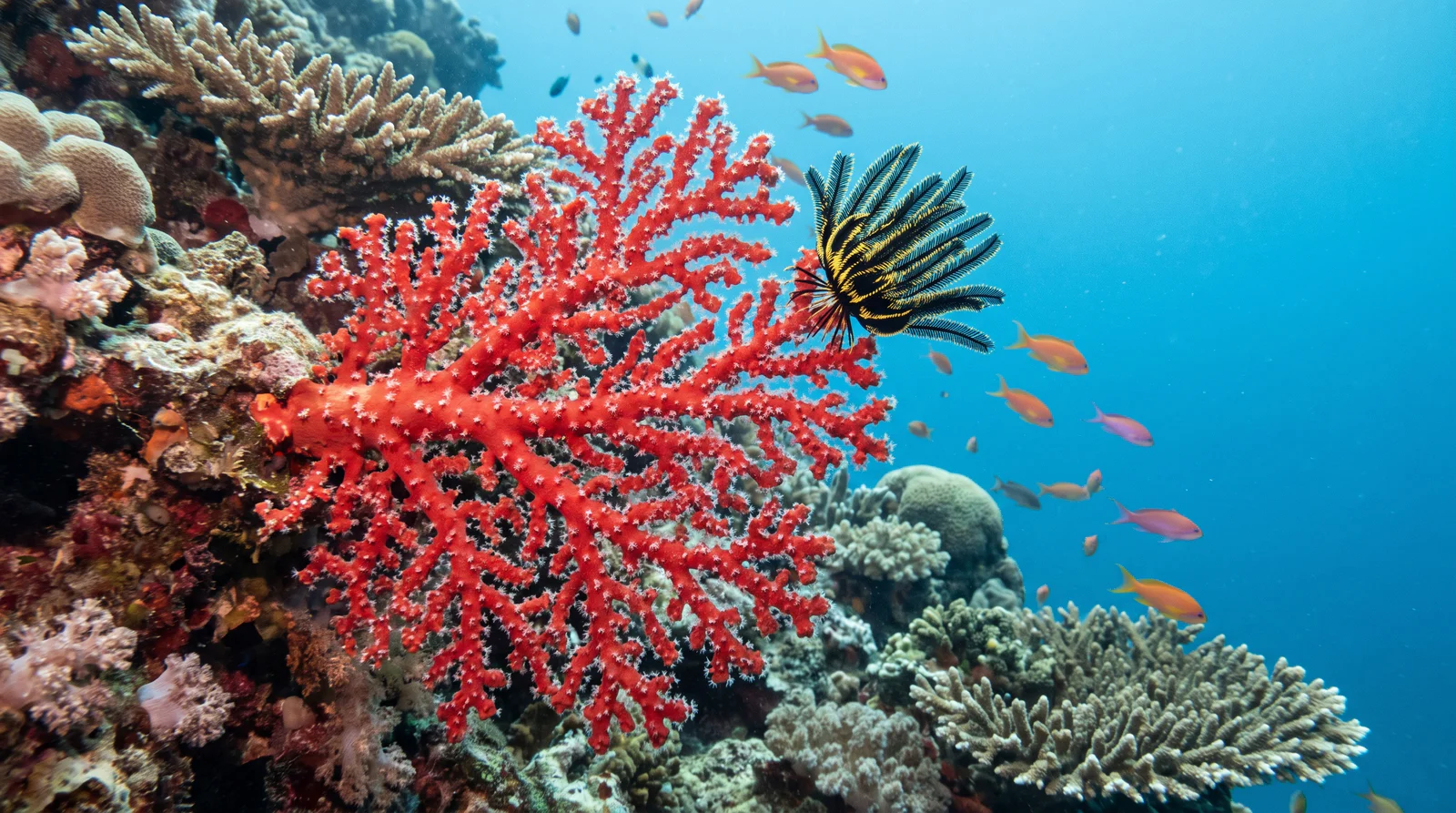 AI-generated
Image credit: AI-generated illustration · Generated for Diveity; no third-party rights · Higgsfield nano_banana_pro image generation
Octocorallia spp. (gorgonians)
About Sea Fan / Gorgonian (assorted).
Gorgonians are colonial octocorals, usually branching, fan-shaped or whip-like, whose polyps are held up by an internal axis. This group entry covers gorgonian sea fan sightings where the species was not recorded. Diveity also has individual pages for the Gorgonian Sea Fan (Annella mollis), the Common Sea Fan (Gorgonia ventalina, western Atlantic) and the Sea Whip (Junceella fragilis). Black corals such as the Black Coral Tree (Antipathes) and the Soft Coral (assorted) group have separate entries. A 2023 paper in the Journal of Experimental Biology uses "gorgonian" for octocorals with an internal support axis and branching structure.
"Gorgonian" is a growth-form and common name, not a single taxon, so the scientific name used here is the class Octocorallia. WoRMS treats the older orders Alcyonacea and Gorgonacea as unaccepted names for Octocorallia, and accepts two orders erected by McFadden, van Ofwegen and Quattrini in 2022, Malacalcyonacea and Scleralcyonacea. In WoRMS, A. mollis (Subergorgiidae) and G. ventalina (Gorgoniidae) sit in Malacalcyonacea, while J. fragilis (Ellisellidae) sits in Scleralcyonacea. The World List of Octocorallia notes that no clear synapomorphies define either order and that the number of valid species remains unknown. Black corals are a different group: WoRMS places Antipathes in the order Antipatharia, class Hexacorallia.
Identification
- Polyps: NOAA describes octocorals as having polyps with eight tentacles surrounding the mouth, and NOAA Ocean Exploration contrasts this with six tentacles in hard corals.
- Skeleton: The World List of Octocorallia describes gorgonian axes as composed of calcium carbonate and/or the horn-like protein gorgonin. NOAA's coral disease glossary defines gorgonin as a fibrous, collagenous protein that supports sea fans.
- Form and size: The 2023 paper reports that the internal skeleton allows colonies to grow up to 2 m in height, and that fan-like colonies are oriented normal to currents. SeaLifeBase gives no maximum size for A. mollis, G. ventalina or J. fragilis.
- Not gorgonians: The World List of Octocorallia states that soft corals and stoloniferans lack a skeletal axis, so a soft coral with no internal axis is not a gorgonian in this sense.
Conservation status varies by species and is largely unassessed. SeaLifeBase lists A. mollis, G. ventalina and J. fragilis as Not Evaluated on the IUCN Red List (version 2025-2).
Where it lives.
The sources opened for this entry describe gorgonians from both the Indo-Pacific and the Atlantic. SeaLifeBase describes A. mollis as an Indo-West Pacific species that inhabits lower reef slopes and the bottom, and reefs exposed to strong tidal currents, on rock or sand, with a listed depth range of 12–18 m. For the western Atlantic, SeaLifeBase lists G. ventalina at 0–4 m, and NOAA says sea fans are commonly found throughout Florida and the Caribbean. SeaLifeBase gives J. fragilis as Indo-West Pacific, recorded from Australia, Palau and Indonesia.
Where Divers Find Them
- Current-exposed slopes: SeaLifeBase places A. mollis on lower slopes and in strong tidal currents. The 2023 paper reports that fan-like colonies face across the current to favour passive suspension feeding.
- Clear water at depth: A 2014 Scientific Reports study describes a dense population of Annella reticulata, about 50 m by 100 m, at 10–25 m in Okinawa, in a deep (more than 20 m), clear-water environment where sea fans are dominant.
- Caves and deep water: The 2023 paper says there are both photosynthetic and non-photosynthetic gorgonians, the latter mostly in dark habitats such as caves and the deep sea. For the West Indies, a University of Miami field guide counts about 170 gorgonian species, of which 100 are restricted to depths greater than 50 m.
- Seahorse hosts: FishBase says Bargibant's pygmy seahorse (Hippocampus bargibanti) is only known on gorgonians of the genus Muricella, whose host corals usually grow deeper than 20 m. It lists Denise's pygmy seahorse (H. denise) in association with the gorgonian sea fans Annella reticulata, Muricella sp. and Echinogorgia sp., at 7–100 m.
- Other residents: The same field guide, written about the Caribbean, lists gorgonians as holdfasts for hermit crabs, brittlestars and crinoids, and as a refuge for fish and shrimp that mimic gorgonians in shape or colour.
Depth records in these databases are narrow and species-specific, so treat them as examples rather than limits. Look closely at the branches of larger fans, because small residents can resemble the colony itself.
How it behaves.
Gorgonians are sessile: once settled, a colony stays attached to the substrate. The 2023 paper says they are thought to depend mainly on passive suspension capture, since many have few prey-capturing nematocysts. It reports that three gorgonians studied from southern Taiwan (Subergorgia suberosa, Melithaea ochracea and Acanthogorgia vegae) captured prey fastest at flow speeds of about 8 cm per second, and that S. suberosa, with the largest polyps of the three, fed actively only in a narrow range of 7–9 cm per second. NOAA describes a Pacific gorgonian that gathers food using its stinging cells and has no symbiotic relationship with zooxanthellae.
Underwater Encounter Behavior
A fan usually looks motionless and shows little reaction to divers. Its branches sway only with currents or surge, which is one reason the University of Miami guide notes they are often mistaken for plants. FishBase says Bargibant's pygmy seahorse has tubercles and a snout resembling the host's polyps and a body resembling the gorgonian stem, which makes it very hard to spot; up to 28 pairs have been recorded on a single gorgonian. FishBase gives a maximum length of 2.4 cm for Bargibant's pygmy seahorse and 2.4 cm for females of Denise's pygmy seahorse. Colonies can also carry growths of their own: the Okinawa study found cyanobacterial overgrowth on 26% of the A. reticulata colonies it assessed.
Diver Tips
- Do not touch or hold: Keep hands, gauges and cameras off fans and the seabed beside them, and do not use a fan as a handhold in current. This is general good practice.
- Buoyancy and fins: Settle your trim before approaching a wall, keep fins clear of the colony and avoid kicking up silt onto polyps. This is general good practice.
- Lights and strobes: Around small residents such as pygmy seahorses, use lights and flash sparingly and briefly, and keep a respectful distance. This is general good practice rather than a species-specific rule.
- Slow recovery: NOAA Sanctuaries describes slow-growing coral and sponge communities off Washington that may take many years to recover from damage by trawl nets and fixed fishing gear. A PeerJ study in the British Virgin Islands found sea fan cover about 2.6 times lower at highly anchored sites. These are not measurements of diver contact, but they show why damage to fans matters.
Where to see it.
Evidence for philippines · 15 dive sites
General range is not evidence of occurrence at a specific dive site.
Blue Hole
Romblon
Documented site occurrence
Season not yet documented
Source reviewed on 2026-10-15 · Source: Romblon Island / Romblon Freediving (article 2025-06-18) · Observation date not documented
Channel Drift
Boracay
Documented site occurrence
Season not yet documented
Source reviewed on 2026-10-15 · Source: DiveGurus Boracay · Observation date not documented
Crocodile Island
Boracay
Documented site occurrence
Season not yet documented
Source reviewed on 2026-10-15 · Source: Wicked Squid Divers Boracay (Wayback snapshot 2026-03-12 of /boracay-dive-sites/) · Observation date not documented
Eva's Point
Sipalay
Documented site occurrence
Season not yet documented
Source reviewed on 2026-10-15 · Source: cbartazo.com "Seeking Sipalay" trip report (2017-10-28, single diver, Artistic Diving guest) · Observation date not documented
Friday's Rock
Boracay
Documented site occurrence
Season not yet documented
Source reviewed on 2026-10-15 · Source: New Wave Divers Boracay (article "Discovering Friday's Rock") · Observation date not documented
Kontiki Reef
Mactan
Documented site occurrence
Season not yet documented
Source reviewed on 2026-10-15 · Source: Divernet, "Don't Miss Mactan" by Henley Spiers (2018-11-18) · Observation date not documented
Laguna
Boracay
Documented site occurrence
Season not yet documented
Source reviewed on 2026-10-15 · Source: DiveGurus Boracay · Observation date not documented
Manta Drop
Sipalay
Documented site occurrence
Season not yet documented
Source reviewed on 2026-10-15 · Source: Diving Squad, "Sipalay Diving" guide (single-author first-person review) · Observation date not documented
Marigondon Cave
Mactan
Documented site occurrence
Season not yet documented
Source reviewed on 2026-10-15 · Source: Divernet, "Don't Miss Mactan" by Henley Spiers (2018-11-18) · Observation date not documented
Punta Bunga
Boracay
Documented site occurrence
Season not yet documented
Source reviewed on 2026-10-15 · Source: New Wave Divers Boracay (dated dive log) · Observation date not documented
Shangri-La Marine Sanctuary
Mactan
Documented site occurrence
Season not yet documented
Source reviewed on 2026-10-15 · Source: Scotty's Dive Center (Wayback snapshot 2025-06-09) · Observation date not documented
Talima Marine Sanctuary
Mactan
Documented site occurrence
Season not yet documented
Source reviewed on 2026-10-15 · Source: Adrenaline Romance, Talima dive report (2018-02-05) · Observation date not documented
Tingo Point
Mactan
Documented site occurrence
Season not yet documented
Source reviewed on 2026-10-15 · Source: Scotty's Dive Center (Wayback snapshot 2024-04-24) · Observation date not documented
Virgin Drop
Boracay
Documented site occurrence
Season not yet documented
Source reviewed on 2026-10-15 · Source: New Wave Divers Boracay (dive-site page) · Observation date not documented
Yapak
Boracay
Documented site occurrence
Season not yet documented
Source reviewed on 2026-10-15 · Source: Wicked Squid Divers Boracay (Wayback snapshot 2026-03-12 of /boracay-dive-sites/) · Observation date not documented
Gallery.
 AI-generated
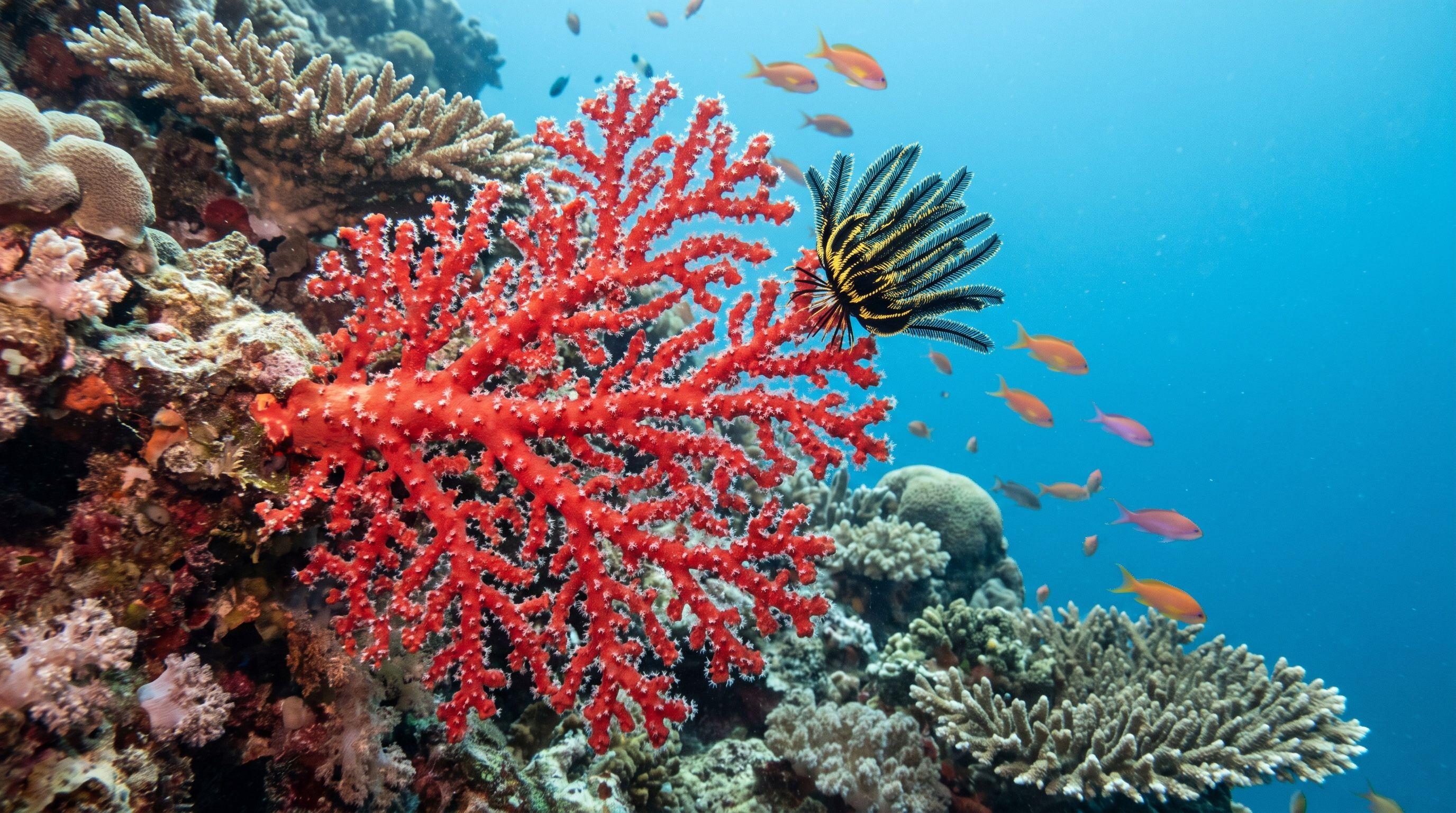
AI-generated illustration
Image credit: AI-generated illustration · Generated for Diveity; no third-party rights · Higgsfield nano_banana_pro image generation