Sea Snake / Sea Krait (assorted)
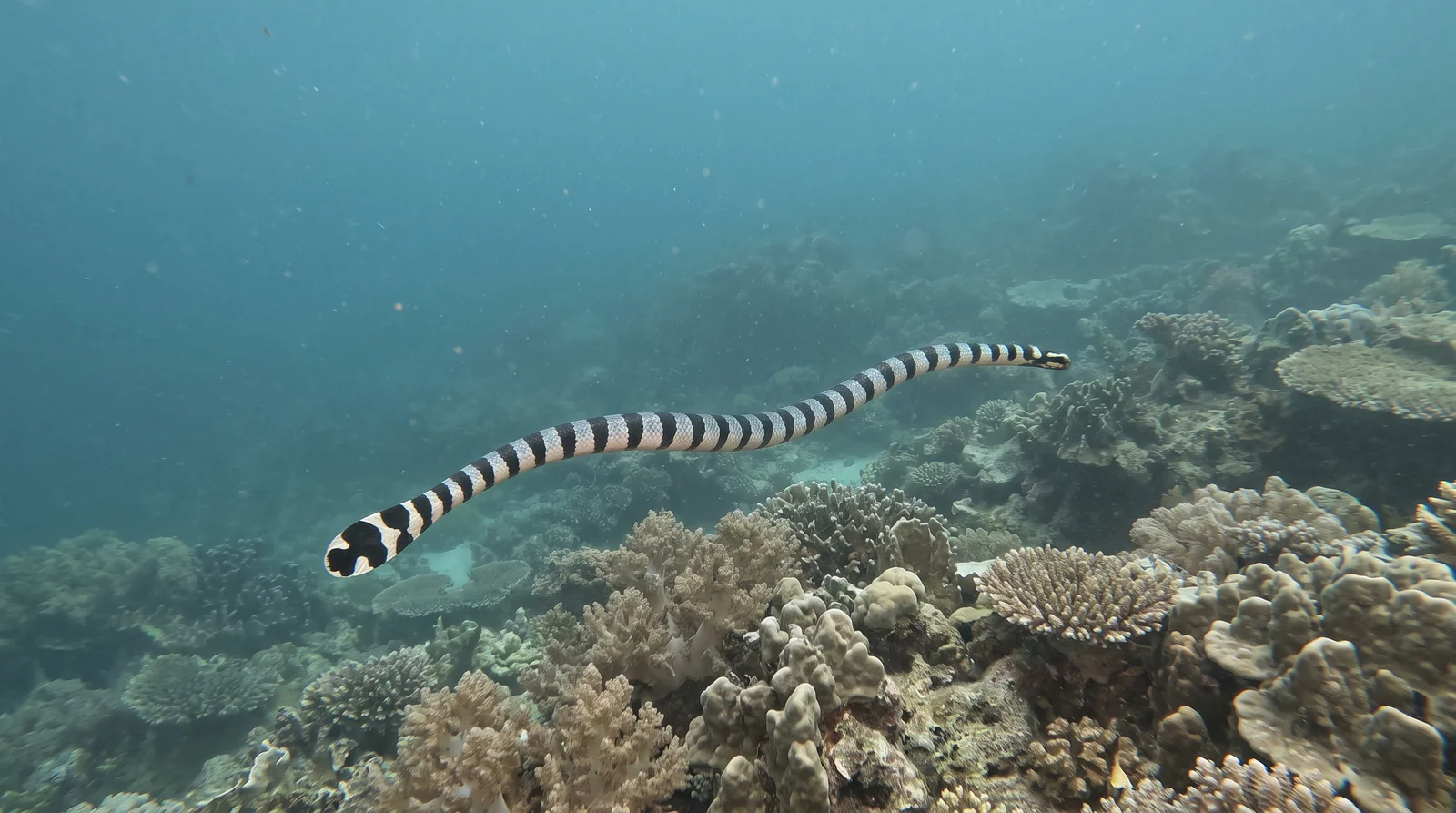 AI-generated
Image credit: AI-generated illustration · License unspecified · Source unspecified
Hydrophiinae spp.
About Sea Snake / Sea Krait (assorted).
"Sea Snake / Sea Krait (assorted)" is a general entry for sightings of marine snakes where the species was not identified. It covers both the true sea snakes and the sea kraits of the genus Laticauda. Both groups belong to the cobra family, Elapidae, and both are venomous. Telling species apart underwater is often difficult, so many dive logs simply record "sea snake". When the animal can be identified, use a species entry instead, such as the Banded Sea Krait (Laticauda colubrina).
True sea snakes live in the warm tropical and subtropical parts of the Indian and Pacific Oceans and live exclusively in water. Sea kraits are distributed along the shores of the Western Pacific and the Eastern Indian Ocean, and the genus Laticauda is usually given as eight species. The classification of sea kraits is debated: some authors place them in the subfamily Hydrophiinae with the true sea snakes, while others use a separate subfamily (Laticaudinae) or family (Laticaudidae).
Kraits versus True Sea Snakes
- Sea kraits: Hunt at sea but must return to land to digest, rest, shed their skin, mate and lay eggs. Their large belly scales help them crawl on land.
- True sea snakes: Spend their whole lives in water. The pelagic sea snake (Hydrophis platurus), for example, gives birth to live young.
- Shared feature: A flattened, paddle-shaped tail that helps them swim.
Identification
- Shape: A scaly snake body ending in a paddle-shaped tail, unlike the pointed tail of an eel.
- Size: Varies by species. The banded sea krait reaches about 150 cm total length, and the pelagic sea snake averages about 1 m.
- Colour: Some species, such as the banded sea krait, are boldly banded; the pelagic sea snake has a yellow tail with dark spots or bars. Colour alone is not a reliable guide to species.
Conservation status varies by species. SeaLifeBase lists the banded sea krait and the pelagic sea snake as Least Concern (assessed 2009) and the leaf-scaled sea snake (Aipysurus foliosquama) as Data Deficient (assessed 2018). Researchers also report that many sea krait populations collapsed during the last three decades.
Where it lives.
Sea snakes and sea kraits are reptiles of the tropical and subtropical Indian and Pacific Oceans. The habitats they use differ markedly between species and between the two groups, which is one reason sightings are hard to generalise.
Where Divers Meet Them
- Coral reefs and shallow coasts: Sea kraits forage on coral reefs and in shallow coastal water. The banded sea krait is recorded on fringing reefs, in mangroves and around coral islands, usually in shallow water, with a listed depth range of 0-10 m.
- Shorelines and islets: Kraits return to land, usually coralline islets, to rest, shed skin and digest prey. On land they shelter in vegetation, under rocks and in crevices and caves. Mating takes place on shore, and eggs are laid in rock crevices.
- Open ocean: The pelagic sea snake lives near the surface in the open ocean, away from coasts and reefs, and is often found around floating debris. Currents occasionally carry it into temperate waters, and sick or injured snakes may drift ashore.
- Reef-bottom species: Some sea snakes live close to the bottom; the leaf-scaled sea snake (Aipysurus foliosquama), for example, is listed at depths of 10 m or less.
Dependence on Land and Fresh Water
Sea kraits show strong site fidelity, and access to fresh water is considered crucial for them, so coastal land matters to them as much as the reef. Because they lay their eggs on land, they are also exposed to threats on shore. Researchers link the collapse of many sea krait populations to habitat loss and harvesting for the leather industry, and note risks from coastal development.
In practice, divers are most likely to see sea kraits on shallow reefs close to islands and shorelines, while true sea snakes may be met on the reef or, depending on the species, in open water.
How it behaves.
Sea snakes and sea kraits are air-breathing reptiles that must return to the surface to breathe, so divers often see them swimming between the reef and the surface. Most encounters are brief and calm. Behaviour differs between sea kraits, which move between land and sea, and true sea snakes, which never need to leave the water.
Feeding
- Sea kraits: Feed mostly on eels on coral reefs. In one study the main prey were two species of moray eel. In the banded sea krait, adult females usually take a single large conger eel, while males eat smaller moray eels and often take several prey items.
- Pelagic sea snake: Eats only fish, sometimes ambushing prey while waiting motionless at the surface near floating debris.
Underwater Encounter Behavior
Researchers describe most sea snakes as not aggressive unless they are being handled or threatened, or during the mating season; their behaviour is better described as defensive. In an Australian study of 13 sea snake bites recorded between 2002 and 2020, all patients were in or near the water when bitten. Most were fishing, one was spearfishing, and one was a snake handler.
Venom and Safety
Sea snakes are venomous. In the pelagic sea snake the fangs are short, about 1.5 mm, and a bite usually injects only a small dose, but the venom is highly toxic and contains neurotoxins and myotoxins. Most sea snake envenoming causes muscle damage (myotoxicity). Bites can be painless at first, so anyone who may have been bitten should seek medical attention immediately.
Diver Tips
- Do not handle: Rough handling is likely to result in a bite.
- Give space: Do not block a snake's path as it rises to breathe or returns to the reef.
- Stranded snakes: Do not pick up a snake on the beach or return it to the sea yourself; contact local wildlife authorities.
- Photograph, don't chase: Clear photos of the head, body pattern and tail help with species identification.
Where to see it.
Evidence for boracay · 3 dive sites
General range is not evidence of occurrence at a specific dive site.
Camia II Wreck
Boracay
Documented site occurrence
Season not yet documented
Source reviewed on 2026-10-14 · Source: New Wave Divers Boracay (dive-site page) · Observation date not documented
Diniwid
Boracay
Documented site occurrence
Season not yet documented
Source reviewed on 2026-10-14 · Source: New Wave Divers Boracay (dive-site page) · Observation date not documented
Friday's Rock
Boracay
Documented site occurrence
Season not yet documented
Source reviewed on 2026-10-14 · Source: Wicked Squid Divers Boracay (Wayback snapshot 2026-03-12 of /boracay-dive-sites/) · Observation date not documented
Gallery.
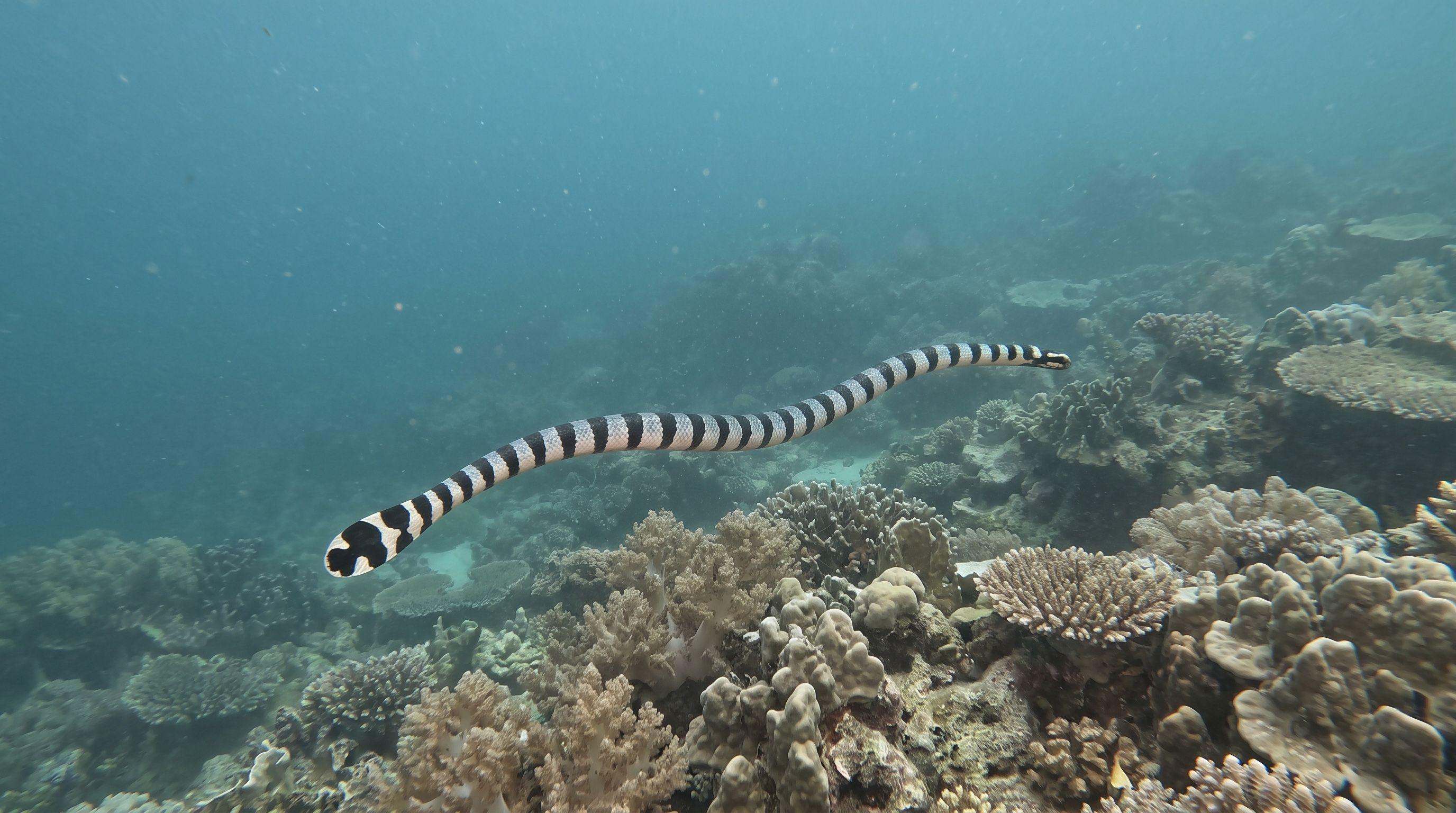 AI-generated
AI-generated illustration
Image credit: AI-generated illustration · License unspecified · Source unspecified