Sergeant Major
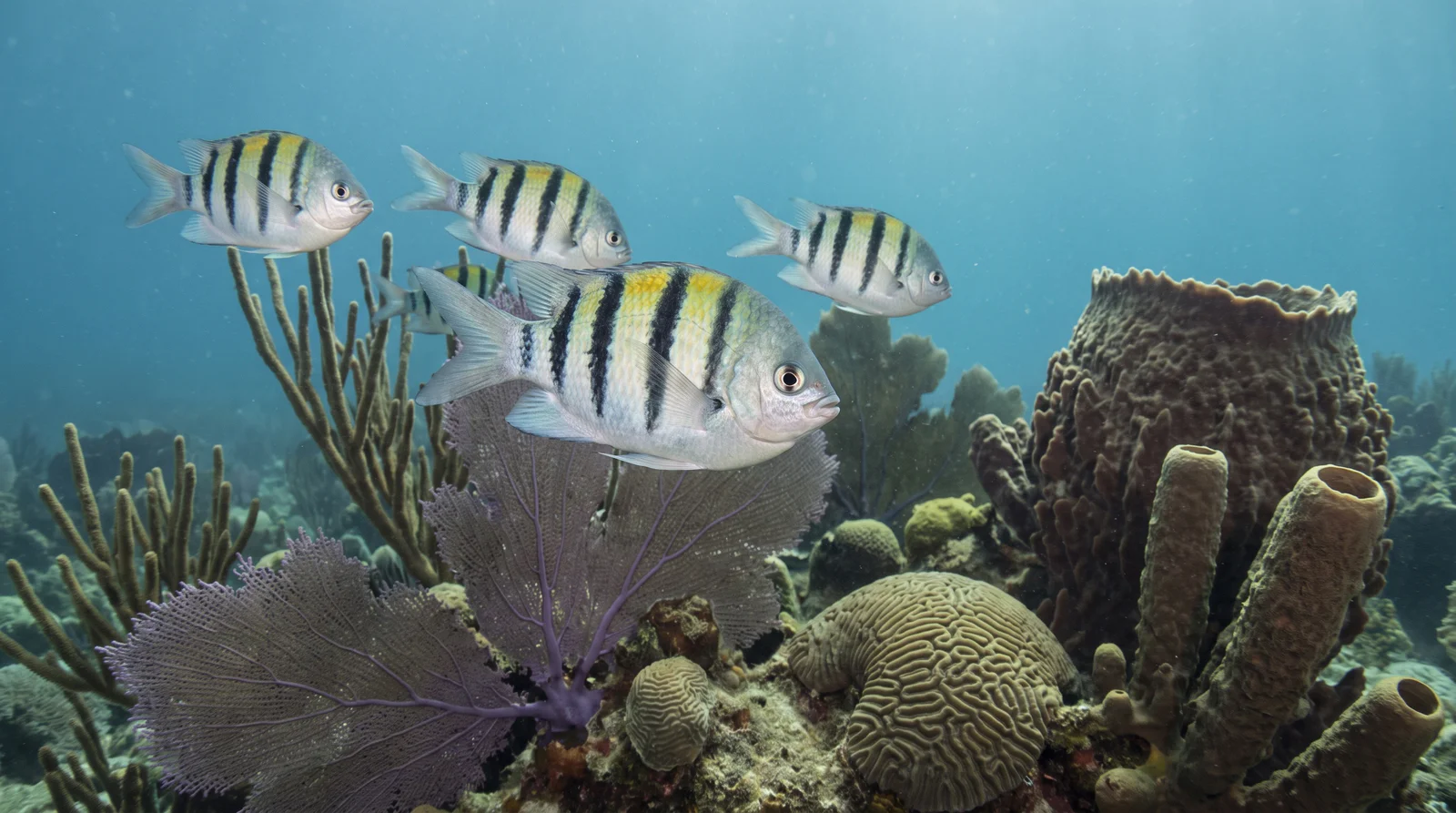 AI-generated
Image credit: AI-generated illustration · License unspecified · Source unspecified
Abudefduf saxatilis
About Sergeant Major.
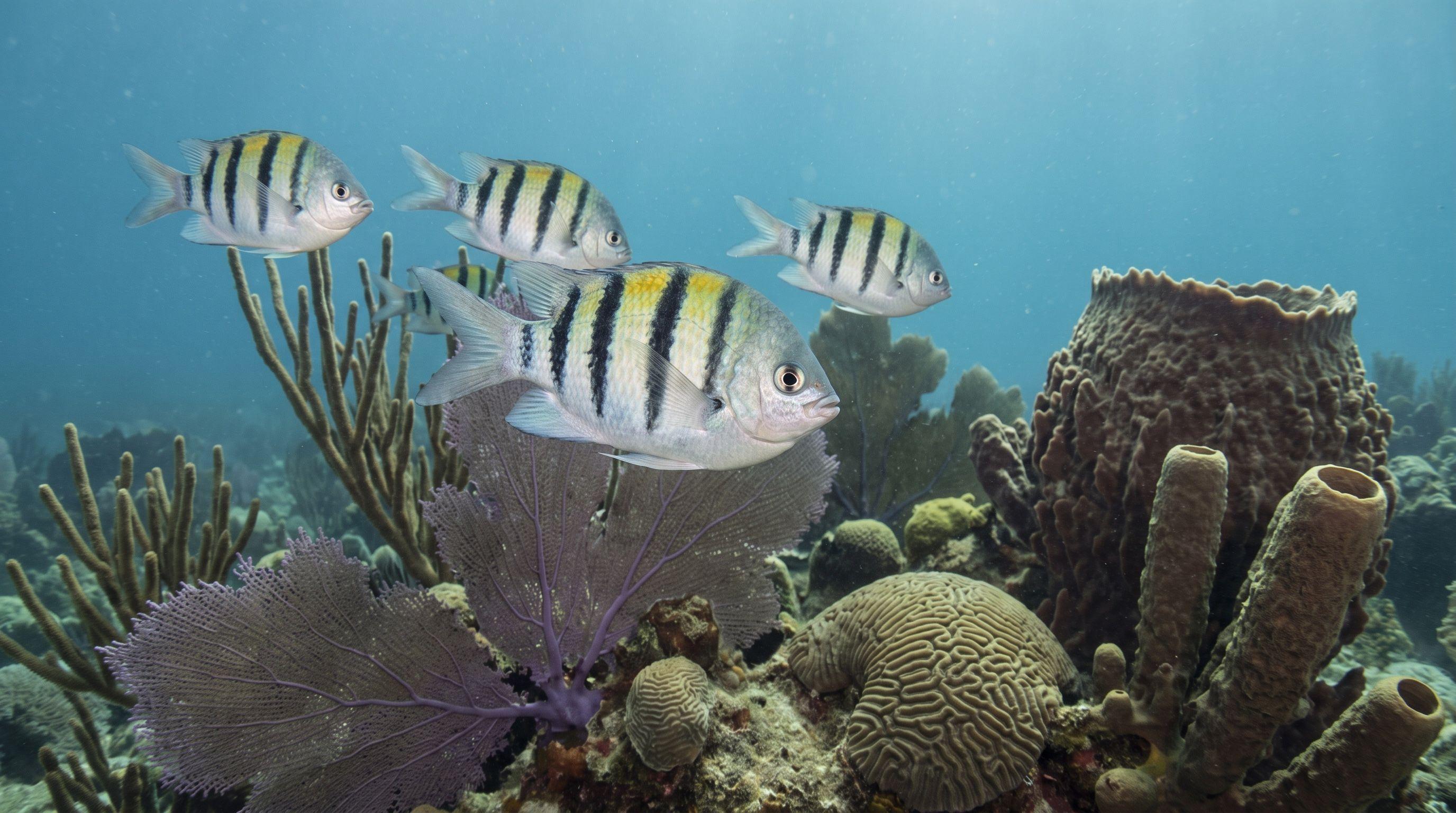
The Sergeant Major, also known as the five finger fish or pilot fish, is a small, rounded damselfish characterized by its laterally compressed body. This striking species is readily identifiable by its five prominent black vertical bars set against a background that typically ranges from silvery-gray to bluish-silver, often with a yellow-green hue along its back or spine area, shading to white on its underside. Juveniles commonly display a greenish-yellow top that transitions to white below, maintaining the distinct black bars, and can occasionally appear entirely black when very young. A notable feature of the adult male during the breeding season is a dramatic color shift to a deep bluish-violet or dark blue, at which point its signature stripes become less pronounced.
Distinguishing the Sergeant Major from similar species, such as the Night Sergeant (Abudefduf taurus), involves observing its more pronounced vertical bars and a slimmer body profile, alongside a shorter distance between the eye and the upper margin of the mouth. The species possesses a single nostril on each side of its snout and a small, terminal mouth equipped with numerous small teeth. Its scientific name, Abudefduf saxatilis, translates to 'father' and 'living among rocks' with 'tile-like in color,' reflecting both its habitat and the males' protective, often aggressive, parental behavior. Its common name is derived from the five black bars that evoke the insignia of a military Sergeant Major. Typically, individuals can grow to a maximum length of about 23 cm (9 inches) and weigh up to 0.2 kg (0.45 pounds). They are equipped with 13 dorsal spines, 12 to 13 dorsal soft rays, two anal spines, and 10 to 12 anal soft rays.
Where it lives.
The Sergeant Major is a widely distributed reef-associated species, thriving in the warm tropical and subtropical waters of the Atlantic Ocean. Its extensive range spans from the northeastern coast of the United States (as far north as Rhode Island seasonally) south to Uruguay in the western Atlantic, encompassing the Gulf of Mexico, the Bahamas, and the diverse islands of the Caribbean Sea. In the eastern Atlantic, populations are found from Portugal, the Azores, the Canary Islands, and Cape Verde, extending along the tropical coast of western Africa down to Angola. This adaptable fish primarily inhabits shallow coral reefs, rocky reefs, areas with rubble, pilings, and sea grass beds. Juveniles are frequently observed in tide pools and occasionally associate with floating sargassum communities. While most commonly found at depths of 0-20 meters (0-65 feet), typically within 0-10 meters (0-33 feet), Sergeant Majors have been recorded at depths reaching up to 40 meters (130 feet) or even 43 meters (140 feet), demonstrating a preference for well-lit, shallow environments. Younger fish tend to occupy shallower habitats.
How it behaves.
Sergeant Majors are gregarious fish, frequently forming large, loose schools or feeding aggregations that can number in the hundreds of individuals. These impressive schools typically swim over shallow reef tops during the day to feed, dispersing into protective crevices within the reef at night. As diurnal feeders, their diet is omnivorous and highly generalized, consisting of a variety of food items including algae, zooplankton, small crustaceans (such as invertebrate larvae), and even small fish. They also display fascinating and opportunistic feeding behaviors; for instance, at the Fernando de Noronha Archipelago, they have been observed feeding on spinner dolphins' feces and vomit. Juveniles are known to establish cleaning stations, where they remove algae, molted skin, and parasites from green sea turtles.
A defining characteristic of Sergeant Major behavior is their pronounced territoriality, particularly exhibited by males during the breeding season. Males meticulously prepare nesting sites on hard substrates like rocks, reef outcrops, shipwrecks, or pilings. During reproduction, which involves distinct pairing, the male's coloration intensifies to a dark blue, and he becomes fiercely protective, guarding and aerating the demersal eggs, which adhere to the substrate, and aggressively chasing away any perceived threats, including divers. This strong paternal instinct is even reflected in their genus name, Abudefduf, meaning 'father.' While generally social, they can also display aggression towards other individuals of their own kind, particularly when defending their territory. Divers who offer food may find themselves readily approached by these curious fish.
Where to see it.
Evidence for bonaire · No dive sites
General range is not evidence of occurrence at a specific dive site.
No documented dive-site associations in this destination yet.
Gallery.
 AI-generated
 illustration
Image credit: AI-generated illustration · License unspecified · Source unspecified