Soldierfish (assorted)
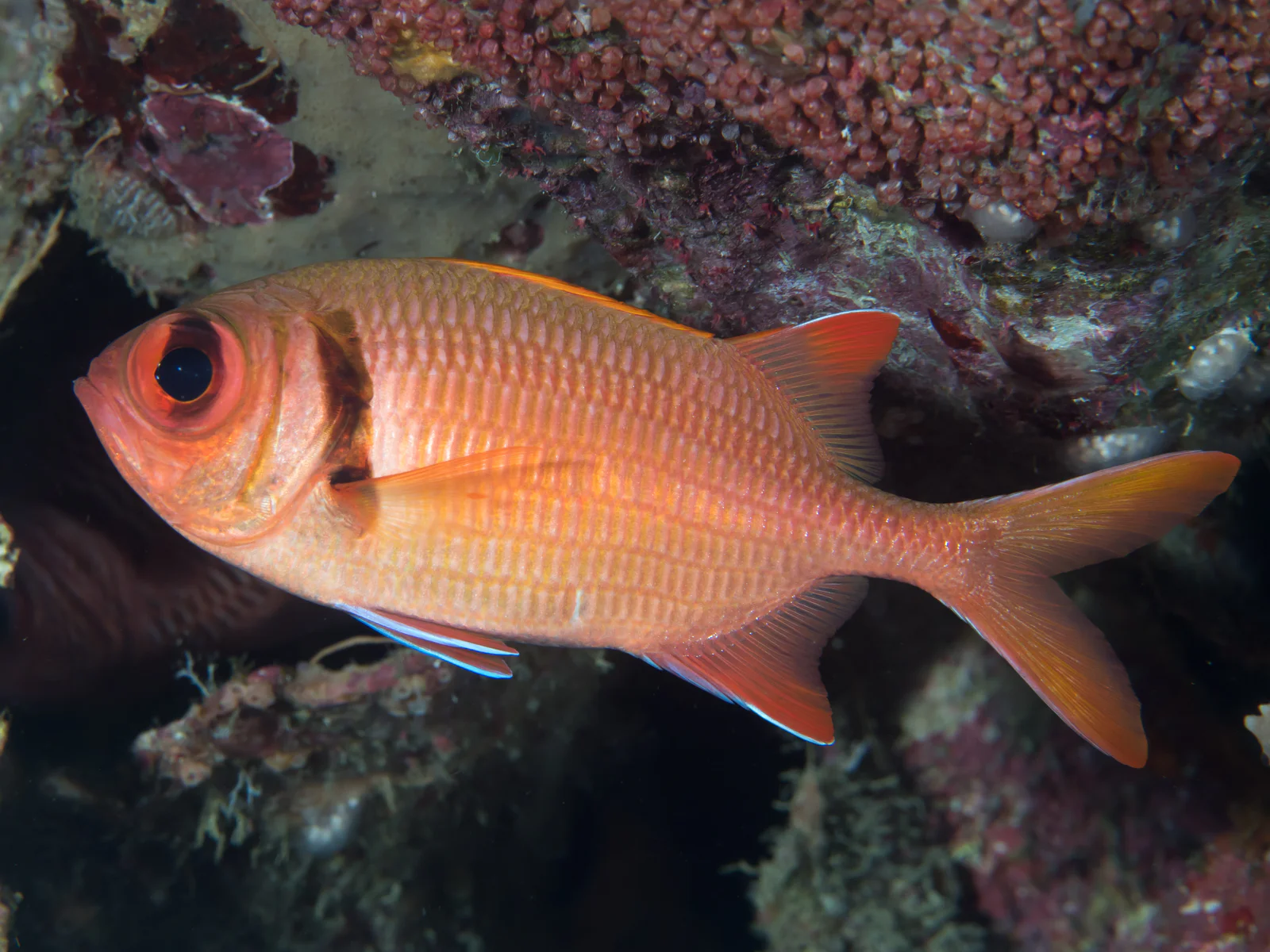
Image credit: Rickard Zerpe · CC BY 2.0 · Wikimedia Commons, from Flickr (krokodiver), cropped by this page
Myripristis sp.
About Soldierfish (assorted).
Soldierfish (Myripristis) are red, big-eyed tropical reef fish that hide in caves and under ledges by day and feed on plankton at night.
The World Register of Marine Species (WoRMS) lists Myripristis Cuvier, 1829 as an accepted genus of the family Holocentridae, which it places in the order Holocentriformes; Wikipedia places the family in the Beryciformes. Wikipedia lists 28 recognised species, citing FishBase, and says that members of the subfamily Myripristinae are typically known as soldierfish and those of the Holocentrinae as squirrelfish. This page covers the genus as a group.
Identification
Wikipedia describes the family as largely or entirely nocturnal, with relatively large eyes, and says red and silvery colours dominate. FishBase gives each of the five species read here (M. murdjan, M. kuntee, M. violacea, M. berndti and M. vittata) a compressed body with 11 dorsal spines and 4 anal spines, and separates them by marks such as the gill-cover membrane, the colour of the spiny dorsal fin and the fin edges. M. kuntee has a reddish brown bar from the top of the gill opening to the base of the pectoral fin and a broadly yellow spiny dorsal fin; M. violacea has a silvery-violet sheen, orange fin tips and a dark orange-red bar on the gill cover; M. vittata has white leading edges on its median fins and no dark bar on the gill cover.
Size differs by species. FishBase gives a maximum total length of 25 cm for M. vittata, 26 cm for M. kuntee, 30 cm for M. berndti, 35 cm for M. violacea and 60 cm for M. murdjan, and a common length of 16 to 22 cm for the four where it gives one. Wikipedia says most members of the family reach 15 to 35 cm.
Conservation
FishBase shows each of the five species as Least Concern on the IUCN Red List, assessed on 4 March 2015. It records reports of ciguatera poisoning from M. murdjan and lists the other four as harmless.
Where it lives.
Soldierfish live on tropical reefs and shelter by day in caves, crevices and under ledges.
Range
Wikipedia says the family occurs in tropical parts of the Indian, Pacific and Atlantic Oceans, with the greatest species richness near reefs in the Indo-Pacific. FishBase gives these ranges for the five species read here: M. murdjan from the Red Sea and East Africa to Oceania; M. berndti from East Africa across the Indo-Pacific to the Clipperton, Cocos and Galapagos islands in the eastern Pacific, but not the Red Sea; M. kuntee from East Africa to French Polynesia and the Hawaiian Islands, but not the Red Sea; M. violacea from East Africa to the Tuamotu Islands; and M. vittata mainly around oceanic islands from the Mascarene Islands and Seychelles to French Polynesia and the Hawaiian Islands.
Depth
These sources give no single depth range for the genus. Wikipedia says most members of the family live from the shoreline to 100 m. FishBase gives 1 to 50 m for M. murdjan, 0 to 30 m for M. violacea, 0 to 100 m for M. kuntee, 3 to 100 m, usually 15 to 80 m, for M. vittata, and 0 to 159 m, usually 3 to 15 m, for M. berndti.
Reef setting
FishBase places these species on reef flats, in lagoons and channels and on seaward reefs. It says M. violacea is relatively common near branching Acropora and layered Porites corals, M. kuntee gathers by day where leafy or cavernous coral growth is rich, and M. vittata forms large aggregations in caves and under ledges of steep drop-offs.
How often divers see soldierfish at a particular site is not documented in these sources.
How it behaves.
Soldierfish shelter in reef caves and under ledges by day and come out at night to feed on plankton.
Day and night
Wikipedia says the family is largely or entirely nocturnal and typically stays hidden in crevices, caves or under ledges during the day. FishBase describes M. murdjan as secretive, hovering under ledges and in caves, M. berndti as living in loose aggregations, and M. kuntee as often in large aggregations by day. It notes that individuals of M. vittata often swim upside down, even when mixed in schools of upright fish.
Feeding
Wikipedia says soldierfish typically feed on zooplankton. FishBase says four of the five species read here feed on plankton such as crab larvae, and that M. vittata feeds on plankton and also on crabs and fishes. It notes that M. berndti is almost always caught at night.
Reproduction
FishBase describes M. murdjan as oviparous, with planktonic eggs and larvae, and Wikipedia says the family's larvae live in open water and can be found far out to sea. Spawning seasons are not documented in these sources.
Where to see it.
Evidence for great barrier reef · 1 dive site
General range is not evidence of occurrence at a specific dive site.
Gallery.
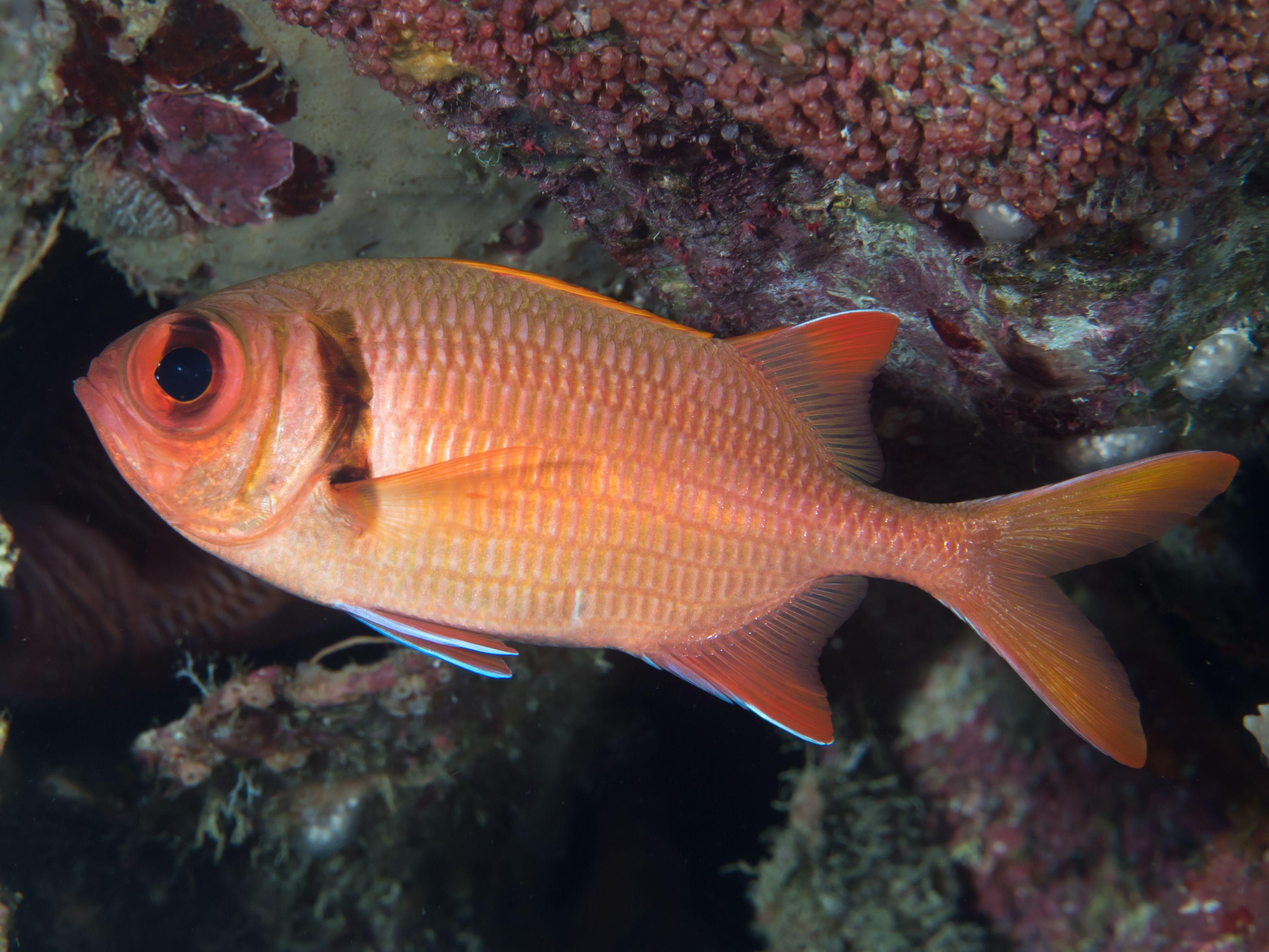
A shoulderbar soldierfish (Myripristis kuntee), one of the soldierfishes this group entry covers, photographed in Raja Ampat, Indonesia, on 3 January 2019, as its file page states. The species is the photographer's identification. It illustrates the group and is not a sighting record. This page's frame crops the photograph.
Image credit: Rickard Zerpe · CC BY 2.0 · Wikimedia Commons, from Flickr (krokodiver), cropped by this page
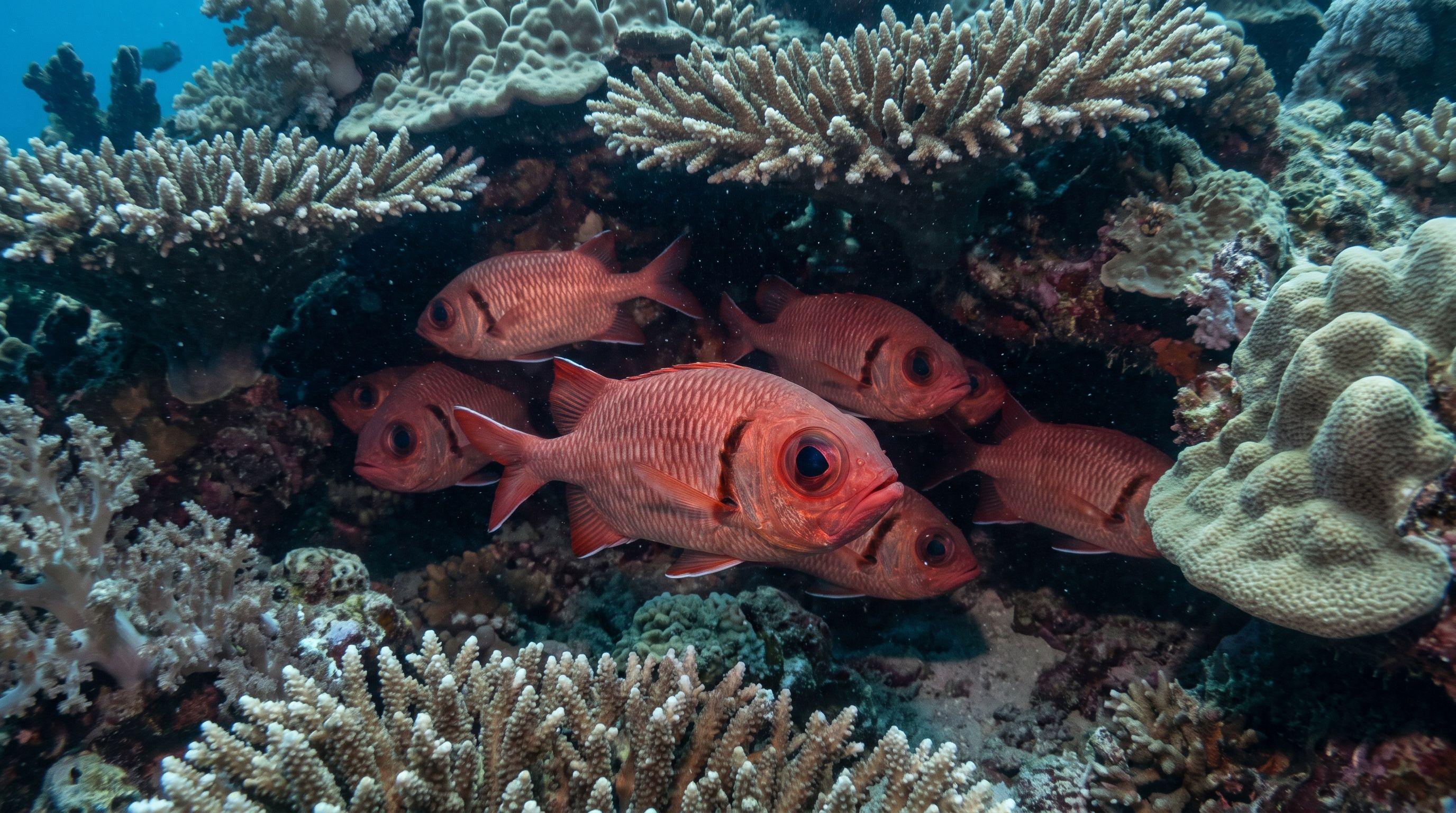 AI-generated
 illustration
Image credit: AI-generated illustration · Diveity