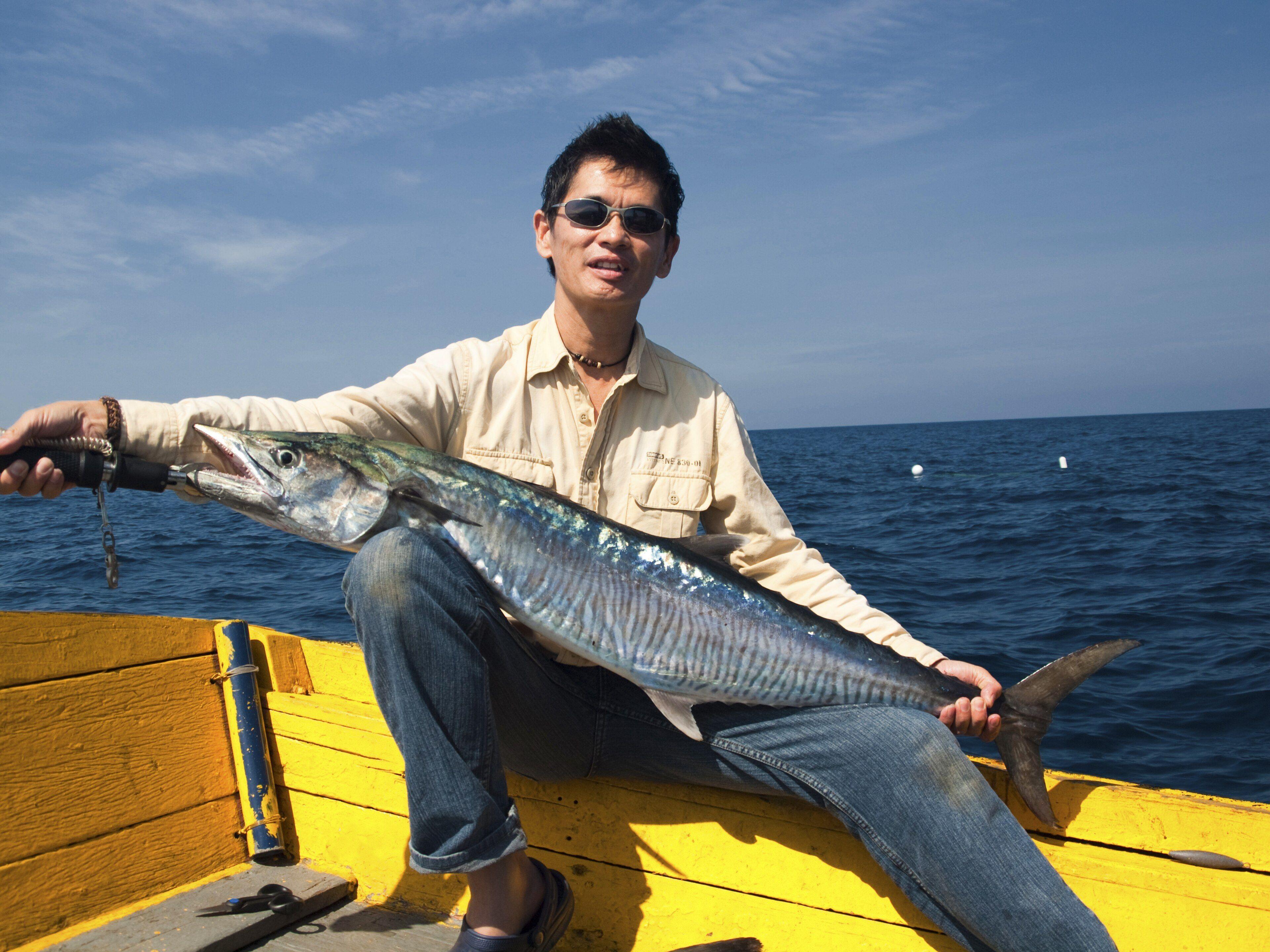
Narrow-barred Spanish Mackerel
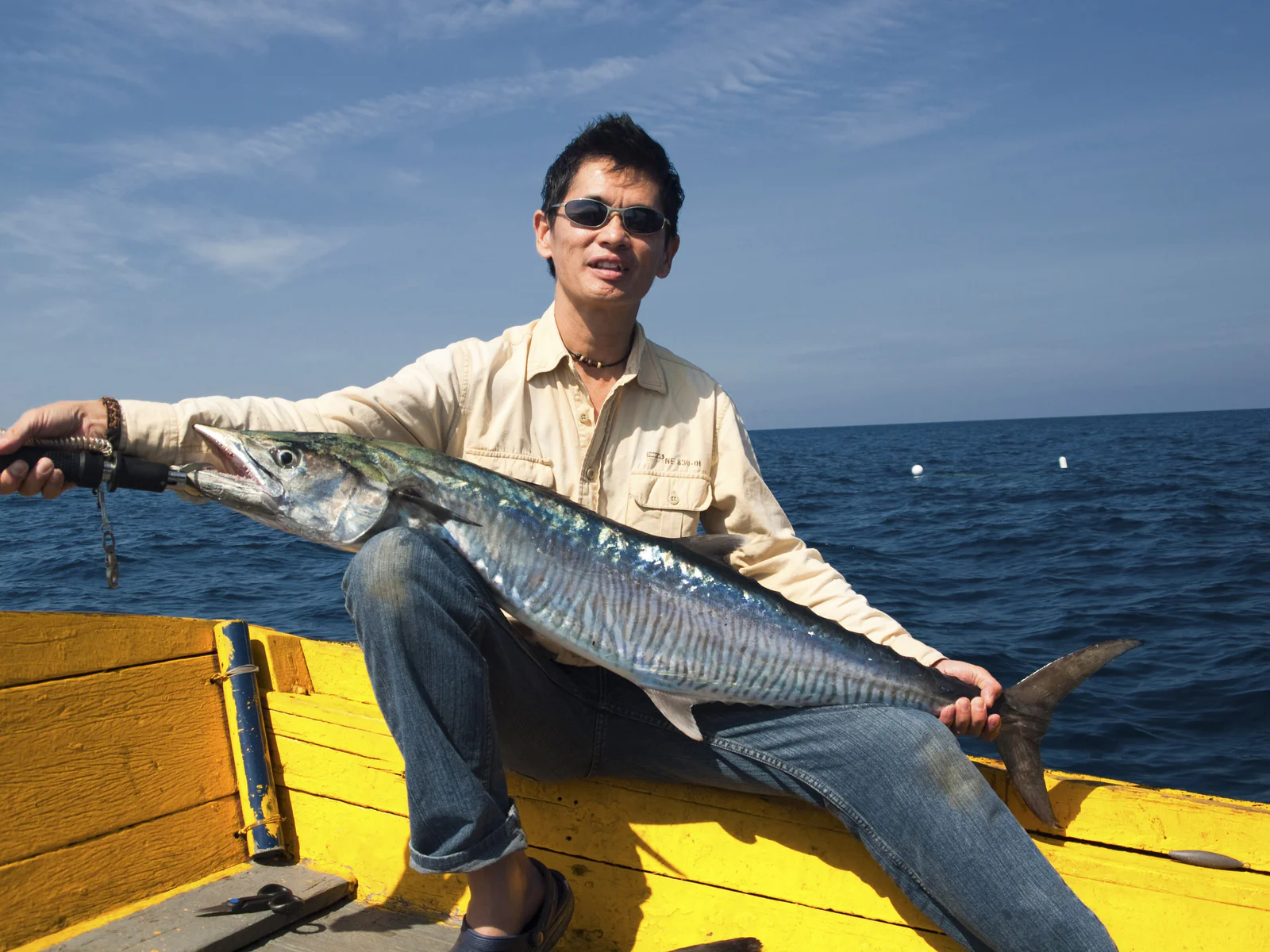
Scomberomorus commerson
About Narrow-barred Spanish Mackerel.
The Narrow-barred Spanish Mackerel (Scomberomorus commerson) is a formidable and highly sought-after pelagic fish belonging to the family Scombridae, which also includes tunas and other mackerels. Known for its impressive speed and predatory prowess, this species is a common sight for divers in various tropical and subtropical waters. It is currently listed as Near Threatened on the IUCN Red List, highlighting the importance of responsible diving and conservation efforts.
These powerful fish are often encountered sweeping through reef pinnacles, drop-offs, and along the edges of continental shelves, actively hunting schooling baitfish. While typically found in depths ranging from 10 to 70 m, they can occasionally be observed deeper, down to 200 m. Their diet primarily consists of small fish such as anchovies, sardines, and carangids, along with squid and shrimp.
Divers have reported occasional sightings of the Narrow-barred Spanish Mackerel at dive sites such as Crystal Rock, Pamilacan Sanctuary, and Sardine Reef, while it is a more common encounter at Kilima Steps.
Identification
- Size: The Narrow-barred Spanish Mackerel is one of the largest mackerels, capable of reaching a maximum length of 2.4 m (8 ft) and a weight of up to 70 kg (154 lbs).
- Body Shape: It possesses an elongated, torpedo-shaped body that is moderately compressed laterally, allowing for incredible speed and agility in the water.
- Coloration: The back is typically a vivid blue to dark grey, transitioning to a silvery blue-grey on the flanks and belly.
- Distinctive Markings: The most distinguishing feature is the presence of numerous narrow, wavy, vertical dark bars or lines running down its sides. The number of these bars can vary, from as few as 20 in smaller individuals to as many as 65 in larger specimens. Juveniles may also exhibit spots.
- Fins: It has two dorsal fins, separated by a narrow gap. The first dorsal fin has 15-18 spines, while the second dorsal fin has 15-20 soft rays, followed by 8-11 finlets. The anal fin, which originates below the midpoint of the second dorsal fin, has 16-21 soft rays, followed by 7-12 finlets. These finlets help reduce drag during rapid movement. The pectoral fins consist of 21-24 rays.
- Lateral Line: A key identification feature is the lateral line, which makes an abrupt downward bend below the end of the second dorsal fin.
- Head and Mouth: It has a large, pointed head with strong, compressed, triangular teeth in its jaws, indicative of its predatory nature.
Where it lives.
The Narrow-barred Spanish Mackerel (Scomberomorus commerson) is a highly migratory, coastal pelagic fish belonging to the Scombridae family. Renowned for its speed and predatory nature, this species inhabits a diverse range of marine environments across the Indo-West Pacific, making it a fascinating subject for divers.
Geographic Distribution
This species boasts an extensive distribution, primarily centered in Southeast Asia, extending westward along the east coast of Africa, through the Persian Gulf, and across the northern coastal areas of the Indian Ocean. Its range reaches as far east as Fiji in the Southwest Pacific Ocean, and north to China and Japan. It is commonly found along both sides of Australia, from Perth to Sydney. Notably, the Narrow-barred Spanish Mackerel has also established a significant presence in the Mediterranean Sea, having migrated through the Suez Canal as a Lessepsian migrant, and is now a common sight in the eastern Levant.
Habitat and Depth Range
As a pelagic and oceanodromous species, the Narrow-barred Spanish Mackerel typically inhabits waters from the edge of the continental shelf to shallow coastal areas. While it is often observed in depths ranging from 10 to 70 m, it can also be found in deeper waters, occasionally down to 200 m. Some sources indicate it can be found at depths up to 650 m, particularly in tropical waters of the Indian and Western Pacific Oceans.
Ecosystems and Substrate Associations
Divers are likely to encounter these impressive fish in a variety of ecosystems, often associated with structural features that provide hunting grounds. Key habitats include:
- Reef Edges and Slopes: They are frequently found around drop-offs, and shallow or gently sloping reef and lagoon waters, where they may aggregate to feed and spawn.
- Coastal Waters: The species thrives in shallow coastal waters, sometimes tolerating areas of low salinity and high turbidity, and can even be found in estuaries and lagoons, especially as juveniles.
- Continental Shelf: Adults are commonly found in coastal waters out to the continental shelf.
- Seamounts and Islands: They also inhabit oceanic and pelagic waters around islands and rocky headlands.
The Narrow-barred Spanish Mackerel is a top-level predator, playing a crucial role in these ecosystems. It typically hunts solitarily or in small schools, preying on smaller fish such as anchovies, clupeids, and carangids, as well as squids and shrimps. While known for undertaking lengthy longshore migrations, permanent resident populations also exist in certain regions.
How it behaves.
- Underwater Encounter Behavior: Narrow-barred Spanish Mackerel are typically observed as solitary individuals or in small schools, often patrolling the edges of continental shelves, drop-offs, and shallow coastal waters, including reefs and lagoons. They are active swimmers, constantly on the move in search of prey. When divers encounter them, these mackerel may exhibit curiosity, sometimes approaching divers, especially if there is activity in the water, such as spearfishing. However, they can also be wary in very clear water. Their streamlined, torpedo-shaped bodies allow for rapid bursts of speed, making them formidable hunters in the open water. They are generally found in depths ranging from 10 to 70 m, though they can be encountered as deep as 200 m. They prefer tropical waters with temperatures typically between 22.4°C and 31.3°C.
- Feeding Habits: As voracious, opportunistic carnivores and top predators, Narrow-barred Spanish Mackerel primarily feed on small schooling fishes such as anchovies, clupeids, and carangids. Their diet also includes squid and penaeoid shrimps. Studies have shown that their prey composition can vary by size and season, with smaller individuals consuming different prey than larger ones. They are known to feed around the clock.
- Social Structure: While often seen alone, Narrow-barred Spanish Mackerel also form small schools. These schools may aggregate in specific locations on reefs and shoals for feeding and spawning. Larger individuals may exhibit more resident behavior, contributing to a metapopulation structure, although the species is also known to undertake lengthy migrations.
- Notable Seasonal Patterns Relevant to Divers: Narrow-barred Spanish Mackerel undertake seasonal migrations, often following isotherms of 23–26°C. Spawning is seasonal and protracted in warmer tropical waters, with females being multiple spawners. Spawning aggregations occur in specific areas, typically off reef slopes and edges over the continental shelf. For instance, in Australian waters, spawning can occur between August and November in the Kimberley region and October and January in the Pilbara region. In the Central Taiwan Strait, spawning peaks between March and May, extending through August. Divers may observe increased activity and larger aggregations of these mackerel during these spawning seasons, particularly in areas known for their reproductive gatherings.
Where to see it.
Evidence for philippines · 3 dive sites
General range is not evidence of occurrence at a specific dive site.
Kilima Steps
Puerto Galera
Site occurrence not yet documented
Season not yet documented
No dated observations available.
Mainit
Dauin
Site occurrence not yet documented
Documented site seasonality: Nov, Dec, Jan, Feb, Mar, Apr, May
No dated observations available.
Pamilacan Sanctuary
Pamilacan Island
Site occurrence not yet documented
Documented site seasonality: Nov, Dec, Jan, Feb, Mar, Apr, May
No dated observations available.
Gallery.