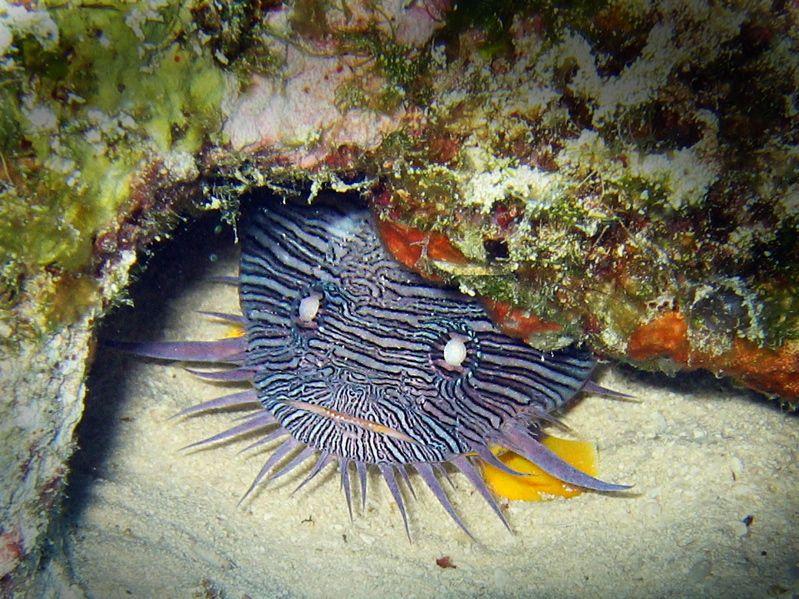
Splendid Toadfish
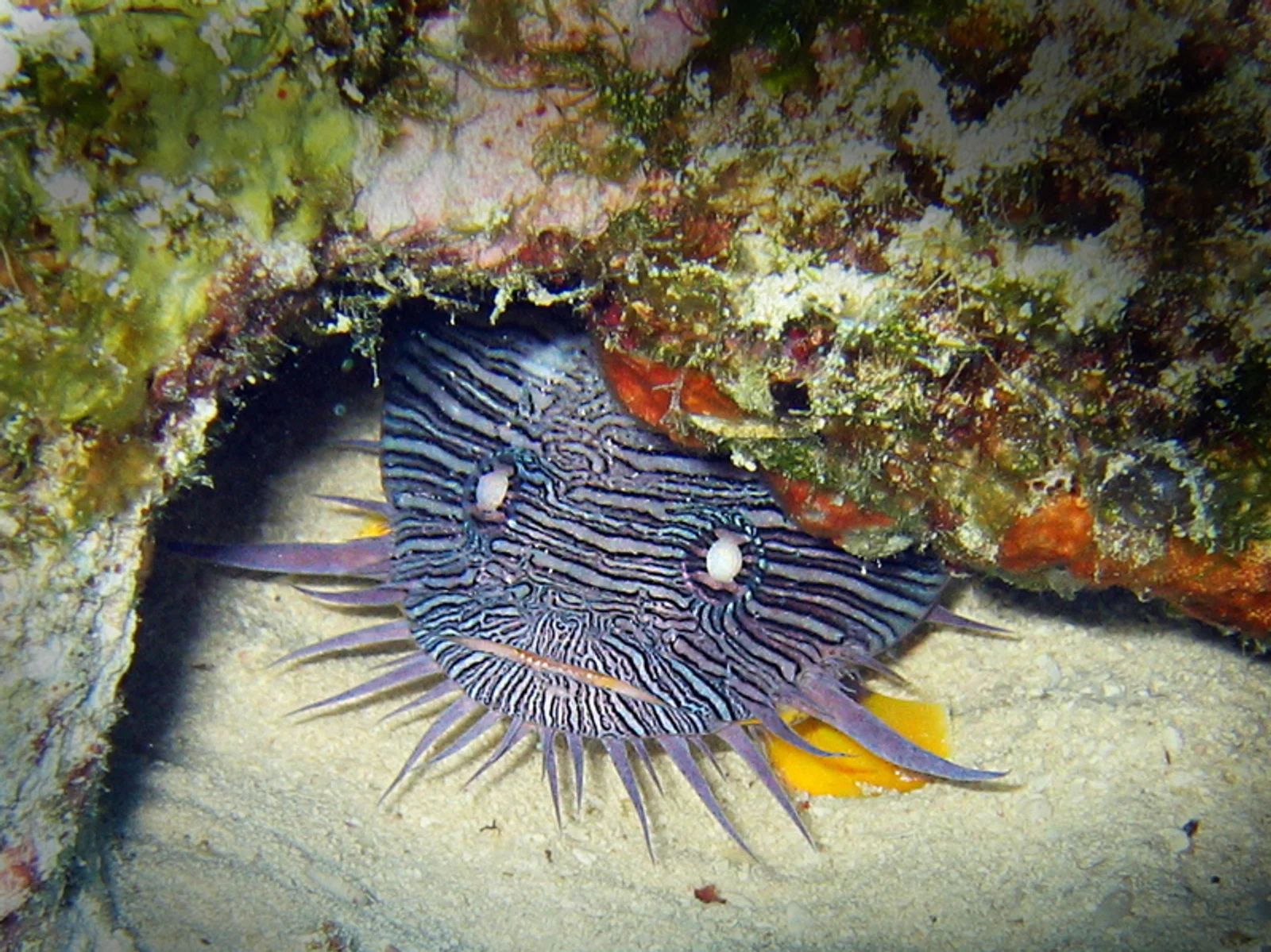
Sanopus splendidus
About Splendid Toadfish.
The Splendid Toadfish (Sanopus splendidus) is a captivating and highly sought-after species among divers, renowned for its vibrant coloration and elusive nature. Often considered a "bucket-list" spotting for macro photographers, this unique fish is primarily known from the reefs of Cozumel, Mexico. While historically believed to be entirely endemic to Cozumel, sightings have also been reported in Glover's Reef, Belize, and other parts of the Yucatán Peninsula, extending north of Cozumel up to Cancun.
This fascinating bottom-dweller belongs to the family Batrachoididae and is classified as Endangered by the IUCN Red List. Its conservation status is largely due to its restricted distribution and threats from habitat degradation, pollution, and the impact of increasing tourism in its limited range. The Splendid Toadfish is typically reclusive, preferring to hide in rocky caves and crevices during the day, emerging at night to hunt for small fish, crustaceans, snails, and polychaete worms. Divers may occasionally hear its characteristic humming or croaking sound, used for mating and territorial communication.
This species has been observed at several popular dive sites in Cozumel, including:
- Devil's Throat (Punta Sur) (common)
- Chankanaab Reef (rare)
- Paradise Reef (common)
- Tormentos Reef (occasional)
- Palancar Reef (occasional)
Identification
The Splendid Toadfish is a relatively small fish, reaching a maximum size of 25 cm (10 in). Its most striking feature is its dazzling and intricate pattern, which sets it apart from other toadfish species.
- Body and Head: It possesses a broad, flattened head and body, well-suited for tucking into crevices and under coral ledges. The eyes are comparatively small and positioned high on the head, looking directly upwards, a common adaptation for bottom-dwelling species. Small, fleshy, whisker-like barbels, some of which may be branched, dangle from its chin and lower jaw. Its wide jaws are equipped with small, sharp teeth.
- Coloration: The body exhibits a mesmerizing blend of hues, ranging from dark brown to magenta, purple, or blue-violet, often adorned with gray patches. Its face is distinctively marked with dark and white or yellow stripes, giving it a "zebra-striped" appearance.
- Fins: All eight of its fins, with the exception of the pelvic fins, are bordered with a brilliant, electric-yellow margin. The pelvic fins themselves are entirely yellow. It has two dorsal fins (one short with spines, one long and flowing), two rounded pectoral fins, two smaller pointed pelvic fins, a caudal fin, and an anal fin. The long dorsal fins aid in balance, while the rounded pectoral fins assist in navigation. The mouth is also often yellow.
Where it lives.
The Splendid Toadfish (Sanopus splendidus) is a captivating and highly sought-after species for divers, primarily known for its vibrant coloration and reclusive nature. This fascinating fish is largely endemic to the waters surrounding Cozumel Island, Mexico, though occasional sightings have been reported in other parts of the Western Caribbean, including mainland coastal reefs near Playa del Carmen, the Banco Chinchorro atoll, Isla Mujeres, and Belize (particularly at Glover's Reef).
Its preferred habitat consists of the intricate coral reef ecosystems of Cozumel, which are part of the Mesoamerican Barrier Reef System, the second-largest barrier reef in the world. Within these reefs, the Splendid Toadfish is a benthic species, typically found at depths ranging from 5 to 30 m, though it is most commonly observed between 10 and 25 m.
Divers can often spot this elusive creature tucked away in sheltered areas. Its strong preference is for crevices, cracks at the base of coral heads, under ledges and overhangs, and small rocky caves. It is often seen partially hidden, with only its distinctive head protruding from its chosen den. These dens usually extend deep into the coral structures, providing a safe retreat from threats. The Splendid Toadfish is primarily nocturnal, emerging at night to hunt for small fish, crustaceans (such as shrimp and crabs), snails, and worms, playing a role as a benthic predator in the reef's trophic dynamics.
Popular dive sites in Cozumel where the Splendid Toadfish has been observed include:
- Devil's Throat (Punta Sur)
- Chankanaab Reef
- Paradise Reef
- Tormentos Reef
- Palancar Reef
- Punta Tunich
- Paso Del Cedral
- Yucab Reef
- San Francisco Reef
The clear, calm waters and diverse coral formations of Cozumel provide an ideal environment for this species. The Splendid Toadfish's reliance on specific reef habitats and its limited geographic range contribute to its classification as Vulnerable by the IUCN Red List.
How it behaves.
The Splendid Toadfish (Sanopus splendidus) is a highly sought-after encounter for divers in its endemic range, primarily around Cozumel, Mexico. This vibrantly colored fish, reaching up to 25 cm (10 in) in length, exhibits fascinating behaviors that make it a unique subject for observation.
- Underwater Encounter Behavior: During daylight hours, the Splendid Toadfish is predominantly reclusive and nocturnal, typically found hidden within crevices, cracks, or under coral heads along the reef or sandy bottoms. Divers will often spot only its distinctive head, adorned with bright yellow fins and unique patterns, peering out from its chosen den. Approaching too quickly will often cause the toadfish to retreat further into its shelter, so patience and slow, deliberate movements are key to a successful observation. Its eyes are positioned on top of its flattened head, allowing it to look upwards and spot potential prey from its hiding spot. A remarkable characteristic is the male's ability to produce a low, guttural mating call, described as grunts, croaks, hums, or buzzes, which can often be heard by divers before the fish is seen. While generally shy, some dive masters may use lures to gently coax them forward, though they are usually reluctant to leave the safety of their dens. For those keen on seeing the Splendid Toadfish actively hunting, night dives offer the best opportunity, as they emerge from their shelters to forage. This species is not dangerous to humans.
- Feeding Habits: The Splendid Toadfish is a carnivorous benthic predator, employing an ambush strategy. It remains still and camouflaged until prey comes within striking distance, then executes a quick lunge to engulf its meal with its wide, powerful jaws lined with small, sharp teeth. Its diet primarily consists of small fish, mollusks (such as snails), crustaceans (like shrimp and crabs), and polychaete worms found on the reef floor. This predatory role is crucial for regulating populations of smaller invertebrates and contributing to the ecological balance of the reef ecosystem.
- Social Structure: The Splendid Toadfish is largely solitary and territorial, preferring to inhabit a specific den rather than roaming widely or forming schools. During reproduction, the male plays a significant role in parental care, guarding the eggs within the chosen shelter after mating.
- Notable Seasonal Patterns Relevant to Divers: While the precise breeding season is not extensively documented, the reproductive behavior of the Splendid Toadfish follows typical toadfish patterns. Males use their distinctive vocalizations to attract mates. Females lay adhesive eggs, which are then fertilized and attach to the walls of rock cavities or other debris within the den. The male diligently guards these eggs during their incubation period, which lasts approximately three weeks. A key aspect of their life cycle is the absence of a pelagic larval phase; larvae develop within the protection of the reef and disperse by crawling on the seabed, contributing to the species' limited dispersal and high site fidelity. For divers, the Splendid Toadfish can be observed year-round at dive sites like Devil's Throat (Punta Sur) and Paradise Reef. However, the period from May to September often offers the best visibility and calmest diving conditions in Cozumel, enhancing the chances of spotting this elusive creature.
Where to see it.
Evidence for philippines · No dive sites
General range is not evidence of occurrence at a specific dive site.
No documented dive-site associations in this destination yet.
Gallery.