Sponge (assorted)
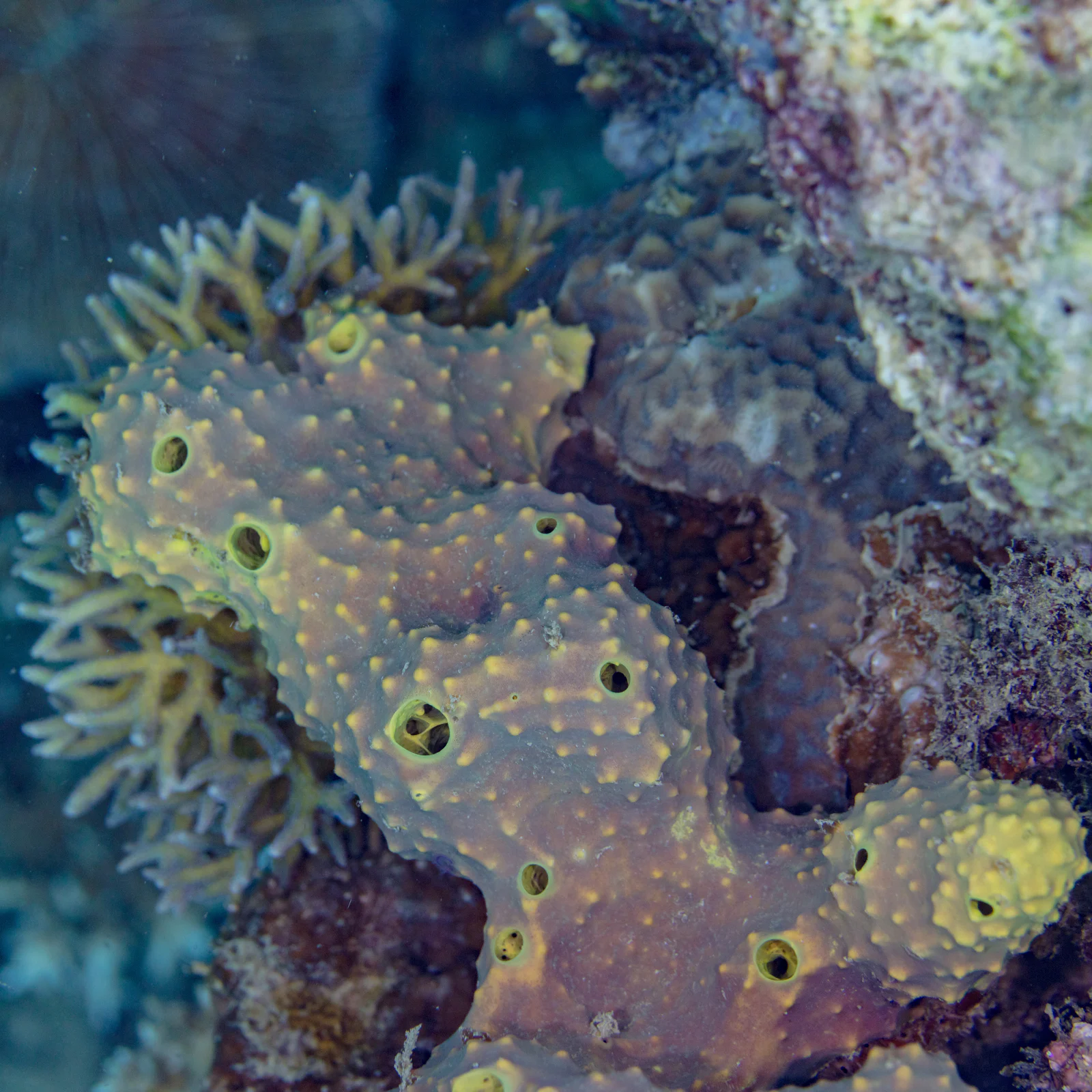
Image credit: Diego Delso, delso.photo · CC BY-SA 4.0 · Wikimedia Commons, cropped by this page
Porifera spp. (sponges)
About Sponge (assorted).
Sponges are filter-feeding animals of the phylum Porifera that live fixed to the seabed, often on rocks, from tidal zones to the deep sea. This group entry covers sightings where the species was not recorded. The World Register of Marine Species (WoRMS) lists Porifera (Grant, 1836) as an accepted phylum in the kingdom Animalia.
Wikipedia says a sponge's body is a jelly-like layer, the mesohyl, between two thin layers of cells, usually shaped into tubes full of pores and channels through which water circulates. It says sponges have no true tissues or organs and no complex nervous, digestive or circulatory systems, and that most rely on a constant flow of water, driven by the flagella of collar cells, to bring in food and oxygen and carry away waste. It says many have a skeleton of spicules of calcium carbonate or silica, of spongin fibres, or both, that over 90% of known species are demosponges, and that the glass sponges are restricted to polar regions or ocean depths. It puts the number of known species at about 5,000 to 10,000.
A conservation status is not given here, because this entry covers a whole phylum. Wikipedia says the few demosponges with entirely soft skeletons, long used as padding and cleaning tools, had been so heavily overfished by the 1950s that the industry almost collapsed.
Where it lives.
Wikipedia says sponges live worldwide, from the polar regions to the tropics, and that a great majority are marine, with freshwater species on every continent except Antarctica. It says most live in quiet, clear water, because sediment stirred up by waves or currents would block their pores, and that the greatest numbers are usually found on firm surfaces such as rocks, though some anchor in soft sediment with a root-like base. It says sponges are more abundant but less diverse in temperate waters than in tropical ones, and that demosponges and calcareous sponges are abundant and diverse in shallower non-polar waters.
Where Divers Find Them
In Lombok, a Starfish dive account says The Cathedral, a pinnacle that rises from about 40 m to the surface, is a steep wall covered with soft corals, sponges and tunicates. The Wahana Wisata Jatim blog says big gorgonians and sponges are found on the north side of Shark Point, a plateau from 10 m down to 30 or 40 m. Neither source says which species, how often they are seen or in which months.
How it behaves.
Wikipedia says adult sponges are sessile, attached to an underwater surface, while their larvae swim; some species can creep across the seabed at 1 to 4 mm a day, a few can contract their whole bodies, and many can close their openings. It says most feed on planktonic bacteria and other microscopic particles in the water, that some also host photosynthetic cyanobacteria or algae, and that a few species in food-poor waters are carnivores that snag small crustaceans with hook-like spicules. It says sponges can regrow from broken fragments that include the right types of cells, that turtles and some fish feed mainly on sponges, and that shrimps of the genus Synalpheus live in colonies inside sponges.
Underwater Encounter Behavior
Wikipedia says a few species, including the Caribbean fire sponge Tedania ignis, cause a severe rash in people who handle them. The sources cited here do not describe how sponges react to divers.
Where to see it.
Evidence from all destinations · 14 dive sites
General range is not evidence of occurrence at a specific dive site.
Angel's Window
Lembeh Strait
Documented site occurrence
Season not yet documented
Source reviewed on 2026-11-20 · Source: Dive The World · Observation date not documented
Aw Shucks
Lembeh Strait
Documented site occurrence
Season not yet documented
Source reviewed on 2026-11-20 · Source: Matuari Sarawet (blog) · Observation date not documented
Bianca
Lembeh Strait
Documented site occurrence
Season not yet documented
Source reviewed on 2026-11-20 · Sources: Infinite Blue Dive Travel, Lembeh Resort · Observation date not documented
Bimoli Wreck
Lembeh Strait
Documented site occurrence
Season not yet documented
Source reviewed on 2026-11-20 · Source: Matuari Sarawet (blog) · Observation date not documented
Friwen Wall
Dampier Strait
Documented site occurrence
Season not yet documented
Source reviewed on 2026-11-21 · Sources: La Galigo Liveaboard, Raja Ampat Biodiversity Nature Resort · Observation date not documented
Kaledupa Double Spur
Wakatobi
Documented site occurrence
Season not yet documented
Source reviewed on 2026-11-26 · Source: Wakatobi Guide Book (FTKP Wakatobi and Swisscontact WISATA) · Observation date not documented
North Wall (Hoga)
Wakatobi
Documented site occurrence
Season not yet documented
Source reviewed on 2026-11-25 · Sources: Divernet, Wakatobi Guide Book (FTKP Wakatobi and Swisscontact WISATA) · Observation date not documented
Nudi Retreat
Lembeh Strait
Documented site occurrence
Season not yet documented
Source reviewed on 2026-11-20 · Source: Infinite Blue Dive Travel · Observation date not documented
Outer Pinnacle (Hoga)
Wakatobi
Documented site occurrence
Season not yet documented
Source reviewed on 2026-11-25 · Source: Tours Wakatobi Dive dan Wisata · Observation date not documented
Pak Kasim's
Wakatobi
Documented site occurrence
Season not yet documented
Source reviewed on 2026-11-26 · Sources: Divernet, Wakatobi Guide Book (FTKP Wakatobi and Swisscontact WISATA) · Observation date not documented
Shark Point (Senggigi)
Lombok
Documented site occurrence
Season not yet documented
Source reviewed on 2026-11-19 · Source: Wahana Wisata Jatim (blog) · Observation date not documented
The Cathedral
Lombok
Documented site occurrence
Season not yet documented
Source reviewed on 2026-11-19 · Source: Starfish · Observation date not documented
Waha Wall
Wakatobi
Documented site occurrence
Season not yet documented
Source reviewed on 2026-11-26 · Source: Tours Wakatobi Dive dan Wisata · Observation date not documented
Wandoka Pinnacle
Wakatobi
Documented site occurrence
Season not yet documented
Source reviewed on 2026-11-26 · Source: Tours Wakatobi Dive dan Wisata · Observation date not documented
Gallery.

A sea sponge, named on its file page as Pseudoceratina verrucosa, on a reef at Anilao, Philippines; the file page gives the photograph as taken on 22 August 2023. It stands for the sponges as a group, and this photograph is not from Lombok. This page's frame crops the photograph.
Image credit: Diego Delso, delso.photo · CC BY-SA 4.0 · Wikimedia Commons, cropped by this page