Spotted Eagle Ray
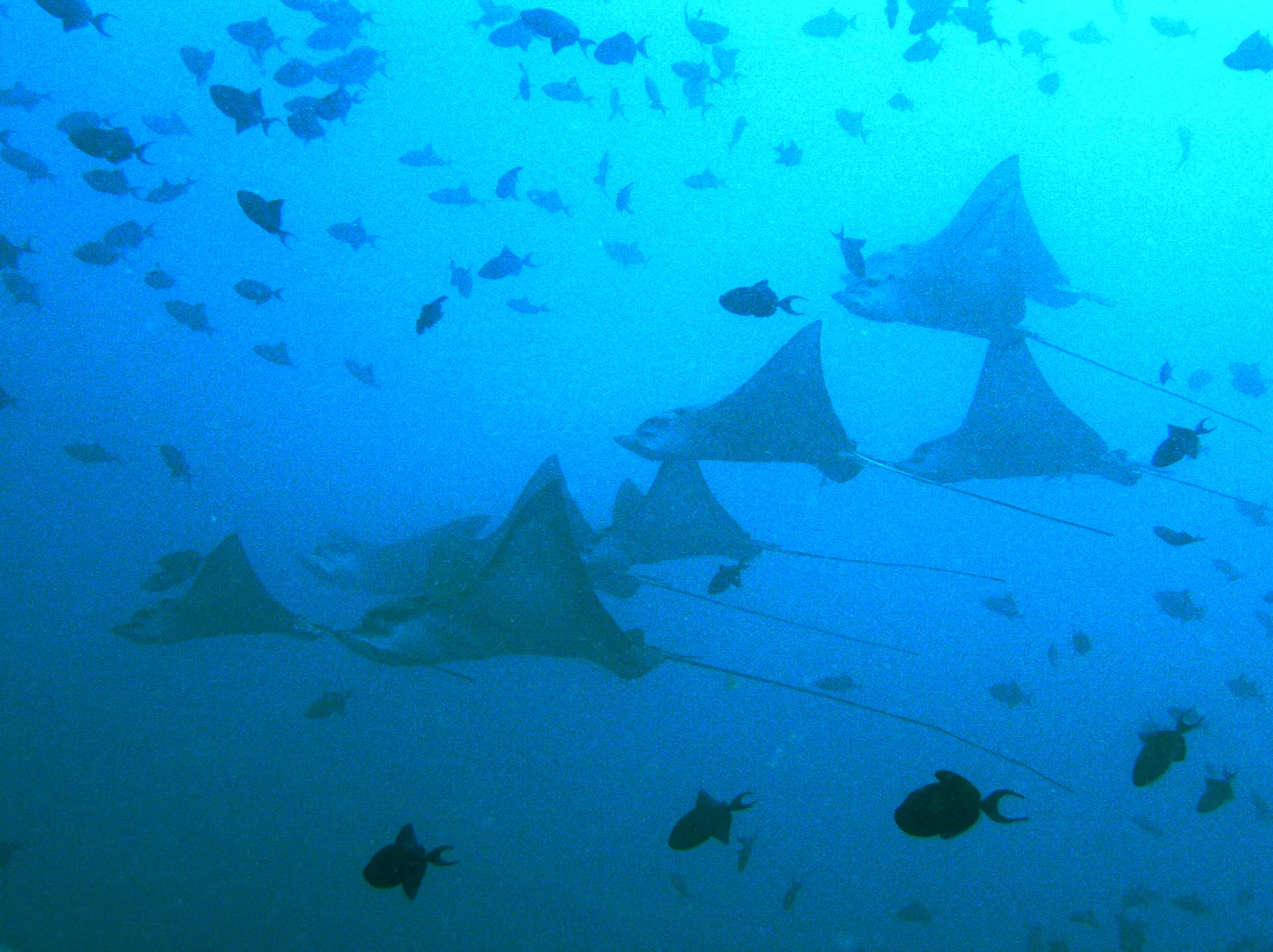
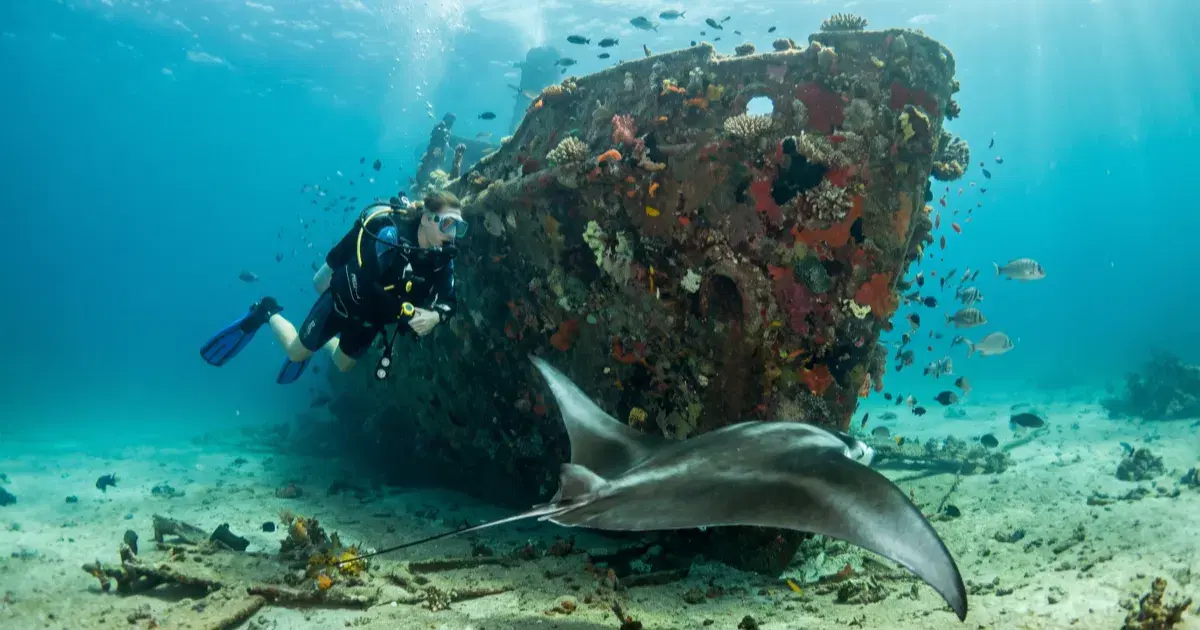
Image credit: Matthias Kleine · CC BY-SA 3.0 · Wikimedia Commons, cropped by this page
Aetobatus narinari
About Spotted Eagle Ray.
The spotted eagle ray (Aetobatus narinari) is an Endangered eagle ray with white spots on a dark disc, a duck-bill snout and a long whip-like tail.
The World Register of Marine Species (WoRMS) lists Aetobatus narinari (Euphrasen, 1790) as an accepted species in the eagle ray family Aetobatidae, and lists Aetobatus ocellatus (Kuhl, 1823) as a separate accepted species. FishBase gives the range of A. narinari as the western Atlantic and probably the eastern Atlantic, and says that Indo-Pacific records refer to A. ocellatus and eastern Pacific ones to A. laticeps. Wikipedia says the species was traditionally treated as found in tropical seas worldwide, and that recent authorities restrict it to the Atlantic on genetic and morphological evidence. This page uses the name in its traditional, wider sense. On FishBase's and Wikipedia's reading, the white-spotted eagle rays of the Indo-Pacific sites linked here are ocellated eagle rays, A. ocellatus.
Identification
FishBase describes a long snout, flat and rounded like a duck's bill, a thick head, a pectoral disc with sharply curved, angular corners and no tail fin, with numerous white spots on a black or bluish disc and a white underside. The long whip-like tail carries a long spine near its base, behind a small dorsal fin. Wikipedia says it may have two to six venomous spines behind the pelvic fins. It also says that, compared with A. narinari, A. ocellatus has a longer tail and a longer spine, and a darker back, greenish or greyish to almost black where A. narinari is paler, yellowish to brownish.
The size is disputed. Wikipedia gives a length of up to 5 m, a wingspan of up to 3 m and a mass of 230 kg. FishBase gives A. narinari a maximum disc width of 230 cm, commonly 140 cm, and a published weight of up to 230 kg. For A. ocellatus FishBase gives a maximum disc width of 300 cm, commonly 180 cm, and a published weight of up to 200 kg, and says it can grow to more than 3 m across and 880 cm in total length when the tail is undamaged.
Conservation
FishBase shows both species as Endangered on the IUCN Red List: A. narinari assessed on 28 July 2020 and A. ocellatus on 6 July 2023. In Wikipedia's article on the spotted eagle ray, the infobox gives Endangered globally and Near Threatened in central and northern South America, while the Conservation section gives Near Threatened. Wikipedia says there are no target fisheries for it but that it is often eaten after being caught as bycatch, that its fishing, landing, purchase and trade are outlawed in Florida, and that it is protected in the Great Barrier Reef. FishBase says A. ocellatus is a common catch of tangle nets, bottom trawls and inshore gillnets, used for its meat and cartilage.
Where it lives.
These eagle rays live in warm coastal waters by reefs and in bays, and also swim in open water near the surface.
Range
FishBase gives A. narinari the western Atlantic and probably the eastern Atlantic, and A. ocellatus the Indo-West Pacific, from East Africa and the Red Sea to the Hawaiian Islands and French Polynesia. Wikipedia says that, as traditionally defined, the species is found in tropical seas of the Atlantic, Indian and Pacific Oceans, most commonly in bays and on reefs, and that it spends much of its time swimming in open water, generally in schools close to the surface, and can travel long distances in a day.
Depth and water
The depth range differs between the sources. FishBase gives 1 to 80 m for A. narinari, and 1 to 100 m, usually 20 to 25 m, for A. ocellatus; Wikipedia gives shallow coastal water down to 80 m. FishBase lists both as marine and brackish, and says A. ocellatus is found in coastal waters including estuaries. Wikipedia says the spotted eagle ray prefers water of 24 to 27 °C.
How often divers see these rays at a particular site is not documented in these sources.
How it behaves.
These rays swim actively in open water, often near the surface, and dig in the sand with their snouts for shelled prey.
Swimming and groups
Wikipedia says spotted eagle rays are social and often occur in groups: loose aggregations of 3 to 16 rays, or schools of six or more swimming in the same direction at the same speed, although in shallow water they are most often seen alone. It says one tracking study found them more active at high tide, and that they leap out of the water, either straight up or at an angle of about 45 degrees, sometimes several times in a row.
Feeding
Wikipedia says they feed mainly on bivalves, crabs, whelks and other animals living in the sea floor, and also on other molluscs and crustaceans, echinoderms, worms, hermit crabs, shrimps, octopuses and some small fish. It describes the ray digging with its snout so that a cloud of sand surrounds it and spews from its gills, and chevron-shaped teeth that crush hard shells. FishBase says A. ocellatus feeds mainly on hard-shelled bottom-dwelling invertebrates such as hermit crabs, whelks, oysters and clams, and also on crustaceans, worms, octopuses and fishes.
Reproduction
FishBase describes both species as ovoviviparous, which Wikipedia explains as eggs that hatch inside the female before the young are born live. FishBase gives A. narinari up to four young, 17 to 35 cm across at birth, and A. ocellatus litters of up to ten, usually four or fewer, 18 cm to at least 50 cm across at birth. Wikipedia gives a gestation of one year and maturity at four to six years.
Around divers
Wikipedia says spotted eagle rays are shy, generally avoid people and are not a significant threat to humans, though rays have leapt from the water onto boats and landed on people. FishBase classes both species as able to wound people, and Wikipedia says the tail spines are venomous. Wikipedia names tiger, lemon, bull, silvertip and great hammerhead sharks among their predators.
Where to see it.
Evidence for great barrier reef · 3 dive sites
General range is not evidence of occurrence at a specific dive site.
Admiralty Anchor
Coral Sea
Site occurrence not yet documented
Season not yet documented
No dated observations available.
Lighthouse Bommie
Ribbon Reefs
Site occurrence not yet documented
Season not yet documented
No dated observations available.
SS Yongala
Townsville
Site occurrence not yet documented
Season not yet documented
No dated observations available.
Gallery.
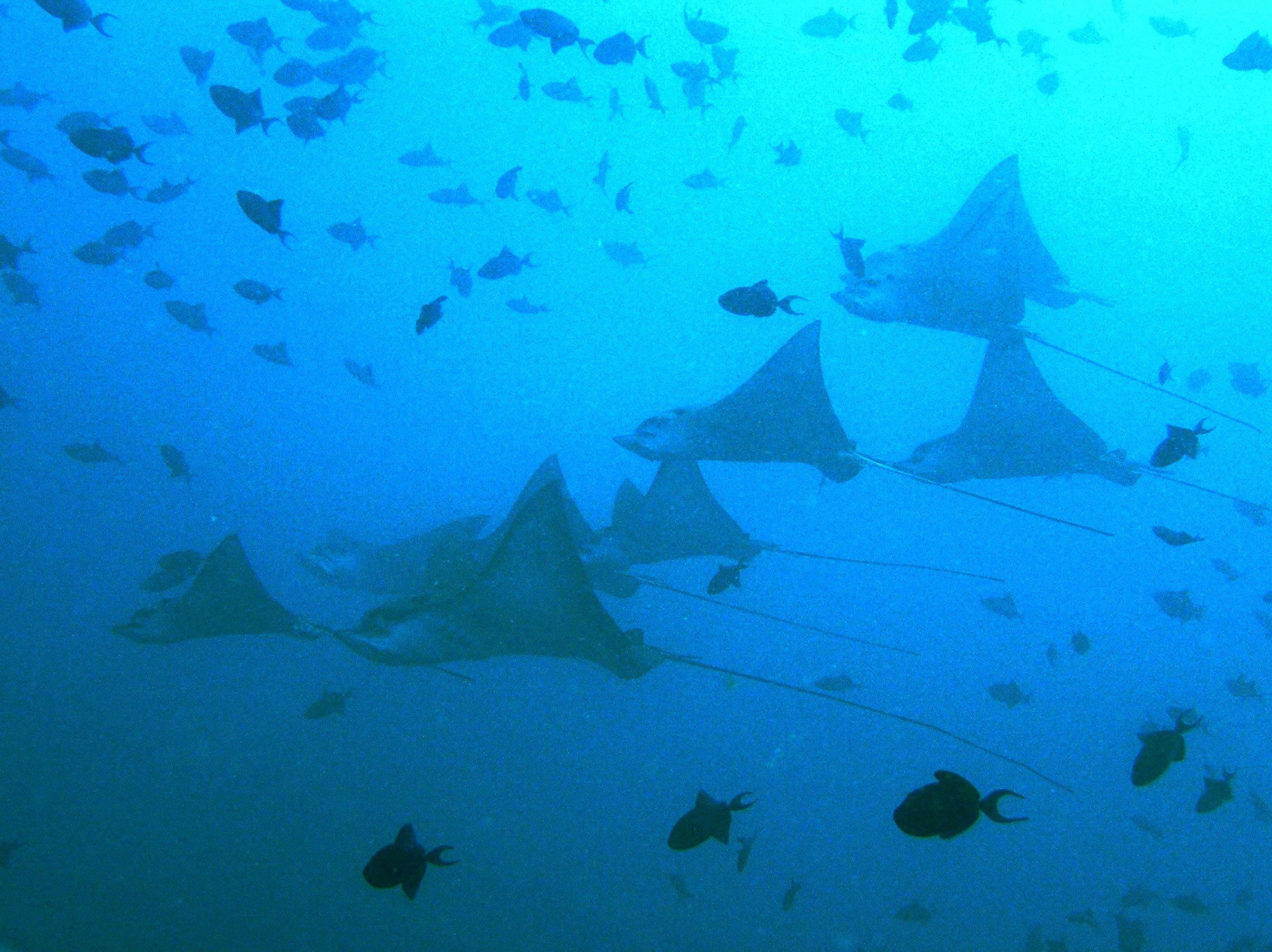
A group of eagle rays swimming in open blue water among many small dark fish at Veligandu, Maldives, photographed in December 2004; the photographer identifies them as Aetobatus narinari. The photograph names no dive site, so it is not tied to any Diveity dive site. This page's frame crops the photograph.
Image credit: Matthias Kleine · CC BY-SA 3.0 · Wikimedia Commons, cropped by this page
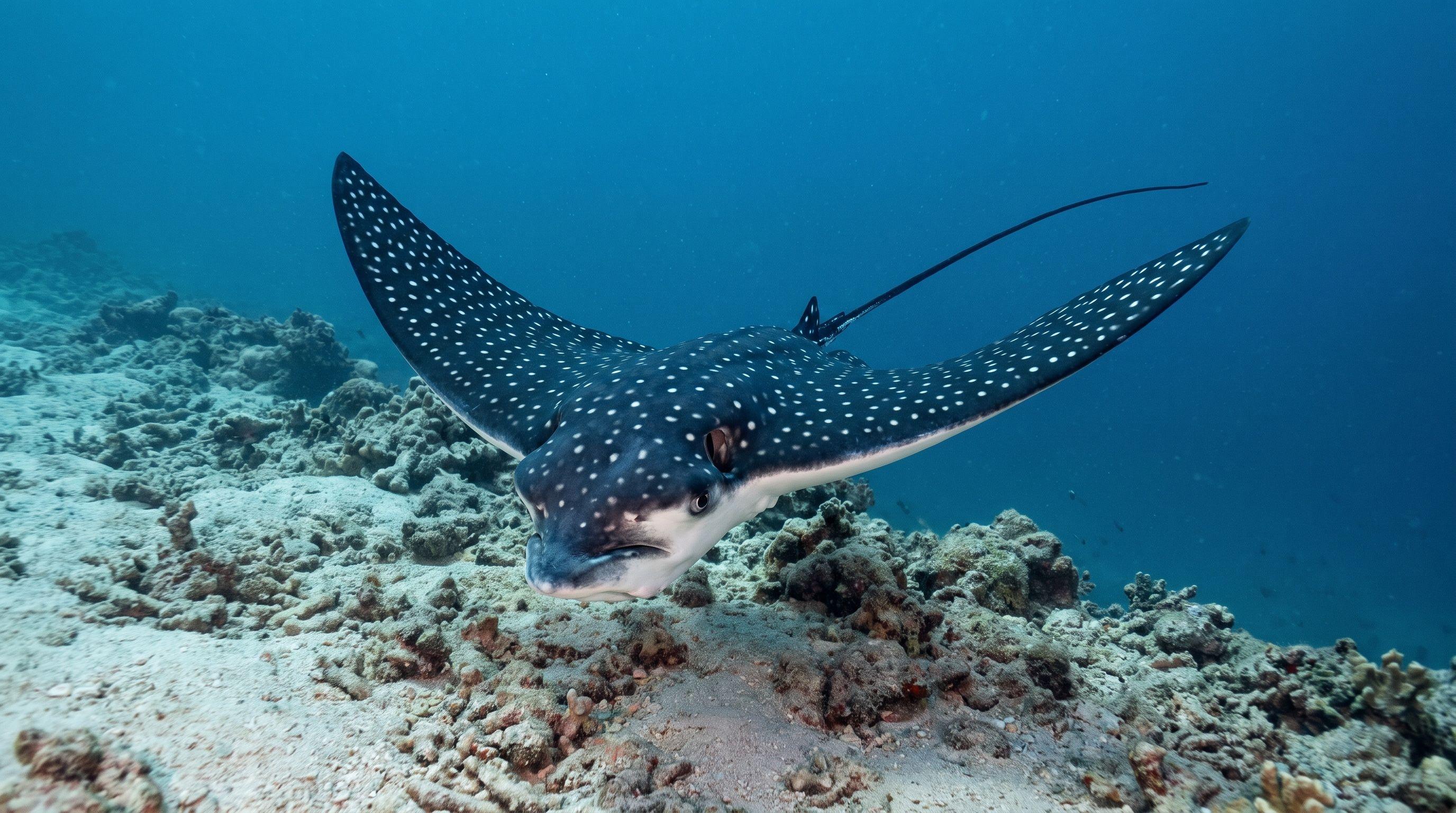 AI-generated
 illustration
Image credit: AI-generated illustration · Diveity
Related dive articles.
Best Wreck Dives in the World: 10 Wrecks Ranked
The SS Thistlegorm, SS Yongala and President Coolidge top the world's best wreck dives. Depths, certification levels and seasons for all 10.
Diving the SS Yongala: Australia's Best Wreck Dive
SS Yongala dive guide: depth, marine life, certification requirements, and how to reach this Townsville wreck dive.