Spotted Snake Eel
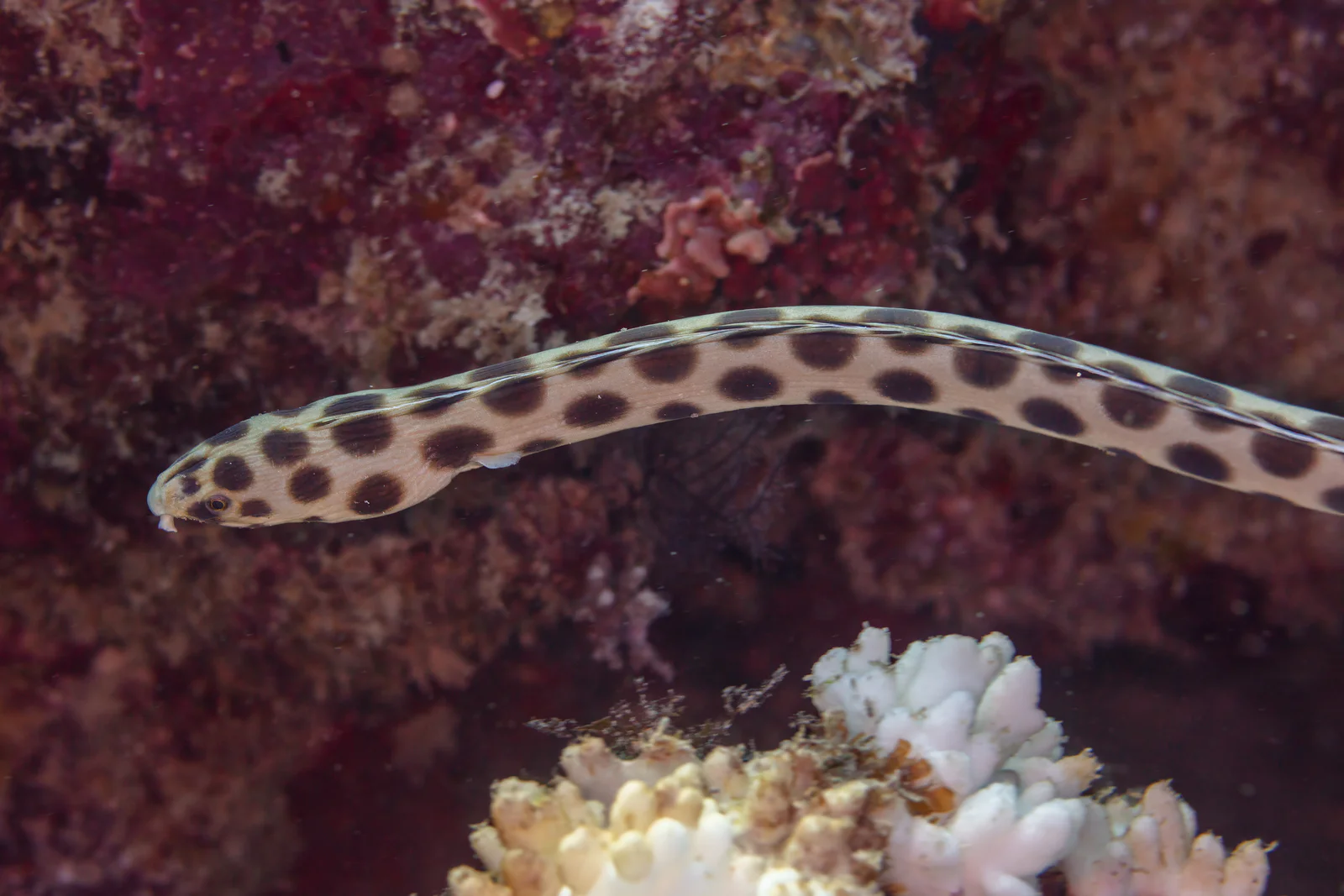
Image credit: Diego Delso · CC BY-SA 4.0 · Wikimedia Commons, cropped by this page
Myrichthys maculosus
About Spotted Snake Eel.
The spotted or tiger snake eel (Myrichthys maculosus) is a cream, dark-spotted eel of Indo-Pacific sandy reef flats, up to 1 m long, down to about 260 m.
Names and classification
WoRMS accepts Myrichthys maculosus (Cuvier, 1816) in the snake-eel family Ophichthidae, order Anguilliformes, and FishBase places it in the subfamily Ophichthinae. WoRMS gives Muraena maculosa Cuvier, 1816 as the original name and lists it among seven unaccepted names, one of them a misspelling; the others include Muraena tigrina Rüppell, 1830, Myrichthys aki Tanaka, 1917 and Ophichthys dromicus Günther, 1870. WoRMS and FishBase use tiger snake eel as the English name, and Wikipedia adds ocellate snake eel and spotted snake eel. FishBase derives Myrichthys from the Greek myros, the male of the moray eel, and ichthys, fish.
Identification
Wikipedia describes an elongated, snake-like fish with a small head, a short snout and long tubular nostrils that point downwards, and with two rows of teeth on each jaw and two more on the palate. Its dorsal fin begins just behind the head and its anal fin midway along the body, and both run to near the tip of the tail; it has no pelvic or caudal fins, and its pectoral fins are small. FishBase calls the body eel-like and circular in cross-section and counts 185 to 189 vertebrae.
In FishBase's account the fish is pale cream with a variable pattern of large and small black spots separated by narrower white spaces, and the young have black saddles. Wikipedia gives a cream or yellow fish with large brown or black spots, circular or oval, in a single longitudinal row on young fish and in three rows on large ones. On the young, then, they disagree: black saddles for FishBase, a single row of spots for Wikipedia.
Size
FishBase puts the maximum length at 100 cm total length and the common length at 50 cm total length. Wikipedia's figures, up to 1 m and more commonly 50 cm, are the same.
Conservation and people
Two dates attach to its Least Concern listing on the IUCN Red List: 4 November 2019, the assessment date in FishBase under list version 2025-2, and 2022, the year of the assessment by McCosker, Smith and Tighe that Wikipedia cites. To FishBase the species is harmless to people, with commercial fisheries and a commercial aquarium trade, and Wikipedia mentions that it is occasionally encountered in the aquarium trade.
Where it lives.
The spotted snake eel lives in sandy reef flats, lagoons, seagrass beds and seaward reefs of the tropical and warm temperate Indo-Pacific.
Range
FishBase gives the Indo-Pacific from the Red Sea and East Africa to the central Pacific, between 30° N and 33° S, without Hawaii and the Leeward Islands, where Myrichthys magnificus replaces it. Wikipedia carries the range east to French Polynesia and the Galápagos Islands and north and south from Japan to eastern Australia, and it also says that the magnificent snake eel, Myrichthys magnificus, takes its place in Hawaii. So the two sources end the range in different places: the central Pacific for FishBase, the Galápagos Islands for Wikipedia.
Depth and bottom
According to FishBase it is marine and reef-associated, at depths of 0 to 262 m, in sandy areas of reef flats, lagoons and seaward reefs, where it lives buried in the sand. Wikipedia lists lagoons, reef flats, seagrass beds and sandy plains, down to about 260 m.
How it behaves.
The spotted snake eel is active mainly at night and spends the day buried in sand, though it is sometimes seen out in daylight.
Day and night
Wikipedia calls it mainly nocturnal and says it can sometimes be seen during the daytime swimming over sandy or vegetated areas; it generally spends the day buried in the sand, which it enters tail first. FishBase describes it as solitary and more common at night, and sometimes fully exposed when it searches for prey. Both say that at night it may gather in large numbers under artificial light. FishBase compares its behaviour with that of Myrichthys colubrinus and Leiuranus semicinctus.
Feeding
FishBase says it feeds on small fishes and crustaceans. Wikipedia says it uses a well-developed sense of smell to find prey buried in the sediment, and names crustaceans, banded snake eels and other small fish.
Breeding
Little is known about its reproduction, according to Wikipedia: the sexes are separate, and the larvae are leaf-shaped and called leptocephali.
Where to see it.
Evidence for visayas · 1 dive site
General range is not evidence of occurrence at a specific dive site.
Gallery.
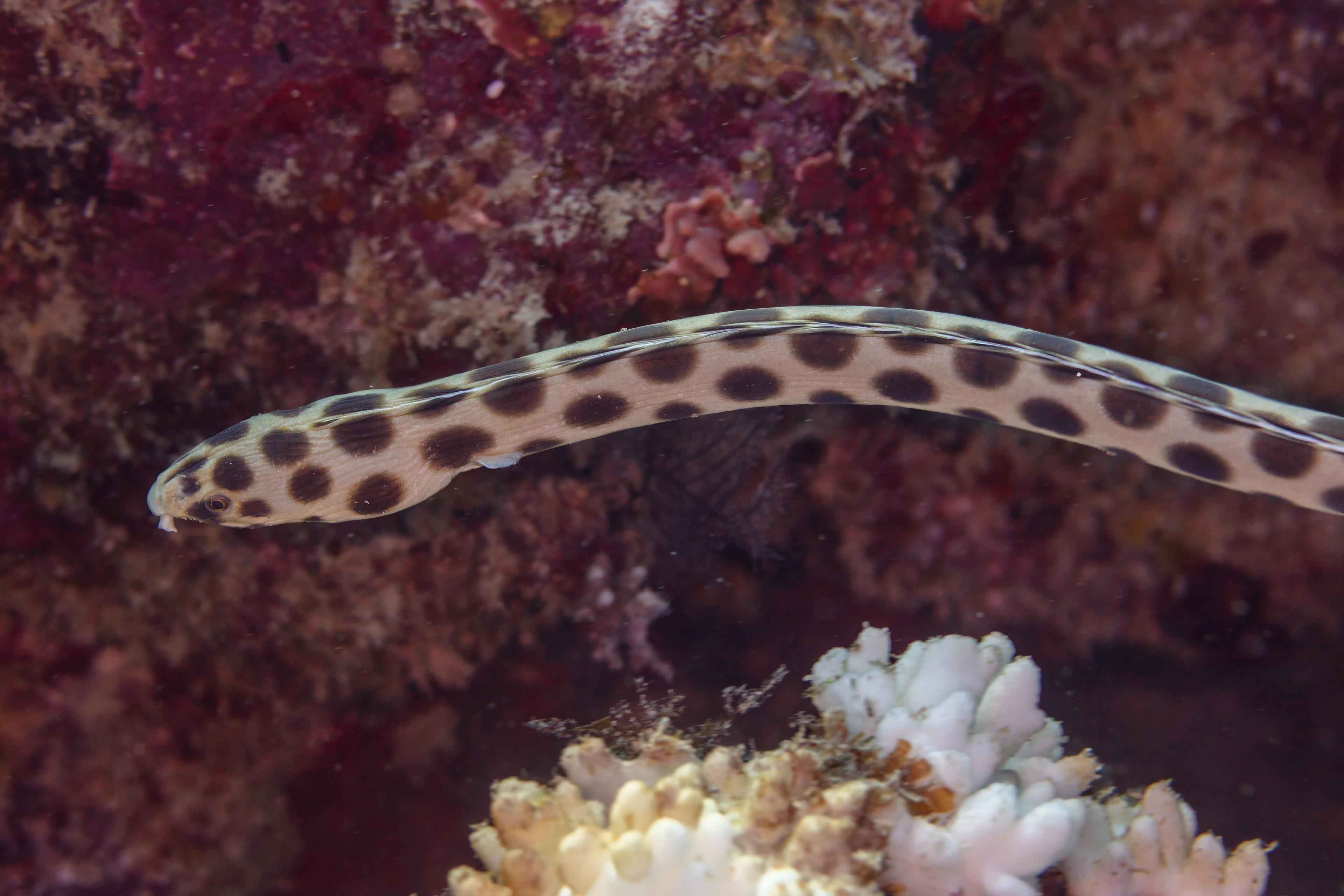
A spotted snake eel in front of a reef wall, its head to the left. The photographer, Diego Delso, gives the place as Zanzibar, Tanzania, and the date as 31 May 2024 on its Wikimedia Commons file page, which names it Myrichthys maculosus. It illustrates the species; it is not a sighting record for any dive site in this guide. This page's frame crops the photograph.
Image credit: Diego Delso · CC BY-SA 4.0 · Wikimedia Commons, cropped by this page
 AI-generated
 illustration
Image credit: AI-generated illustration · Diveity