Spotted Trunkfish
 AI-generated
Image credit: AI-generated illustration · License unspecified · Source unspecified
Lactophrys bicaudalis
About Spotted Trunkfish.
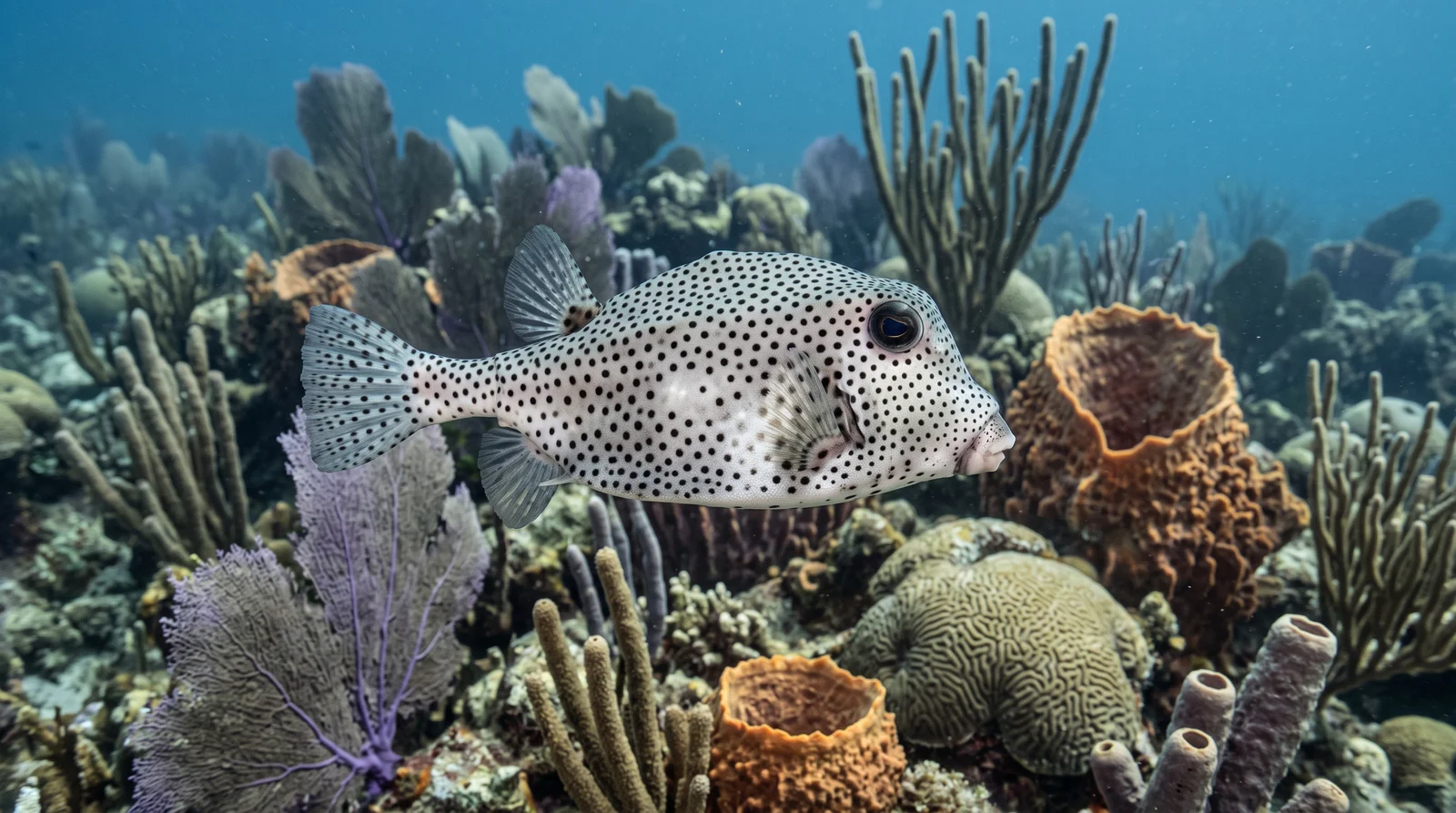
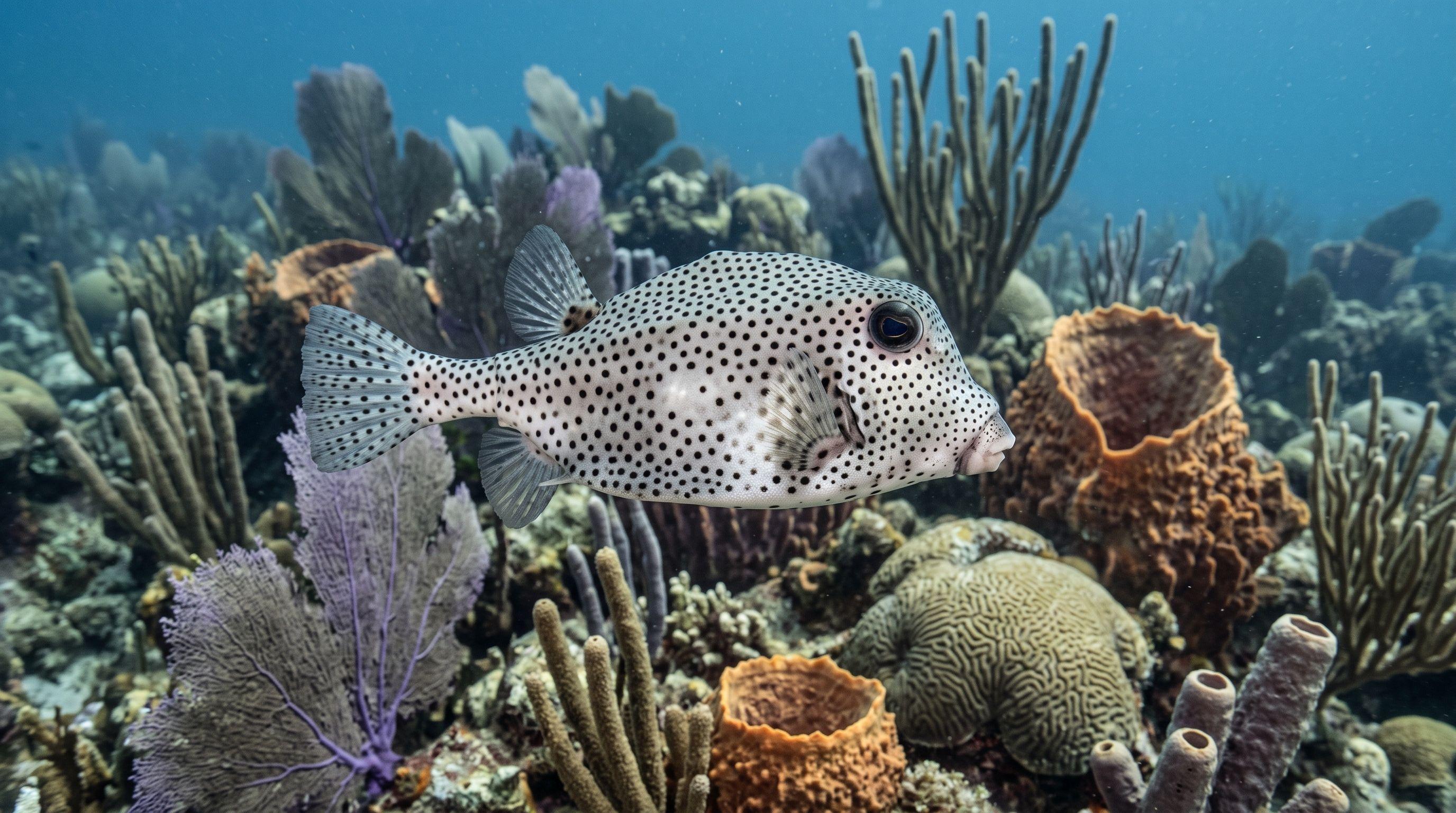
The Spotted Trunkfish, Lactophrys bicaudalis, is a fascinating marine species instantly recognizable by its unique, box-like appearance. Its body is encased in a rigid, bony carapace composed of thickened, joined, hexagonal scale plates, giving it a somewhat triangular or oblong shape with a humped back. This robust armor serves as a significant defense against predators. The base color of the trunkfish typically ranges from pale gray to whitish or yellowish, adorned with numerous dark brown to black spots covering its body and caudal fin. Distinctive white areas can be observed around its mouth and lips. Mature individuals often display two to three prominent white spots in a diagonal row just behind their eyes, which contrast with the overall spotted pattern. Juveniles exhibit an orange-white hue with a more limited scattering of black spots.
Only the eyes, snout, fins, and tail protrude from this rigid, protective shell. The fish possesses a pointed snout with fleshy, protuberant lips encircling a small mouth equipped with small conical teeth. Its gill slits are notably short, and its lateral line is inconspicuous. The anal fin features two sharp spines, while the caudal fin is fan-like and rounded. The dorsal fins are positioned far back on the body, and it lacks pelvic fins. Despite its imposing armor, the Spotted Trunkfish possesses a remarkable defense mechanism: when stressed or touched, it can secrete a colorless, toxic substance known as ostracitoxin from glands in its skin. While not immediately harmful to divers, this toxin is dangerous if ingested and has been known to be lethal to larger predators, including nurse sharks, making them an undesirable meal. The maximum recorded size for the Spotted Trunkfish is approximately 48 cm (19 inches), though mature individuals commonly average between 15 to 30 cm (6 to 12 inches) in length.
Where it lives.
The Spotted Trunkfish is widely distributed throughout the Western Atlantic Ocean, inhabiting the warm, clear waters of coral reef ecosystems. Its range extends across the Caribbean Sea, the southern half of the Gulf of Mexico, the Florida Keys, and the Bahamas, stretching southward to Brazil and including Ascension Island in the Eastern Atlantic. This species shows a strong preference for environments rich in coral reefs, rocky reefs, and seagrass beds. Divers can frequently spot them in areas with natural formations such as fissures, crevices, small holes, and under ledges, where they often hover. They thrive in tropical temperatures, typically between 22 and 26 degrees Celsius (72 and 79 degrees Fahrenheit). While generally found in relatively shallow depths, their habitat can extend from approximately 3 meters (10 feet) down to 50 meters (165 feet), with some observations noting a preference for depths between 4.5 and 18 meters (15 and 60 feet).
How it behaves.
The Spotted Trunkfish is characterized by its slow and deliberate swimming movements, a consequence of its rigid, bony carapace that limits agility. Instead of rapid burst swimming, it propels itself primarily by rippling its dorsal and anal fins and gently beating its pectoral fins. Should a burst of speed be required, it can additionally employ its caudal (tail) fin for propulsion. Generally, these fish are observed as solitary individuals, though they may occasionally be seen in small groups. They are known to be shy yet curious, and active during daylight hours.
As a benthic species, the Spotted Trunkfish primarily forages on or near the seabed. Its feeding strategy involves generating a jet stream of water from its mouth to blow away sand and expose buried invertebrates. Their diet is omnivorous and diverse, consisting of a variety of small bottom-dwelling organisms. This includes acorn worms, mollusks, peanut worms, polychaete worms, crustaceans (such as crabs and shrimps), sea urchins, starfish, brittle stars, sea cucumbers, sessile tunicates, seagrasses, and algae. While typically tolerant of divers and appearing friendly, their defense mechanism of secreting a skin toxin when stressed means direct contact should be avoided. The average lifespan for a Spotted Trunkfish is estimated to be between 6 and 12 years.
Where to see it.
Evidence for philippines · No dive sites
General range is not evidence of occurrence at a specific dive site.
No documented dive-site associations in this destination yet.
Gallery.
 AI-generated
AI-generated illustration
Image credit: AI-generated illustration · License unspecified · Source unspecified