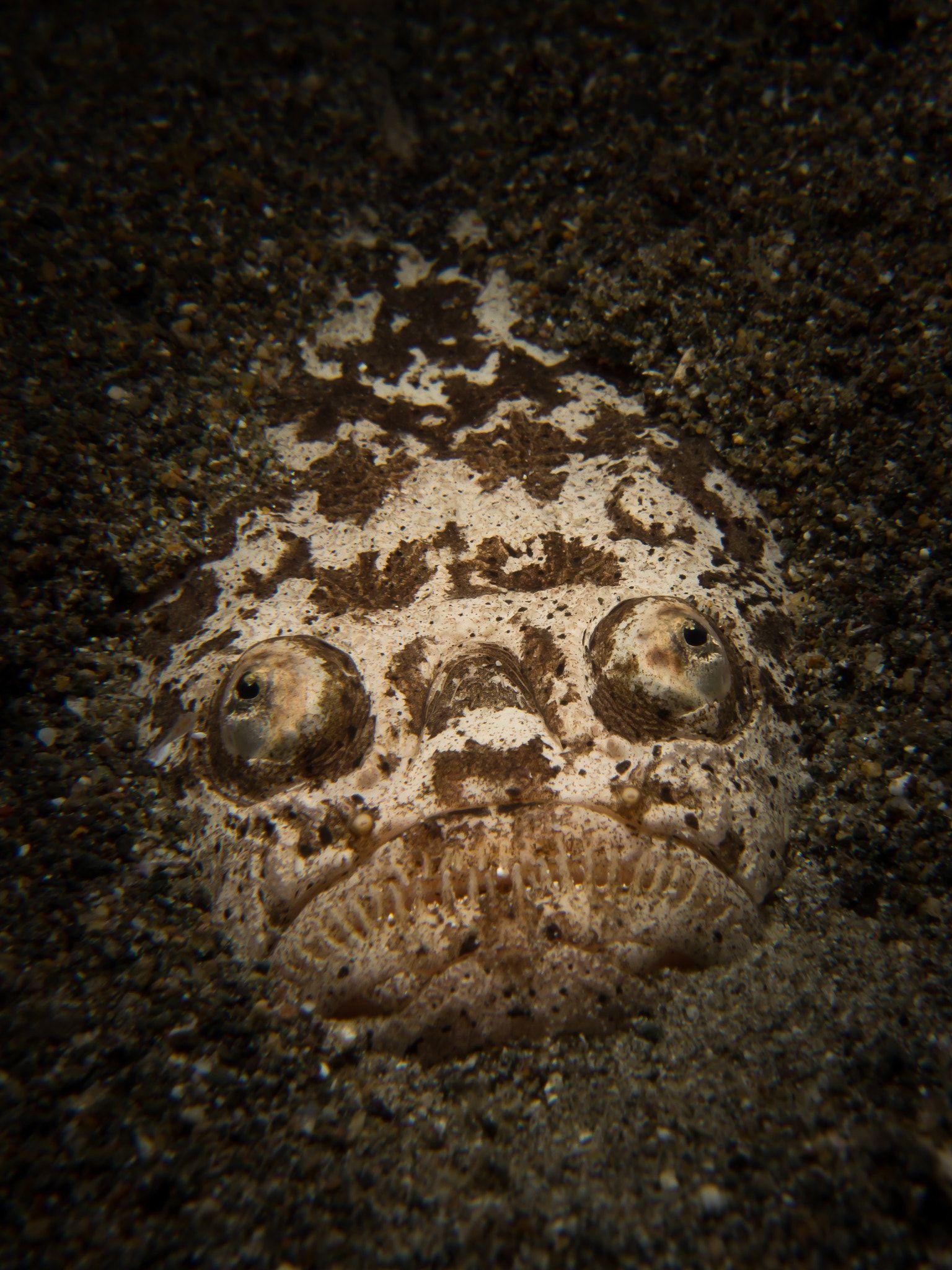
Stargazer
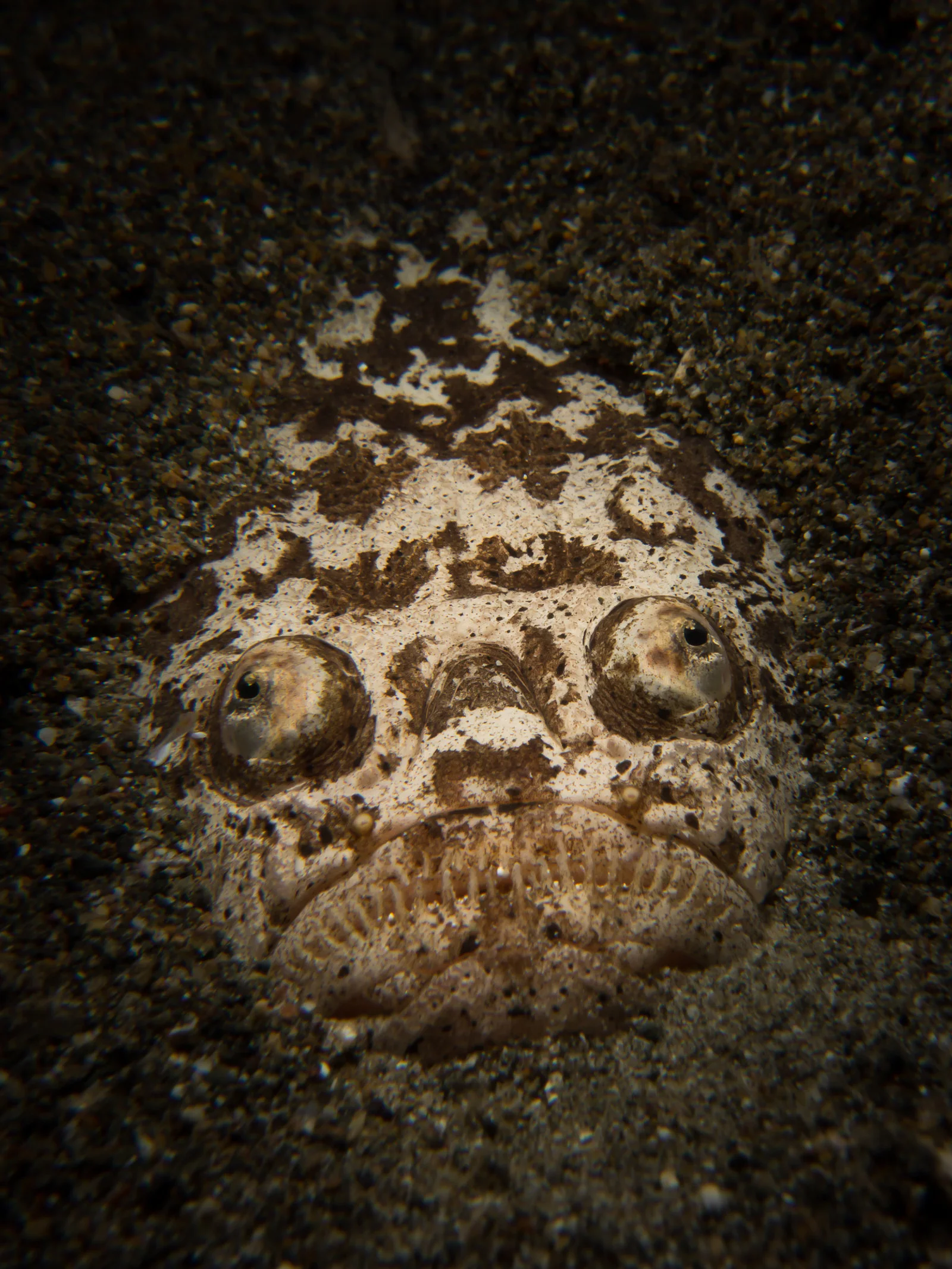
Uranoscopus sp.
About Stargazer.
The Stargazer, belonging to the family Uranoscopidae, is a fascinating and highly specialized marine fish renowned for its unique ambush predation strategy. Its common name, and indeed its scientific genus name Uranoscopus (derived from Greek words meaning "sky" and "to look"), perfectly describe its most distinctive feature: eyes positioned on top of its head, constantly gazing upwards. These benthic fish are masters of camouflage, spending most of their lives buried in sandy or muddy substrates, patiently awaiting unsuspecting prey.
Found worldwide in tropical and temperate shallow to deep saltwaters, Stargazers are carnivorous predators, primarily feeding on small fish, crabs, and other crustaceans. Their hunting technique involves a rapid, vacuum-like strike, engulfing prey whole in less than 30 milliseconds. While generally docile unless provoked, divers should exercise caution as many Stargazer species possess venomous spines and some are capable of delivering electric shocks as a defensive mechanism. The Stargazer is currently listed as a species of Least Concern, indicating a stable global population.
Identification
- Size: Stargazers can reach a maximum size of 35 cm (14 in), though some species within the family can grow larger.
- Body and Head: They possess a bulky, robust body that is dorsoventrally flattened, particularly the head, giving them a somewhat squarish or cuboidal appearance. Their skin is often scaleless or covered with small, embedded scales, and is typically thick and mucus-coated.
- Eyes and Mouth: The most striking feature is their large head with prominent, upward-facing eyes positioned directly on top. Their large, wide mouth is also oriented upwards, often equipped with fringed lips and inward-bent teeth, perfectly adapted for their ambush feeding strategy. Some species may even have a small, worm-like lure inside their mouth to attract prey.
- Fins: Stargazers have large pectoral fins that are highly adapted for rapid digging and burying themselves in the substrate. They typically have two dorsal fins, with the first often being small or barely visible, and a moderately long anal fin.
- Coloration: Their coloration provides excellent camouflage, usually ranging from grey to brown on the dorsal (upper) side, often with white speckles or dark bands, and a paler or yellowish-white ventral (underside). This allows them to blend seamlessly with sandy or muddy seafloors.
- Defensive Features: Divers should be aware that Stargazers possess two robust, venomous spines located behind their opercles (gill covers) and above their pectoral fins. Additionally, some species, including those in the genus Uranoscopus, are capable of generating electric shocks from specialized organs, primarily for defense.
This species has been occasionally observed at the Anilao Pier dive site and rarely at Talisay Pier, offering a unique sighting for observant divers.
Where it lives.
Stargazers (Uranoscopus sp.) are fascinating benthic fish renowned for their unique ambush predation strategy, which heavily influences their habitat preferences. These bottom-dwelling creatures are primarily found in soft-bottom environments, expertly camouflaging themselves within sandy, silty, and muddy substrates.
Their preferred habitats include:
- Substrate: Primarily sandy and silty muck bottoms, but also extending to sand flats, coastal bottoms, and muddy sediments. Some species, like the Whitemargin Stargazer (Uranoscopus sulphureus), are also associated with reef flats and sandy lagoons in tropical marine environments. They are masters of concealment, burying themselves almost entirely in the substrate, with only their upward-facing eyes and mouth exposed to scan for prey.
- Depth Range: Stargazers inhabit a broad range of depths, from shallow coastal waters to the continental shelf and upper slopes. While some species can be found in depths as shallow as 5 m, others extend much deeper. For instance, the Atlantic Stargazer (Uranoscopus scaber) is typically found at depths of 15–400 m. The Whitemargin Stargazer (Uranoscopus sulphureus) has a recorded depth range of 5–350 m, though it is most commonly observed in shallower, reef-associated zones.
- Ecosystems: These fish are integral components of various marine ecosystems, particularly those characterized by extensive soft-bottom areas. They thrive in warm, subtropical, and tropical waters. For example, the Whitemargin Stargazer prefers waters typically ranging from 26.9–28.1°C. They are solitary and often nocturnal, spending daylight hours buried and becoming more active at night.
Stargazers are widely distributed across tropical and temperate waters of the Atlantic, Indian, and Pacific oceans. Divers may occasionally encounter them at dive sites known for their sandy or silty bottoms, such as Anilao Pier and Talisay Pier, where their cryptic nature makes them a rare but exciting find.
How it behaves.
The Stargazer (Uranoscopus sp.) is a fascinating bottom-dwelling fish known for its unique adaptations to an ambush predatory lifestyle, making it a distinctive, albeit often cryptic, encounter for divers.
- Underwater Encounter Behavior
Stargazers are masters of camouflage, spending most of their time buried in sandy, silty, muddy, or gravel substrates, often at depths ranging from 14 to 400 m. They use their large pectoral fins like shovels to rapidly bury themselves, often in a matter of seconds, leaving only their upward-facing eyes, nostrils, and mouth exposed. This allows them to remain hidden from both prey and predators. Divers typically need a keen eye to spot these fish, as their brownish bodies with small pale patches blend seamlessly with the seafloor. When approached, a Stargazer generally remains motionless unless disturbed. However, caution is advised: Stargazers possess two robust venomous spines located behind their operculum (gill covers) and above their pectoral fins, capable of inflicting painful stings. Furthermore, species within the genera Uranoscopus (including Uranoscopus scaber) and Astroscopus are also capable of producing electric shocks, which they use defensively to deter predators. While they generally leave divers alone, they have been known to bite if provoked, especially at night. Stargazers are primarily nocturnal predators, becoming more active during the night. - Feeding Habits
As quintessential ambush predators, Stargazers lie in wait for unsuspecting prey to swim within striking distance. They possess a large, upturned mouth with rows of inward-curving teeth designed to secure prey. Some species, such as the Atlantic Stargazer (Uranoscopus scaber), have a small, protractible, worm-like appendage or fringed skin strip on their lower jaw or mouth, which they wave to act as a lure, attracting small fish. When prey approaches, the Stargazer launches an explosive upward strike, engulfing the victim whole in less than 30 milliseconds by creating a vacuum with its large mouth. Their diet is carnivorous and opportunistic, primarily consisting of small teleost fish (including fish larvae, gobies, and picarels), crustaceans (like crabs and shrimp), cephalopods, molluscs, echinoderms, and annelids. Feeding activity for the Atlantic Stargazer shows an increase during the fall, decreasing to a low in the summer. - Social Structure
Stargazers are generally considered solitary fish, living a largely independent existence on the seafloor. However, some studies have reported observations of Uranoscopus scaber congregating in clusters, though the reasons for this behavior remain largely unknown. During reproduction, adults are thought to form temporary aggregations for spawning. - Notable Seasonal Patterns
Reproduction for Stargazers typically occurs during a spawning period that generally extends from March or April to September, with peak activity often observed in the summer months, such as May. This timing can vary regionally. Stargazers are oviparous, releasing small, pelagic eggs (approximately 2 mm in diameter) that float in the water column, with no parental care documented. Larvae and juveniles remain pelagic before transitioning to a benthic lifestyle as they mature, with their eyes migrating to the top of their heads. Larger individuals, particularly females, are often observed more frequently during spring and summer. Additionally, the electric discharge activity of some Stargazer species, such as Uranoscopus scaber, can exhibit longer pulses during the summer spawning period, suggesting a role in reproductive communication.
Where to see it.
Evidence for philippines · 2 dive sites
General range is not evidence of occurrence at a specific dive site.
Anilao Pier
Anilao
Site occurrence not yet documented
Season not yet documented
No dated observations available.
Talisay Pier
Cabilao Island
Site occurrence not yet documented
Documented site seasonality: Jan, Feb, Mar, Apr, May, Jun, Jul, Aug, Sep, Oct, Nov, Dec
No dated observations available.
Gallery.