Stinger / Goblinfish (assorted)
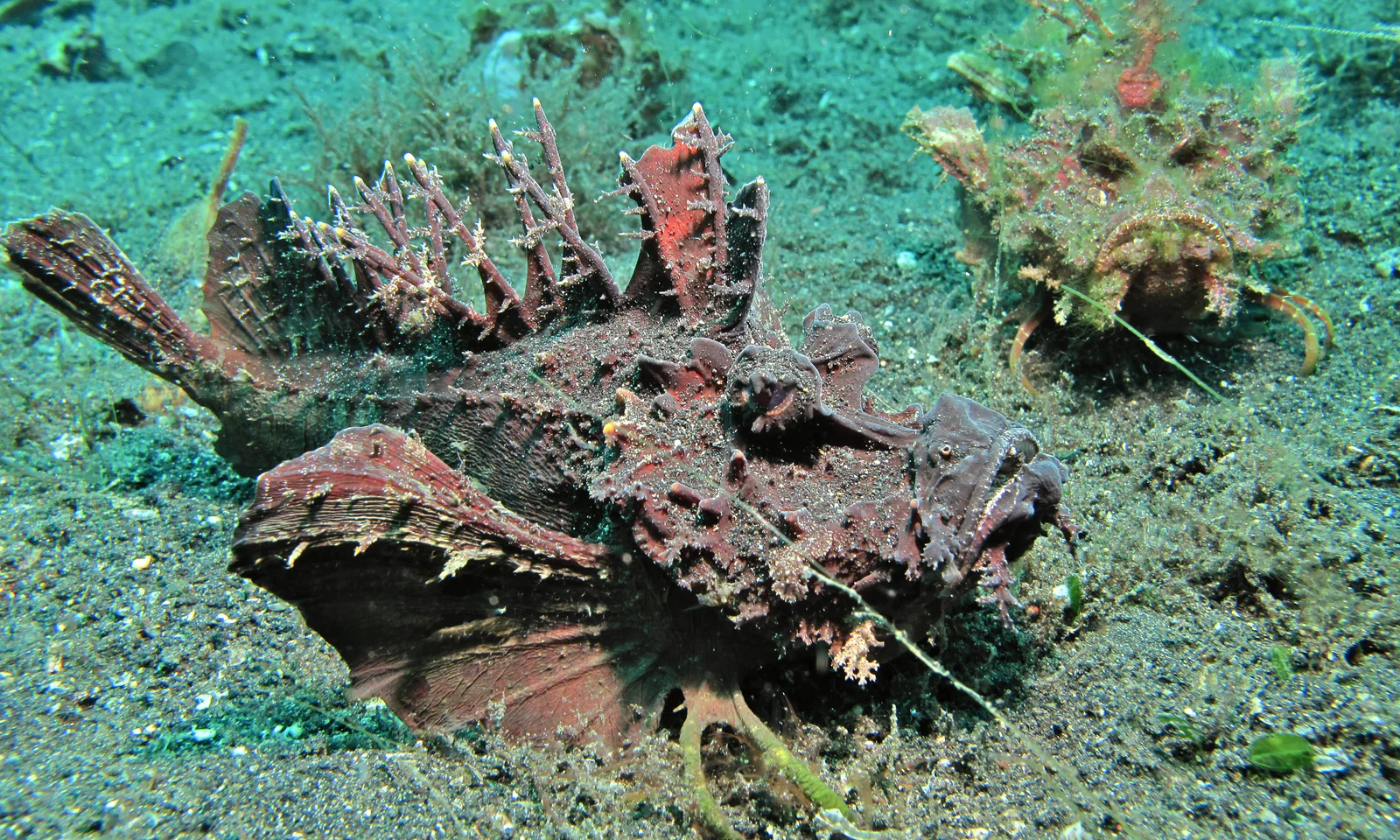
Image credit: Bernard DUPONT · CC BY-SA 2.0 · Wikimedia Commons, cropped by this page
Inimicus spp.
About Stinger / Goblinfish (assorted).
Stingers, or goblinfish, are venomous bottom-dwelling fishes of the genus Inimicus, related to scorpionfish, that hide on sand and silt. This group entry covers sightings where the species was not recorded. The World Register of Marine Species (WoRMS) lists Inimicus Jordan & Starks, 1904 as an accepted genus in the family Synanceiidae. Wikipedia places it within the scorpionfish family Scorpaenidae, noting that some authorities use Synanceiidae, and says its ten described species are known collectively as ghoul, goblinfish, sea goblin, spiny devilfish, stinger and stingfish. FishBase lists "devil stinger" as an English name used in Indonesia for Inimicus didactylus.
Wikipedia says the species are nearly identical in appearance and behaviour and often confused with one another. Adults are typically 13 to 25 cm long and dull yellow, grey, brown or rust with light blotches that match the seabed; the skin is scaleless except along the lateral line and covered in venomous spines and wart-like glands, the head is flattened, and the eyes, mouth and nostrils face upwards. The two rearmost rays of each pectoral fin are detached from the rest of the fin and used to prop up the front of the body and to walk along the bottom.
A conservation status is not given here, because this entry covers a whole group.
Where it lives.
Wikipedia says the genus lives mainly in warm tropical coastal waters of the Indo-Pacific, from the Red Sea off Egypt east to New Caledonia and from northern New South Wales north to Aomori in Japan. It gives sandy or silty bottoms of lagoon and seaward reefs, mangrove swamps and coral reefs as habitat, at depths between 5 and 450 m.
Where Divers Find Them
At Deep Reef, Pemuteran, Abyss Ocean World lists devil stinger among the scorpionfish divers can observe there, with cuttlefish and octopus. It does not say which species, at what depth, how often or in which months.
How it behaves.
Wikipedia says stingers are nocturnal, piscivorous ambush predators that lie partly buried on the sea floor or on a coral head during the day, covered with sand and debris, and that they have no known natural predators. When threatened they spread their brilliantly coloured pectoral and caudal fins as a warning, and once dug in they are very reluctant to leave their hiding places.
Underwater Encounter Behavior
Wikipedia says every species has a complex, extremely potent venom in glands at the bases of needle-like dorsal spines, and that contact can deliver a very painful, potentially fatal sting for which medical aid must be sought at the earliest opportunity. It says their colouring makes them extremely difficult to detect. The sources cited here do not describe how they react to divers.
Where to see it.
Evidence from all destinations · 1 dive site
General range is not evidence of occurrence at a specific dive site.
Gallery.
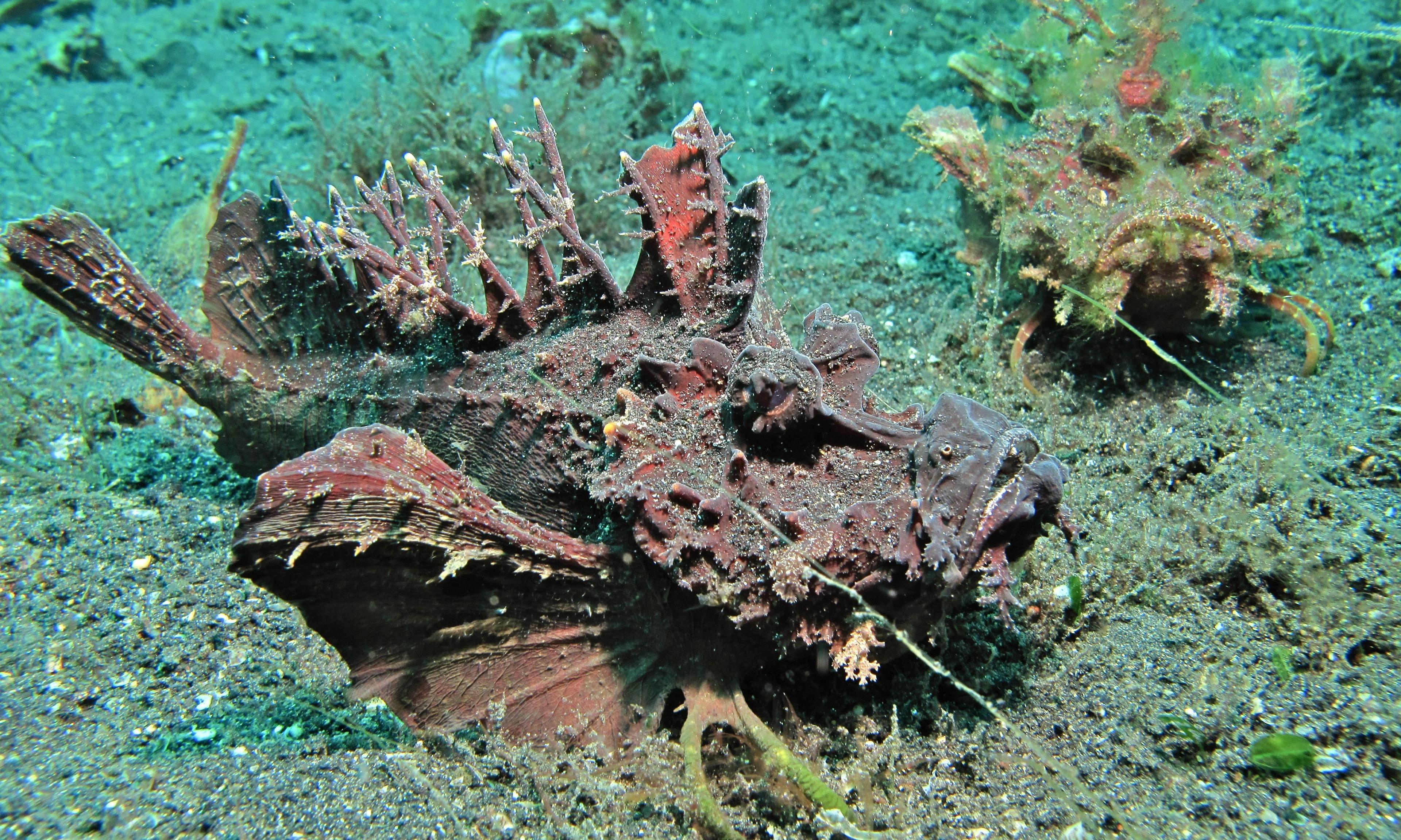
A bearded ghoul, Inimicus didactylus, one species of the stinger genus Inimicus, resting on dark sand in the Lembeh Strait, Sulawesi, Indonesia, photographed on 2009-10-12 and named by the photographer on its Commons page; a second, algae-covered fish sits in the background. This photograph is not from Pemuteran, and the source for Pemuteran's sighting names the fish only as a devil stinger, without a species. This page's frame crops the photograph.
Image credit: Bernard DUPONT · CC BY-SA 2.0 · Wikimedia Commons, cropped by this page