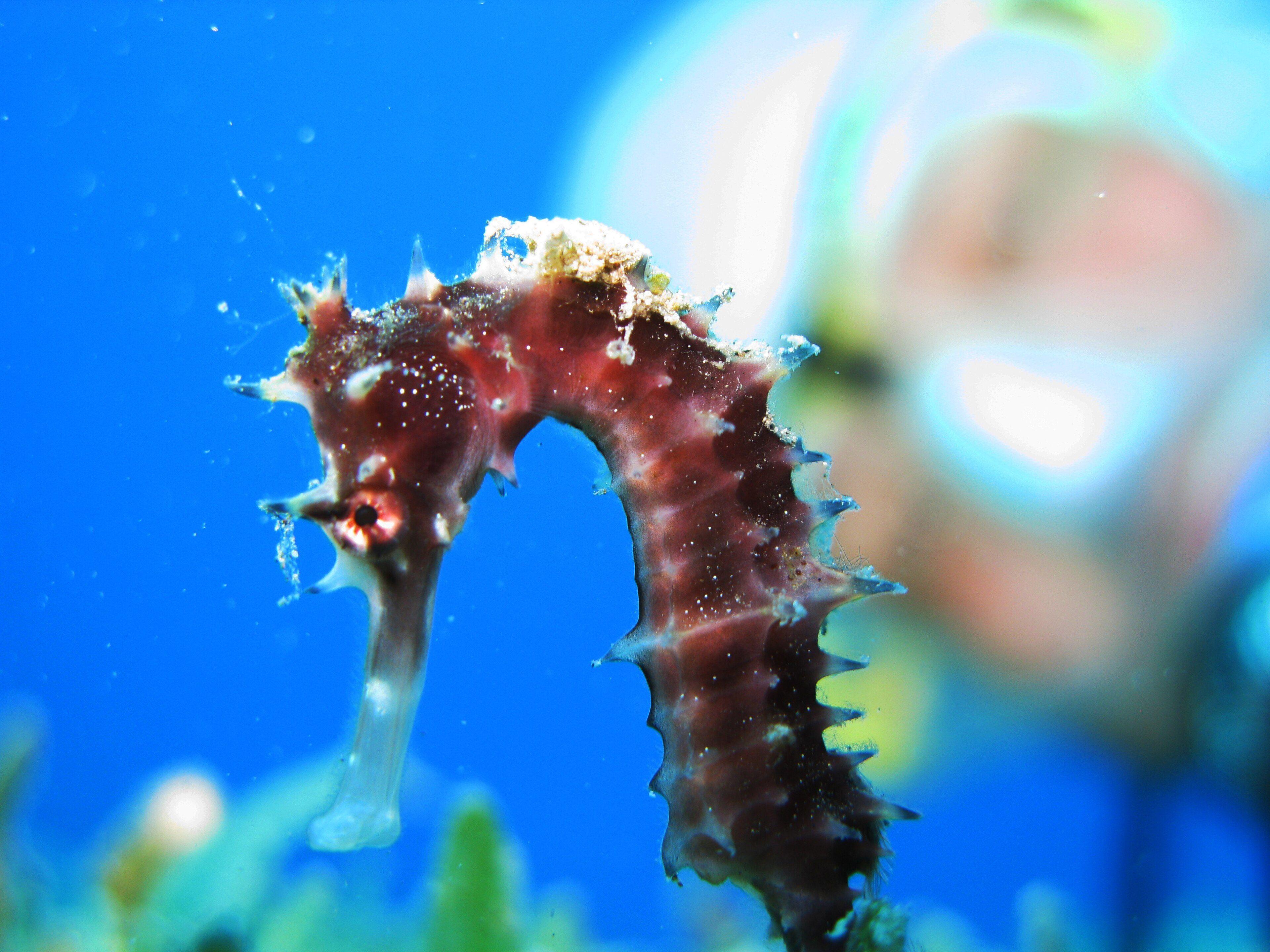
Thorny Seahorse
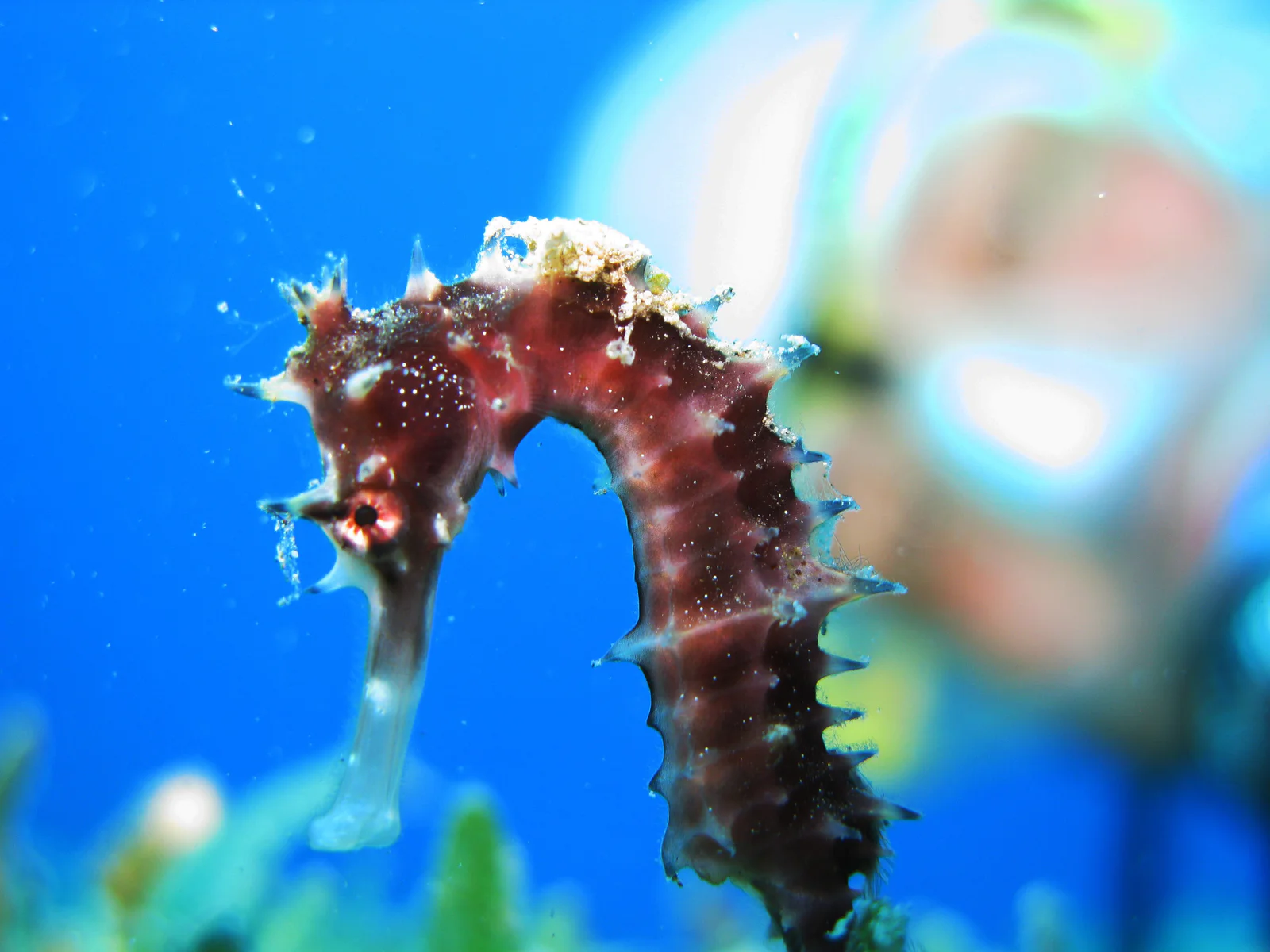
Hippocampus histrix
About Thorny Seahorse.
The Thorny Seahorse, Hippocampus histrix, is a captivating member of the family Syngnathidae, which includes seahorses and pipefishes. Known for its distinctive spiny appearance, this species is a prized find for macro photographers and divers exploring the diverse ecosystems of the Indo-Pacific. It is currently classified as Vulnerable by the IUCN, highlighting the importance of responsible diving practices to protect its populations.
Typically found in shallow to mid-depth sheltered reef environments, the Thorny Seahorse inhabits a variety of substrates including muck, seagrass beds, sponges, and soft corals, often clinging to gorgonian sea fans or feathery black corals with its prehensile tail. These masters of camouflage are generally observed at depths of 5–95 m, though they are usually found below 15 m. While often solitary, they are ambush predators, feeding on small crustaceans and zooplankton that drift within striking distance. Optimal water temperatures for this species, particularly for reproduction, range from 20–30°C.
Divers have occasionally encountered the Thorny Seahorse at dive sites such as Secret Bay, Basura, and Kalipayan, with rare sightings reported at Twin Peaks Reef.
Identification
The Thorny Seahorse is a medium-sized seahorse, reaching a maximum length of 17 cm. Its most striking feature, and the origin of its common name, is its body, which is slender, elongated, and entirely covered with prominent, sharp, dark-tipped spines, also known as cirri.
- Body and Spines: The entire body, including the prehensile tail, is adorned with sharp, highly developed spines that are uniformly sized on the tail. These spines contribute to its rugged, almost prehistoric appearance and aid in camouflage.
- Coronet: It possesses a coronet of moderate height, featuring 4-5 or 5 elongate, divergent spines at its apex.
- Head and Snout: The head is also covered with numerous spines, particularly on the forehead, the base of the cheeks, the nose, and above the eyes. A distinctive characteristic is its very long and tapered snout, which often displays one or more thin white lines.
- Coloration: The coloration of the Thorny Seahorse is highly variable, allowing it to blend seamlessly with its surroundings. It can range from pale yellows, creamy whites, and mottled browns to oranges, grey, green, red, and even burgundy-red. Individuals may be plain or exhibit saddle-like markings, along with small darker spots and blotches on their sides and dorsal surface.
- Fin and Ring Counts: Key meristic features include 17-19 dorsal fin rays, 11 trunk rings, and 33-34 tail rings.
Where it lives.
Habitat and Depth
The Thorny Seahorse is primarily a reef-associated species, favoring environments with both hard and soft bottoms. Divers can typically encounter this species at depths ranging from 10–95 m, though it is usually found below 15 m. While some sources indicate it is most often found between 15–40 m, it can occasionally be observed in shallower areas around 8–10 m. In Mauritius, it has been observed in shallow to mid-depth coral reef systems, typically between 5 and 30 m.
Ecosystems and Substrate Preference
This seahorse exhibits a strong preference for complex habitats that offer ample opportunity for concealment and attachment. Key ecosystems and substrates include:
- Soft Corals and Sponges: Thorny Seahorses are frequently found with their prehensile tails wrapped around soft corals, gorgonian sea fans, and various sponge species, using these structures for anchorage and camouflage.
- Seagrass Beds: These vital underwater meadows are a significant habitat for *Hippocampus histrix*, providing both shelter and hunting grounds.
- Muck and Rubble Areas: Consistent with observations at dive sites like Secret Bay and Basura, they inhabit sandy rubble and muck sites, often near reef edges. These areas, characterized by volcanic sand scattered with debris, sponges, and algae, offer a unique environment for macro photography enthusiasts.
- Rocky Reefs and Algae: They may also frequent weedy rocky reefs and areas with algal outgrowths, further demonstrating their adaptability to various benthic structures.
The Thorny Seahorse's highly variable coloration, ranging from cream to grey, greenish, yellow, brown, or even burgundy-red, allows it to perfectly match its surroundings, enhancing its cryptic lifestyle. This species is often solitary but can occasionally be seen in small groups, patiently waiting to ambush small crustaceans and other planktonic organisms.
How it behaves.
Underwater Encounter Behavior
The Thorny Seahorse is primarily a sedentary species, often observed with its prehensile tail clasped around various substrates. Divers will typically find them anchored to gorgonian sea fans, feathery black corals, dense soft coral colonies, sponges, or seagrass beds, where their spiny body and variable coloration (ranging from yellow, brown, green, orange, to red) provide exceptional camouflage. They are masters of disguise, relying on their ability to blend seamlessly with their surroundings to avoid predators. When approached carefully, Thorny Seahorses are generally shy and tend to ignore divers. Their movements are slow and deliberate, propelled by a rapidly oscillating dorsal fin, while pectoral fins assist with steering. Unlike many fish, seahorses can move each eye independently, allowing them to scan for both prey and potential threats simultaneously. Divers seeking to observe this species should move slowly, maintain excellent buoyancy control, and meticulously scan the preferred habitats. They are typically encountered at depths of 5–40 meters, in waters of 24–28°C.
Feeding Habits
Thorny Seahorses are carnivorous ambush predators. Lacking a true stomach and teeth, they are voracious eaters that must feed frequently throughout the day. They employ a unique feeding strategy: patiently waiting for small prey to drift within striking distance, then rapidly sucking them into their elongated, tubular snout with a precise, quick strike. Their diet primarily consists of tiny crustaceans such as copepods, mysis shrimp, amphipods, zooplankton, and occasionally larval fish.
Social Structure
Thorny Seahorses are often found solitarily, but they can also be observed in pairs. Like many seahorse species, they are believed to be socially monogamous, forming pair bonds that can last for the duration of a breeding season or even longer. These bonds are reinforced through daily courtship rituals, where the male and female engage in synchronized displays, color changes, and intricate dances, sometimes twirling with interlocked tails. A distinctive feature of seahorse reproduction is male pregnancy; the female transfers her eggs into a specialized brood pouch on the male's abdomen, where he fertilizes and incubates them.
Notable Seasonal Patterns
The breeding season for wild seahorses typically commences in April and continues through the warmer summer months, lasting until the onset of winter when some species may move to deeper waters. However, in some southern regions, Thorny Seahorses may breed year-round, especially in stable environmental conditions. The gestation period, during which the male carries the developing embryos in his brood pouch, can last between two to six weeks, influenced by water temperature. At the end of gestation, the male undergoes muscular contractions to expel miniature, fully formed seahorse fry, which are immediately independent. Divers may observe increased activity and pair-bonding behaviors during these warmer breeding periods.
Where to see it.
Evidence for philippines · 5 dive sites
General range is not evidence of occurrence at a specific dive site.
Basura
Anilao
Site occurrence not yet documented
Season not yet documented
No dated observations available.
Boatyard
Puerto Galera
Site occurrence not yet documented
Season not yet documented
No dated observations available.
Kalipayan
Panglao
Site occurrence not yet documented
Season not yet documented
No dated observations available.
Secret Bay
Anilao
Site occurrence not yet documented
Season not yet documented
No dated observations available.
Twin Peaks Reef
Coron
Site occurrence not yet documented
Documented site seasonality: Nov, Dec, Jan, Feb, Mar, Apr, May
No dated observations available.
Gallery.