Thorny Seahorse
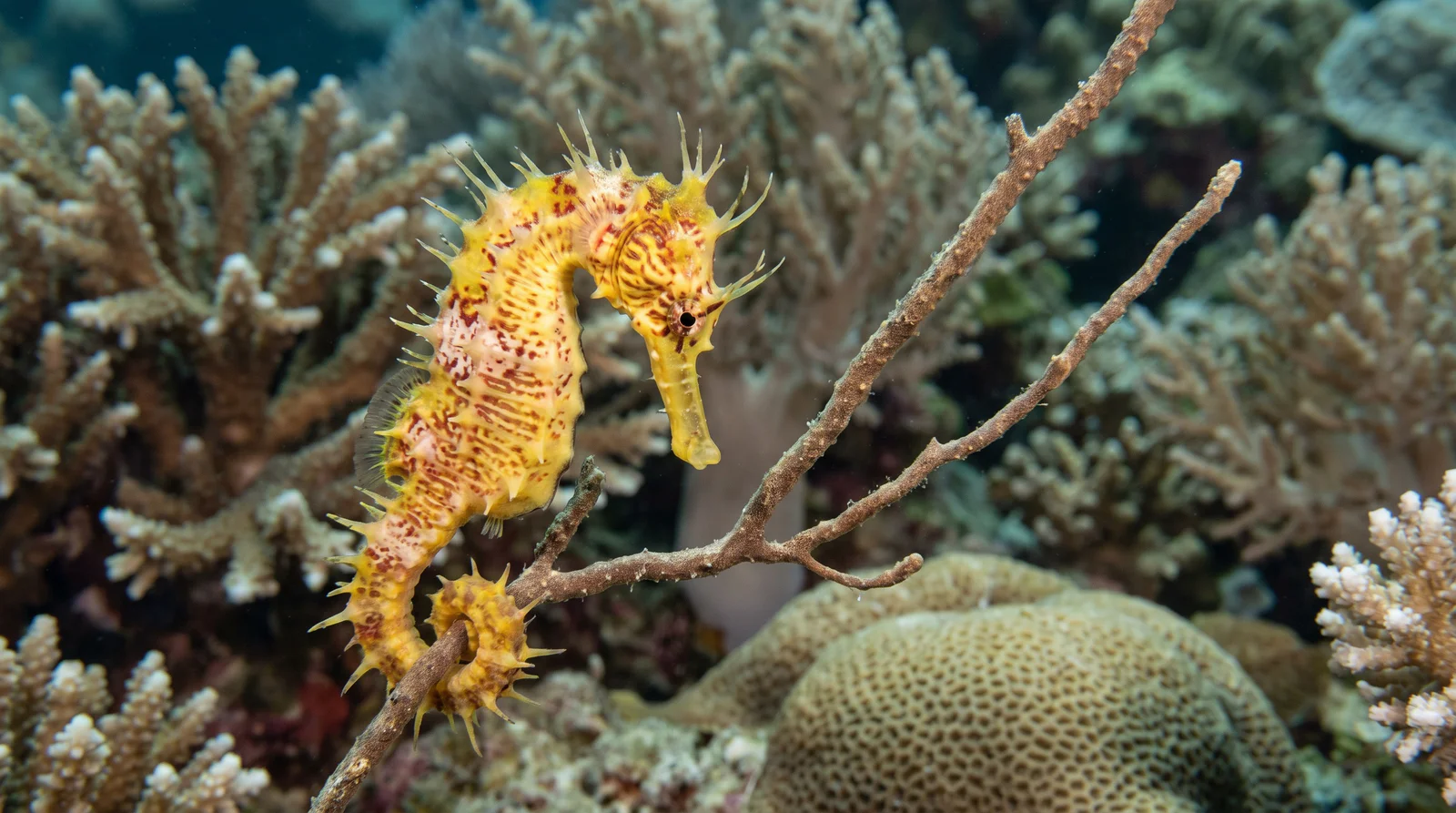 AI-generated
Image credit: AI-generated illustration · Diveity
Hippocampus histrix
About Thorny Seahorse.
The thorny seahorse is a small Indo-Pacific seahorse of up to about 17 cm, covered in long, sharp, often dark-tipped spines, with a long snout.
Names and classification
WoRMS accepts the name Hippocampus histrix Kaup, 1856 in the family Syngnathidae, order Syngnathiformes, and lists Hippocampus curvicuspis Fricke, 2004 as a synonym, together with the spellings Hippocampus hystrix and Hippocamphus hystrix. Its vernacular list has thorny seahorse in English and イバラタツ in Japanese. Wikipedia titles its article spiny seahorse, gives thorny seahorse as another name, and warns that in Great Britain spiny seahorse also means the long-snouted seahorse, a different species. FishBase lists 42 common names, among them longspine seahorse, Ibara-Tatsu and kuda laut duri.
Identification
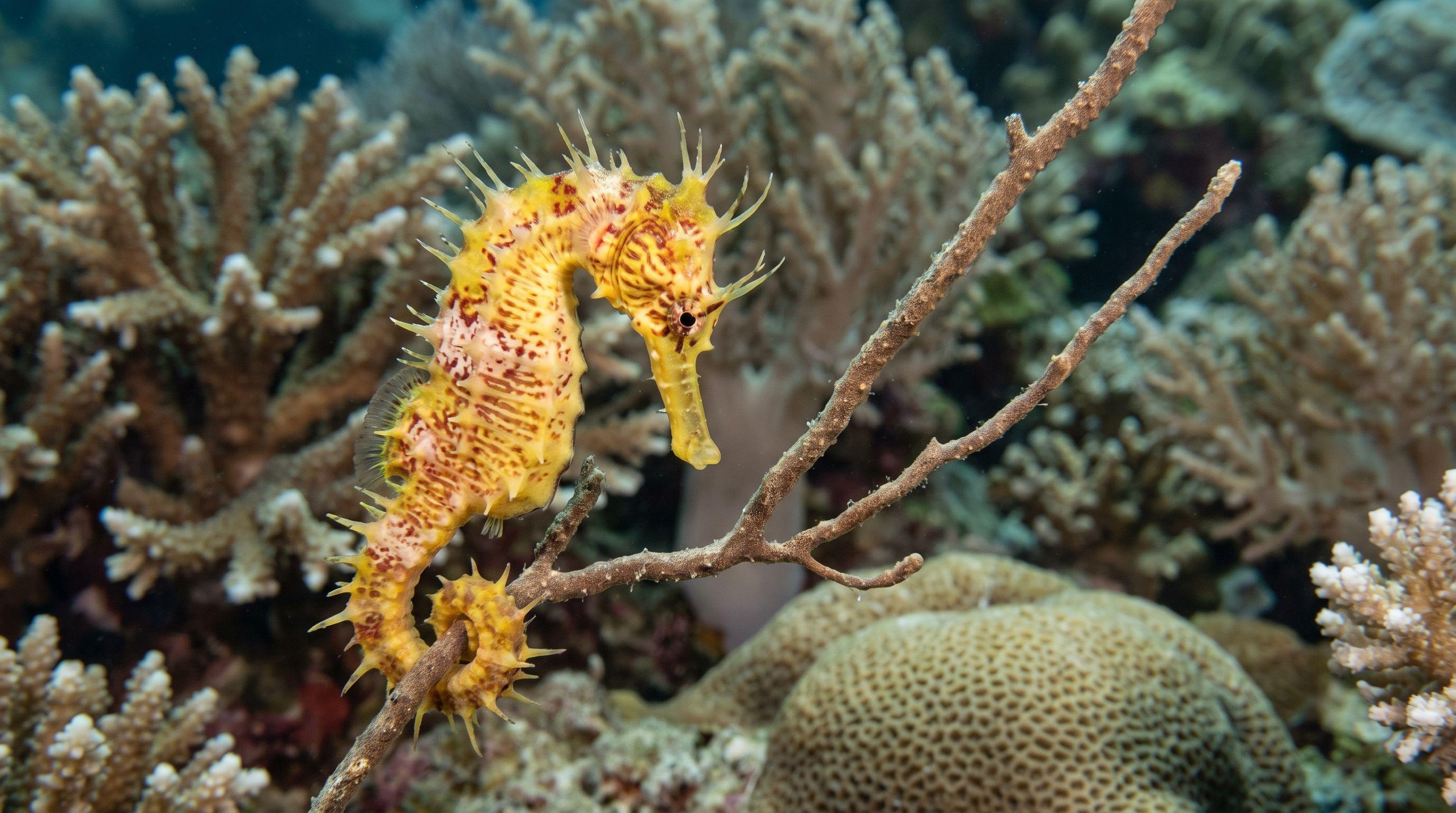
Fishes of Australia describes a narrow body with very long, extremely sharp spines whose tips are often black, a long head angled down towards the trunk, a snout as long as the head or longer, and a coronet of moderate height topped by five long, spreading spines. Its colour varies to match the surroundings, from cream or grey to greenish, yellow, brown or burgundy-red, plain or with saddle-like markings and small dark spots, and the snout usually carries one to several fine white bars. Wikipedia gives the same picture with four or five coronet spines. Fishes of Australia counts 17 to 19 dorsal-fin rays, 4 anal-fin rays, 17 or 18 pectoral-fin rays, 11 trunk rings and 33 or 34 tail rings, while FishBase gives 15 to 18 dorsal soft rays and 4 anal soft rays.
Similar species
Fishes of Australia says the species is most often confused with Hippocampus multispinus: the thorny seahorse has a single long lower shoulder-ring spine where H. multispinus has two that diverge in a V, and its nape spine sits close to the coronet and points upwards rather than forwards. The same account notes that the name H. histrix has often been used for many spiny tropical seahorses, which makes the species look more widespread than it may be. Wikipedia adds that in trade its common name is often a label for any spiny Indo-Pacific seahorse.
Size and conservation
FishBase gives a maximum of 17.0 cm total length for males or unsexed fish and first maturity at about 7.9 cm; Wikipedia gives 15 to 17 cm, and Fishes of Australia a height of up to 150 mm. On the IUCN Red List the species is Vulnerable: FishBase, citing version 2025-2 of the list, dates that assessment to 26 January 2017 and Wikipedia cites the same 2017 assessment, while Fishes of Australia still calls it Data Deficient. Wikipedia says populations are thought to have declined by more than 30 % over 10 to 15 years, through targeted catch for traditional medicine and the aquarium trade, bycatch in shrimp trawls and the loss of inshore seagrass. FishBase, Fishes of Australia and Wikipedia all record it on Appendix II of CITES. FishBase lists it as harmless to people, highly commercial in fisheries and commercial in the aquarium trade, though not common there, and says its use in traditional Chinese medicine is rising with patent medicines. Fishes of Australia says it is rarely collected for aquariums because it lives in moderately deep water, and that specimens may be dried for traditional medicine or sold as curios.
Where it lives.
The thorny seahorse lives on Indo-Pacific reefs, seagrass and soft bottoms, often holding on to soft corals or sponges, usually below 15 m.
Range
FishBase gives an Indo-Pacific range from South Africa to French Polynesia, north to Japan and south to Australia, and says the species is not in the Red Sea. Fishes of Australia records it in Australia south of Ashmore Reef in the Timor Sea, on the Great Barrier Reef in Queensland and at Port Stephens in New South Wales, and elsewhere in the tropical and subtropical western Pacific, from Bali in Indonesia, Papua New Guinea, New Caledonia and Japan. Wikipedia, drawing on that account, calls the species relatively rare but widespread through the Indo-Pacific.
Depth and bottom
The sources differ on depth. FishBase records the species from 0 to 82 m, usually 15 to 40 m, as a marine, reef-associated and non-migratory fish, a rare inhabitant of shallow sheltered reefs among clumps of algae or in seagrass beds, associated with sponges and sea squirts; it adds that large adults are pelagic and probably drift with floating debris. Fishes of Australia places it on hard and soft bottoms, often attached to soft corals or sponges, at 10 to 95 m and usually below 15 m, and sometimes on shallower algae-rubble or rocky reef at about 10 m, while the quick facts of the same page give a depth of 5 to 95 m. Wikipedia gives the same 10 to 95 m and says it lives mainly on seagrass beds, as well as on sponges, weedy rocky reefs and soft corals. The WoRMS entry carries the marine flag only.
How it behaves.
Thorny seahorses feed on small crustaceans and zooplankton and live in monogamous pairs, and the male carries the eggs in a brood pouch.
Feeding
FishBase says the species feeds on zooplankton and small crustaceans, and estimates its trophic level from food items at 3.5, with a standard error of 0.53. Fishes of Australia is more cautious: like other seahorses, it presumably preys on small crustaceans and other planktonic organisms. Wikipedia calls the diet carnivorous.
Pairs and breeding
FishBase describes obligate and genetic monogamy, with the fish always in home-ranging pairs that do not defend an exclusive territory, and calls the species ovoviviparous. In Fishes of Australia the female uses an ovipositor to place her eggs in an enclosed pouch under the male's abdomen, where FishBase puts the pouch under the tail; the male fertilises the eggs inside it, protects the embryos, regulates their salt balance, aerates them and may provide some nourishment until they are born. Wikipedia adds that the pouch is lined with villi rich in capillaries that surround each egg like a placenta, and that the young are independent once they are expelled.
Where to see it.
Evidence for visayas · 2 dive sites
General range is not evidence of occurrence at a specific dive site.
Gallery.
 AI-generated
 illustration
Image credit: AI-generated illustration · Diveity