Thresher Shark (assorted)
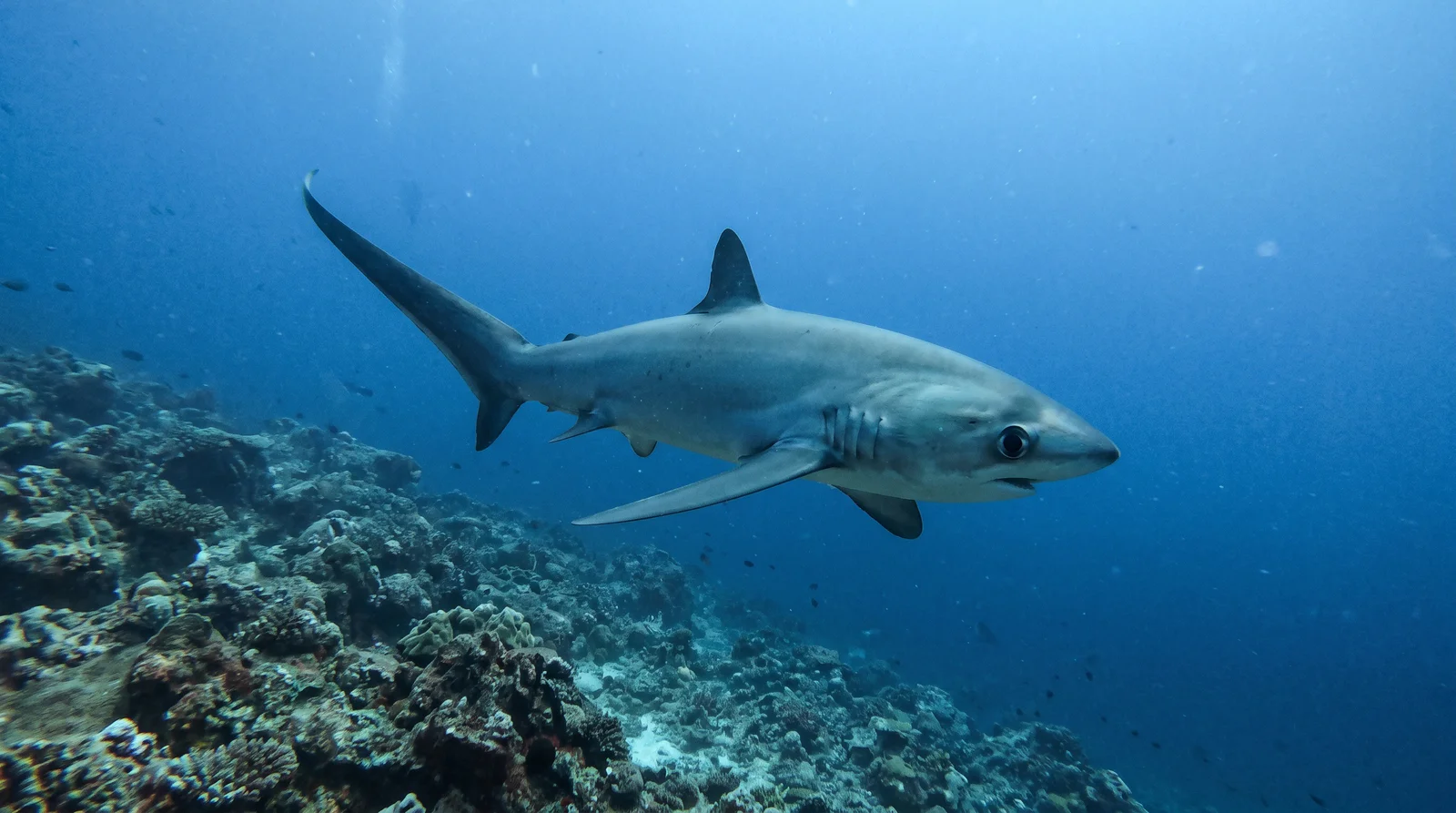 AI-generated
Image credit: AI-generated illustration · License unspecified · Source unspecified
Alopias spp.
About Thresher Shark (assorted).
Thresher sharks form the family Alopiidae, which contains a single genus, Alopias, and three species: the Pelagic Thresher (A. pelagicus), the Common Thresher (A. vulpinus) and the Bigeye Thresher (A. superciliosus). They occur in all oceans. This group entry covers thresher sightings that cannot be confirmed to species; the Pelagic Thresher also has its own entry.
The defining feature is the tail. The upper lobe of the tail fin is greatly elongated and makes up almost half of the shark's total length. Threshers use this long lobe to bunch up and stun prey. The family name comes from the Greek alopex, meaning fox.
Identification
- Tail: An extremely long, strap-like upper tail lobe, recognisable even at a distance.
- Gills: The third to fifth gill openings sit above the origin of the pectoral fin.
- Bigeye Thresher: Very large eyes and an indented forehead set it apart from the other two species.
- Size: Varies by species. Maximum recorded total lengths are about 4.3 m for the Pelagic Thresher, 4.9 m for the Bigeye Thresher and 5.7 m for the Common Thresher, tail included.
- Pelagic or Common?: FishBase notes that the Pelagic Thresher is often confused with the Common Thresher, so reliable records are lacking. If you cannot confirm the species, this group entry is the safer choice.
- Lifespan: Threshers are long-lived: FishBase gives maximum reported ages of 29 years for the Pelagic Thresher and 25 years for the Common Thresher.
Conservation
Conservation status varies by species. On the IUCN Red List (assessed in 2018), the Pelagic Thresher is Endangered, while the Common Thresher and the Bigeye Thresher are both Vulnerable. The Common Thresher is also listed on CITES Appendix II and CMS Appendix II. All three species bear small litters, usually of two pups.
Where it lives.
Thresher sharks are open-water sharks of tropical and temperate seas around the world. FishBase describes all three species as pelagic-oceanic and oceanodromous, meaning they live and move widely in the open ocean.
- Pelagic Thresher: Primarily oceanic but sometimes close inshore, and it may enter atoll lagoons. Recorded from the surface to 300 m, usually in the upper 150 m. Records cover the Indo-Pacific, including the Red Sea, and the eastern Pacific.
- Common Thresher: Found over continental and island shelves and also far from land; young often stay close inshore in shallow bays. Recorded to 650 m, usually in the upper 200 m, in temperate and tropical seas worldwide.
- Bigeye Thresher: Lives in coastal waters over continental shelves, sometimes close inshore, and on the high seas far from land. Recorded to 730 m, usually in the upper 100 m.
- Movement: The Common and Bigeye Threshers are described as highly migratory.
- Latitude range: FishBase gives about 74°N to 58°S for the Common Thresher and about 46°N to 40°S for the Bigeye Thresher.
- Overlap with divers: All three species are usually found in the upper 100-200 m, which overlaps only partly with recreational diving depths.
Because threshers spend much of their lives in open water, they are uncommon on most dive sites. Sightings are more likely where these oceanic sharks come close inshore, such as the inshore and atoll-lagoon records noted for the Pelagic Thresher. Records of young Common Threshers in shallow bays also show that some life stages use coastal water.
How it behaves.
Threshers are active predators of fishes and cephalopods. The Common Thresher uses its long upper tail lobe to bunch up and stun prey, and the Pelagic and Bigeye Threshers are also reported to stun prey with the tail.
Diets in the three species include schooling fishes such as mackerels, herrings and lanternfishes, squids and octopuses, pelagic crustaceans and, for the Bigeye Thresher, bottom fishes such as hake. The Pelagic Thresher is thought to feed mainly on small fishes and cephalopods.
Reproduction
All three species are ovoviviparous. Embryos first feed on their yolk sac and then on eggs produced by the mother, a strategy called oophagy. Litters are small, usually two pups, and newborns are large: about 1.1-1.5 m in the Common Thresher. The Bigeye Thresher has no fixed mating or birthing season.
Underwater Encounter Behavior
- Where they swim: Threshers are open-water animals, so expect them in the water column rather than resting on the bottom.
- Risk to divers: FishBase considers the Common Thresher harmless to humans, though its size commands respect.
- Segregation: In the northwestern Indian Ocean, male and female Common Threshers are separated by area and depth.
- Mating: FishBase records distinct pairing with an embrace during mating in the Common Thresher.
- Unusual prey: FishBase notes that the Common Thresher rarely also takes seabirds.
Diver Tips
- Keep your distance: Do not chase or try to touch a thresher; let the shark decide how close it comes.
- Limit disturbance: Hold position, avoid sudden movements and keep your breathing steady.
- Record details: Note eye size and forehead shape, which separate the Bigeye Thresher, plus depth and time, to help others confirm the species.
- Depth discipline: Do not follow a thresher deeper than your training or dive plan allows.
Where to see it.
Evidence for mactan · 1 dive site
General range is not evidence of occurrence at a specific dive site.
Gallery.
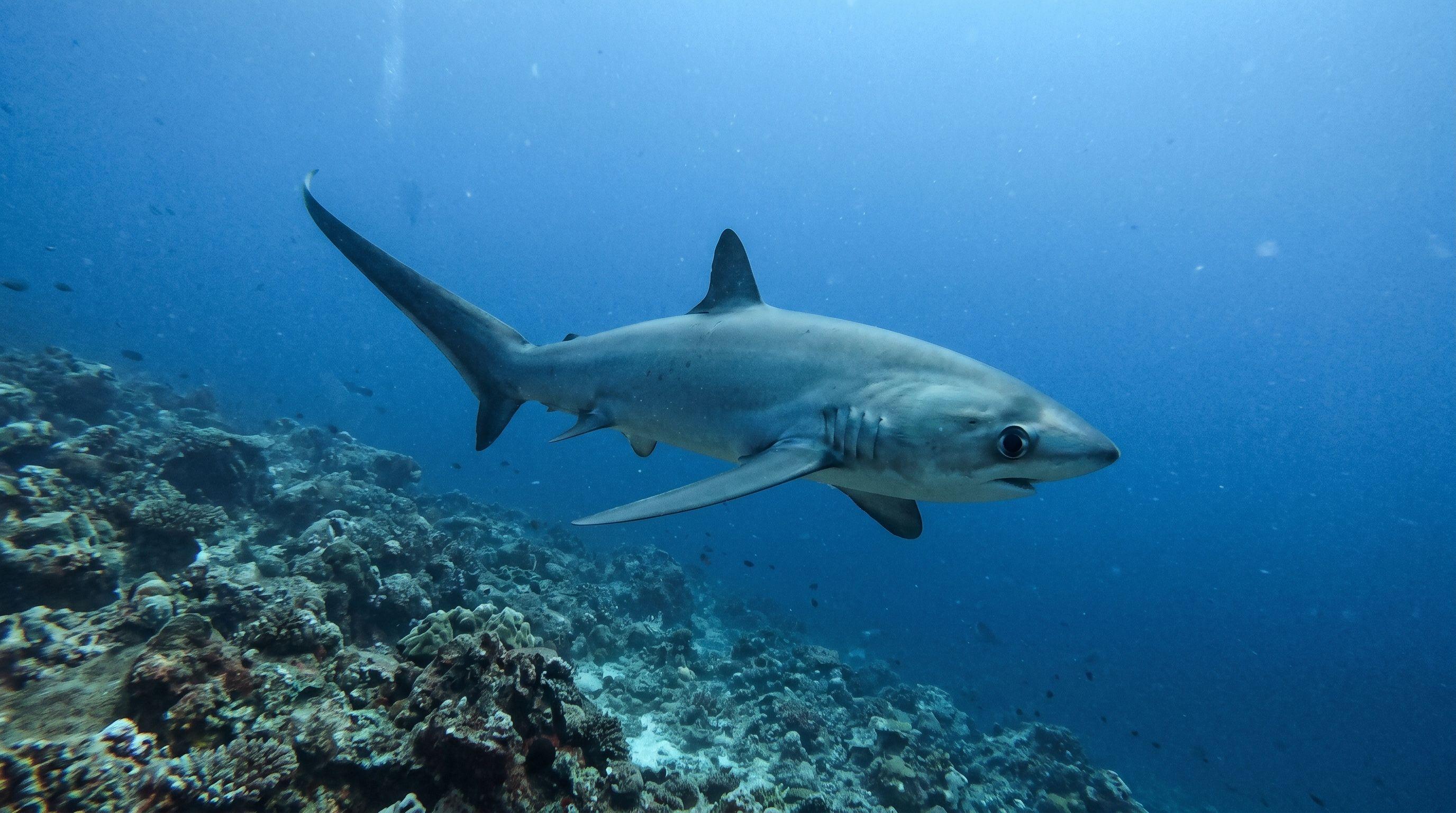 AI-generated
AI-generated illustration
Image credit: AI-generated illustration · License unspecified · Source unspecified