Tiger Grouper
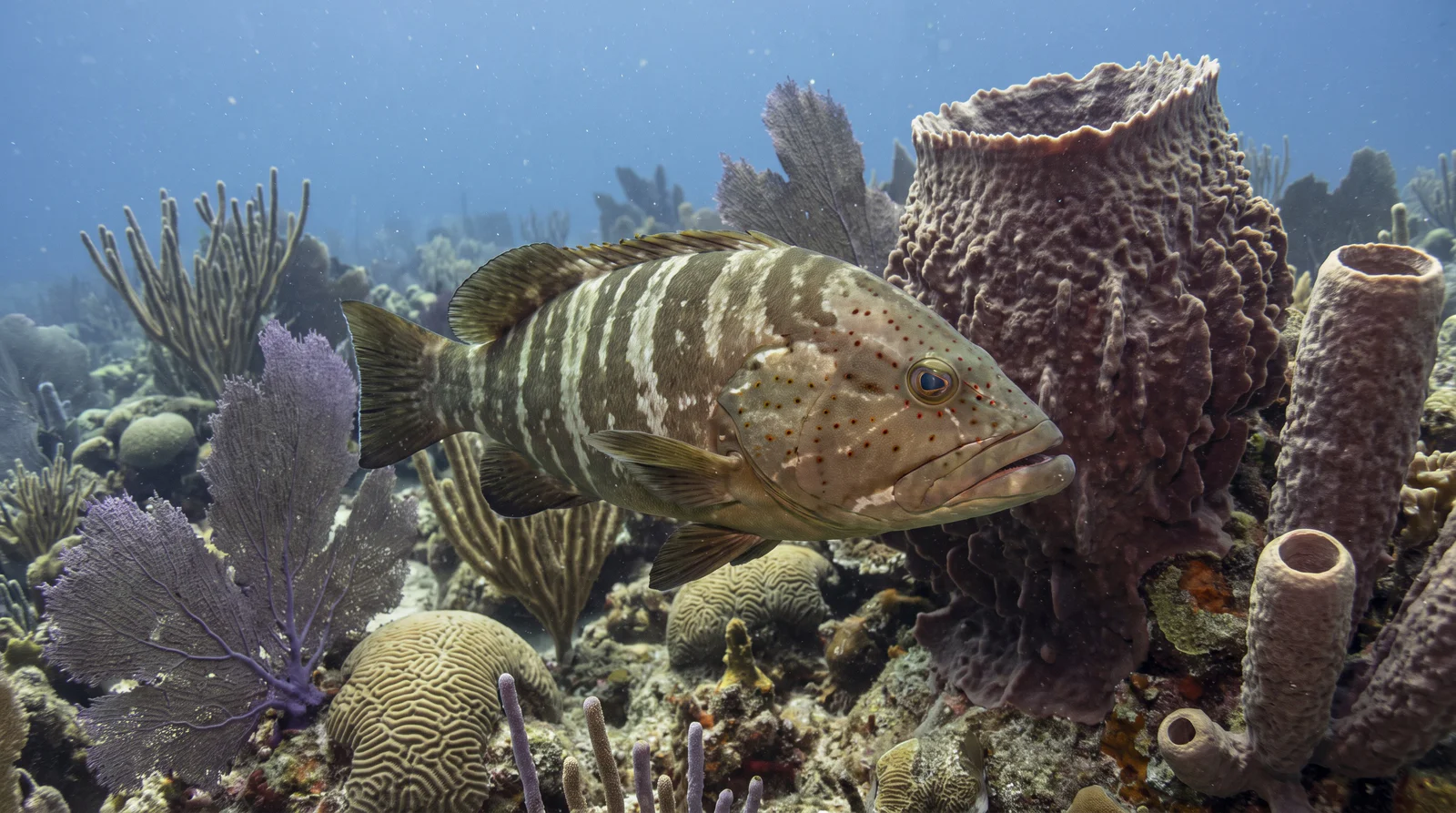 AI-generated
Image credit: AI-generated illustration · License unspecified · Source unspecified
Mycteroperca tigris
About Tiger Grouper.
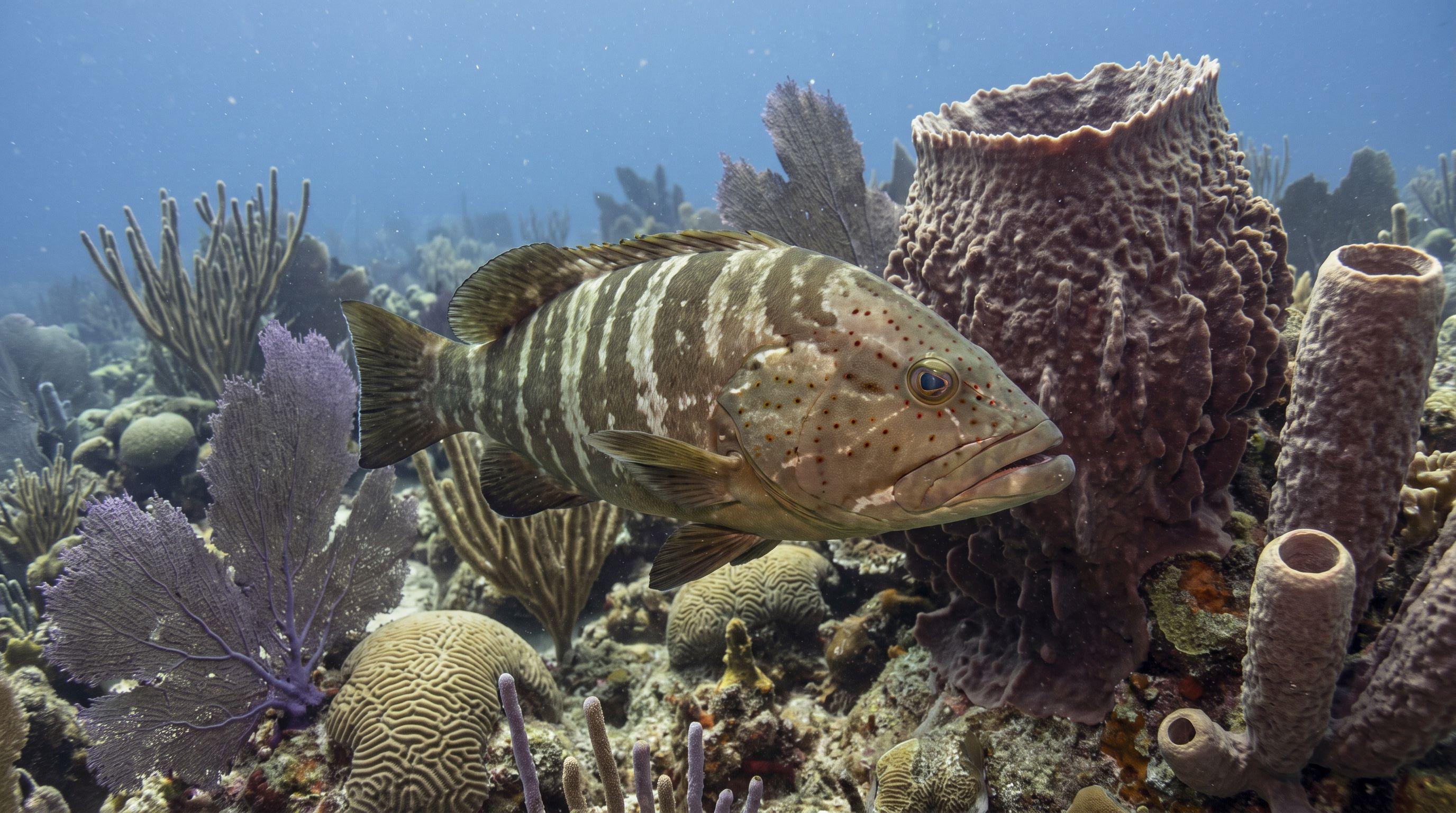
The Tiger Grouper, known scientifically as Mycteroperca tigris, is a striking marine ray-finned fish characterized by its elongated, robust, and compressed body. Its most distinctive feature is its cryptic coloration, typically a dark upper body adorned with 9 to 11 thin, pale oblique lines that slant downward and forward, reminiscent of a tiger's stripes. This pattern serves as effective camouflage within its reef habitats. Notably, these fish possess a remarkable ability to change their coloration dramatically and rapidly, capable of lightening, darkening, or even displaying a bright red hue, especially when interacting at cleaning stations or in response to their mood and environment.
Its head features relatively small eyes, a prominent lower jaw, and a large mouth equipped with rows of mobile canine teeth that lean inwards to secure prey before returning to their original position. The preopercle (bone forming the front and lower margin of the gill cover) is rounded without a distinct lobe at its angle. The dorsal fin is continuous and located far back on the head, comprising 11 spiny rays and 15-17 soft rays, while the anal fin has 3 spiny rays and 11 soft rays. The pectoral fins are ample and rounded, typically counting 17-19 rays, and the long, thin pelvic fins are inserted just behind the pectorals, aiding in stability and precise movements. In juveniles, the caudal fin is straight, becoming slightly concave in adults. Young Tiger Groupers present a different appearance, being bright yellow with a single dark streak running horizontally along their sides. Furthermore, sexual dimorphism is observed in pectoral fin coloration, with males typically exhibiting dark fins and females having orange ones. This species can attain a maximum total length of approximately 1 meter (3.3 feet), though individuals are commonly observed around 40 centimeters (16 inches), with a maximum recorded weight of 10 kilograms (22 pounds).
Where it lives.
The Tiger Grouper (Mycteroperca tigris) is a tropical species predominantly found throughout the warmer waters of the Western Atlantic Ocean. Its geographical range extends from southeastern Florida, Bermuda, and the Bahamas, southwards through the Gulf of Mexico and the Caribbean Sea to the Maroni River in French Guiana. A distinct, separate population exists off the coast of Brazil, ranging from Ceará State to Rio de Janeiro State. This species is primarily reef-associated, inhabiting coral reefs and rocky environments, as well as madreporic formations and reef slopes, walls, and drop-offs. Adults can also be found in lagoons, around patch reefs, and within channels and along outer reef slopes, particularly in areas with clear water and abundant coral. Juveniles, in contrast, tend to occupy seagrass beds and estuarine or low-salinity inshore areas. Tiger Groupers typically reside at depths ranging from 10 to 40 meters (33 to 130 feet) in the Caribbean. However, they can be encountered in shallower waters down to 3 meters (9.8 feet) and as deep as 112 meters (367.5 feet). The Brazilian population is found at greater depths, usually between 60 and 110 meters. They thrive in water temperatures generally between 24.7 and 28 °C (68 °F - 82.4 °F).
How it behaves.
The Tiger Grouper is a largely solitary and diurnal species, primarily active during the day. It is an adept ambush predator, employing a stealthy hunting strategy by concealing itself among corals, rocks, and sponges. It patiently waits until unsuspecting prey, primarily smaller reef fish such as grunts, parrotfish, croakers, angelfish, and damselfish, along with crustaceans, ventures close enough to be swiftly swallowed whole. While some reports suggest it is purely piscivorous, consuming various fish species, it is also known to feed at dusk. Despite its predatory nature, the Tiger Grouper is often considered approachable by divers, frequently remaining concealed even when observed.
A notable aspect of its behavior is its attendance at cleaning stations, where it allows cleaner fish to remove parasites. During these cleaning interactions, its body coloration can dramatically shift, sometimes appearing bright red. Like many groupers, the Tiger Grouper is a protogynous hermaphrodite, meaning individuals mature first as females and then some transition to males as they grow larger. Studies indicate that all individuals smaller than 37 cm (15 inches) are female, while those larger than 45 cm (18 inches) are male. This species forms reproductive spawning aggregations, typically occurring between December and March, often a few days after the full moon. During these aggregations, males establish and defend territories to attract mates, engaging in courtship behaviors. Spawning activity is highly predictable, usually occurring just before and after sunset, with males chasing females to the surface where millions of eggs can be fertilized each night.
Where to see it.
Evidence for bonaire · No dive sites
General range is not evidence of occurrence at a specific dive site.
No documented dive-site associations in this destination yet.
Gallery.
 AI-generated
 illustration
Image credit: AI-generated illustration · License unspecified · Source unspecified