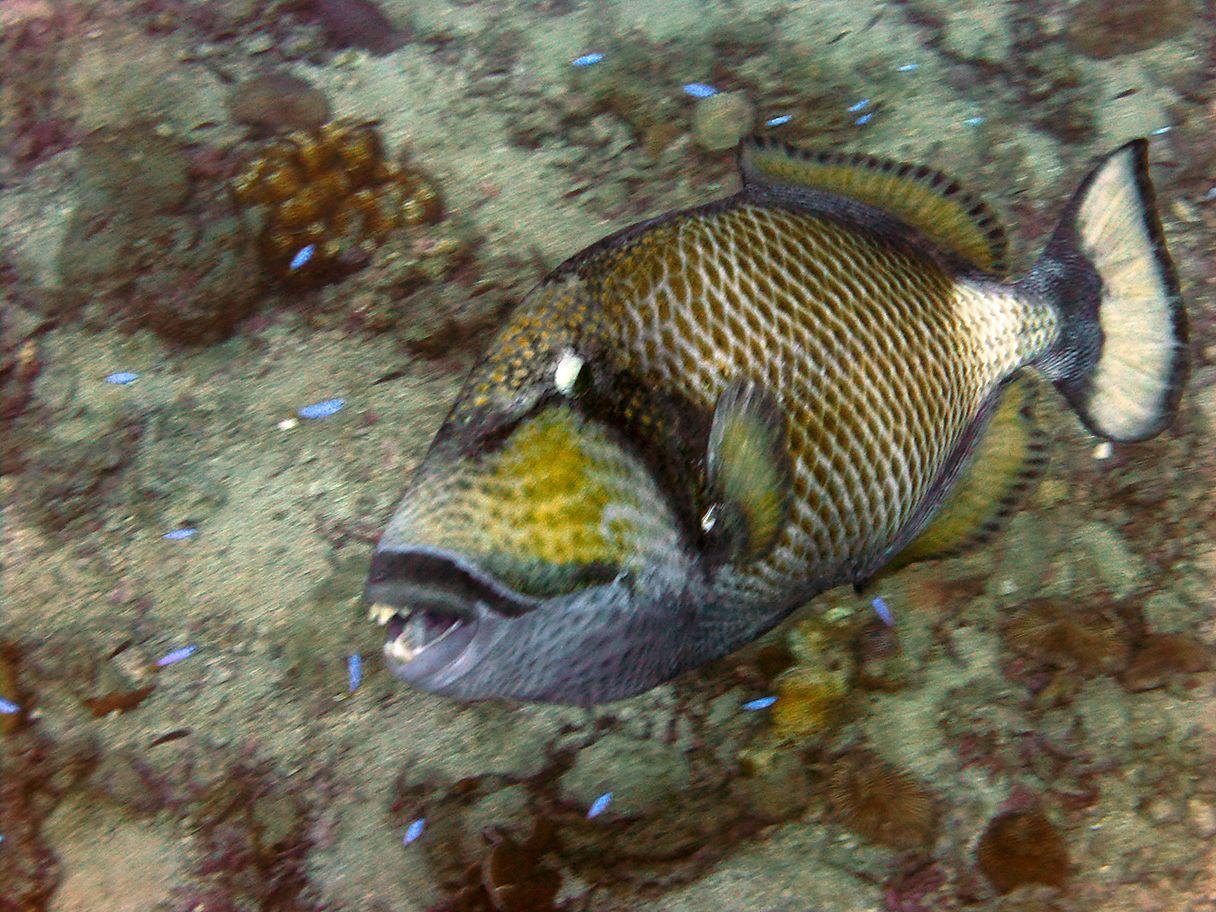
Titan Triggerfish
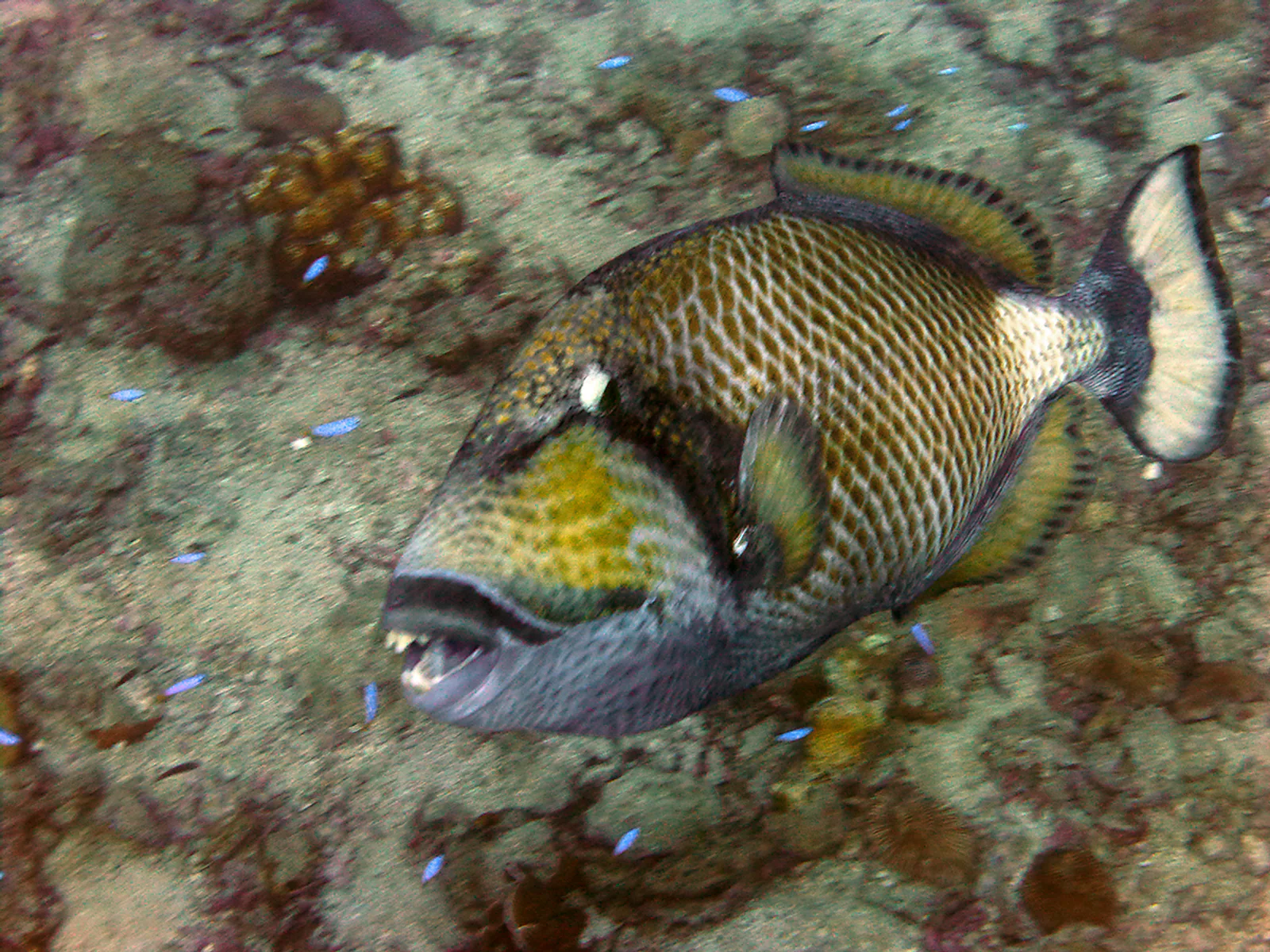
Balistoides viridescens
About Titan Triggerfish.
The Titan Triggerfish (Balistoides viridescens) is the largest and arguably most iconic species within the triggerfish family (Balistidae) across its Indo-Pacific range. Growing up to 75 cm (30 in) in length, this robust and highly territorial fish is a common sight on coral reefs, known for its distinctive appearance and bold demeanor.
Found in lagoons, seaward reefs, and sheltered inner reef slopes, the Titan Triggerfish plays a crucial ecological role by feeding on a diverse diet of hard-shelled invertebrates such as sea urchins, molluscs, crustaceans, and coral. Its powerful jaws and strong teeth enable it to crush tough prey, and its foraging activities, which often involve turning over rocks and blasting sand, create feeding opportunities for smaller reef inhabitants.
While generally solitary and diurnal, the Titan Triggerfish is infamous for its aggressive defense of nests, particularly during breeding season. Nests are typically constructed in flat sandy areas, and the fish will vigorously guard a cone-shaped territory extending upwards from the nest to the surface. Divers who inadvertently enter this zone may be charged or bitten, with bites capable of inflicting serious injury due to their strong teeth. Warning signs of agitation include the fish raising its prominent dorsal spine or rolling onto its side. If confronted, it is advised to swim horizontally away from the area rather than ascending, to exit the conical defense zone.
This species is widely distributed throughout the Indo-Pacific, from the Red Sea and East Africa to northern Australia, extending eastward to the Line and Tuamotu islands, and north to southern Japan. It is commonly observed at dive sites such as Beatrice Rock, Marsa Abu Dabbab, and Around the Bend, and occasionally at False Entrance. The Titan Triggerfish is currently listed as "Least Concern" by conservation assessments.
Identification
Identifying the Titan Triggerfish is relatively straightforward due to its distinctive features:
- Size and Shape: It possesses a large, robust, and deep, compressed oval-shaped body, reaching up to 75 cm (30 in) in length.
- Coloration: The body is typically yellowish-grey to brown, with dark brown or greenish centers on its heavily scaled body, creating a noticeable crosshatch or diamond-shaped pattern.
- Head Features: The head is heavily scaled with a deep groove in front of both eyes. A prominent dark "moustache" marking is visible above the mouth, separating a lighter chin from a yellowish cheek. There is a scaleless area around the lips.
- Mouth and Teeth: Despite its relatively small mouth, it houses powerful jaws and strong, conical teeth, perfectly adapted for crushing hard-shelled prey.
- Eyes: The eyes are often surrounded by a black region with yellow spots, sometimes appearing with a white ring and thin brown lines.
- Fins:
- The first dorsal fin features a prominent "trigger" spine that can be locked upright, used for defense or to wedge itself into crevices.
- The soft dorsal and anal fins often have broad blackish margins.
Where it lives.
The Titan Triggerfish thrives in a variety of reef-associated environments across the vast Indo-Pacific region, extending from the Red Sea and East Africa eastward through northern Australia to the Line and Tuamotu islands, and north to southern Japan. It is notably absent from Hawaii.
Divers can typically encounter these impressive fish in:
- Coral Reefs: They are residents of coral reefs, including seaward reefs and sheltered inner reef slopes.
- Lagoons: Often found in the calmer waters of lagoons.
- Rubble Zones: Frequently observed in areas with coral rubble and exposed reef slopes, particularly in surge zones.
- Sandy Patches: They prefer sandy patches and areas with strong coral growth, often nesting in these regions during the breeding season. They are known to turn over rocks and stir up sand while foraging.
Regarding depth, the Titan Triggerfish is generally found in relatively shallow waters. While they can be observed from the surface down to depths of 60 m, they are most commonly encountered at depths of up to 50 m. Adults tend to inhabit deeper parts of lagoons or seaward reefs, while juveniles are often associated with isolated patches of branching coral or rubble in shallow, sandy, protected areas.
As an integral part of the coral reef ecosystem, the Titan Triggerfish is considered an "ecosystem engineer." Their feeding habits, which include preying on sea urchins, molluscs, crustaceans, tube worms, and coral, contribute to the health and dynamics of the reef. By turning over rocks, stirring up sand, and biting off pieces of branching coral, they create microhabitats and make nutrients available, helping to prevent the overgrazing of coral by controlling sea urchin populations. This activity also exposes boring bivalves, another preferred prey, which can undermine reef frameworks.
The species is solitary and diurnal, often seen alone or in pairs. While generally wary, they are famously territorial, especially when guarding their nests, which are typically made in flat sandy areas. During this period, they can become aggressive towards intruders, including divers.
How it behaves.
Underwater Encounter Behavior
While generally wary of divers and snorkelers, the Titan Triggerfish is renowned for its highly territorial nature, especially during its breeding season when females are guarding their nests. Nests are typically excavated in flat, sandy areas or coral rubble on the reef, often in shallow waters, and are vigorously defended against any perceived intruder. The territory around a nest is cone-shaped, extending upwards from the seafloor, meaning a diver swimming above the nest can still be within the defended zone.
Divers should be alert for warning signs if they inadvertently approach a nesting area. These include the fish facing the intruder directly, holding its first dorsal spine erect (the "trigger" from which they get their name), rolling onto its side, or exhibiting zigzag or circling swimming patterns. If these warnings are observed, it is crucial to swim horizontally away from the area, rather than ascending, as swimming upwards will only keep you within the cone-shaped territory. Although bites are not venomous, their powerful jaws and strong, rabbit-tooth-like teeth can inflict serious injury that may require medical attention. Keeping fins or a camera between yourself and the fish can offer some protection. Outside of nesting periods, Titan Triggerfish are generally more docile and tend to go about their business, paying little attention to divers.
Feeding Habits
The Titan Triggerfish is a diurnal (active during the day) and carnivorous feeder with a varied diet. They possess powerful jaws and specialized teeth designed for crushing hard-shelled prey. Their primary diet consists of sea urchins, molluscs, crustaceans, tube worms, and coral. They are often observed actively foraging by turning over rocks, stirring up sand, and blowing jets of water into sandy areas to uncover hidden prey. They will also bite off pieces of branching coral, sometimes destroying hard coral to access crustaceans hiding within. This feeding behavior can attract smaller fish species that feed on the detritus and organisms stirred up by the triggerfish. Notably, Titan Triggerfish are also known to prey on the crown-of-thorns starfish, playing an important ecological role in controlling sea urchin populations and maintaining reef health. They can even flip sea urchins upside down to expose their vulnerable undersides.
Social Structure
Titan Triggerfish are primarily solitary animals. While they are often encountered alone, they can sometimes be seen in pairs. During the breeding season, a male and a single female will pair for reproduction. The female is responsible for laying eggs in a nest excavated in the substrate, and both parents may guard the nest, though the female is typically the more aggressive defender. They are known to be aggressive towards other fish that enter their territory.
Notable Seasonal Patterns Relevant to Divers
The most significant seasonal pattern relevant to divers is the Titan Triggerfish's breeding and nesting season. During this time, which typically occurs for about a week each month, often following the full or new moon, females become highly territorial and aggressive. While some sources suggest nesting is more prevalent in warmer months (e.g., March to May in some regions), the lunar cycle appears to be a consistent trigger for this behavior. Dive sites like Beatrice Rock, Marsa Abu Dabbab, and Around the Bend are common locations for observing this species, and divers should exercise particular caution in these and similar sandy reef areas during nesting periods. Dive guides often provide warnings if nesting triggerfish are present at a dive site.
Where to see it.
Evidence for philippines · 2 dive sites
General range is not evidence of occurrence at a specific dive site.
Gallery.