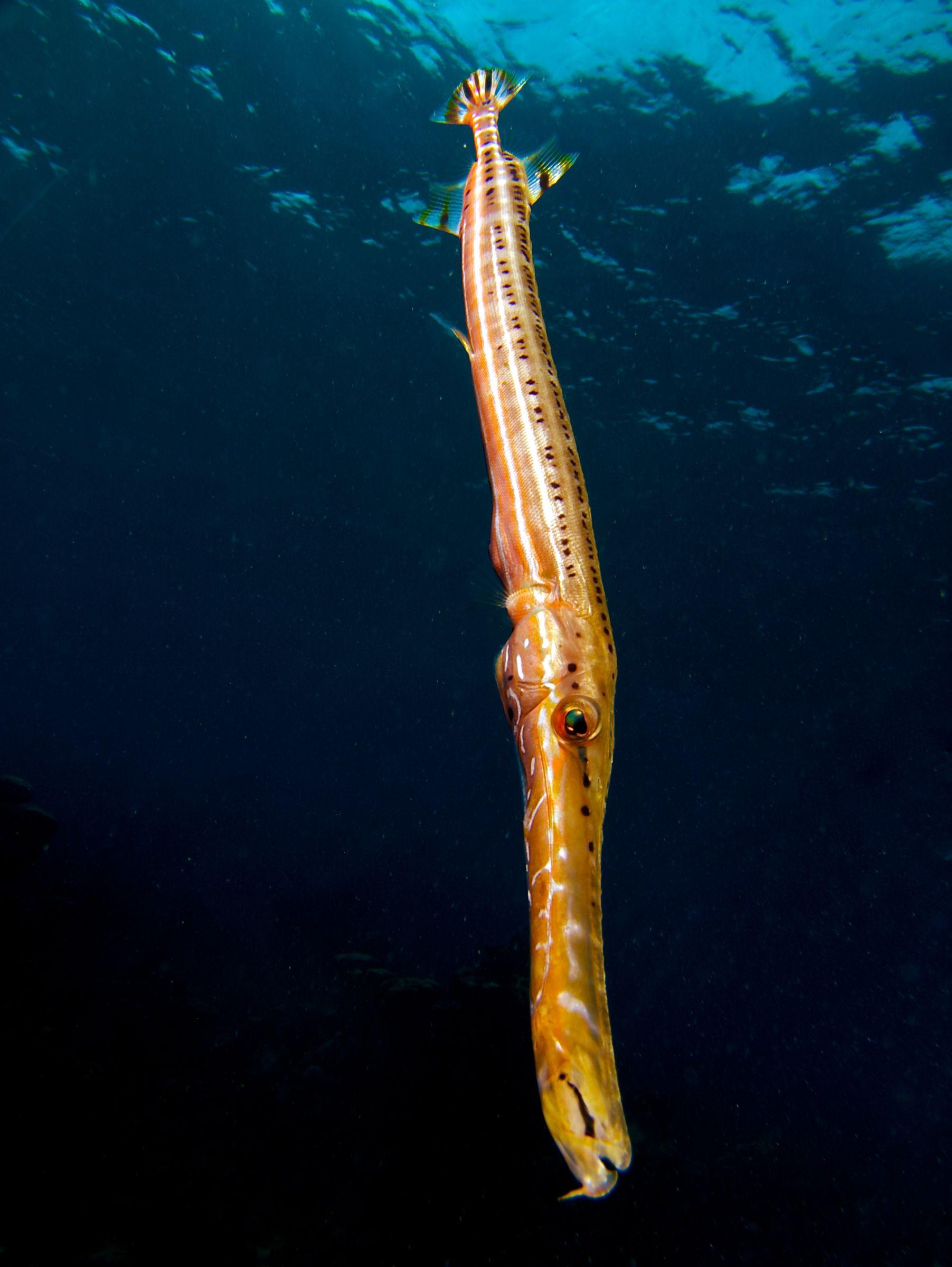
Trumpetfish
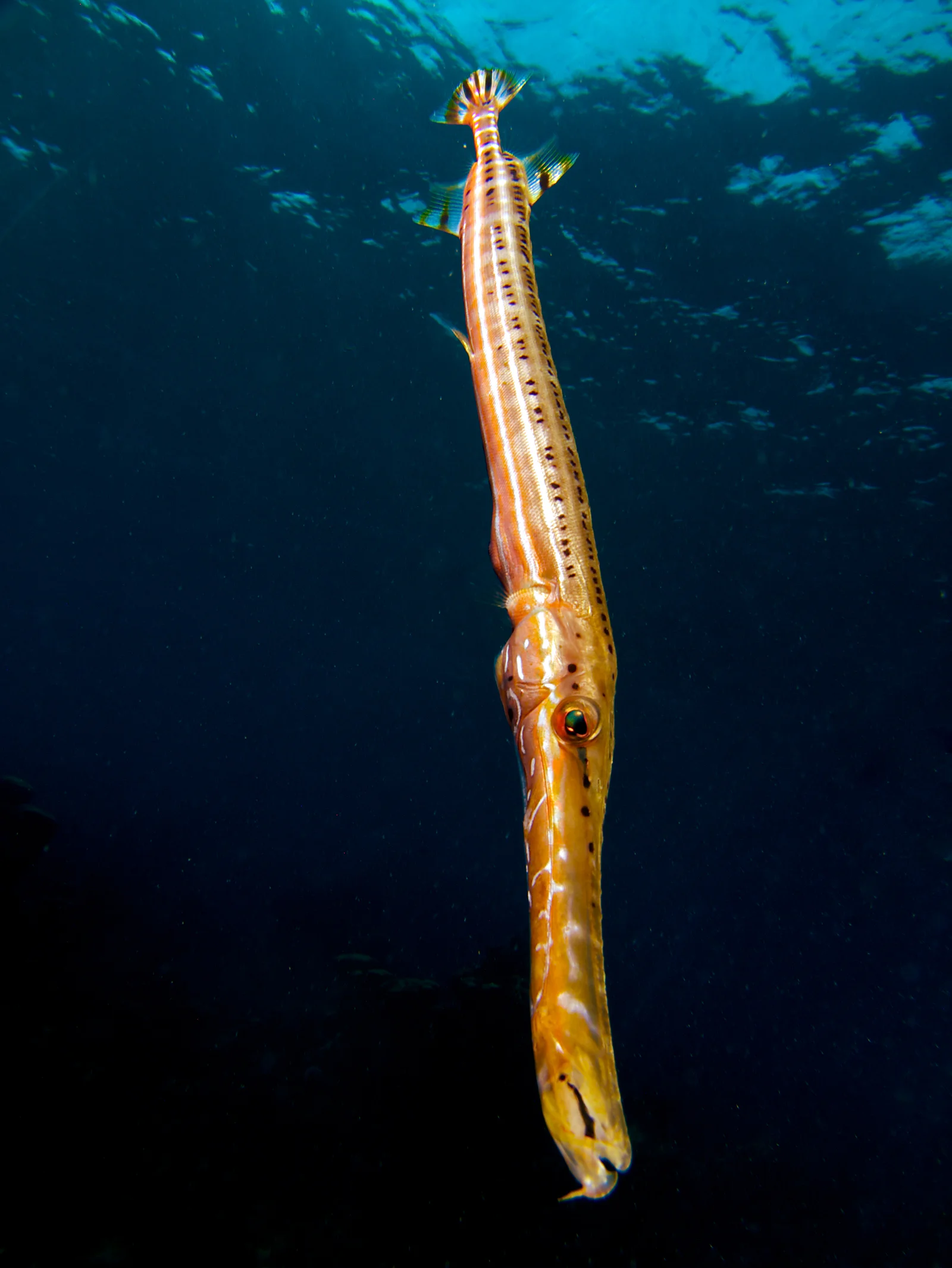
Aulostomus chinensis
About Trumpetfish.
The Trumpetfish, Aulostomus chinensis, is a fascinating and often elusive inhabitant of tropical Indo-Pacific reefs, known for its distinctive elongated form and masterful camouflage. Also commonly referred to as the Chinese Trumpetfish, Pacific Trumpetfish, or Painted Flutemouth, this species belongs to the family Aulostomidae, which comprises only three known species globally. With a conservation status of "Least Concern," its populations are considered stable and widely distributed, though the degradation of coral reefs remains a long-term concern for its habitat.
As an ambush predator, the Trumpetfish employs remarkable stealth and mimicry to hunt its prey. Divers often observe it drifting vertically, head-down, blending seamlessly with corals, gorgonians, or even alongside larger, non-threatening fish like groupers or rabbitfish, to approach unsuspecting small fish and crustaceans. This slow-moving hunter relies on its ability to dart down vertically and rapidly suck prey into its protrusible, trumpet-like mouth. Typically solitary, these fish are found in clear, calm waters around rocky and coral reefs, inhabiting depths generally ranging from 3 to 122 meters, though they can be found deeper, up to 245 meters. They thrive in waters with temperatures typically between 21–27°C. This species is a common sight at dive sites such as Ligpo Island, Cathedral, and Royal Garden.
Identification
Identifying the Trumpetfish is relatively straightforward due to its unique morphology:
- Body Shape: It possesses a very elongated, laterally compressed, and somewhat stick-like body, growing up to a maximum length of 80 cm (31 inches).
- Snout and Mouth: A defining feature is its long, tubular snout, which gives the fish its common name. At the tip of its lower jaw, a small barbel is present. Its mouth is highly protrusible, capable of extending forward to create a vacuum to engulf prey.
- Coloration: Trumpetfish exhibit highly variable coloration, allowing them to adapt to their surroundings. Common color phases include uniform or mottled patterns of brown, green, or grey. A striking bright yellow (xanthic) morph is also frequently observed in some areas. They possess the remarkable ability to change their colors rapidly to enhance their camouflage.
- Fins:
- The first dorsal fin is composed of 8 to 12 isolated spines located mid-body.
- The second dorsal fin, consisting of 24 to 27 soft rays, is shaped similarly to and positioned directly above the anal fin. Both the dorsal and anal fins are typically light with a distinctive dark basal bar.
- The caudal (tail) fin is wedge-shaped and usually features two round black spots.
- Small pelvic fins are located mid-body, each with a single black spot at its base.
- Scales: The body is covered with small, rough scales.
Where it lives.
The Trumpetfish (Aulostomus chinensis) is a fascinating and often-overlooked inhabitant of tropical and subtropical marine environments, known for its elongated body and unique hunting strategies. This species is widely distributed across the Indo-Pacific and Eastern Central Pacific, ranging from East Africa to Hawaii and the Easter Islands, extending north to southern Japan and south to Lord Howe Island. It is also found in the Eastern Central Pacific, including areas around Panama, Costa Rica, Colombia, and the Galapagos Islands.
Divers can typically encounter Trumpetfish in clear, calm, shallow waters, though their depth range is quite extensive. They are commonly observed at depths of 3–120 m, with some records indicating their presence down to 245 m. These fish are primarily reef-associated and benthopelagic, meaning they live near the seafloor.
Key habitats and associated ecosystems include:
- Coral Reefs: Trumpetfish are frequently found in and around vibrant coral reefs, including reef slopes, walls, and pinnacles. They utilize the complex structures of both stony corals and black corals for camouflage and ambush predation.
- Rocky Reefs: In addition to coral formations, they also inhabit rocky areas, blending seamlessly with their surroundings.
- Seagrass Beds: Juveniles and adults alike can be found in seagrass beds, where their elongated bodies and ability to swim vertically allow them to mimic seagrass blades, aiding in their stealthy hunting.
- Vertical Structures: Trumpetfish are masters of camouflage, often orienting themselves vertically, head-down, to blend in with sea fans, pipe sponges, sea whips, and other upright reef structures. They can rapidly change their coloration to match their environment, appearing in shades of brown, green, gray, or yellow, often with pale stripes or spots.
While generally solitary, Trumpetfish are known to employ a unique hunting strategy by shadowing larger, herbivorous fish, using them as a moving blind to approach unsuspecting prey. They are typically found in tropical and subtropical waters with temperatures ranging from approximately 21–27°C.
How it behaves.
Underwater Encounter Behavior
Trumpetfish are masters of disguise, often remaining motionless or swimming slowly to blend seamlessly with their surroundings. Divers may spot them hanging vertically, head-down, among sea whips, pipe sponges, or other vertical structures, mimicking the swaying of gorgonians in the current. Their elongated, slender bodies and ability to rapidly change color, utilizing specialized skin cells called chromatophores, allow them to match various backgrounds, including yellow, reddish-brown, or mottled gray-brown hues. This exceptional camouflage helps them evade predators and ambush unsuspecting prey. A notable behavior is "shadowing," where a Trumpetfish will discreetly position itself behind a larger, often herbivorous, fish like a surgeonfish or parrotfish. By using the larger fish as cover, the Trumpetfish can approach its prey without detection. They have even been observed shadowing scuba divers.Feeding Habits
As strict carnivores, Trumpetfish primarily feed on smaller fish and invertebrates, including gobies, blennies, and shrimp. They are passive hunters, relying on stealth and ambush rather than high-speed pursuits. Their distinctive tubular snout and highly protrusible mouth are key to their feeding success. When prey is within striking distance, the Trumpetfish rapidly expands its jaws, creating a powerful suction force that draws the victim into its mouth, often swallowing it whole. This "pipette feeding" mechanism allows them to consume prey nearly the size of their own body. While they hunt during the day, they appear to be most successful during twilight hours.Social Structure
Trumpetfish are generally solitary creatures. They do not typically form schools, and interactions with other Trumpetfish are usually limited to territorial displays, particularly during the breeding season. Despite their solitary nature, they play an important role in the coral reef ecosystem as both predators and prey.Notable Seasonal Patterns Relevant to Divers
Information regarding specific seasonal patterns for *Aulostomus chinensis* is limited, but general Trumpetfish reproductive behavior involves elaborate courtship rituals. These displays occur near the water's surface, where males rapidly change colors and engage in dance-like movements to attract females. Similar to seahorses, the female transfers her eggs to the male, who then fertilizes and incubates them in a specialized pouch until they hatch. While the exact timing for *A. chinensis* is not well-documented, some Trumpetfish species are known to reproduce in the springtime. Juvenile Trumpetfish are often found at greater depths, sometimes exhibiting a reddish color to blend with black corals or deep sponges.Where to see it.
Evidence for philippines · 3 dive sites
General range is not evidence of occurrence at a specific dive site.
Cathedral
Panglao
Site occurrence not yet documented
Season not yet documented
No dated observations available.
Ligpo Island
Anilao
Site occurrence not yet documented
Season not yet documented
No dated observations available.
Royal Garden
Panglao
Site occurrence not yet documented
Season not yet documented
No dated observations available.
Gallery.