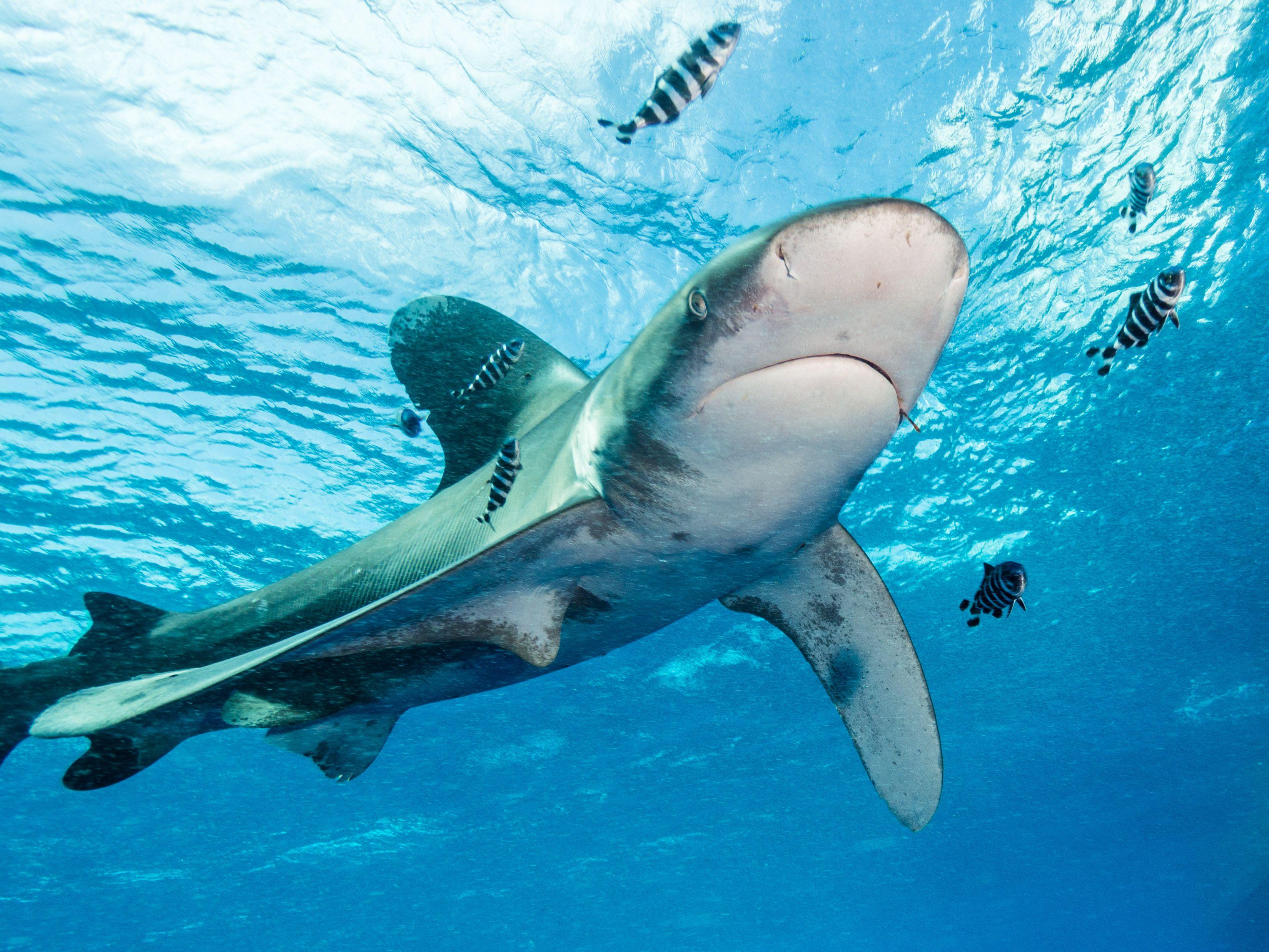
Whitetip Reef Shark
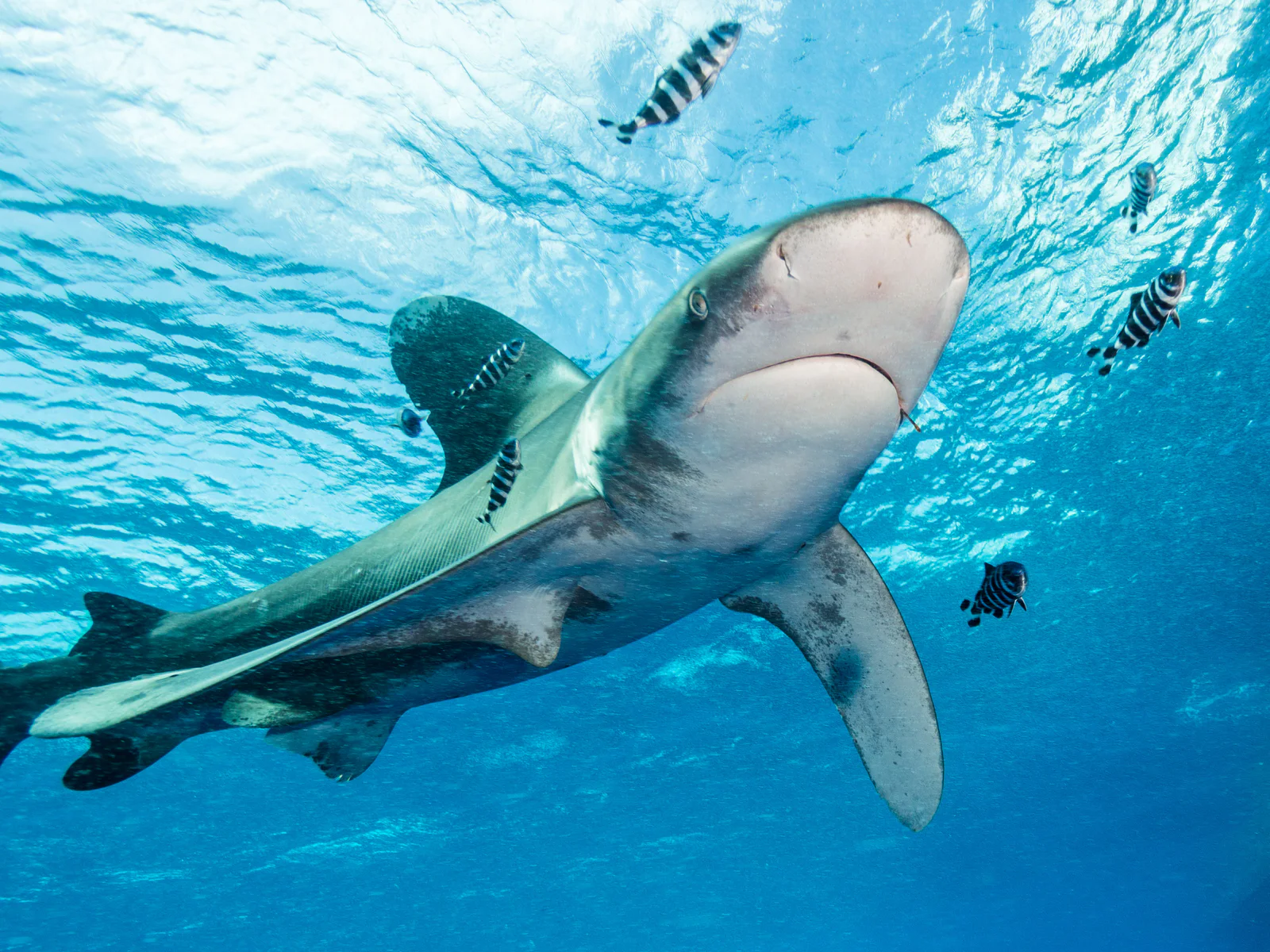
Triaenodon obesus
About Whitetip Reef Shark.
The Whitetip Reef Shark (Triaenodon obesus) is a common and charismatic species belonging to the Carcharhinidae family, often encountered by divers across the Indo-Pacific. Recognizable by its distinctive white-tipped fins, this slender reef shark plays a vital role in coral reef ecosystems. While generally considered harmless and curious towards humans, its global population is assessed as Vulnerable by the IUCN Red List due to increasing fishing pressure and habitat degradation.
These sharks are primarily nocturnal predators, spending their days resting in sheltered areas such as caves, under ledges, or on sandy bottoms, often in groups referred to as "cuddle puddles" or "shivers". Unlike many other shark species, the Whitetip Reef Shark possesses the unique ability to pump water over its gills while stationary, allowing it to remain motionless without needing to swim constantly to breathe. At night, they become active hunters, utilizing their lithe bodies to wriggle into reef crevices and holes in pursuit of bony fish, cephalopods, and crustaceans that hide while sleeping. They are known to be highly site-attached, often returning to the same resting spots for extended periods.
The Whitetip Reef Shark is widely distributed throughout tropical and subtropical waters of the Indian and Pacific Oceans, ranging from East Africa to the Eastern Pacific, including the Red Sea, Indian subcontinent, Australia, and numerous Pacific islands. They are almost exclusively associated with clear coral reef habitats, lagoons, sandy flats, and near drop-offs. While they can be found at depths ranging from 1 to 330 meters, they are most commonly observed by divers at depths of 8–40 meters. Dive sites such as Norman Reef, Crystal Bay, Batu Bolong, Karang Makassar (Manta Point), Castle Rock, Crystal Rock, Shotgun (The Cauldron), Golden Passage, Tatawa Besar, and Tatawa Kecil are known locations where this species is commonly observed.
Identification
The Whitetip Reef Shark is a relatively small and slender shark, typically reaching a maximum length of 1.6 meters, though some individuals have been reported up to 2.13 meters. Key identification features include:
- Body Shape: A slender body with a short, broad, and flattened snout.
- Coloration: Generally grey-brown on the upper body, fading to a pale or white underside. Scattered small, dark spots are often visible on its flanks, which can be unique to each individual.
- Fins: The most distinguishing characteristic is the brilliant white tips on the first dorsal fin and the upper lobe of the caudal (tail) fin. White tips may also occasionally be present on the second dorsal fin and lower caudal fin lobe. The first dorsal fin is positioned well back on the body, closer to the pelvic fins than the pectoral fins. There is no ridge between the first and second dorsal fins.
- Head Features: It has large, oval eyes with vertical pupils and distinctive tubular skin flaps beside its nostrils. The mouth often presents with a distinct downward slant.
Where it lives.
The Whitetip Reef Shark (Triaenodon obesus) is a quintessential inhabitant of tropical and subtropical coral reef ecosystems across the vast Indo-Pacific region. This slender shark is commonly encountered by divers, particularly during daylight hours when it often rests within the intricate structures of the reef.
Its geographic distribution is extensive, spanning from the eastern coast of Africa, through the Red Sea and Indian Ocean, across northern Australia and numerous Pacific islands, and extending eastward to Central America, including locations like the Cocos Islands, Galapagos, and the coasts of Panama and Costa Rica.
Whitetip Reef Sharks are almost exclusively associated with clear, shallow waters on or near coral reefs. They are frequently found:
- Around coral heads and ledges with significant vertical relief.
- Within coral lagoons and over sandy flats adjacent to reefs.
- Near drop-offs to deeper waters.
During the day, these sharks exhibit a sedentary nature, often found resting motionless on the bottom, in caves, or under coral ledges. Unlike many other requiem sharks, the Whitetip Reef Shark can actively pump water over its gills, allowing it to remain stationary without needing to swim continuously for respiration. They are known to be social, sometimes gathering in groups within these resting spots.
While commonly observed at depths of 8–40 m, their preferred range for divers, Whitetip Reef Sharks have been recorded in shallower waters, occasionally entering depths of less than 1 m when foraging. Exceptionally, they have been found at much greater depths, with records extending down to 330 m.
As nocturnal hunters, they emerge at night to forage for prey, utilizing their slender bodies to wriggle into crevices and holes within the reef to extract hidden fish, cephalopods, and crustaceans.
How it behaves.
The Whitetip Reef Shark (Triaenodon obesus) is a slender, medium-sized shark, typically reaching up to 1.6 meters in length, easily identified by the distinctive white tips on its first dorsal and upper caudal fins. A common inhabitant of Indo-Pacific coral reefs, this species is a captivating sight for divers in tropical waters.
- Underwater Encounter Behavior
Whitetip Reef Sharks are generally considered docile and are often curious around divers, making them a popular subject for underwater encounters. During daylight hours, they are frequently observed resting motionless on the seabed, in caves, or under coral ledges, a unique ability among many requiem sharks due to their capacity to actively pump water over their gills without constant swimming. While typically unperturbed by human presence, if a diver approaches too closely, a Whitetip Reef Shark will usually respond by calmly swimming away rather than displaying aggressive behavior. They are not considered dangerous to humans, though caution is always advised, particularly if provoked or during active feeding periods. - Feeding Habits
These sharks are primarily nocturnal predators, becoming most active after dusk to hunt for prey that seeks shelter in the reef. Their diet mainly consists of bony fishes, cephalopods (such as octopuses), and crustaceans (like crabs and spiny lobsters). Whitetip Reef Sharks are specialists in extracting hidden prey, using their slender bodies to wriggle into tight holes, crevices, and under coral heads, sometimes even breaking off coral in their vigorous pursuit. They utilize scent, sound, and electroreception to detect their meals. While they typically hunt individually, cooperative hunting has been observed in some locations, where groups work together to flush out prey. Unlike some other shark species, Whitetip Reef Sharks do not usually become agitated or enter a feeding frenzy when hunting in groups. - Social Structure
Whitetip Reef Sharks are social animals, often found in loose aggregations, sometimes referred to as "shivers," during the day. They commonly rest together in groups within caves or on ledges, occasionally piled on top of one another. This species exhibits strong site fidelity, often returning to the same favored resting spots daily, sometimes for years. They are non-territorial and share their home ranges with other individuals of their species. - Notable Seasonal Patterns
Whitetip Reef Sharks are found in clear, tropical waters throughout the Indo-Pacific region, typically associated with coral reef habitats at depths commonly encountered at 8–40 m, though they can range from 1 to 330 meters. Their presence at dive sites is generally consistent year-round in these tropical environments, as they do not undertake extensive migrations. While they are viviparous, giving birth to 1 to 5 pups per litter with a biennial reproductive cycle, specific seasonal breeding aggregations highly relevant to divers are not widely documented. Divers can expect to encounter these sharks consistently across their known dive sites, such as Norman Reef, Crystal Bay, and Castle Rock, regardless of specific seasons.
Where to see it.
Evidence for philippines · 20 dive sites
General range is not evidence of occurrence at a specific dive site.
Apo Island Marine Sanctuary
Apo Island
Site occurrence not yet documented
Season not yet documented
No dated observations available.
Bahura
Anilao
Site occurrence not yet documented
Season not yet documented
No dated observations available.
Cabilao Shark Point (Lighthouse)
Cabilao Island
Site occurrence not yet documented
Season not yet documented
No dated observations available.
Doljo Point
Panglao
Site occurrence not yet documented
Season not yet documented
No dated observations available.
Ernie's Point
Puerto Galera
Site occurrence not yet documented
Season not yet documented
No dated observations available.
Fish Bowl
Puerto Galera
Site occurrence not yet documented
Season not yet documented
No dated observations available.
Gorgonian Wall
Cabilao Island
Site occurrence not yet documented
Documented site seasonality: Jan, Feb, Mar, Apr, May, Jun, Jul, Aug, Sep, Oct, Nov, Dec
No dated observations available.
Mainit Point
Anilao
Site occurrence not yet documented
Season not yet documented
No dated observations available.
Mapating
Anilao
Site occurrence not yet documented
Season not yet documented
No dated observations available.
Nat-Nat
El Nido
Site occurrence not yet documented
Season not yet documented
No dated observations available.
Pescador Island (The Cathedral)
Moalboal
Site occurrence not yet documented
Season not yet documented
No dated observations available.
Shark Cave
Puerto Galera
Site occurrence not yet documented
Season not yet documented
No dated observations available.
Shark Ridge (Apo Reef)
Apo Reef Natural Park
Site occurrence not yet documented
Season not yet documented
No dated observations available.
The Atoll
Puerto Galera
Site occurrence not yet documented
Season not yet documented
No dated observations available.
The Canyons
Puerto Galera
Site occurrence not yet documented
Season not yet documented
No dated observations available.
Tubbataha North Atoll
Tubbataha Reefs
Site occurrence not yet documented
Season not yet documented
No dated observations available.
Tubbataha South Atoll & Jessie Beazley
Tubbataha Reefs
Site occurrence not yet documented
Season not yet documented
No dated observations available.
Verde Island Wall
Verde Island
Site occurrence not yet documented
Season not yet documented
No dated observations available.
Washing Machine (Verde Island)
Verde Island
Site occurrence not yet documented
Season not yet documented
No dated observations available.
West Escarceo
Puerto Galera
Site occurrence not yet documented
Season not yet documented
No dated observations available.
Gallery.