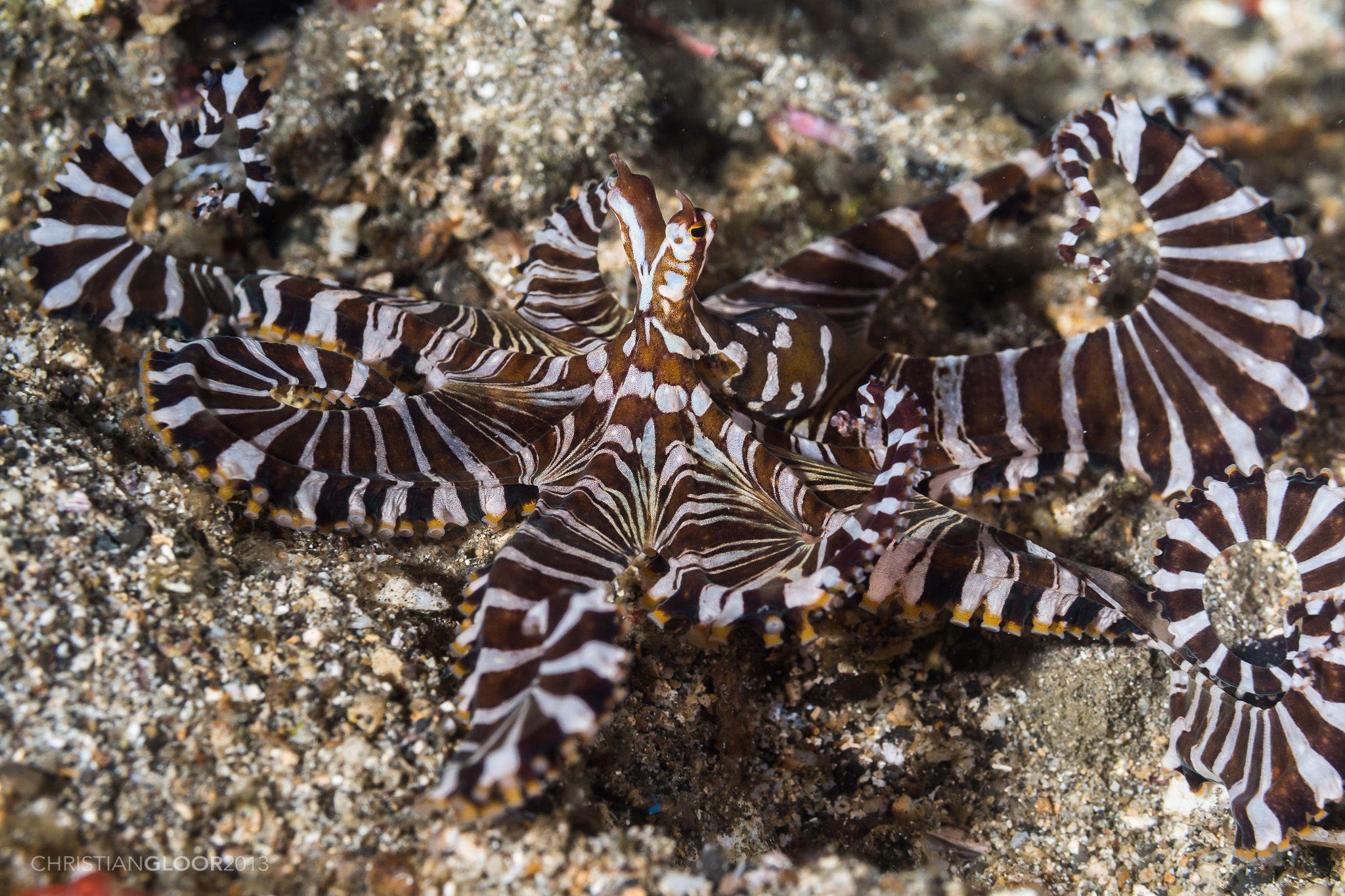
Wonderpus
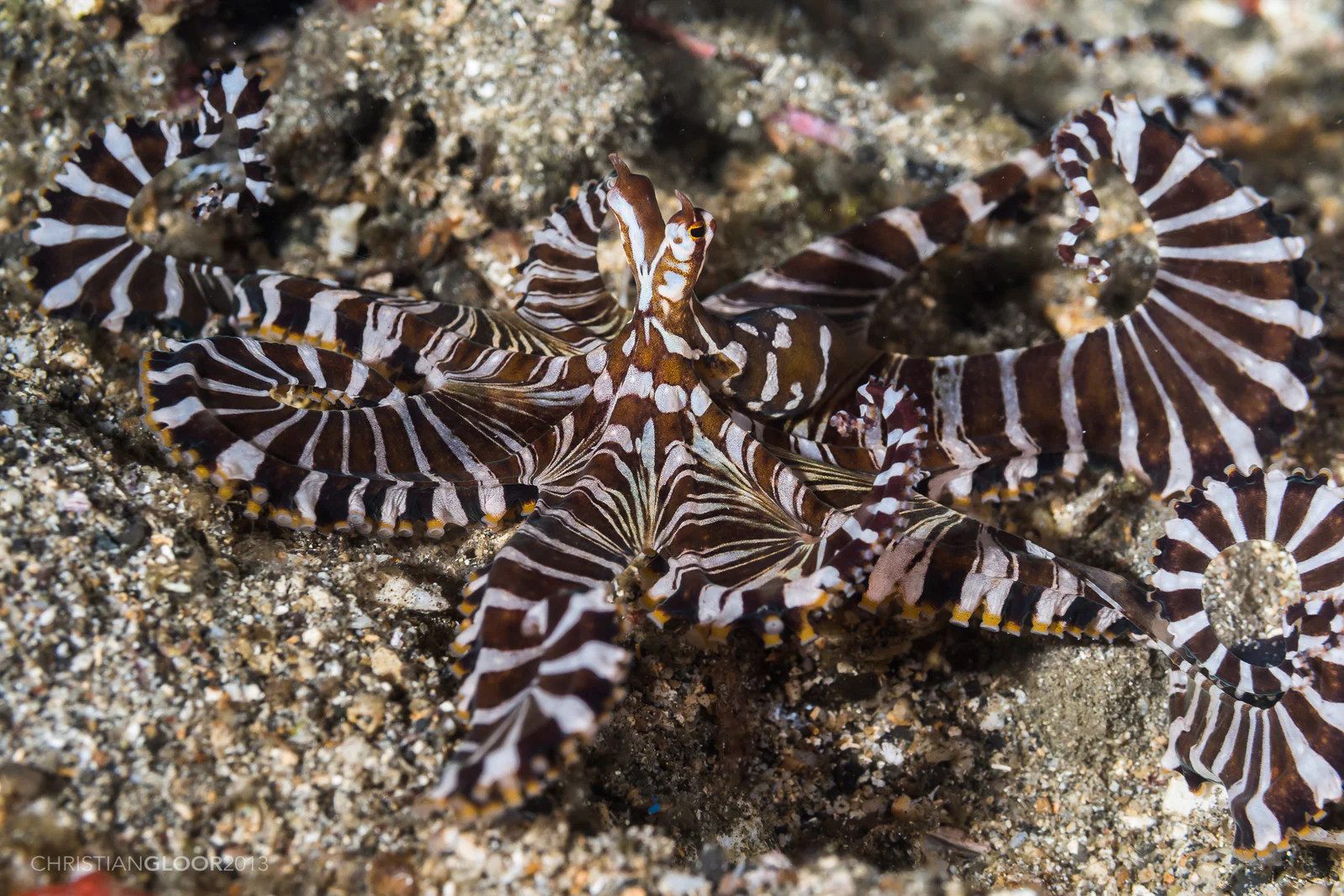
Wunderpus photogenicus
About Wonderpus.
The Wunderpus photogenicus, commonly known as the Wonderpus, is a captivating cephalopod belonging to the family Octopodidae. Its scientific name itself, derived from the German "wunder" meaning 'marvel or wonder' and "photogenicus" for its striking appearance, perfectly encapsulates why this octopus is a highly sought-after subject for underwater photographers and a prize find for divers.
First discovered in the 1980s and officially described in 2006, the Wonderpus is a relatively recent addition to marine biology, yet it has quickly gained renown for its distinctive patterns and intriguing behaviors. This species is currently listed as Data Deficient in terms of conservation status, highlighting the need for further research into its populations and life history.
Found predominantly in the shallow, soft sediment habitats of the Indo-Malayan Archipelago, including areas from Vanuatu to Papua New Guinea, Indonesia, Malaysia, and the Philippines, the Wonderpus typically inhabits depths of 0.5 to at least 20 m. It prefers sandy, muddy, or rubble substrates, where it either digs its own burrows or occupies those created by other marine life. While often observed foraging openly in muck, it is primarily crepuscular, meaning it is most active during dawn and dusk, though sightings during daylight hours are not uncommon.
The Wonderpus is a carnivorous predator, feeding mainly on small crustaceans such as crabs and shrimp, as well as small fishes. It employs clever hunting strategies, including probing its long arms into holes to flush out prey or flaring its webbed arms over patches of sand to trap enclosed animals, a technique known as webcasting.
This species is also a master of defense, utilizing its dramatic coloration as a warning display. When threatened, its patterns become even more pronounced, potentially signaling toxicity or mimicking venomous creatures like lionfish or banded sea snakes that share its habitat.
Notable dive sites where the Wonderpus has been observed include Secret Bay (occasional), Anilao Pier (occasional), Kalipayan (rare), and Giant Clams (rare).
Identification
Identifying the Wonderpus is a rewarding experience for divers, thanks to its unique and consistent physical characteristics:
- Size: This is a slender octopus with a maximum arm span of up to 50 cm (20 in). Its mantle (body) is relatively small, typically measuring 24–36 mm, while its arms are remarkably long and thin, often 5–7 times the mantle length.
- Coloration and Pattern: The Wonderpus displays a striking and fixed pattern of bold white spots and bands over a rich rusty brown to reddish-brown background. These white markings are individually unique, much like human fingerprints, allowing researchers and divers to differentiate between individuals. The white bands along its arms are distinct and broken, rather than forming a continuous border.
- Eyes: A key distinguishing feature is its small eyes, which are set atop elongated stalks. This gives the head a characteristic Y-shaped appearance, with a long, conical papilla (horn-like projection) located over each eye.
- Mantle: The mantle is thin-walled with weak musculature and a wide aperture. While generally smooth, it can raise dorsal papillae when needed.
- Differentiation from Mimic Octopus: The Wonderpus is often confused with the similar-looking Mimic Octopus (*Thaumoctopus mimicus*). However, the Wonderpus can be distinguished by its longer, more prominent eye stalks (mimic octopuses have much shorter ones), its typically richer reddish-brown coloration with sharply defined white markings, and its broken white arm bands. While both are masters of mimicry, the Wonderpus's fixed pattern is central to its impersonations, whereas the mimic octopus is known for more varied shape-shifting.
Where it lives.
The Wunderpus photogenicus, commonly known as the Wonderpus, is a captivating cephalopod primarily found in the shallow, tropical waters of the Indo-Malayan Archipelago. Its distribution spans from Vanuatu to Papua New Guinea, Indonesia, and Malaysia, extending north to the Philippines.
This species thrives in specific environments, making it a sought-after subject for underwater photographers and divers. Key habitat characteristics include:
- Substrate Preference: Wonderpus octopuses predominantly inhabit soft sediment habitats, favoring sandy, silty, and muddy bottoms, often interspersed with rubble. They are frequently observed in sandy areas within lagoons and bays. These octopuses are adept at utilizing their environment for shelter, either by digging their own burrows or occupying those created by other marine animals.
- Depth Range: Typically encountered in shallow coastal waters, the Wonderpus is usually found at depths of less than 20 m. Observations and collected specimens indicate a depth range from as shallow as 0.5 m down to at least 20 m. Some reports suggest they can be found slightly deeper, up to 25 m.
- Ecosystem Associations: The Wonderpus is a prominent resident of "muck dive sites," which are characterized by gentle slopes of volcanic sand, often littered with debris, sponges, algae, and rubble. These areas provide ample opportunities for foraging, as the Wonderpus is a crepuscular hunter, emerging at dusk and dawn to feed on small crustaceans and fish. They employ unique hunting strategies, such as flaring their arms and webs over patches of sand or coral rubble to trap prey, or probing into holes and crevices.
Dive sites such as Secret Bay, Anilao Pier, Kalipayan, and Giant Clams are known locations where divers with the appropriate certification may occasionally spot this remarkable species.
How it behaves.
The Wonderpus (Wunderpus photogenicus) is a captivating cephalopod renowned for its striking appearance and intriguing behaviors, making it a highly sought-after subject for divers and underwater photographers. This species is found in the shallow, soft sediment habitats of the Indo-Malayan Archipelago, including areas like Indonesia, the Philippines, Papua New Guinea, and Vanuatu.
Underwater Encounter Behavior
Wonderpus are typically encountered on sandy, muddy, or rubble substrates, often in depths ranging from 0.5 to 20 m. While the species is described as an active daytime forager, it is primarily active during dusk and dawn, making these "golden hours" ideal for divers hoping for an encounter. When disturbed or threatened, the Wonderpus can rapidly alter its body shape and coloration, intensifying its dramatic white spots and bands over a reddish-brown background. This distinctive pattern is believed to serve as a warning display, potentially mimicking venomous animals like lionfish or banded sea snakes to deter predators. Divers should approach slowly and deliberately, allowing the octopus to acclimate to their presence, as they are known to be quick to take flight when threatened. They may also retreat into burrows, which they either dig themselves or occupy from other animals.
Feeding Habits
As a carnivorous predator, the Wonderpus primarily feeds on small fishes and crustaceans, such as crabs. Their hunting strategy involves extending their long, thin arms into holes and crevices to probe for prey, or by spreading their arms and webs over patches of sand or coral rubble to create a "net" to trap enclosed prey, a behavior known as webcasting. Once prey is captured, they typically retract into a shelter to feed, minimizing their exposure to predators.
Social Structure
The Wonderpus exhibits little to no social behavior and is generally considered solitary. During mating, the male mounts the female and uses a specialized arm, the hectocotylus, to transfer sperm packets (spermatophores) into the female's mantle. Females are known to produce around 2,000 small, stalked eggs, which they carry within their arm crown, holding them with their suckers rather than attaching them to surfaces. The female typically broods her eggs for approximately 37 to 38 days, and dies shortly after the offspring hatch. Hatchlings are planktonic, swimming in the water column with tiny finger-like arms.
Notable Seasonal Patterns
While specific seasonal breeding patterns are not extensively documented for the Wonderpus, observations indicate that females brood their eggs for a period of several weeks. The species is observed year-round in its habitat, with no strong seasonal migration patterns reported. Divers may encounter individuals at various stages of their life cycle throughout the year, particularly during the peak foraging times of dusk and dawn. The unique white markings on each individual's body remain constant over time, allowing for photo-identification by researchers and divers.
Where to see it.
Evidence for philippines · 4 dive sites
General range is not evidence of occurrence at a specific dive site.
Anilao Pier
Anilao
Site occurrence not yet documented
Season not yet documented
No dated observations available.
Giant Clams
Puerto Galera
Site occurrence not yet documented
Season not yet documented
No dated observations available.
Kalipayan
Panglao
Site occurrence not yet documented
Season not yet documented
No dated observations available.
Secret Bay
Anilao
Site occurrence not yet documented
Season not yet documented
No dated observations available.
Gallery.