Wrasse (assorted)
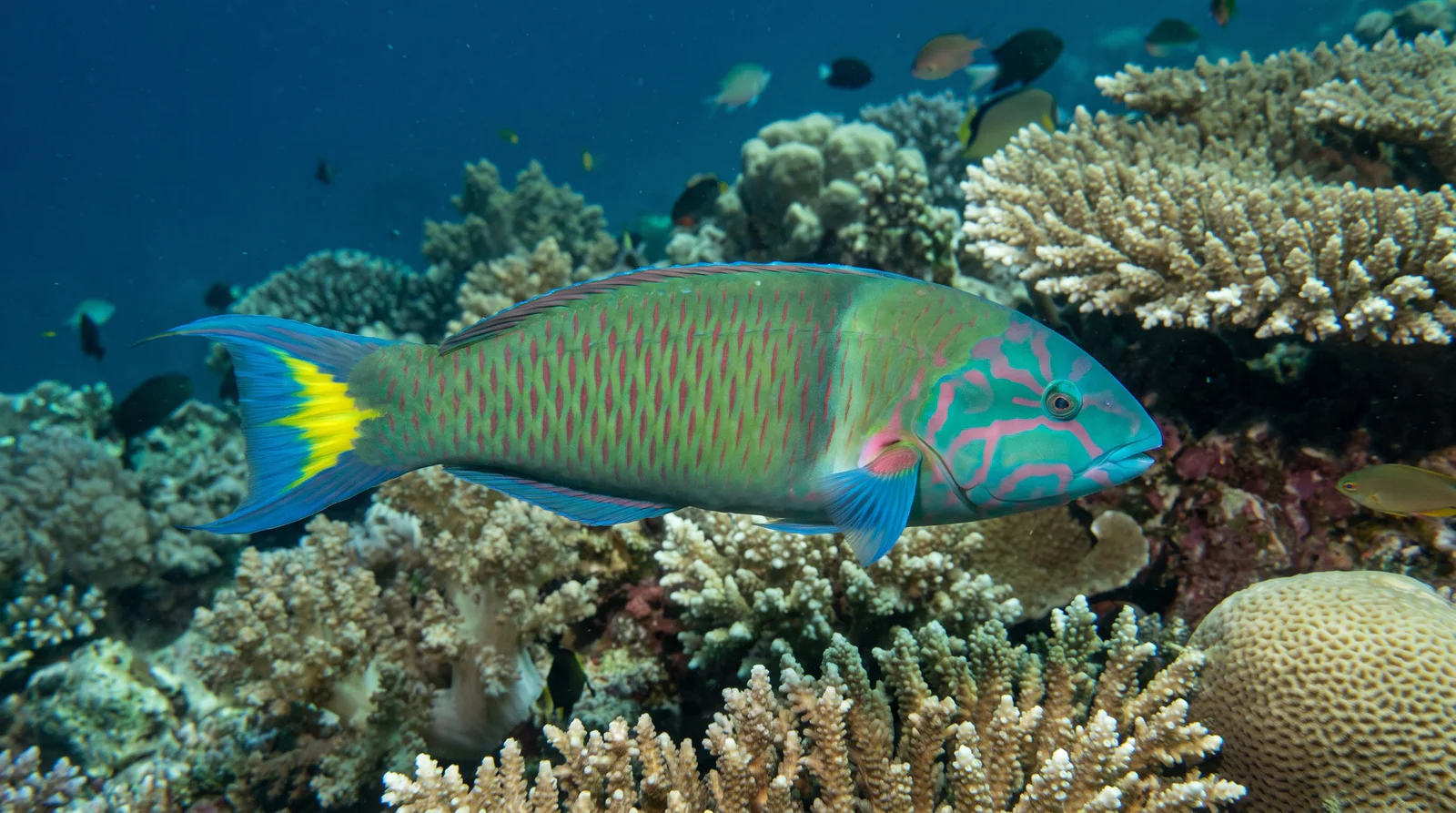 AI-generated
Image credit: AI-generated illustration · Generated for Diveity; no third-party rights · Higgsfield nano_banana_pro image generation
Labridae spp.
About Wrasse (assorted).
This group entry covers wrasse sightings where the species was not recorded. Wrasses make up the family Labridae. Diveity also has individual pages for the Humphead Wrasse (Napoleon) (Cheilinus undulatus) and the Bluestreak Cleaner Wrasse (Labroides dimidiatus) and, from the western Atlantic, the Bluehead Wrasse (Thalassoma bifasciatum), the Creole Wrasse (Clepticus parrae) and the Rosy Razorfish (Xyrichtys martinicensis). Parrotfishes have their own entries (Parrotfish (assorted) and Bumphead Parrotfish) and are not covered here.
FishBase's family page, opened on 15 October 2026, lists 81 genera and 686 species of Labridae in the Atlantic, Indian and Pacific oceans, and describes size, shape and colour as very diversified. Most species burrow in sand and eat benthic invertebrates, some feed on plankton, and some small species remove ectoparasites from larger fishes.
On parrotfishes, FishBase and WoRMS agree. FishBase says the Labridae includes the parrotfishes (Scaridae) as the subfamily Scarinae, and its Scaridae page says the group was moved into Labridae, adding that a complete phylogeny of Labridae is suitable before changing the well known and recognisable clade. WoRMS likewise accepts Labridae with Scarinae as an accepted subfamily and lists Scaridae as a superseded rank. Diveity keeps parrotfishes in separate entries.
Identification
- Family features: FishBase describes a protrusible mouth, most jaw teeth separated by gaps and usually jutting outward, and cycloid scales that are generally large to moderate.
- Size: Varies enormously. FishBase gives a maximum length of about 2.3 m for the family and says many species are under 15 cm, the shortest being 4.5 cm. For single species it lists 229 cm standard length for C. undulatus and 14 cm total length for L. dimidiatus.
- Humphead wrasse: FishBase describes a deep body with prominent jaws and lips, and adults with a large hump on the forehead and a blue-green to blue head with irregular yellowish lines and two black lines running back from the eye.
- Bluestreak cleaner wrasse: Reef Life Survey describes a black stripe from the snout through the eye that widens into a black wedge on the tail, with a pointed snout and the mouth at its tip.
- Moon wrasse: FishBase identifies adults of T. lunare by a yellow lunate tail, and says large males turn blue on the head, grading to green towards the tail. Sources disagree on its maximum size: FishBase gives 45 cm total length and Reef Life Survey gives 25 cm.
FishBase says most wrasse species change colour and sex as they grow, from an initial phase of both males and females to an often brilliantly coloured terminal male phase. The Bluehead (T. bifasciatum) has three primary colour phases, and its largest phase, with a bright blue head, is always male. Juveniles can look different again: FishBase describes juvenile T. lunare with a large dark spot in the middle of the dorsal fin, and Reef Life Survey describes juvenile L. dimidiatus as black with a neon blue line along the back. A wrasse seen once may therefore be a different phase of one seen earlier.
Conservation status varies by species. FishBase lists the humphead wrasse as Endangered on the IUCN Red List (assessed 17 July 2024) and in CITES Appendix II, and Reef Life Survey calls it heavily overfished. The bluestreak cleaner wrasse and the moon wrasse are listed as Least Concern (both assessed 2008).
Where it lives.
Wrasses are listed by FishBase as marine, with some brackish occurrence, in the Atlantic, Indian and Pacific oceans. Because the family is so large, habitat and depth depend on the species. The ranges below belong to the individual species named, not to the family as a whole.
Where Divers Find Them
- Humphead wrasse: FishBase says adults inhabit steep outer reef slopes, channel slopes and lagoon reefs, with a depth range of 0-100 m and benthopelagic at 2-60 m. Juveniles are found in coral-rich areas of lagoon reefs where staghorn Acropora corals abound, and also on algae reefs or in seagrasses.
- Bluestreak cleaner wrasse: FishBase gives coral-rich areas of inner lagoons and subtidal reef flats to seaward reefs, at 0-100 m (usually 1-30 m) and 24-28 °C. Reef Life Survey lists 1-40 m.
- Moon wrasse: FishBase gives the upper portions of lagoon and coastal reefs and protected seaward reefs, usually on the upper portions of ledges and heads, at 1-20 m. It also enters estuaries.
- Bluehead (western Atlantic): FishBase says it inhabits reef areas, inshore bays and seagrass beds, at 0-40 m and usually 3-30 m.
- Creole wrasse (western Atlantic): FishBase, which now lists the species as Bodianus parrae, gives seaward reef slopes, occasionally shallow patch reefs, at 8-100 m.
- Rosy razorfish (western Atlantic): FishBase says it is most common in open sandy areas, at 2-21 m.
Distribution also varies. FishBase gives the moon wrasse as ranging from the Red Sea and East Africa to the Line Islands, north to southern Japan and south to Lord Howe Island and northern New Zealand, and the humphead wrasse from the Red Sea to South Africa and the Tuamotu Islands, north to the Ryukyu Islands and south to New Caledonia. The Bluehead, Creole wrasse and rosy razorfish are western Atlantic species. Taxonomy note: FishBase and WoRMS treat Clepticus parrae as a superseded combination of Bodianus parrae, while Diveity's individual page uses the older name.
How it behaves.
Wrasse diets vary by species. FishBase gives the humphead wrasse as feeding on molluscs, fishes, sea urchins, crustaceans and other invertebrates, and as one of the few predators of toxic animals such as sea hares, boxfishes and crown-of-thorns starfish. The moon wrasse feeds mainly on small benthic invertebrates and fish eggs, the Bluehead on zooplankton and small benthic animals and sometimes on ectoparasites of other fishes, and the rosy razorfish on small sand-dwelling invertebrates. The Creole wrasse forms large midwater aggregations that feed on plankton, small jellyfishes, pteropods, pelagic tunicates and invertebrate larvae.
FishBase lists the bluestreak cleaner wrasse, moon wrasse and Bluehead as protogynous hermaphrodites, meaning individuals change from female to male. For the bluestreak cleaner wrasse, FishBase says cleaning stations are occupied by a pair of adults, a group of juveniles, or a group of females with a dominant male, and that a female becomes a functional male if the dominant male disappears; sex reversal is completed in 14-18 days. The species feeds on crustacean ectoparasites and on the mucus of other fishes. It stays at stations where other fish come to be cleaned, and FishBase says the cleaning intensity is not related to client size or commonness.
Underwater Encounter Behavior
FishBase says an unfamiliar visitor to a cleaning station is usually greeted by dance-like movements of the tail, and that juveniles behave this way when divers approach closely. Reef Life Survey says the cleaner wrasse is very common and sometimes approaches divers, and that its near-perfect mimic, the false cleaner fish, has its mouth on the underside of the snout. The humphead wrasse is usually solitary but may occur in pairs, roves across reefs by day and rests in caves and under coral ledges at night, according to FishBase. Reef Life Survey says it can become accustomed to divers at popular sites and is otherwise curious but shy. The rosy razorfish dives head first into the sand when frightened. FishBase also notes reports of ciguatera poisoning for the humphead wrasse.
Diver Tips
- Do not feed: Do not feed wrasses or other reef fish; watching natural behaviour is more informative.
- Cleaning station etiquette: Keep your distance, avoid chasing or blocking the fish and do not touch them, so that client fish can come and go.
- Photograph to identify: Take photos of the whole fish, the head, the tail and any markings, and note the size and whether it looks like a juvenile, a female or a brightly coloured male.
- Large wrasses: Observe large individuals such as the humphead wrasse from a distance, without touching or chasing them.
- Eating fish: Ask local advice before eating any reef fish; FishBase reports ciguatera poisoning for the humphead wrasse.
Where to see it.
Evidence for philippines · 5 dive sites
General range is not evidence of occurrence at a specific dive site.
Coral Garden
Davao Gulf
Documented site occurrence
Season not yet documented
Source reviewed on 2026-10-15 · Source: Asia Dive Site, Talikud Island page (undated; identical copy at islandsphilippines.com) · Observation date not documented
Eva's Point
Sipalay
Documented site occurrence
Season not yet documented
Source reviewed on 2026-10-15 · Source: cbartazo.com "Seeking Sipalay" trip report (2017-10-28, single diver, Artistic Diving guest) · Observation date not documented
Friday's Rock
Boracay
Documented site occurrence
Season not yet documented
Source reviewed on 2026-10-15 · Source: Wicked Squid Divers Boracay (Wayback snapshot 2026-03-12 of /boracay-dive-sites/) · Observation date not documented
Habok Habok
Sipalay
Documented site occurrence
Season not yet documented
Source reviewed on 2026-10-15 · Source: Diving Squad, "Sipalay Diving" guide (single-author first-person review) · Observation date not documented
Shangri-La Marine Sanctuary
Mactan
Documented site occurrence
Season not yet documented
Source reviewed on 2026-10-15 · Source: Divernet, "Don't Miss Mactan" by Henley Spiers (2018-11-18) · Observation date not documented
Gallery.
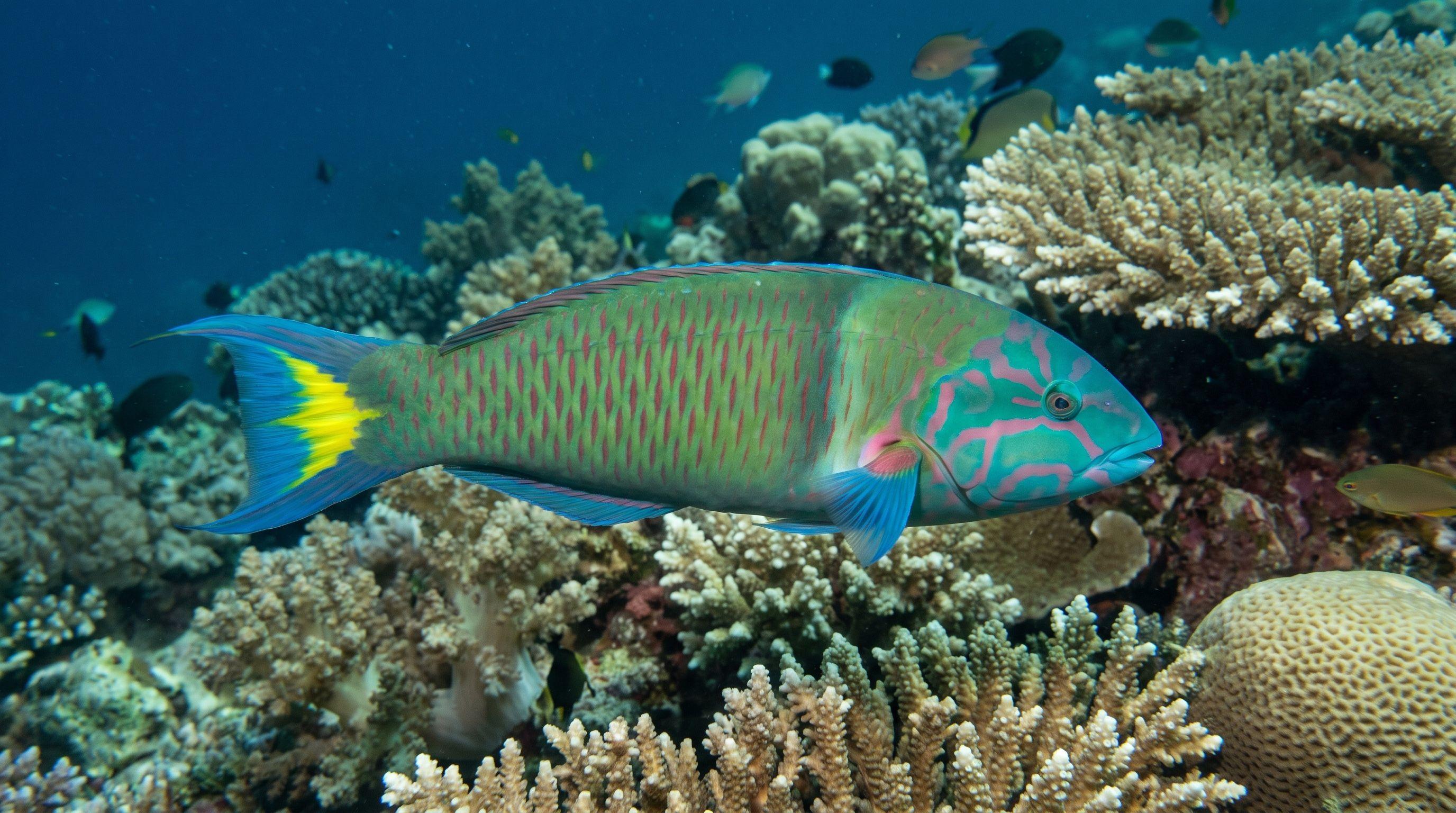 AI-generated
AI-generated illustration
Image credit: AI-generated illustration · Generated for Diveity; no third-party rights · Higgsfield nano_banana_pro image generation