Yellowtail Barracuda
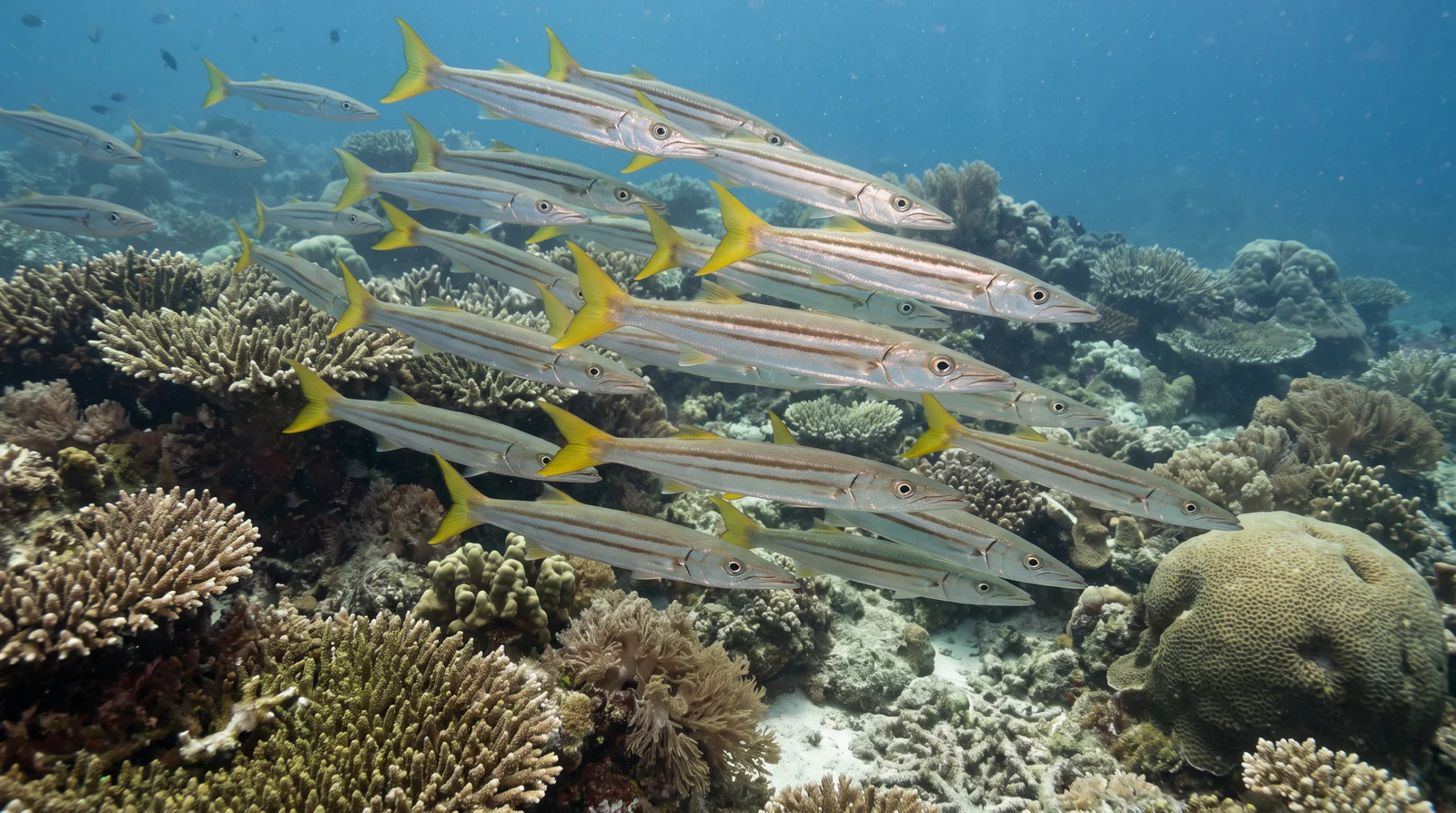 AI-generated
Image credit: AI-generated illustration · Diveity
Sphyraena flavicauda
About Yellowtail Barracuda.
The yellowtail barracuda is a small, slender barracuda of Indo-West Pacific reefs with a yellow tail, schooling by day and reaching 60 cm.
Names and classification
In the World Register of Marine Species the accepted name is Sphyraena flavicauda Rüppell, 1838, a barracuda of the family Sphyraenidae, which the register places in the order Sphyraeniformes; FishBase groups the family among the Carangaria and Wikipedia in the order Carangiformes. The register lists yellowtail barracuda as the English name and タイワンカマス as the Japanese one. Its synonyms there are Sphyraena langsar Bleeker, 1855 and Sphyraenella flavicauda (Rüppell, 1838); Wikipedia gives the same two names with their authors the other way round.
Identification
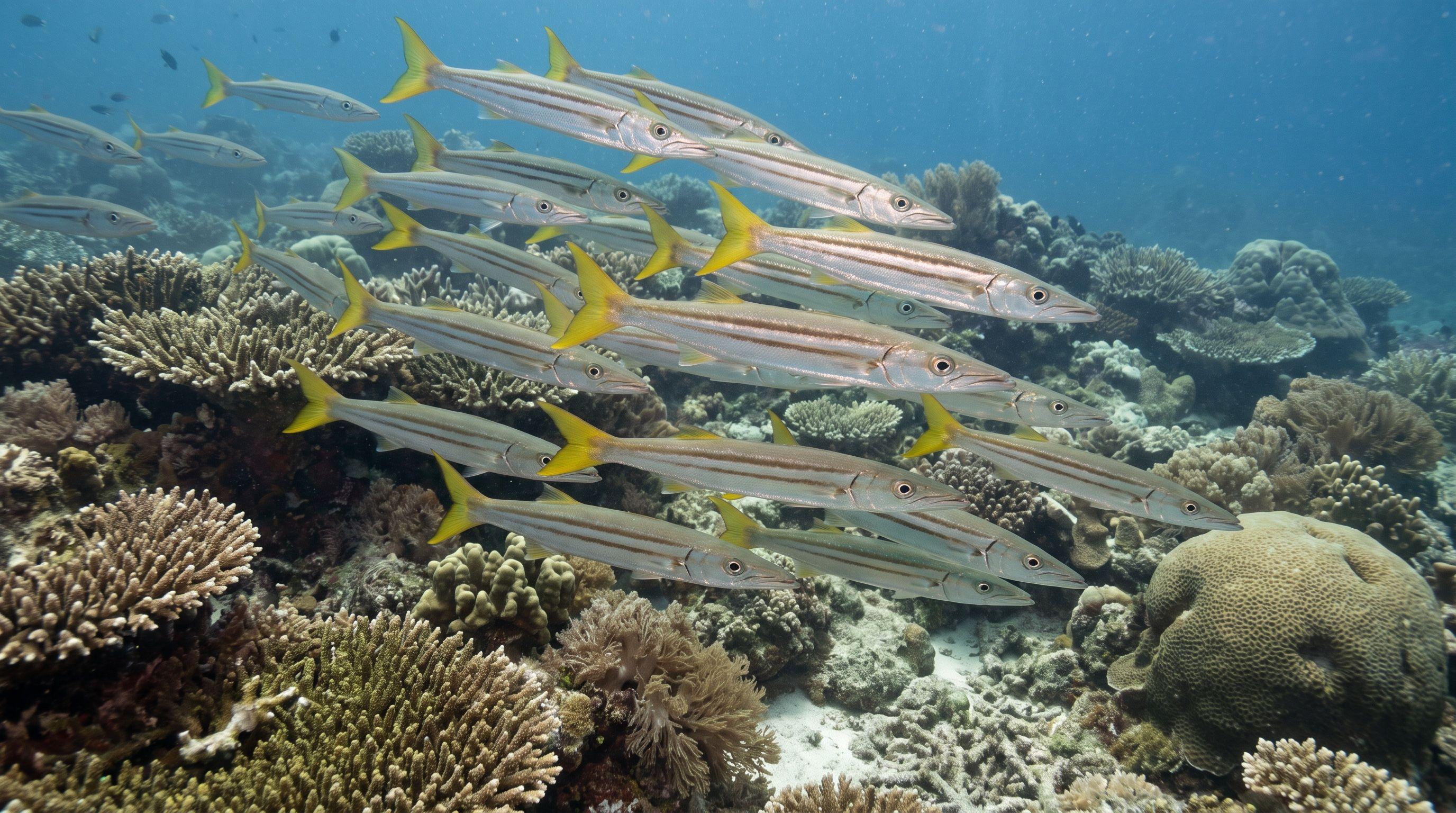
Wikipedia describes an elongated body with two well separated dorsal fins, the first with five spines of which the first is the longest, and the second beginning slightly ahead of the anal fin. The large head has a large eye, a pointed snout and long jaws, the lower jaw jutting forward, with fang-like teeth at the front of the upper jaw and a single large canine-like tooth at the tip of the lower. In its account the fish is grey on the back and white below, the flanks sometimes tinged yellow, and the tail is yellow with black margins. FishBase instead describes two brown or brownish-yellow stripes along the body, which may fade in old fish, and a yellowish tail fin, and counts six dorsal spines in total, nine dorsal soft rays, two anal spines and nine anal soft rays. The database adds that the species is more elongate than Sphyraena obtusata and differs from it in the height of the dorsal fin and the length of the pectoral fin.
Size and age
FishBase gives a maximum of 60 cm total length and a common length of 40 cm, with first maturity at 28 cm. Wikipedia also has 60 cm, with 35 to 40 cm as the normal size. The two disagree on age: Wikipedia says adults live to six years, while FishBase lists a maximum reported age of 99 years.
Conservation and people
Least Concern is the species' category on the IUCN Red List. The assessment date in FishBase, which cites version 2025-2 of the list, is 14 August 2023; Wikipedia's reference is the 2024 publication by Bucol and Carpenter. FishBase lists it as harmless to people and as taken by commercial fisheries.
Where it lives.
The yellowtail barracuda lives on lagoons, sheltered seaward reefs and bays of the Indo-West Pacific, recorded at depths of 2 to 25 m.
Range
In FishBase the species occurs in the Persian Gulf and from the Red Sea to Samoa, north to the Ryukyu Islands and south to the Great Barrier Reef; Wikipedia gives the same limits from the Red Sea to Samoa but does not mention the Persian Gulf. FishBase warns that the exact range is uncertain because the species has been confused with Sphyraena obtusata. Both call it a Lessepsian migrant to the Mediterranean, and Wikipedia says it came from the Red Sea through the Suez Canal. Wikipedia dates the first Mediterranean record to 1991, off Israel, and says the fish now reaches the whole eastern basin; it is established there but still relatively rare, and its true status may be hidden by confusion with related barracudas, although it and Sphyraena chrysotaenia were both found to be common off Libya.
Water and depth
In FishBase this is a tropical sea fish tied to reefs, found between 2 and 25 m in lagoons, on sheltered seaward reefs and in bays. The WoRMS entry carries the marine flag and no brackish or freshwater flag. Wikipedia places the schools in lagoons and on inner and outer reef slopes, and the juveniles in very sheltered coastal waters.
How it behaves.
The yellowtail barracuda gathers in schools by day on coastal reefs and probably hunts fish and large invertebrates at night.
Schools and feeding
FishBase says it often schools on coastal reefs, and Wikipedia that it schools by day in lagoons and on reef slopes and is probably a nocturnal hunter of fish and large invertebrates. Based on its recorded prey, FishBase gives a trophic level of 4.2 with a standard error of 0.59.
Breeding
According to Wikipedia its eggs and fry drift in the plankton, and the juveniles shelter in very sheltered coastal waters until they grow.
Where to see it.
Evidence for visayas · 1 dive site
General range is not evidence of occurrence at a specific dive site.
Gallery.
 AI-generated
 illustration
Image credit: AI-generated illustration · Diveity