Zebra Crab
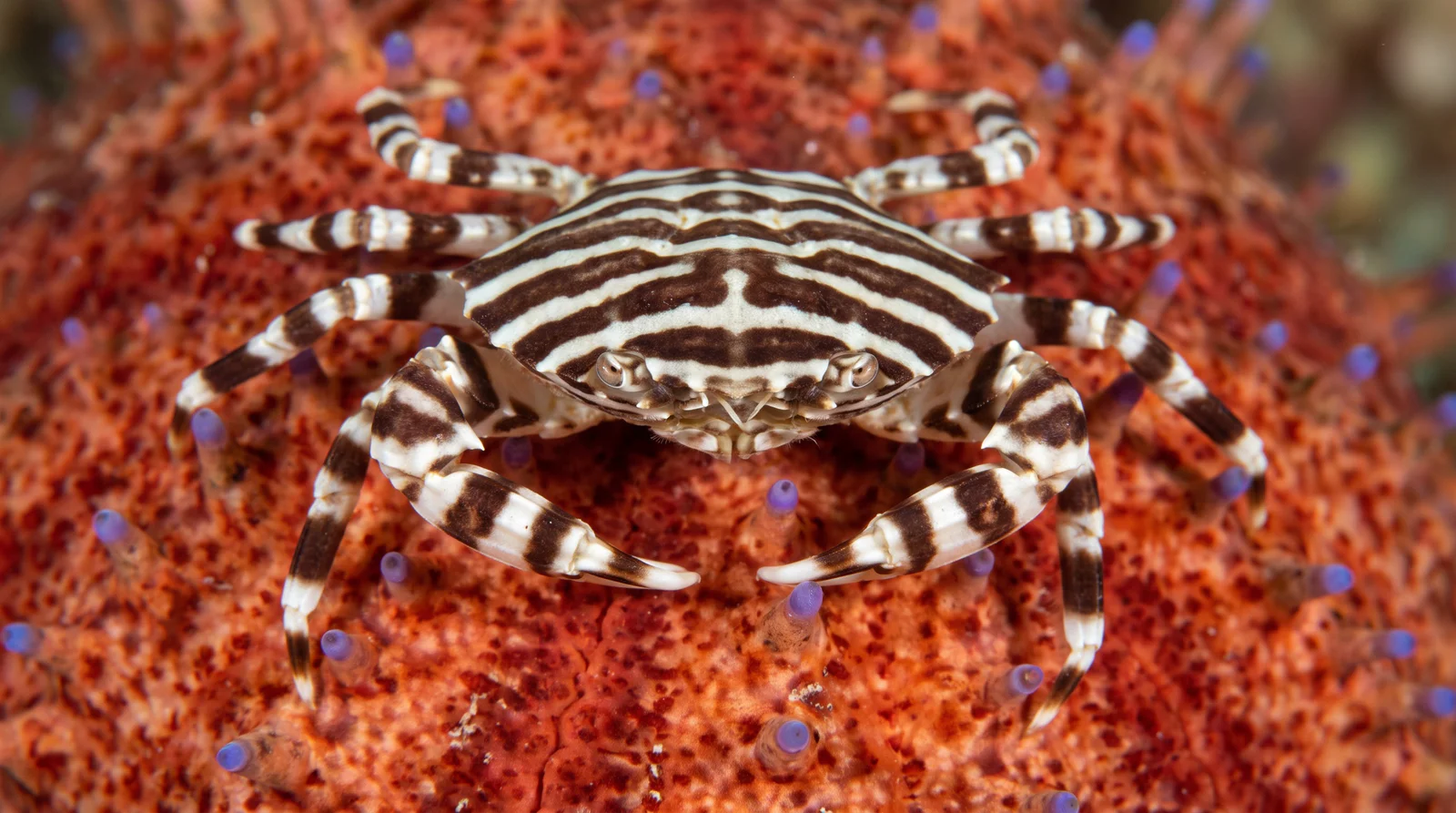 AI-generated
Image credit: AI-generated illustration · License unspecified · Source unspecified
Zebrida adamsii
About Zebra Crab.
The Zebra Crab, Zebrida adamsii, is a captivating macro crustacean renowned for its distinctive appearance and unique lifestyle. Belonging to the family Pilumnidae, this tiny crab forms an obligate commensal relationship with various species of sea urchins, particularly venomous fire urchins, throughout the tropical Indo-Pacific region. Its striking coloration provides exceptional camouflage, allowing it to blend seamlessly among the spines of its host, offering protection from predators.
Often found in shallow waters with temperatures ranging from 22–28°C, the Zebra Crab is a fascinating subject for divers with a keen eye for macro life. While generally solitary, it is occasionally observed with another individual on a single host urchin, where they typically maintain separate territories. The crab feeds on tiny organic particles and algae found on the urchin's surface, and also on the host's tube feet and epidermal tissue. This interaction is considered a symbiotic relationship, providing the crab with both refuge and a food source, while potentially benefiting the urchin through cleaning, though some suggest a slightly parasitic element due to its feeding habits.
The conservation status of Zebrida adamsii is currently listed as Data Deficient, highlighting the need for further research into its populations and ecological role.
Identification
- Size: This is a truly miniature species, reaching a maximum size of approximately 2 cm (0.8 in) in carapace width.
- Coloration: The most defining characteristic of the Zebra Crab is its bold, contrasting pattern of white and dark, reddish-brown (appearing black) vertical stripes across its carapace and limbs, strongly resembling a zebra. This disruptive coloration helps it disappear among the spines of its host.
- Body Shape: Its body is relatively flat and small, perfectly adapted for maneuvering and clinging within the tight spaces between an urchin's spines. Its carapace and limbs are smooth and may feature long spines projecting from the body.
- Host Association: A crucial identification feature is its obligate association with sea urchins. Divers will almost exclusively find Zebrida adamsii nestled deep within the spines of various urchin species, commonly including venomous fire urchins such as Asthenosoma varium and Astropyga radiata, as well as Diadema setosum, Toxopneustes pileolus, and Tripneustes gratilla. It possesses specialized joints on its walking legs that enable it to firmly grip its host's spines.
- Behavior: Unlike many other crabs, the Zebra Crab is quite stationary, rarely straying far from its host urchin. This makes spotting it a matter of carefully observing the urchin itself.
While sightings are occasional at dive sites like Bethlehem, the Zebra Crab's wide distribution across the tropical Indian and Western Pacific Oceans means it can be encountered in many reef environments where suitable host urchins are present.
Where it lives.
The Zebra Crab, Zebrida adamsii, is a fascinating macro species known for its obligate symbiotic relationship with various sea urchins across the Indo-Pacific. This small crab is almost exclusively found living among the spines of its host, utilizing the urchin for both protection and sustenance.
Habitat and Ecosystem:
- The Zebra Crab inhabits tropical coral reefs and mixed reef environments, which include areas of coral, sand, and rubble.
- Its distinctive black-and-white striped pattern provides excellent camouflage, allowing it to blend seamlessly with the spines of its host, thus avoiding predators.
- While the fact sheet mentions an exclusive association with fire urchins (Asthenosoma), research indicates a broader range of host species. These include various sea urchins such as Asthenosoma ijimai, Asthenosoma varium, Astropyga radiata, Diadema setosum, Heliocidaris crassispina, Pseudocentrotus depressus, Salmacis bicolor, Salmacis virgulata, Toxopneustes elegans, Toxopneustes pileolus, Tripneustes gratilla, and certain species of Acanthocidaris.
- The crab feeds on the host's tube feet and epidermal tissue, which the urchin can regenerate, suggesting a parasitic or commensal relationship.
Depth Range:
- Zebrida adamsii is typically found in shallow waters.
- Observations indicate it can be found at depths starting from approximately 11 m, with its presence noted in various shallow reef systems.
Distribution:
- This species has a wide geographic distribution throughout the tropical Indian Ocean and western Pacific Ocean.
- Its range extends from Japan down to Australia, encompassing many popular dive sites within this vast region.
- While often found solitary, Zebra Crabs can occasionally be observed in pairs on a single sea urchin.
How it behaves.
The Zebra Crab (Zebrida adamsii) is a captivating macro species for divers, instantly recognizable by its striking black-and-white striped body, which provides exceptional camouflage amidst the spines of its sea urchin host.
- Underwater Encounter Behavior: This small crab, reaching a maximum size of 2 cm (0.8 in), is an obligate symbiont, meaning it lives in close association with sea urchins, typically favoring species with long, needle-like spines. Its flat body and specialized hooked appendages on its walking legs allow it to cling firmly and maneuver adeptly within the tight spaces of the urchin's spines. Divers will find the Zebra Crab to be a relatively stationary creature, rarely straying far from its host, which provides both refuge from predators and a consistent food source. If its host is threatened or perishes, the crab will seek out another sea urchin. These crabs can be found in shallow tropical waters, often encountered at dive sites like Bethlehem.
- Feeding Habits: The Zebra Crab primarily feeds on tiny organic particles and algae that accumulate on the surface of its sea urchin host, using its pincers to scrape up food. It also consumes the host's tube feet and the epidermal tissue covering the urchin's test and the base of its spines. While this feeding behavior is often described as commensal, where the crab benefits and the urchin is largely unaffected, some research suggests a parasitic relationship, though the urchin readily regenerates the consumed tissues, incurring little long-term harm.
- Social Structure: Zebra Crabs are generally solitary, with a single individual or sometimes a pair occupying a sea urchin. If multiple crabs are present on a single host, they typically maintain separate territories among the spines, occasionally displaying mild competition for position. Females tend to be slightly larger than males and are more likely to remain on a chosen urchin, while males are known to move between hosts, particularly during breeding periods, in search of mates.
- Notable Seasonal Patterns: While specific seasonal breeding patterns are not extensively documented for divers, it is known that during the breeding season, male Zebra Crabs become more active, frequently moving from one urchin host to another to find females for mating. The larval stages of Zebrida adamsii are planktonic, undergoing several developmental phases before settling on the seabed and metamorphosing into juvenile crabs that then seek out a suitable sea urchin host.
Where to see it.
Evidence for philippines · 1 dive site
General range is not evidence of occurrence at a specific dive site.
Gallery.
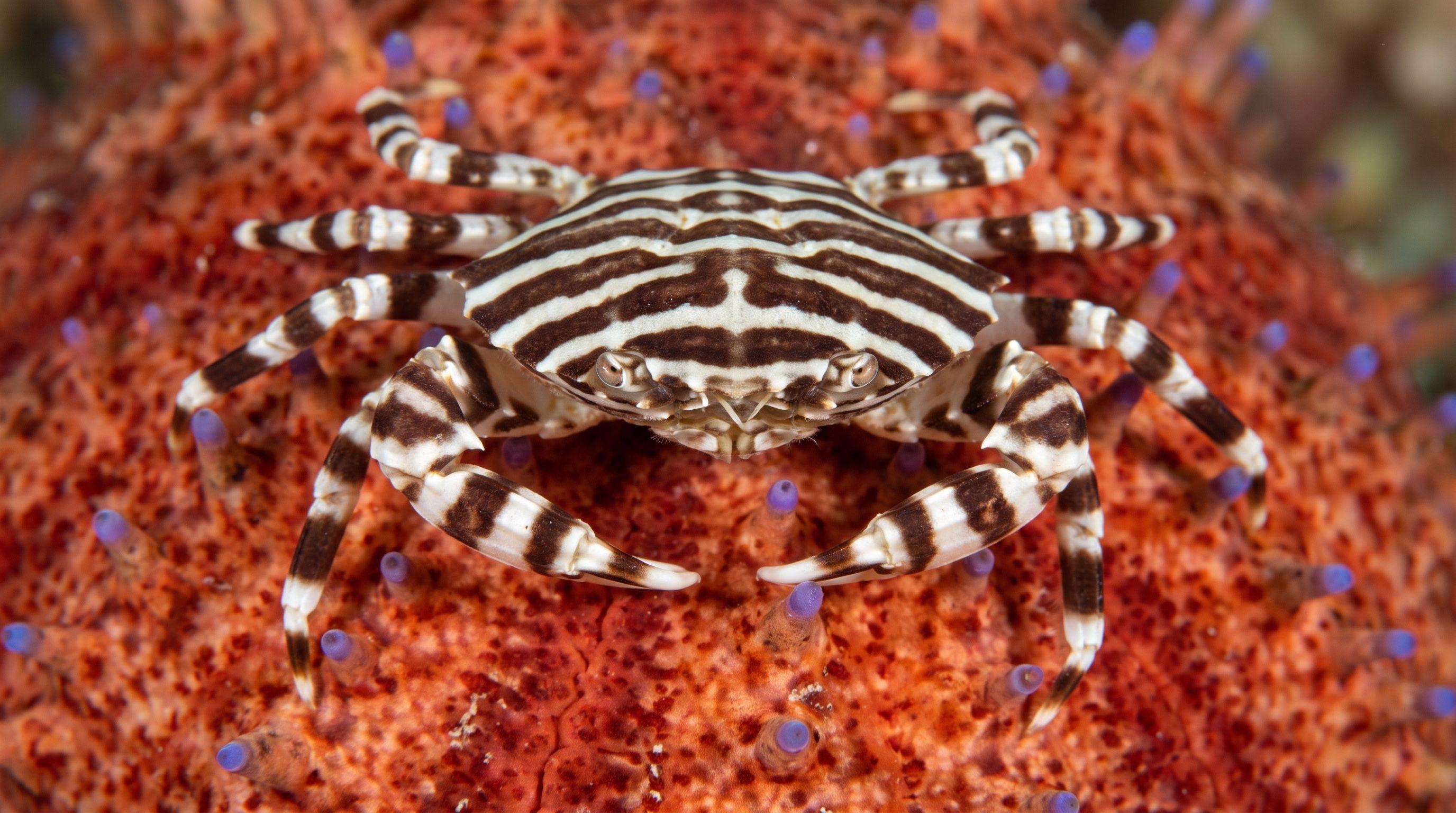 AI-generated
AI-generated illustration
Image credit: AI-generated illustration · License unspecified · Source unspecified