Diveity holds eleven dive-site records for Tulamben, on the north-east coast of Bali, and nine of them list a shore entry. The USAT Liberty wreck is described as a shore dive by Neptune Scuba Diving and Blue Season Bali, though Wannadive.net lists it as dived both by boat and from the shore, and Batu Kelebit is reached by boat. The answers below come from those records and the operators, guides and newspapers they cite, and they say so where a question is left open.
What's the best time of year to dive Tulamben?
The Liberty is the only Tulamben record with best months: Neptune Scuba Diving, a Sanur operator, calls April to October the peak season there. It gives 15 to 25 m of visibility on most days, falling now and then to 10 to 15 m in the November to March wet season after heavy rain or a rough sea. The other ten records name no season, and none of them says whether every site can be dived in every month, so the wet-season picture rests on that one operator.
Which Tulamben sites are dived from the shore?
Most of them. Seraya Secret, Sidem, Batu Niti and Batu Belah, the sites listed as muck dives, are all shore entries in Diveity's records, as are Boga Wreck, Batu Ringgit, Coral Garden, Drop Off and Kubu Monkey. For the Liberty the entry is disputed between shore only and boat or shore, as above. Batu Kelebit is the exception: Blue Season Bali says it is reached by a 10 to 15 minute ride in a local boat, or jukung.
Is Tulamben good for beginner divers?
Some sites are rated for beginners and some are not, and at the Liberty the sources disagree. Wannadive.net, Dive Concepts and Blue Season Bali say divers of every level can dive at least part of the wreck. Neptune Scuba Diving treats Open Water as the minimum for the stern and midsection, roughly 5 to 18 m, and strongly recommends Advanced Open Water for the bow. The shallowest part, the stern, is at about 5 m. Current is disputed too: Neptune describes slack water on most days and 1 to 2 knots on about one day in ten, mostly in the wet season, while Wannadive.net rates it medium, 1 to 2 knots.
Among the muck sites, Diveity rates Seraya Secret for beginners on the word of Amed Jepun Divers and Dive Concepts, who report minimal or weak current on a calm sandy slope; they disagree on its maximum depth, 25 m for Amed Jepun Divers and 30 m for Dive Concepts, and neither sets a required certification. Batu Belah is rated for beginners from Dive Concepts and Bali Fab Dive, with a 25 m maximum given by Dive Concepts, and Sidem's beginner rating and mild current rest on Amed Jepun Divers alone. Two Tulamben records point the other way: Boga Wreck is rated advanced by Amed Jepun Divers and Dive Concepts, and Batu Ringgit by Amed Jepun Divers. At Batu Niti, Amed Jepun Divers warns of variable currents and recommends the site to more experienced divers. Five records set no level at all.
The entry itself is the physical hurdle the sources describe. On the Liberty, Neptune Scuba Diving says the walk in over rolling volcanic gravel is the hardest physical part of the dive, and The Jakarta Post, reporting a visit in 2009, found the water's edge full of fist-sized volcanic stones. Neptune also says the broken midsection has swim-throughs at 12 to 22 m that can collapse, and connects the deaths recorded on the wreck to divers going further into the structure than those openings. Agree the route, the depth and the experience your operator expects before you go in.
What's the USAT Liberty wreck, and is it at Tulamben?
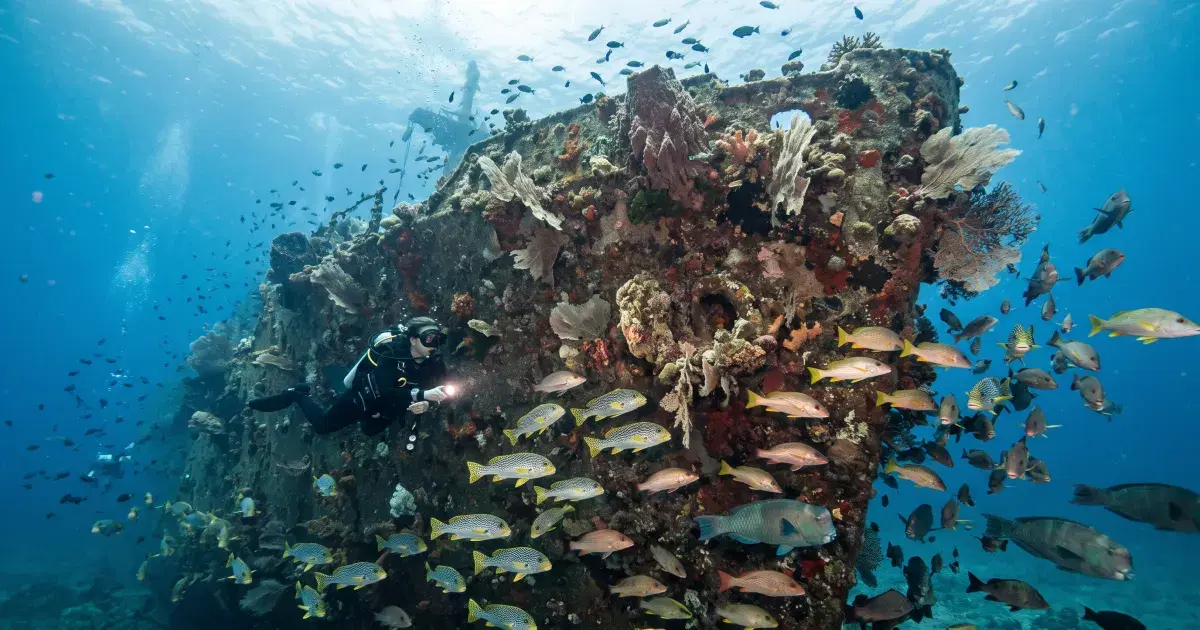
Yes, it lies off Tulamben beach: about 40 m out according to Wikipedia and Blue Season Bali, roughly 30 m according to Neptune Scuba Diving. Wikipedia says the cargo ship served the US Navy in the First World War as USS Liberty, was torpedoed on 11 January 1942 south-west of the Lombok Strait, and was run aground at Tulamben, where her cargo and fittings were taken off; the tremors of Mount Agung's 1963 eruption then sent her sliding off the beach. Wikipedia names the submarine I-66, Wannadive.net and Neptune name it I-166. The wreck runs from about 5 m at the stern down to the bow, which Neptune puts at 25 to 30 m; Wikipedia, Wannadive.net and Blue Season Bali give about 30 m as the deepest point, and Dive Concepts 28 m. Blue Season Bali calls it the most accessible Second World War wreck you are likely to dive.
Do I need a boat to dive Tulamben?
Not for most sites: as listed above, nine of the eleven records give a shore entry, the Liberty's entry is disputed, and Batu Kelebit is the boat dive. At the Liberty, Neptune Scuba Diving describes the entry beach as rolling volcanic gravel and says most operators use porters to carry tanks and BCDs to the entry point; The Jakarta Post found fist-sized volcanic stones at the water's edge there in 2009. The records do not say where to enter at each beach, so that is a question for your operator.
What marine life will I see at Tulamben's muck sites?
Seraya Secret is dived slowly for small and unusual animals rather than for scenery, and Amed Jepun Divers calls it a mecca for macro lovers and underwater photographers. There, Amed Jepun Divers lists ghost pipefish, harlequin shrimps, flamboyant cuttlefish, frogfish and many nudibranch species, Dive Concepts names frogfish, nudibranchs, leopard moray eels and many species of rare shrimps, and the Underwater Photography Guide names pygmy seahorses and frogfish. At Sidem, Amed Jepun Divers names mimic octopus together with ghost pipefish, frogfish, seahorses and nudibranchs. These are operator and writer lists; none of the sources says how often any of these animals turns up.
How does Tulamben compare to Amed for shore diving?
Amed lies further east along the same coast. Its records also include shore-entered muck dives: Ghost Bay, which Amed Jepun Divers calls Amed's premier muck dive, and Melasti, which it calls a quintessential muck diving site. Amed's wreck is the Japanese Shipwreck, a shore dive that Amed Jepun Divers describes as a relatively small, coral-covered vessel beside a reef and Evolution Diver as a small coastal vessel of about 20 m; no source says where it came from or how it sank. How the two places compare for crowds, development or the number of dive operators is not something any Diveity record measures.
FAQ
How deep is the USAT Liberty wreck at Tulamben? The stern is at about 5 m. Neptune Scuba Diving places the bow at 25 to 30 m, Wikipedia, Wannadive.net and Blue Season Bali give about 30 m for the deepest point, and Dive Concepts gives 28 m. On certification, Neptune Scuba Diving asks for Open Water in the shallower half and strongly recommends Advanced Open Water for the bow, while Wannadive.net lists the site for all divers, Dive Concepts calls it accessible to all levels and Blue Season Bali says divers of every level can see parts of it.
Is Tulamben a good base for a Bali dive trip? Diveity's records give no verdict on that. They do give two reasons divers sleep there. Neptune Scuba Diving says a first-light dive on the Liberty, for the school of bumphead parrotfish it reports from about May to October, needs a night in Tulamben because the drive from Sanur takes 2.5 to 3 hours. Wannadive.net says the wreck is very crowded from 10:00 to 14:00 and quiet early in the morning and late in the afternoon for divers staying in Tulamben.
Do I need reef booties for Tulamben's beach entries? No record Diveity read gives footwear advice. What the sources describe is the Liberty's entry beach: rolling volcanic gravel (Neptune Scuba Diving) and fist-sized volcanic stones at the water's edge (The Jakarta Post, 2009). Ask your operator what to wear for the entry and exit.