Brown Chromis
 AI-generated
Image credit: AI-generated illustration · Diveity
Chromis multilineata
About Brown Chromis.
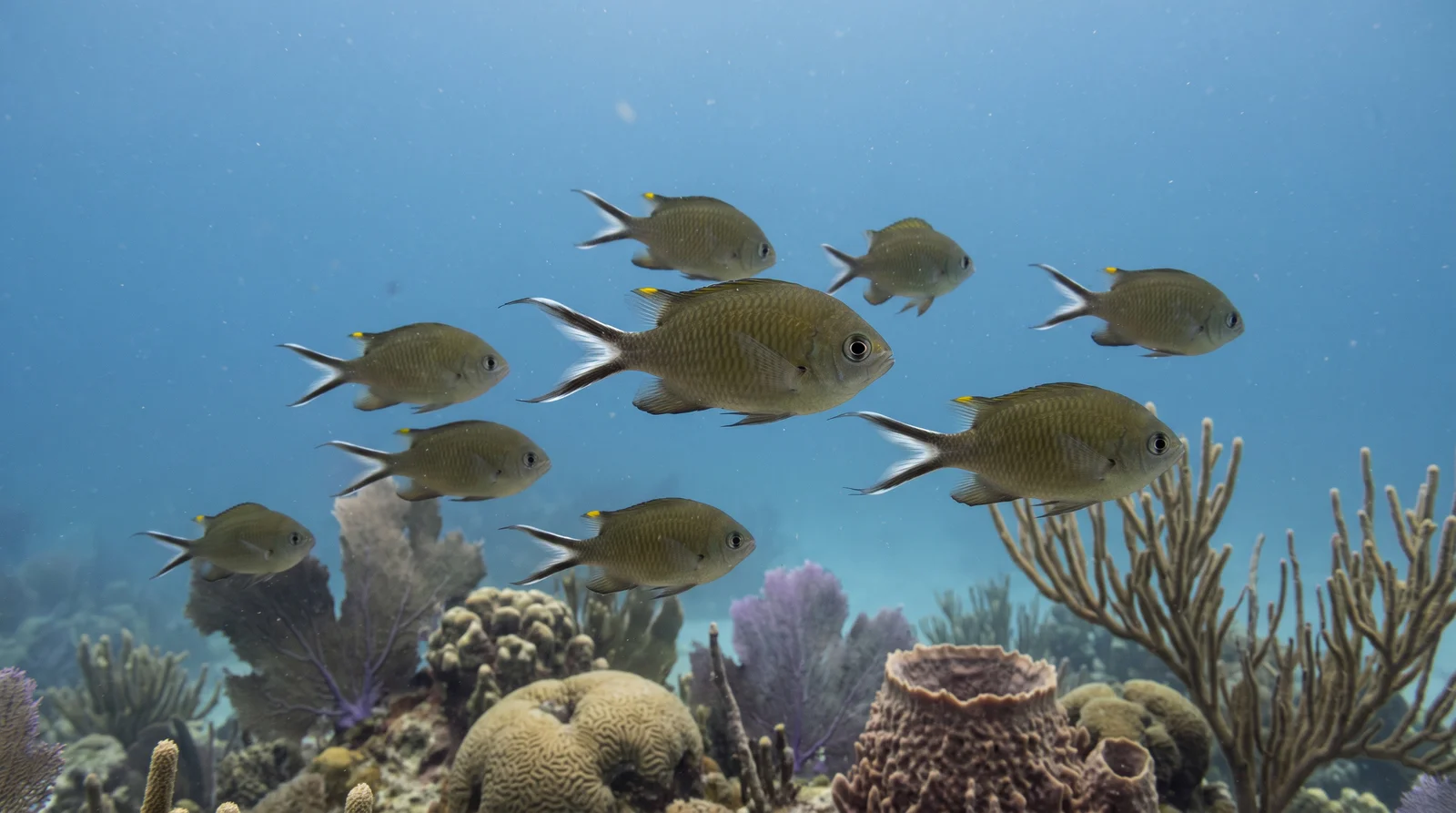
The Brown Chromis, scientific name Chromis multilineata, is a small, deep-bodied damselfish that contributes significantly to the visual dynamism of many Caribbean reefs. Despite its common name, its coloration is often described as predominantly silvery-grey, though individuals can exhibit a greyish-brown or olive-brown hue on their backs, which typically fades to a silvery-white on their bellies.
A key identifying feature of this species is the prominent bright yellow spot found at the posterior base of its dorsal fin. This can sometimes appear as a white or pale yellow marking. Additionally, a distinct large black spot is located at the base of each pectoral fin. The margins of its anal, caudal, and dorsal fins are often edged in yellow, and the deeply forked caudal fin, which aids in rapid swimming, may also feature black borders on its upper and lower edges, especially in southern Caribbean populations.
This fish possesses an elongated, oval, streamlined, and laterally compressed body, indicative of its active lifestyle in the water column. Its head features a small, protrusible mouth equipped with two rows of teeth. Unlike some other damselfish, the Brown Chromis does not display obvious sexual dimorphism, making it difficult to distinguish between males and females visually. Juveniles, however, might present a bright blue or white spot on their upper body, which fades with age. While some sources suggest a maximum size of around 15-16 cm (6 inches), other reliable reports indicate they can reach up to 20 cm (7.9 inches) in total length, making them relatively large among chromis species.
Where it lives.
The Brown Chromis is widely distributed across the tropical Atlantic Ocean. Its range in the Western Atlantic extends from Florida and the Gulf of Mexico southwards to Brazil, encompassing the vast expanse of the Caribbean Sea. In the Eastern Atlantic, populations are found around Cape Verde, the Gulf of Guinea, and specifically off St. Helena and Ascension Island.
This species predominantly inhabits steep outer reef slopes, rocky shores, and patch reefs. It thrives in environments exposed to moderate to strong currents, where it can feed on drifting plankton. Adults are commonly observed in these areas, particularly on reef faces and fore-reef slopes. Brown Chromis are non-migratory and exhibit a diurnal activity pattern, remaining active during the day. They require a balanced habitat that offers both open swimming spaces, which they prefer, and complex hardscape or rockwork, providing crucial shelter during the night or when a perceived threat arises. Their depth range is considerable, typically found from 2 to 60 meters (7 to 197 feet), though they can occur in shallower waters and have been observed as deep as 91 meters (300 feet). They are most commonly encountered by divers between 10 and 30 meters (33 to 98 feet).
How it behaves.
Brown Chromis are renowned for their highly social nature, forming substantial aggregations in the wild. These are more accurately described as 'shoals' rather than true 'schools,' meaning they gather in loose social groups without necessarily exhibiting the tightly coordinated, synchronized movements characteristic of schooling fish. They are frequently observed coexisting and shoaling with other species, such as the Blue Chromis.
As active, planktivorous fish, Brown Chromis spend the majority of their time in the midwater to upper levels of the water column, hovering above reef structures. They constantly forage, picking tiny zooplankton, primarily copepods, mysis shrimp, shrimp larvae, and fish eggs, directly from the currents. Their diet also includes some algae. Due to their high energy levels and fast metabolism, they are continuous grazers in their natural habitat, requiring frequent feeding.
When threatened, these fish quickly retreat into the safety of coral crevices and reef structures. In terms of reproduction, Brown Chromis are oviparous, with distinct pairing occurring during breeding. The females lay demersal eggs that adhere to the substrate, and the males take on the crucial role of guarding and aerating these eggs until they hatch, which typically occurs within three days. While generally peaceful towards other species, within their shoals, particularly as they mature, Brown Chromis can display some intraspecific aggression, establishing dominance hierarchies. However, they are typically considered non-aggressive towards divers.
Where to see it.
Evidence from all destinations · 1 dive site
General range is not evidence of occurrence at a specific dive site.
Gallery.
 AI-generated
 illustration
Image credit: AI-generated illustration · Diveity