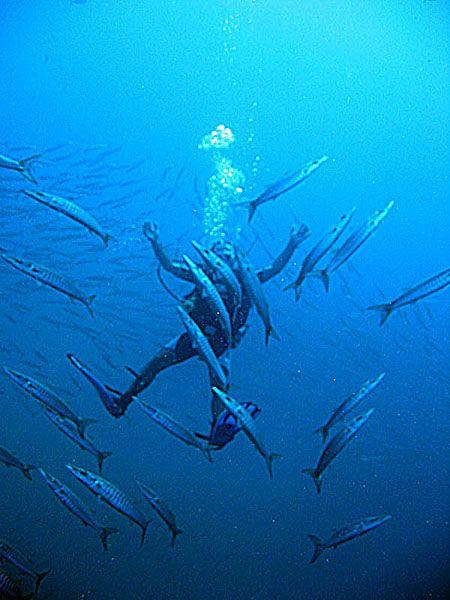
Chevron Barracuda
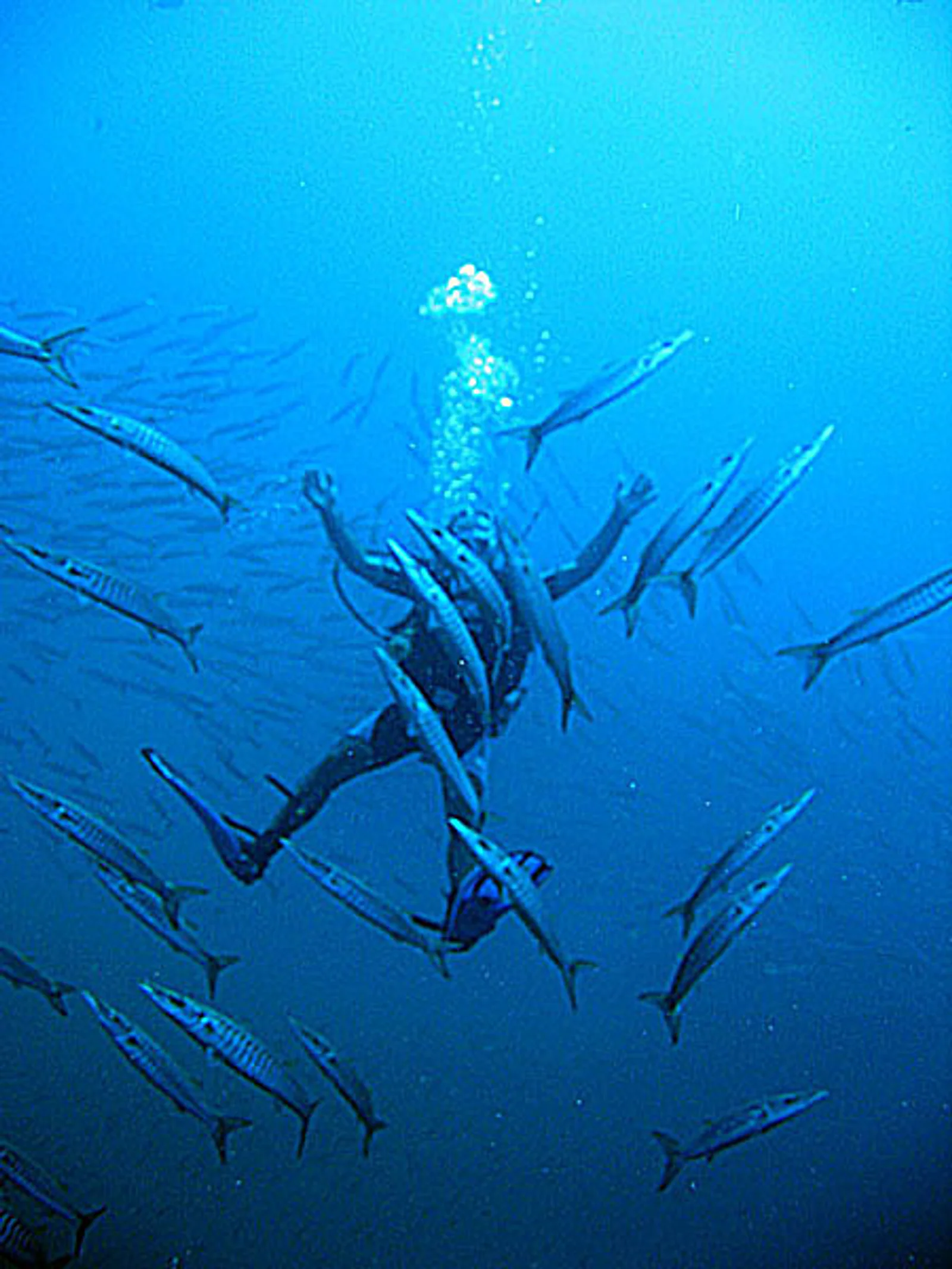
Sphyraena qenie
About Chevron Barracuda.
The Chevron Barracuda, Sphyraena qenie, is a striking and often encountered species within the family Sphyraenidae. Known for its predatory prowess and distinctive markings, this fish is a highlight for many divers across its extensive range. Classified as "Least Concern" by the IUCN Red List (assessed August 14, 2023), the Chevron Barracuda is a common and important component of tropical marine ecosystems.
These formidable fish are renowned for their schooling behavior, often forming impressive, slow-rotating "tornadoes" over current-swept seamounts and reefs. This behavior is a thrilling spectacle for divers and serves both as a defense mechanism and a hunting strategy. They are typically found in tropical and subtropical waters of the Indo-Pacific, ranging from the Red Sea and East Africa to French Polynesia, and occasionally in the Eastern Pacific off Mexico and Panama. Chevron Barracudas inhabit coral reefs, lagoons, and seaward reefs, usually at depths of 1–50 m, though they can be found as deep as 100 m. While their appearance can be menacing, they are generally shy around humans.
Divers frequently observe Chevron Barracudas at popular dive sites such as Cape Kri, Sardine Reef, Ras Mohammed National Park, and Magic Mountain (Shadow Reef), where they are often abundant. They are also commonly seen at Blue Magic, Mainit Point, Fish Head, and Steve's Bommie, with occasional sightings at Blue Hole (Dahab) and Around the Bend.
Identification
The Chevron Barracuda is easily identifiable by several key physical characteristics:
- Size and Shape: This species boasts an elongated, slender, and torpedo-like body, which is cylindrical in its anterior section. It can reach an impressive maximum length of 1.7 m (5.6 ft) and a weight of up to 7.1 kg.
- Coloration: Its body is predominantly silvery, fading to a white belly, and adorned with distinctive dark markings.
- Markings: The most prominent feature is the presence of 18 to 22 dark, chevron-shaped bars running along its sides. These bars are v-shaped with the apex pointing forward, oblique above the lateral line, and nearly vertical below it. In juveniles, these bars may appear very faint.
- Head and Mouth: It possesses a long head with a distinctive conical, pointed snout. The large mouth features a prominent, protractile lower jaw that protrudes beyond the upper jaw and is armed with many long, sharp, fang-like teeth.
- Fins: The caudal fin (tail fin) is largely blackish or dusky, often with a black margin. Adults may also exhibit a pair of small lobes on the posterior margin of the caudal fin. The first dorsal fin has six spines and is positioned well forward on the body, while the second dorsal fin, with nine soft rays, is widely separated from the first and mirrors the anal fin in appearance. Both the second dorsal and anal fins feature elongated last rays.
- Other Features: A unique characteristic of Sphyraena qenie is the absence of gill rakers on the first arch, replaced instead by rough platelets.
Where it lives.
The Chevron Barracuda (Sphyraena qenie) is a highly sought-after species for divers, known for its impressive schooling behavior and sleek, predatory form. This species thrives across a vast expanse of the Indo-Pacific, ranging from the Red Sea and East Africa eastward to French Polynesia. Its distribution also extends, albeit rarely, into the tropical East Pacific, including areas off Mexico and Panama. They are typically found in tropical and subtropical waters, preferring warm, clear marine environments.
Divers can expect to encounter Chevron Barracudas in a variety of reef-associated habitats:
- Coral Reefs: They are commonly found on and around vibrant coral reefs, which serve as their primary habitat.
- Reef Walls and Drop-offs: The species frequently congregates along current-swept reef walls, seamounts, and reef points, often forming spectacular, shimmering schools that can be a highlight of any dive.
- Lagoons and Coastal Waters: Chevron Barracudas also inhabit lagoons and coastal waters, particularly those with good reef development.
- Seagrass Beds: Juveniles and smaller individuals may utilize shallow estuaries and seagrass beds for protection and feeding before venturing into more open reef environments.
Regarding depth, Chevron Barracudas are typically encountered by divers on coral reefs down to approximately 50 m. However, their full depth range is broader, extending from the surface down to 100 m. While often observed in mid-water or near the surface during the day, they are known to move into deeper waters during the late afternoon and dusk to feed. These barracudas are often seen in large, semi-stationary schools during daylight hours, which can remain in the same dive site for extended periods. Their presence is often considered an indicator of a healthy reef ecosystem.
How it behaves.
The Chevron Barracuda (Sphyraena qenie) is a captivating species for divers, known for its impressive schooling behavior and predatory prowess in tropical and subtropical waters. These sleek fish are commonly encountered around coral reefs, lagoons, and coastal areas, often at dive sites with strong currents, which they favor for their rich oxygen and nutrient content.
- Underwater Encounter Behavior: Divers frequently encounter Chevron Barracudas in large, dense, and often semi-stationary schools during the day. These schools can comprise hundreds to thousands of individuals, creating mesmerizing "swirling tornadoes" or "living, moving walls" that are a highlight for many underwater photographers. While their formidable appearance with sharp teeth might seem intimidating, Chevron Barracudas are generally curious but cautious around humans, typically maintaining a respectful distance. They are not considered dangerous unless provoked or startled. Divers are advised to avoid wearing shiny jewelry, which can resemble fish scales and potentially attract unwanted attention from these visually oriented predators. These barracudas are fast swimmers, capable of rapid bursts of speed up to 50 kph (31 mph). They are commonly observed at depths down to 50 meters. As dusk approaches, the large schools tend to disperse, with individual barracudas venturing closer to the reef or into deeper waters to hunt. They can also be spotted on night dives, utilizing ambient light or a diver's torch beam to reflect off smaller prey.
- Feeding Habits: As active predators, Chevron Barracudas are primarily piscivorous, feeding on a variety of smaller fish such as anchovies, mullet, sardines, snappers, and grunts. They also prey on shrimps and squid. Their hunting strategy involves using their keen vision and lightning-fast bursts of speed to ambush unsuspecting prey. The schooling behavior observed during the day is not just for protection; it also enhances their hunting efficiency, allowing them to collectively surround and trap schools of smaller fish before striking.
- Social Structure: Chevron Barracudas are highly social fish, distinguishing them from some other barracuda species that are more solitary as adults. They form impressive schools that serve both defensive and offensive purposes. The sheer number of individuals in a school provides protection from larger predators, while their coordinated movements can confuse both predators and prey. These schools can be quite stable, often occupying the same dive site for extended periods, sometimes for months or even years. Juveniles also commonly form schools for protection in shallower waters.
- Notable Seasonal Patterns: While specific details on their reproductive habits are limited, Chevron Barracudas are believed to aggregate in large numbers for spawning, with the breeding season typically occurring between April and September. During this time, females release numerous pelagic eggs. Newly hatched barracuda seek refuge in shallow, vegetated estuaries, remaining there until they grow large enough to venture into open waters. Adults may exhibit seasonal migrations to certain areas, such as Ryuku Island from tropical waters when temperatures rise, or appear near Okinoerabu Island from July to October. For divers, peak visibility and optimal conditions for encountering large schools in some regions, such as Thailand, are often between November and May, characterized by calm seas and manageable currents. Early morning dives during these months are often recommended for the best sightings.
Where to see it.
Evidence for philippines · 3 dive sites
General range is not evidence of occurrence at a specific dive site.
Doljo Point
Panglao
Site occurrence not yet documented
Documented site seasonality: Nov, Dec, Jan, Feb, Mar, Apr, May
No dated observations available.
Mainit Point
Anilao
Site occurrence not yet documented
Season not yet documented
No dated observations available.
West Escarceo
Puerto Galera
Site occurrence not yet documented
Season not yet documented
No dated observations available.
Gallery.