Emperor Angelfish
 AI-generated
Image credit: AI-generated illustration · License unspecified · Source unspecified
Pomacanthus imperator
About Emperor Angelfish.
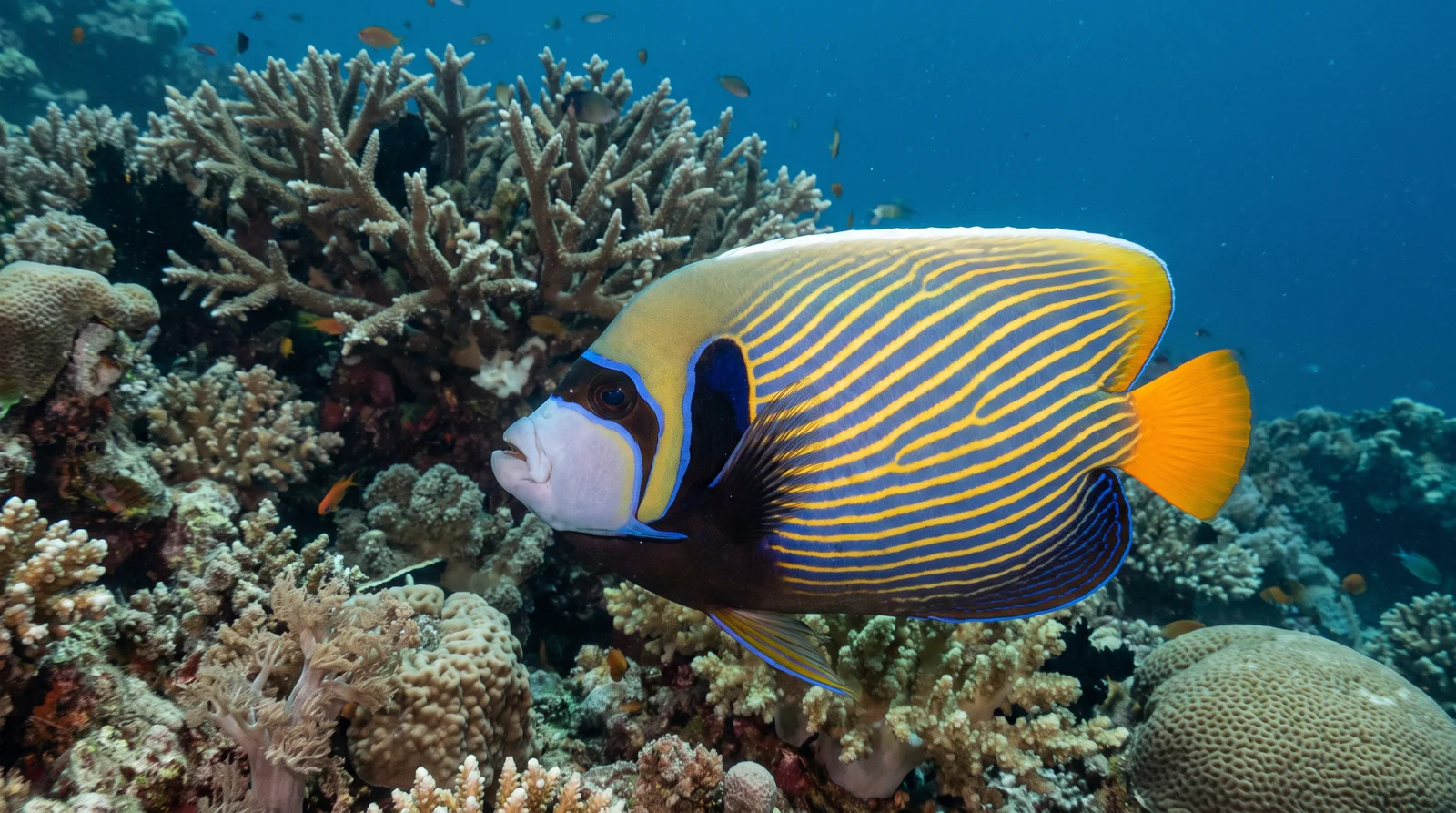
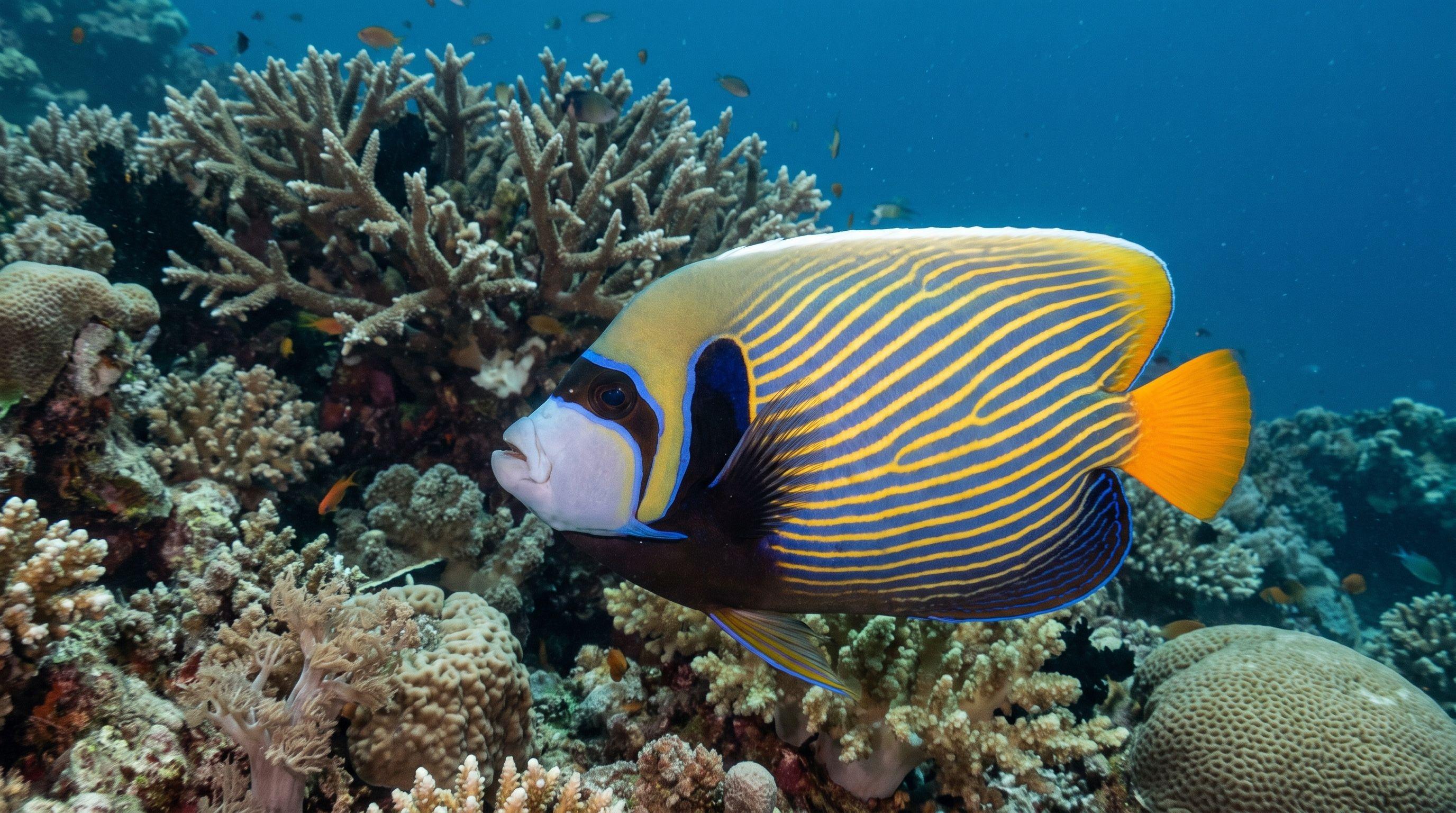
The Emperor Angelfish, Pomacanthus imperator, is a strikingly beautiful marine fish renowned for its vibrant and complex coloration, making it a popular subject for divers, photographers, and aquarists worldwide. Adults exhibit a bold, deep blue body adorned with bright yellow horizontal stripes that sweep across its entirety. A prominent, dark blue-black mask gracefully covers the eye region, complemented by a similarly colored vertical band extending from behind the pectoral fin, edged with sapphire-blue anteriorly and bright yellow posteriorly. Its elegant profile is completed by a brilliant yellow to orange caudal fin. Some populations found in the Pacific Ocean may also display a trailing dorsal filament.
This species is particularly notable for the dramatic transformation it undergoes from its juvenile to adult stage, so profound that juveniles were once mistakenly classified as a separate species until the 1930s. Juvenile Emperor Angelfish present a stark contrast to their adult counterparts, featuring a dark blue-black body intricately patterned with concentric white and electric blue rings that create a mesmerizing, maze-like or "target" appearance. These rings typically start at the tail and radiate forward, often accompanied by a distinct white margin on the dorsal fin. This remarkable metamorphosis from juvenile to adult coloration is a gradual process that typically spans two to two and a half years.
Physically, the Emperor Angelfish possesses a laterally compressed, deep-bodied, and "disk-like" shape, characteristic of many angelfishes. It features a tall profile accentuated by long, continuous dorsal and anal fins that extend rearward. The dorsal fin typically has 13-14 spines and 17-21 soft rays, while the anal fin has 3 spines and 18-21 soft rays. This combination of a distinctive body shape and unparalleled color patterns solidifies its status as one of the most recognizable and admired fish in coral reef ecosystems.
Where it lives.
The Emperor Angelfish enjoys a vast distribution across the Indo-Pacific region, inhabiting coral-rich environments from the Red Sea and East Africa eastward to the Line and Tuamoto islands, extending north to southern Japan and the Ogasawara Islands, and south to the Great Barrier Reef, New Caledonia, and the Austral Islands. This species is a reef-associated fish found in a diverse range of habitats, including coastal and outer reefs, deep lagoons, and areas with abundant coral growth. They can be observed at depths ranging from shallow waters of 1 meter (3.3 feet) down to 100 meters (328.1 feet).
Adult Emperor Angelfish typically prefer clear lagoon, channel, or seaward reefs where coral growth is rich, often seeking shelter within caves and underneath ledges. In contrast, juvenile Emperor Angelfish are frequently found in shallower, more sheltered areas. They commonly shelter beneath ledges, in reef cavities, reef holes, and in relatively protected zones within channels and on outer reef flats. As they mature into subadults, they transition to reef front holes and surge channels before adopting the deeper, more exposed habitats of the adults.
How it behaves.
The Emperor Angelfish exhibits a fascinating array of behaviors within its reef habitat. Adults are predominantly diurnal, active during the day, and are often observed either solitary or in stable pairs, particularly in areas with complex, high-relief coral. Juveniles, on the other hand, are typically solitary. This species is notably territorial, with males actively defending their chosen living space, which can be quite expansive. While they may display aggression towards other angelfish or similarly sized species that they perceive as rivals, they generally show little concern for non-territorial fish.
As omnivores, Emperor Angelfish have a varied diet, primarily grazing on sponges and tunicates. They also consume other encrusting organisms, various marine algae, and small invertebrates, including small crustaceans. An intriguing aspect of their behavior is their role as cleaner fish; both young and adult Emperor Angelfish may pick parasites and dead skin from the bodies of other, often much larger, reef inhabitants, such as sunfish. In terms of reproduction, courtship and spawning typically occur at dusk, with males sometimes emitting grunting noises during their post-spawning descent. The species is also a protogynous hermaphrodite, meaning females possess the remarkable ability to transition into males if an absence of a male occurs within their social structure. In captivity, Emperor Angelfish can live for an impressive 20 to 21 years, though their wild lifespan is less precisely documented.
Where to see it.
Evidence for philippines · 1 dive site
General range is not evidence of occurrence at a specific dive site.
Gallery.
 AI-generated
AI-generated illustration
Image credit: AI-generated illustration · License unspecified · Source unspecified