Ghost Pipefish (assorted)
 AI-generated
Image credit: AI-generated illustration · License unspecified · Source unspecified
Solenostomus spp.
About Ghost Pipefish (assorted).
"Ghost Pipefish (assorted)" covers ghost pipefishes of the family Solenostomidae when a record does not name the species. The family contains a single genus, Solenostomus. Species counts differ between references: Fishes of Australia recognises four species in Australian waters and notes considerable variation within them, so some individuals are hard to assign to a species in the field. The ornate or harlequin ghost pipefish (Solenostomus paradoxus) and the robust ghost pipefish (S. cyanopterus) have their own entries; this group entry is for records that cannot be identified with confidence.
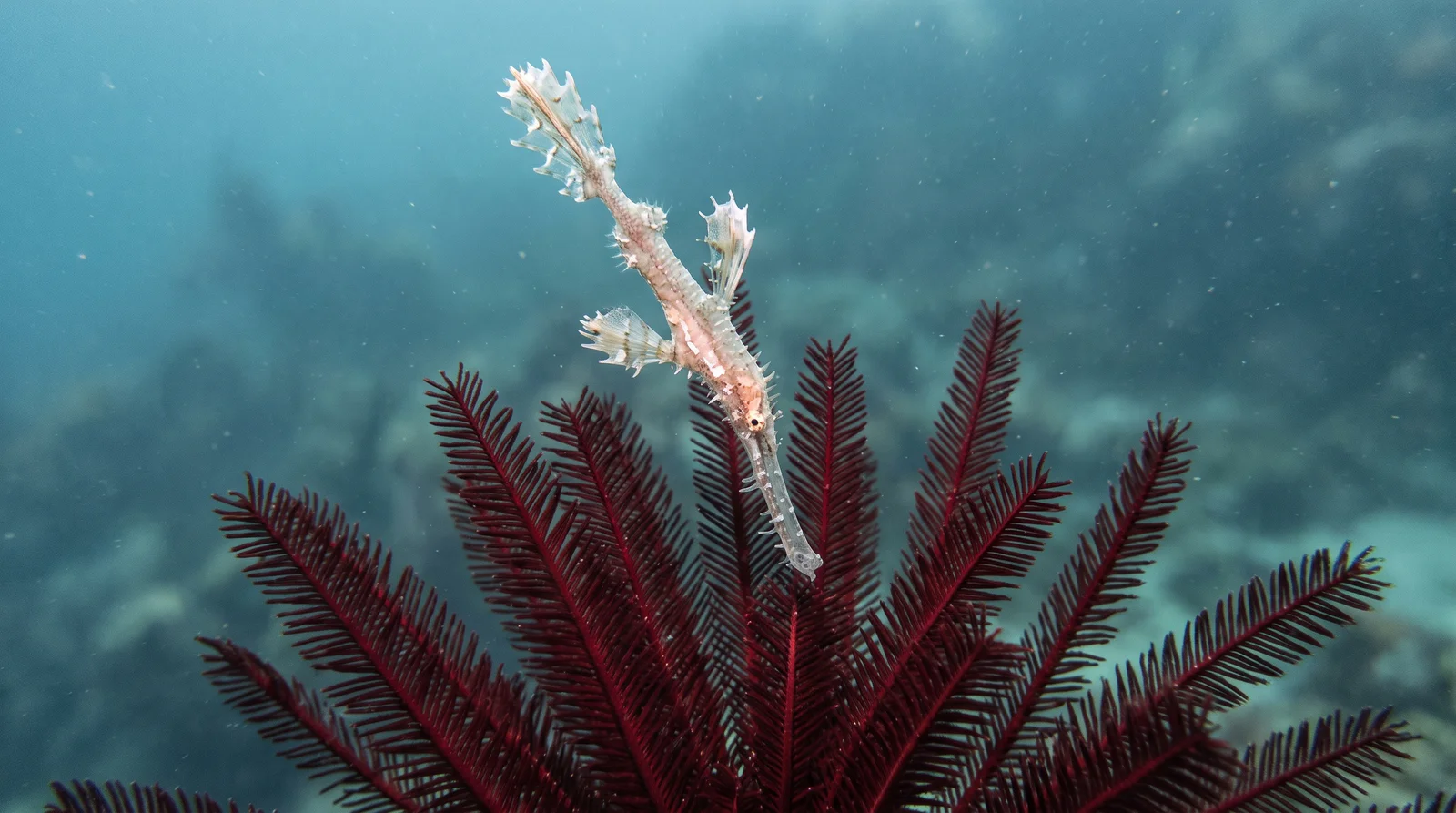
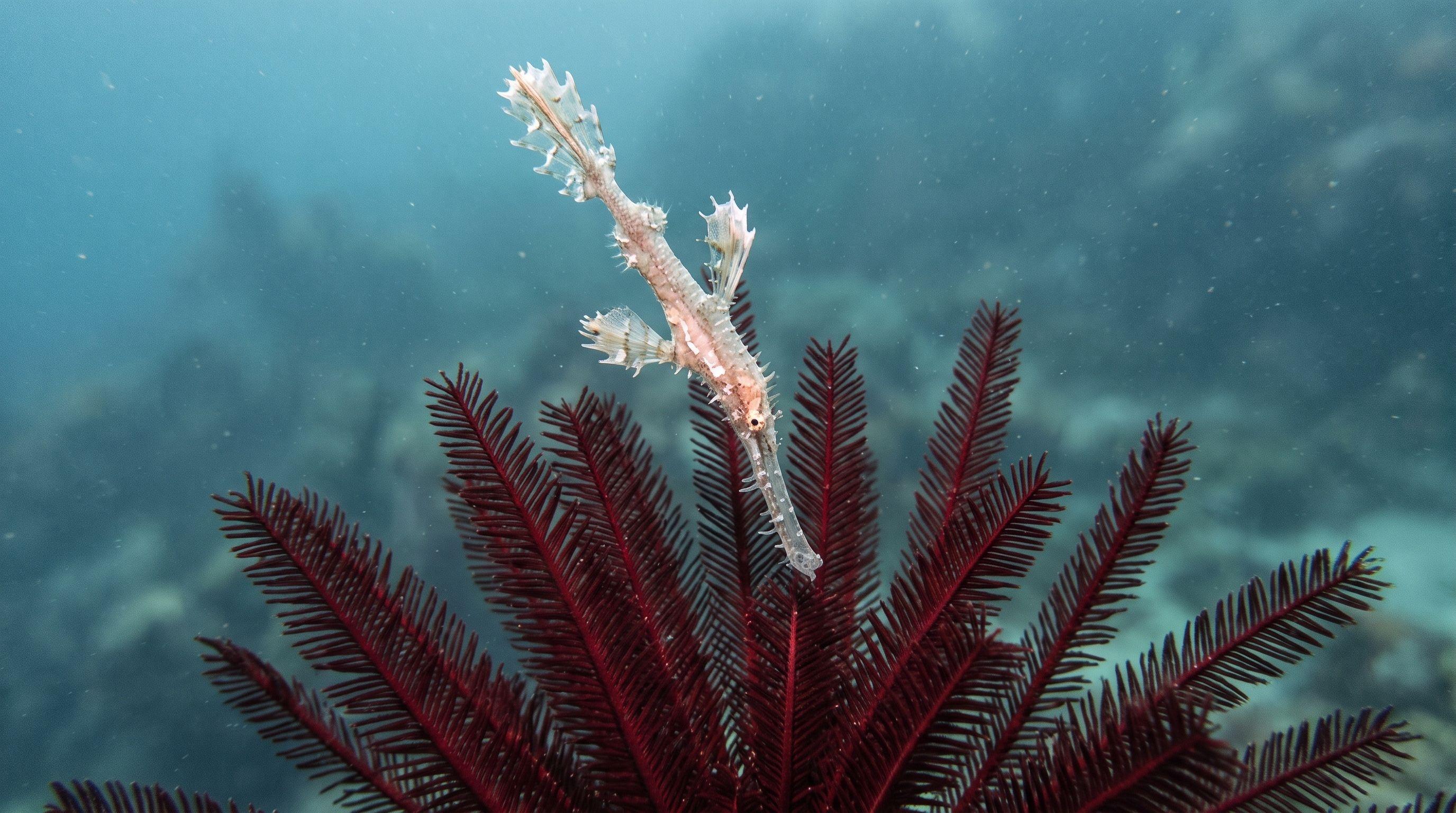
Ghost pipefishes are relatives of the seahorses and pipefishes and are described as masters of camouflage. They mimic algae, seagrass, floating debris, crinoid arms or gorgonian sea fans in both colour and body form, which makes them a prized but difficult find for underwater photographers.
Ghost pipefishes are easily confused with true pipefishes and seahorses (family Syngnathidae). Look for the large, fan-like fins and the star-shaped bony plates; in ghost pipefishes it is also the female, not the male, that broods the eggs.
Identification
- Body: Short and compressed, armoured with large, star-shaped bony plates that are often decorated with skin filaments.
- Snout: Long and tubular, with a small mouth at the tip.
- Fins: Tall and large, with a first dorsal fin of long, weak spines and large pelvic fins below it.
- Size: Small; the family reaches about 17 cm total length, and FishBase gives a maximum of 12 cm for S. paradoxus and 17 cm for S. cyanopterus.
- Colour: Highly variable; S. cyanopterus, for example, ranges from brown to pink or yellow, often matching its surroundings.
Conservation
Conservation status varies by species. As verified examples, the IUCN Red List assessed both S. paradoxus and S. cyanopterus as Least Concern in 2015.
Where it lives.
Ghost pipefishes are found throughout the tropical Indo-Pacific. FishBase records both well-known species from the Red Sea and East Africa east to Fiji, north to southern Japan and south to Australia; S. paradoxus also reaches New Caledonia and has been recorded from Tonga. Within this range the family uses a wide variety of settings, from coral reefs to muddy, sandy, seagrass and algal bottoms.
Typical Settings
- Reef edges with current: Adult S. paradoxus settle along reef edges in current-prone areas, among gorgonian branches, floating weed or crinoids.
- Weedy and seagrass areas: S. cyanopterus lives on coastal and lagoon reefs and in weedy areas, often over algal flats or seagrass beds.
- Soft bottoms: The family occurs over muddy and sandy substrates as well as on coral reefs.
- Depth: From near the surface to about 95 m for the family; FishBase gives 4–35 m for S. paradoxus and 0–25 m for S. cyanopterus.
Where to Look
Search slowly around the objects ghost pipefishes imitate: sea fans, feather stars, clumps of algae, seagrass blades and drifting debris. Because they hover motionless and match their background, the outline of the tubular snout and the shape of the fins are often the first clues. Where one is found, check the same host and its surroundings for a second fish, since the family often lives in pairs.
The two best-known species tend to favour different settings: S. paradoxus is associated with reef edges in current and with gorgonians or crinoids, while S. cyanopterus is more often found over algae and seagrass on coastal and lagoon reefs.
How it behaves.
Ghost pipefishes are slow, deliberate fishes that rely on camouflage rather than speed. They often hover motionless and head-down among the seaweeds and invertebrates they resemble, and they are usually seen alone or in pairs.
Feeding
They suck very small invertebrates and zooplankton, such as mysids and small bottom-living crustaceans, into the tubular snout. They may also feed on small animals living on sea fans or crinoids.
FishBase lists mysids and small benthic shrimps as the main diet of S. paradoxus and small crustaceans for adult S. cyanopterus. The tubular snout works like a pipette: prey is drawn in with a sudden intake of water rather than chased.
Reproduction
Ghost pipefishes reverse the arrangement seen in their seahorse and pipefish relatives: the female, not the male, carries the eggs, in a pouch formed by her fused pelvic fins. Newly hatched larvae are about 3 mm long and well developed, and juveniles of at least one species are reported to live in open water before settling. S. cyanopterus is described as monogamous, living in home-ranging pairs that do not defend an exclusive territory.
Underwater Encounter Behavior
- Response to divers: A ghost pipefish tends to stay close to its host and rely on its disguise, so it can often be watched for some time if left undisturbed.
- Pairs: Two fish of different sizes or colours on the same host may be a pair.
Diver Tips
- Buoyancy first: They live beside fragile sea fans, crinoids and seagrass; hover above the bottom and never kneel on or hold the substrate.
- No handling: Do not touch or move the fish or its host to improve a photograph.
- Short sessions: Limit time and bright light on a single animal so that other divers can also observe it calmly.
- Identification: Photograph the whole body and fins; colour alone is not a reliable guide to species.
Where to see it.
Evidence for sipalay · 2 dive sites
General range is not evidence of occurrence at a specific dive site.
Disneyland
Sipalay
Documented site occurrence
Season not yet documented
Source reviewed on 2026-10-14 · Source: Artistic Diving & Beach Resort, dive-sites page (Wayback snapshot 2019-10-21) · Observation date not documented
Eva's Point
Sipalay
Documented site occurrence
Season not yet documented
Source reviewed on 2026-10-14 · Source: cbartazo.com "Seeking Sipalay" trip report (2017-10-28, single diver, Artistic Diving guest) · Observation date not documented
Gallery.
 AI-generated
AI-generated illustration
Image credit: AI-generated illustration · License unspecified · Source unspecified