Midnight Snapper
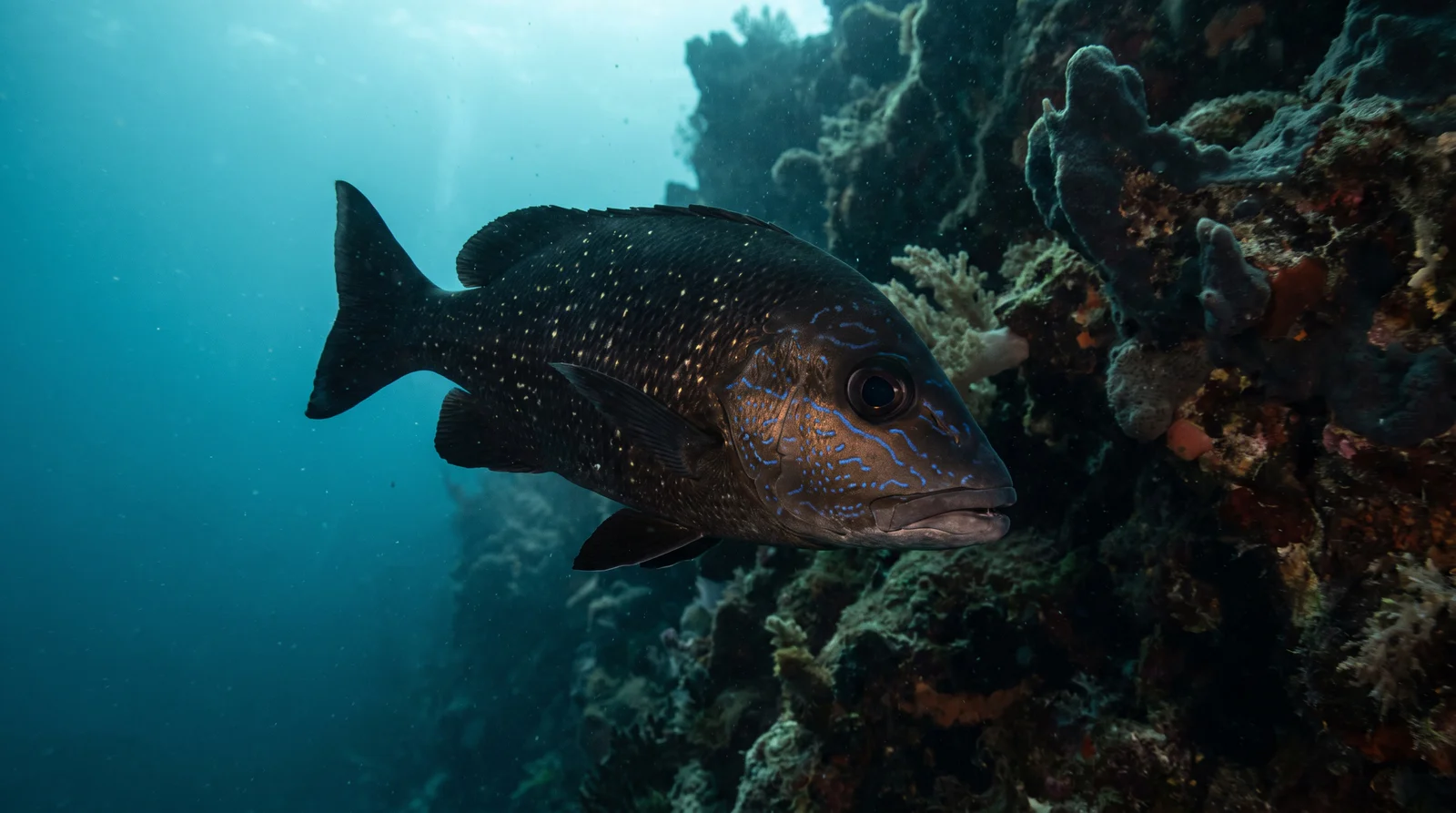 AI-generated
Image credit: AI-generated illustration · License unspecified · Source unspecified
Macolor macularis
About Midnight Snapper.
The Midnight Snapper, scientifically known as Macolor macularis, is a striking member of the Lutjanidae family, commonly referred to as snappers. This species is a captivating sight for divers across its extensive Indo-West Pacific range, which stretches from the Maldives and Chagos Islands eastward to Samoa and the Phoenix Islands, and from southern Japan south to Australia, including the Great Barrier Reef and Christmas Island.
Typically found in tropical waters with temperatures ranging from 22–29°C, Midnight Snappers inhabit coastal lagoons, channel slopes, and seaward reefs at depths of 3–90 m, though they can occasionally be seen as shallow as 2 m. Adults often congregate in loose schools along walls and pinnacles, while juveniles prefer solitary lives, seeking refuge among feather stars, staghorn corals, or large sponges on protected reef slopes. They are primarily nocturnal predators, feeding on large zooplankton, as well as fish and crustaceans. This long-lived species can reach impressive ages, with some individuals recorded living for 40-50 years, and one even reaching 81 years.
The Midnight Snapper is currently listed as a species of Least Concern by conservation organizations. Divers frequently encounter this species at popular dive sites such as Pillarsteen, Sardine Reef, and Boo Windows, where they are commonly observed.
Identification
- Size: This species can grow to a maximum total length of 60 cm (24 in).
- Body Shape: The body is moderately deep and laterally compressed, with adults exhibiting a convex forehead.
- Adult Coloration: Adults display a dark grey-brown coloration dorsally, transitioning to yellow on the head and ventral (lower) body. Their heads are often adorned with fine blue lines or small spots, and individual body scales may feature blue lines or dashes. A distinguishing feature is their prominent golden iris (eye). Smaller adults may retain subtle traces of their juvenile patterns.
- Juvenile Coloration: Juveniles are dramatically different, showcasing a striking piebald pattern of black and white. They typically have five to ten large white spots along their upper body, with additional white patterns on the lower side. Subadults show a transition, with more numerous small white spots scattered across their black areas.
- Fins:
- The dorsal fin has 10 spines and 13-14 soft rays, while the anal fin has 3 spines and typically 10 soft rays.
- Both the dorsal and anal fins have distinctly pointed rear tips.
- A key identification feature for juveniles (especially those around 20 cm or less) is their exceptionally long and pointed pelvic fins, which extend noticeably downwards. As the fish matures, these pelvic fins shorten and become rounded in adults.
- The caudal fin is rounded in very small juveniles (under 20 cm) and becomes emarginate (slightly forked) in larger individuals.
- Other Features: The preoperculum (gill cover bone) has a deep incision on its lower margin.
Where it lives.
The Midnight Snapper (Macolor macularis) is a striking reef-associated species found throughout the tropical Indo-West Pacific, inhabiting a broad range from the Maldives and southwestern India eastward to Samoa and the Phoenix Islands, and north to Taiwan and southern Japan, extending south to Australia and Melanesia.
This species is typically encountered in clear waters, thriving in diverse coral reef environments. Adults primarily frequent steep reef slopes, walls, pinnacles, and the outer faces of seaward reefs and channels.
- Depth Range: Midnight Snappers are found at depths ranging from the shallowest reefs to deeper waters, typically between 0 and 90 m. While they can be observed in shallower areas, adults are commonly found on deeper reef slopes.
- Ecosystem and Substrate: These snappers are integral to vibrant coral reef ecosystems. Juveniles exhibit a preference for more sheltered reef slopes, often found singly amongst the protective branches of staghorn corals, within large sponges, or near feather stars, utilizing these structures for camouflage and refuge. Adults may be observed alone or in small groups, navigating the complex topography of offshore reefs.
- Dive Sites: Divers frequently encounter Midnight Snappers at renowned dive sites such as Pillarsteen, Sardine Reef, and Boo Windows, where their distinctive appearance makes them a highlight.
How it behaves.
- Underwater Encounter Behavior: Adult Midnight Snappers are typically found along the steep slopes of lagoons, channels, or seaward reefs, often at depths ranging from 5 to 90 m. They can be observed either solitarily or in small, loose midwater schools. When encountered, these schools may appear to stand motionless above coral areas. Juveniles, however, exhibit a different behavior; they are often solitary and seek refuge near cover, such as within the arms of feather stars, among staghorn corals, or inside large sponges. Their juvenile coloration, a stark black and white pattern with prominent white spots, provides excellent camouflage in these environments. As they mature, their coloration shifts to a dark grey-brown dorsally, fading to yellow on the head and ventral body, adorned with fine blue lines or spots on the head and blue lines or dashes on their scales. Divers may also observe them at cleaning stations, where they are assisted by cleaner wrasse.
- Feeding Habits: The Midnight Snapper is a nocturnal predator. Its diet primarily consists of large zooplankton, but it also preys on smaller fish and crustaceans. Unlike many other snapper species that forage on the bottom, Macolor macularis, along with other members of its genus, specializes in consuming larger zooplankton.
- Social Structure: As indicated, Midnight Snapper social structure varies with age. Juveniles are solitary and cryptic, relying on cover for protection. Adults, while sometimes solitary, are more frequently observed in small groups or loose schools in the midwater column. They may occasionally form mixed aggregations with their close relative, the Black-and-white Snapper (Macolor niger).
- Notable Seasonal Patterns: Information regarding specific seasonal breeding patterns for the Midnight Snapper is not extensively documented for divers. However, it is known that both males and females engage in external fertilization in open water. Their eggs are pelagic, drifting as zooplankton, which can then become a food source for other marine life. The species is considered to have a medium resilience, with a minimum population doubling time of 1.4 to 4.4 years. Midnight Snappers are also known to be long-lived, with some individuals reaching ages of 40-50 years, and one recorded specimen living to 81 years.
Where to see it.
Evidence for mactan · 2 dive sites
General range is not evidence of occurrence at a specific dive site.
Hilutungan Island Sanctuary
Mactan
Documented site occurrence
Season not yet documented
Source reviewed on 2026-10-14 · Source: Scotty's Dive Center (Wayback snapshot 2023-12-07) · Observation date not documented
Shangri-La Marine Sanctuary
Mactan
Documented site occurrence
Season not yet documented
Source reviewed on 2026-10-14 · Source: Divernet, "Don't Miss Mactan" by Henley Spiers (2018-11-18) · Observation date not documented
Gallery.
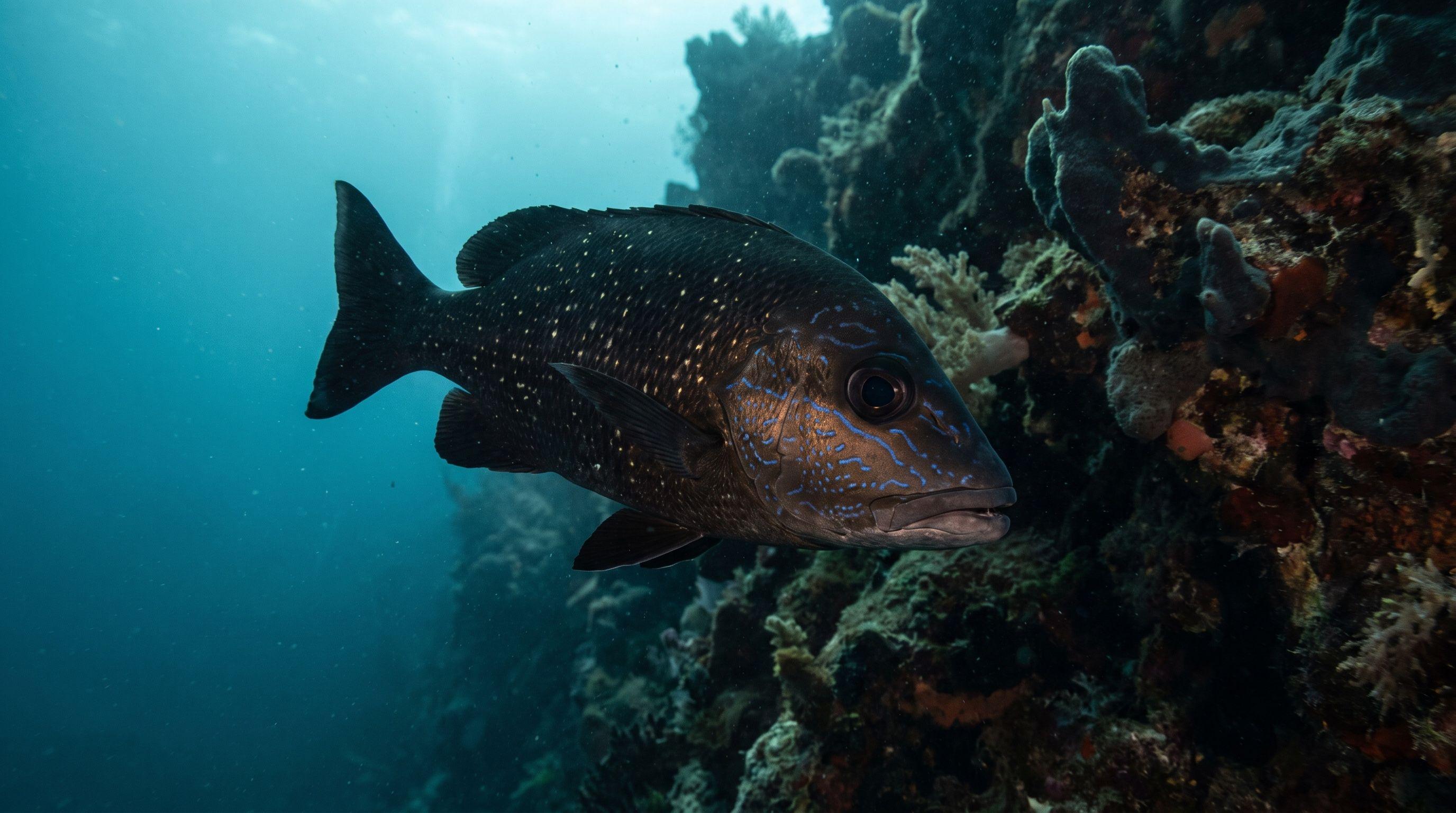 AI-generated
AI-generated illustration
Image credit: AI-generated illustration · License unspecified · Source unspecified