Mobula Ray
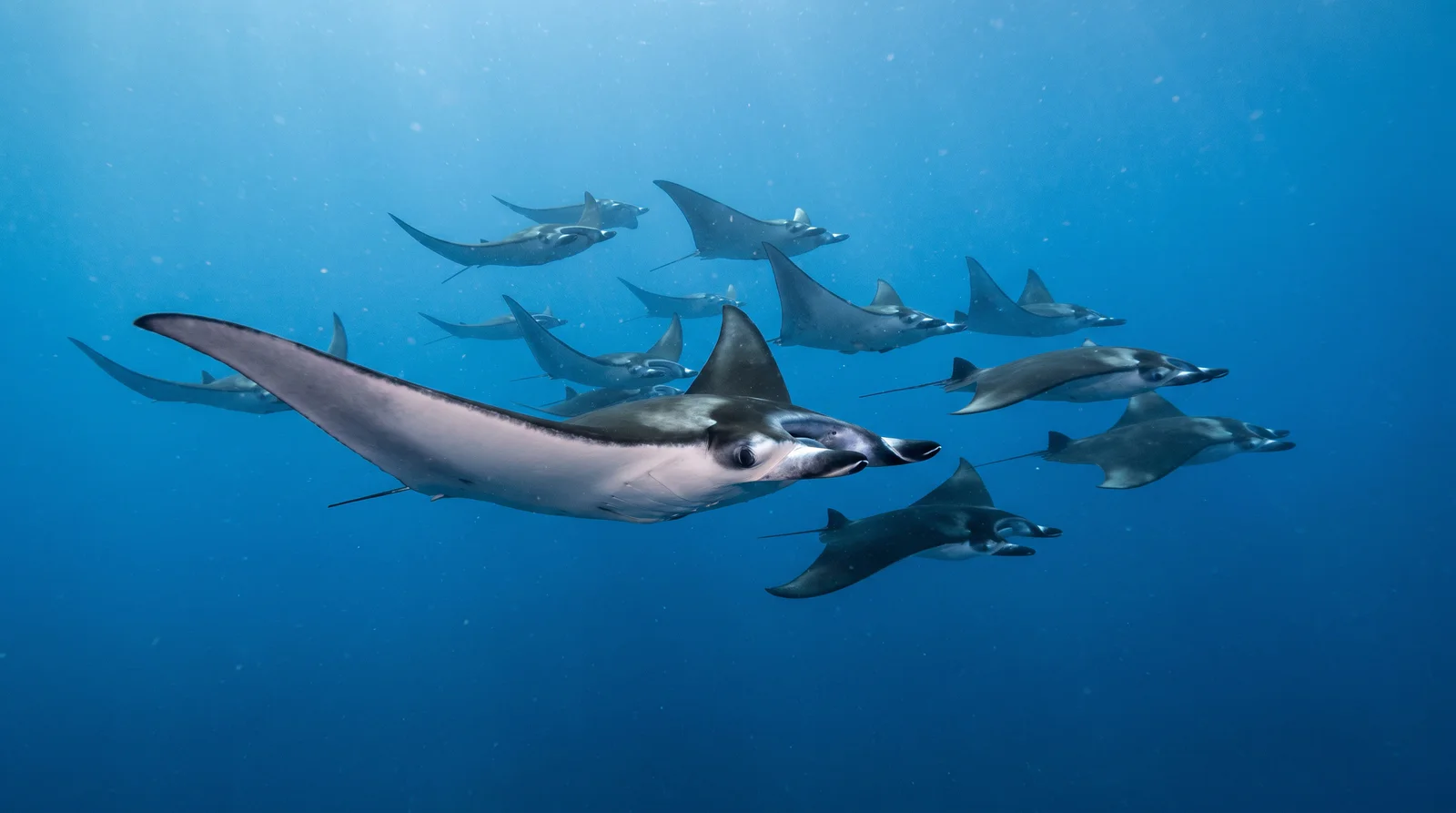 AI-generated
Image credit: AI-generated illustration · Generated for Diveity; no third-party rights · Higgsfield nano_banana_pro image generation
Mobula spp. (schooling)
About Mobula Ray.
Mobula rays, often referred to as "devil rays" due to their distinctive horn-shaped cephalic fins, are captivating members of the family Mobulidae, which also includes their larger relatives, the manta rays. These cartilaginous fish are renowned for their graceful, bird-like movements through the water and their tendency to form large, impressive schools, sometimes even leaping clear of the surface in spectacular breaches.
Found in tropical and subtropical waters across the globe, Mobula rays are pelagic filter feeders, primarily consuming zooplankton and small fish that thrive in nutrient-rich upwelling currents. Divers frequently encounter these magnificent creatures sweeping past pinnacles and along coastal areas, such as those found in South Komodo and occasionally at dive sites like Three Sisters.
Unfortunately, Mobula rays face significant threats. Their conservation status is currently listed as Endangered by the IUCN Red List. This critical status is largely due to unsustainable fishing practices, particularly for their gill plates which are sought after in some traditional medicine markets, as well as incidental capture (bycatch), habitat degradation, pollution, and boat strikes. Their slow reproductive rate, typically producing only a single pup every two to five years, further exacerbates their vulnerability to population declines.
Identification
Identifying Mobula rays underwater can be an exhilarating experience. Here are their key physical characteristics:
- Size: Mobula rays typically have a disc width (wingspan) ranging from 1 to 5 meters (3 to 17 feet). The species referred to as Mobula Ray (Mobula spp.) in schooling aggregations often reaches a maximum wingspan of around 3 meters (10 feet).
- Body Shape: They possess a flattened, diamond-shaped or kite-shaped body disc, allowing for efficient gliding through the water column.
- Cephalic Fins: A most distinguishing feature is the pair of prominent, horn-like cephalic fins located at the front of their head. These fins are extensions of their pectoral fins and are unfurled to funnel plankton and small prey into their mouths while feeding. When not feeding, these fins are often rolled up, giving them their "devil ray" moniker.
- Mouth Position: A crucial identifier, especially when distinguishing them from manta rays, is their mouth. Mobula rays have a sub-terminal mouth, meaning it is positioned on the underside of the head, rather than at the very front.
- Coloration: Dorsally, Mobula rays are generally dark grey to black, while their ventral (underside) surface is typically white. Some species may exhibit distinct patterns or markings on their shoulders or between their gill slits.
- Tail: Most Mobula species have a relatively short, whip-like tail. Unlike many other ray species, the majority of Mobula rays either lack a stinging barb or have one that is encased and harmless. However, the Spinetail Devil Ray (Mobula mobular) is an exception, possessing a "free" stinger.
Where it lives.
Mobula rays (Mobula spp.), often observed schooling in impressive aggregations, are highly migratory pelagic rays found across the world's tropical and subtropical oceans. These magnificent filter feeders inhabit a wide range of marine environments, from shallow coastal waters to the vast open ocean.
Their distribution is circumglobal, encompassing the Atlantic Ocean (from Portugal to South Africa, including the Mediterranean Sea), the Eastern Pacific Ocean (including the Sea of Cortez and Gulf of California), and various regions of Australia, among others.
Mobula rays are primarily associated with:
- Open Ocean (Pelagic Zone): They are quintessential inhabitants of the open sea, particularly the epipelagic zone, where sunlight penetrates sufficiently for photosynthesis, supporting the planktonic food sources they rely upon.
- Coastal and Continental Shelf Waters: While often oceanic, some species, such as the Reef Mobula Ray, are frequently sighted in inshore coastal habitats, near coral and rocky reefs, and around islands, where they establish cleaning and feeding areas.
- Nutrient-Rich Upwelling Zones: Mobula rays are strongly attracted to areas of nutrient upwelling, which lead to abundant plankton blooms – their primary food source. This includes areas near seamounts, as noted in the species fact sheet, and other productive oceanic regions.
Mobula rays exhibit a broad depth range, reflecting their adaptable pelagic lifestyle. They are commonly found from the surface down to depths of 50 m, making them accessible to divers. However, they are known to undertake significant deep dives, with observations extending to over 1,000 m for some species like the Giant Mobula Ray, and 600–700 m for others. When encountered by divers, especially during large aggregations, they often remain in shallow waters, close to the surface.
These rays thrive in warm waters, typically preferring temperatures ranging from 20–28°C, though specific regional and seasonal variations can see them in waters from 21–30°C. Their diet consists mainly of zooplankton, including euphausiids (krill), copepods, and small pelagic fishes and crustaceans, which they efficiently filter feed using their specialized cephalic fins.
Mobula rays play a role in their ecosystems, sometimes forming "mobile ecosystems" by associating with other fish species like remoras, jacks, and cobia, particularly among juvenile manta rays (a type of Mobula ray). Their habitat often overlaps with important tuna fishing grounds, highlighting the need for conservation efforts to mitigate bycatch.
How it behaves.
Mobula rays (Mobula spp.) are captivating filter feeders known for their dynamic behaviors, often observed in tropical and temperate waters. These rays are primarily planktivorous, consuming zooplankton and small fish by swimming with their mouths open and unfurling specialized cephalic fins to funnel prey into their gill rakers.
Underwater, Mobula rays are generally shy and can be skittish around divers, often avoiding the bubbles produced by scuba gear, possibly due to predator avoidance behaviors. For optimal encounters, maintaining a respectful distance of at least 3 meters and avoiding sudden movements is recommended. They are highly social, forming massive schools, sometimes numbering in the thousands, referred to as "fevers."
A notable behavior is their spectacular breaching, where individuals leap up to 2 meters out of the water, a display thought to be related to communication, mating rituals, or parasite removal. Seasonal migrations, particularly for feeding and breeding, lead to large aggregations in specific dive sites. For instance, the Sea of Cortez experiences significant Mobula ray migrations from April to July, with peak numbers often observed from mid-May to early June, when nutrient-rich upwellings provide abundant food.
Where to see it.
Evidence from all destinations · 1 dive site
General range is not evidence of occurrence at a specific dive site.
Gallery.
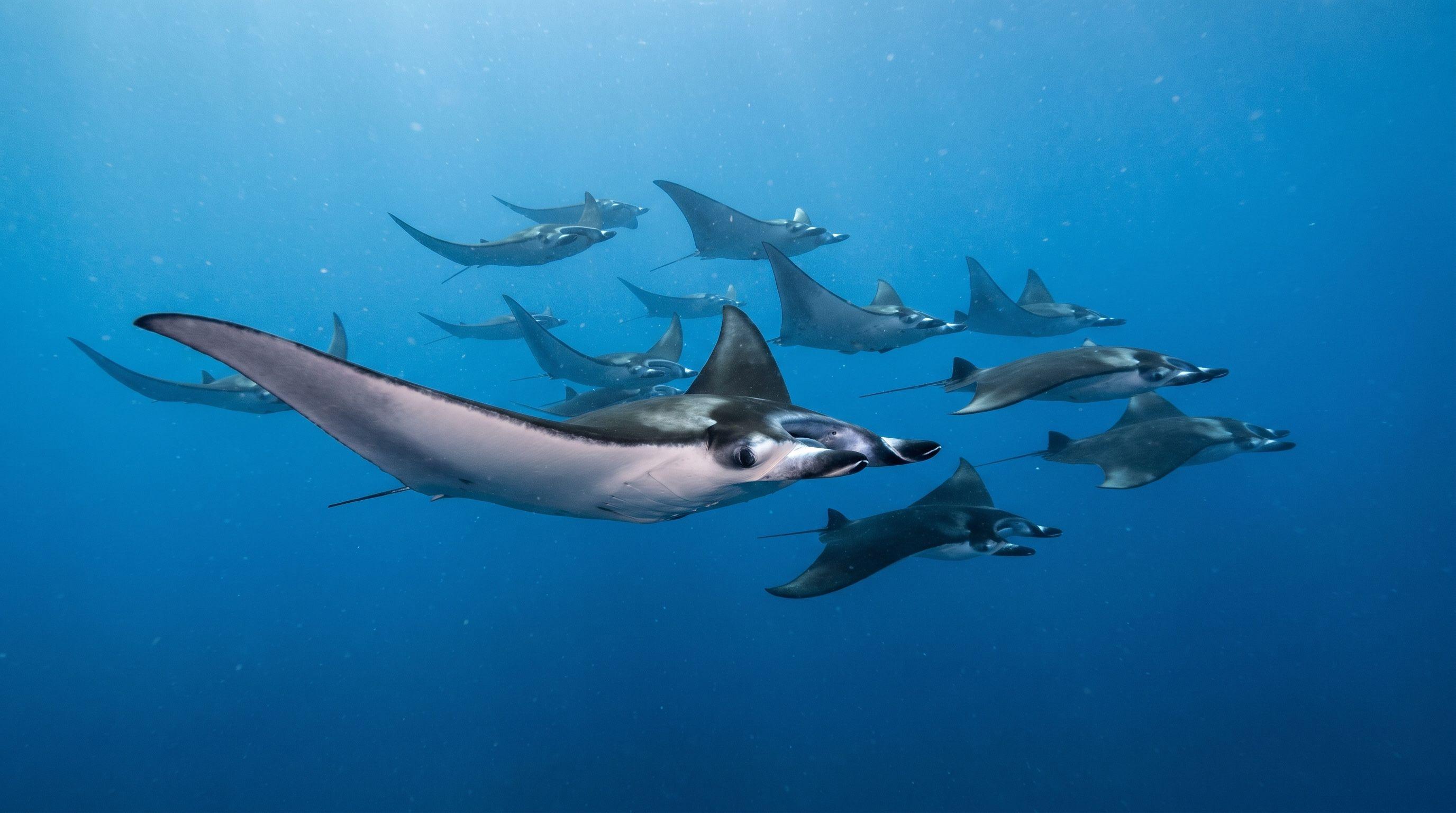 AI-generated
 illustration
Image credit: AI-generated illustration · Generated for Diveity; no third-party rights · Higgsfield nano_banana_pro image generation