Moray Eel (assorted)
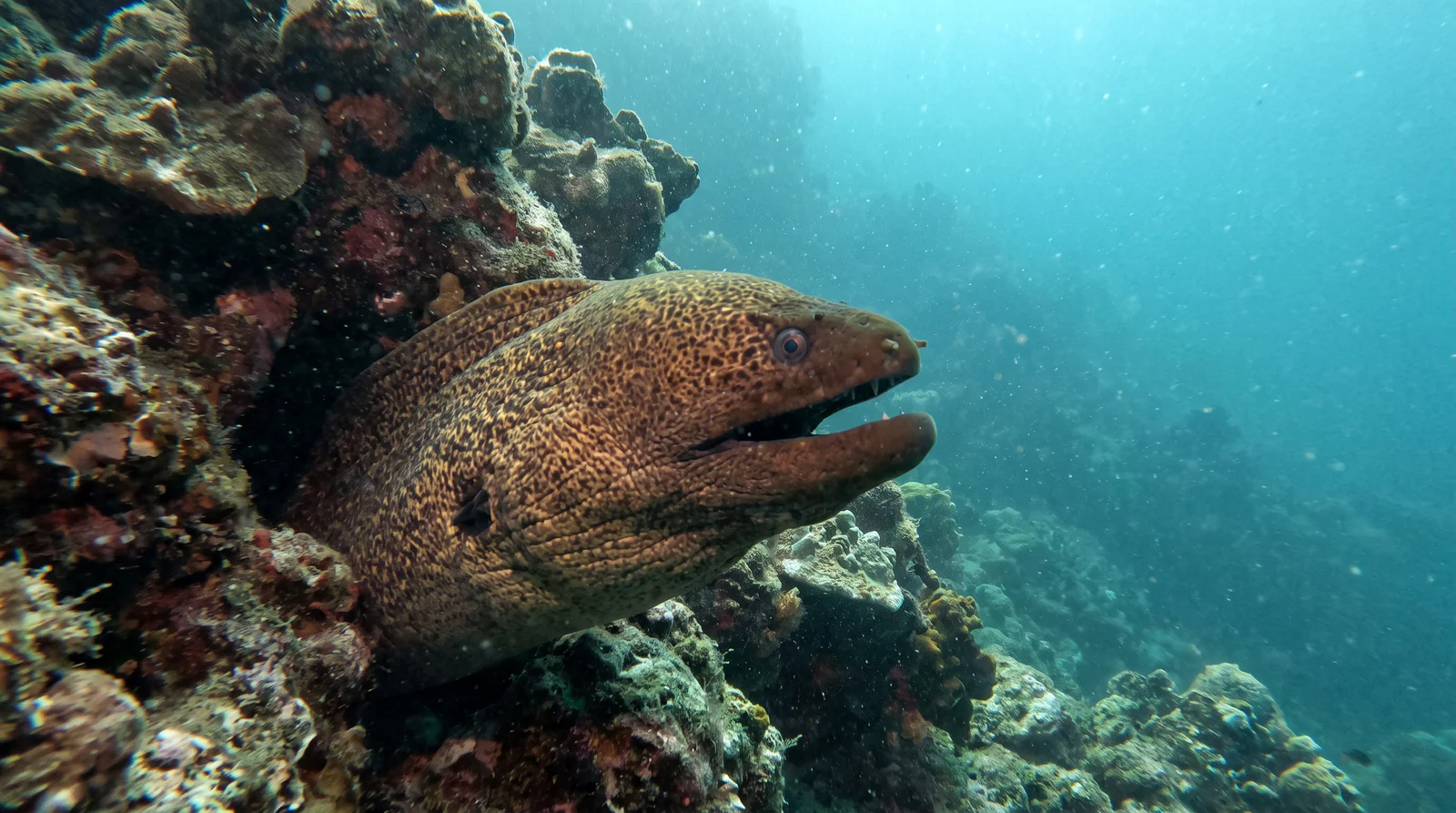 AI-generated
Image credit: AI-generated illustration · License unspecified · Source unspecified
Muraenidae spp.
About Moray Eel (assorted).
Moray eels (family Muraenidae) are elongated, mostly reef-dwelling eels of tropical and warm seas. This group entry covers moray sightings where the species was not recorded. Diveity also has individual pages for the Giant, Honeycomb, Goldentail, Green and Spotted morays and the Blue-ribbon Eel. The family contains many genera and species, which the World Register of Marine Species (WoRMS) places in the eel order Anguilliformes.
Morays are predators that spend much of the day in reef holes with only the head showing. Their open, constantly moving mouth can look threatening, but the Florida Museum of Natural History explains that this action pumps water over the gills for breathing.
Identification
- Body: Long, muscular and snake-like, with a continuous fin along the back. The Florida Museum notes that morays lack pectoral fins and, like all eels, pelvic fins.
- Skin: Scaleless and covered in mucus; in the Green Moray (Gymnothorax funebris) a yellowish mucus gives the fish its green tint.
- Size: Varies widely. FishBase gives maximum lengths of about 3 m for the Giant Moray (G. javanicus), 130 cm for the Ribbon Moray or Blue-ribbon Eel (Rhinomuraena quaesita) and 120 cm for the Turkey Moray (G. meleagris), with a maximum published weight of 30 kg for the Giant Moray.
- Colour phases: FishBase describes Ribbon Moray juveniles as entirely black, males with a yellow dorsal fin and females mostly yellow, a sequence thought (but not yet confirmed) to reflect sex change.
Conservation status varies by species. FishBase reports IUCN Red List assessments of Least Concern for G. javanicus and G. meleagris (both assessed in 2011) and R. quaesita (assessed in 2009), while the Florida Museum notes that the Green Moray is not currently listed by the IUCN. FishBase and the Florida Museum both link large morays, such as the Giant and Green morays, with ciguatera poisoning when eaten.
Where it lives.
Morays are bottom-dwelling fishes of coral reefs and rocky shores. Most species seen by divers live among coral, rock and rubble, using holes and crevices as shelter. FishBase gives the Giant Moray an Indo-Pacific range from the Red Sea and East Africa to the Marquesas, north to the Ryukyu and Hawaiian islands, and the Ribbon Moray a range from East Africa to the Tuamotu Islands. FishBase lists the Turkey Moray across the Indo-Pacific and also in the Southeast Atlantic off South Africa, and notes that it can occur in brackish and fresh water as well as the sea.
Where Divers Find Them
- Depth: Many species occur from the shallows to recreational depths. FishBase gives 0–50 m for G. javanicus, 0–51 m for G. meleagris and 1–67 m for R. quaesita; the Florida Museum gives shallower than 30 m for the Green Moray.
- Reef holes and slopes: Adult Giant Morays live on lagoon and seaward reefs and are commonly seen along deep drop-offs and slopes; juveniles are more secretive and live on intertidal reef flats.
- Sand and rubble: The Ribbon Moray usually hides in sand or rubble, sometimes with only its head showing.
- Shallow and mixed habitats: FishBase notes that Turkey Moray adults prefer very shallow, coral-rich water; the Florida Museum describes the Green Moray near rocky shorelines, coral reefs, mangroves, seagrass beds and harbours.
Because morays shelter in holes by day, the best way to find them is to scan crevices, coral heads and wreck openings slowly, looking for a head and a mouth that opens and closes.
How it behaves.
Morays are mostly solitary, bottom-dwelling predators. The Florida Museum describes the Green Moray foraging at night, hiding by day in crevices and finding prey largely by smell. FishBase notes that the Turkey Moray feeds during the day and probably at night too, and is often seen hunting among partly exposed reefs at low tide. The diets recorded on these pages are mainly fish, with crustaceans, and for the Green Moray also cephalopods.
Underwater Encounter Behavior
Most encounters are with a moray resting in a hole, head out, its mouth opening and closing as it breathes. This is normal breathing, not a sign of aggression. Species that forage at night may be seen swimming openly across the reef after dark. FishBase records observed prespawning pairs of Giant Morays intertwined on the reef bottom. The Turkey Moray, by contrast, may be seen hunting in the shallows during the day. The Ribbon Moray behaves differently from the larger reef morays, usually showing only its head from a burrow in sand or rubble. FishBase notes that the Giant Moray's position at the top of the reef food chain contributes to its ciguatoxicity.
Diver Tips
- Keep hands out of holes: The Florida Museum reports that bites are most likely when divers feed morays or reach into reef holes; unprovoked attacks are exceedingly unusual, but a large moray's bite can be severe. FishBase notes that the Giant Moray will bite humans when provoked.
- Do not feed: Hand-feeding is one of the main situations in which bites happen.
- Give space: Observe and photograph from a respectful distance and do not block the moray's hole, which is its shelter and escape route.
- Night dives: Watch where you place your hands and shine your torch, since morays that forage at night may be moving across the reef.
- Do not eat: Large morays are a documented source of ciguatera poisoning.
Where to see it.
Evidence for philippines · 14 dive sites
General range is not evidence of occurrence at a specific dive site.
Angol Point
Boracay
Documented site occurrence
Season not yet documented
Source reviewed on 2026-10-14 · Source: New Wave Divers Boracay (dive-site page) · Observation date not documented
Balinghai Wall
Boracay
Documented site occurrence
Season not yet documented
Source reviewed on 2026-10-14 · Source: New Wave Divers Boracay (dive-site page) · Observation date not documented
Blue Hole
Romblon
Documented site occurrence
Season not yet documented
Source reviewed on 2026-10-14 · Source: Romblon Island / Romblon Freediving (article 2025-06-18) · Observation date not documented
Diniwid
Boracay
Documented site occurrence
Season not yet documented
Source reviewed on 2026-10-14 · Source: New Wave Divers Boracay (dive-site page) · Observation date not documented
Disneyland
Sipalay
Documented site occurrence
Season not yet documented
Source reviewed on 2026-10-14 · Source: Sea Explorers Sipalay, "Sipalay Dive Sites" page · Observation date not documented
Eva's Point
Sipalay
Documented site occurrence
Season not yet documented
Source reviewed on 2026-10-14 · Source: Sea Explorers Sipalay, "Sipalay Dive Sites" page · Observation date not documented
Friday's Rock
Boracay
Documented site occurrence
Season not yet documented
Source reviewed on 2026-10-14 · Source: New Wave Divers Boracay (dive-site page) · Observation date not documented
Isla Reta
Davao Gulf
Documented site occurrence
Season not yet documented
Source reviewed on 2026-10-14 · Source: Asia Dive Site, Talikud Island page (undated; identical copy at islandsphilippines.com) · Observation date not documented
Laguna
Boracay
Documented site occurrence
Season not yet documented
Source reviewed on 2026-10-14 · Source: New Wave Divers Boracay (dive-site page) · Observation date not documented
MS Jojo
Sipalay
Documented site occurrence
Season not yet documented
Source reviewed on 2026-10-14 · Source: Artistic Diving & Beach Resort, dive-sites page (Wayback snapshot 2019-10-21) · Observation date not documented
Pinnacle Point
Davao Gulf
Documented site occurrence
Season not yet documented
Source reviewed on 2026-10-14 · Source: Asia Dive Site, Samal Island page (undated; identical copy at islandsphilippines.com) · Observation date not documented
Punta Bunga
Boracay
Documented site occurrence
Season not yet documented
Source reviewed on 2026-10-14 · Source: Alta Vista de Boracay blog (Wayback snapshot 2026-05-15) · Observation date not documented
Tribird
Boracay
Documented site occurrence
Season not yet documented
Source reviewed on 2026-10-14 · Source: New Wave Divers Boracay (dive-site page) · Observation date not documented
Virgin Drop
Boracay
Documented site occurrence
Season not yet documented
Source reviewed on 2026-10-14 · Source: New Wave Divers Boracay (dive-site page) · Observation date not documented
Gallery.
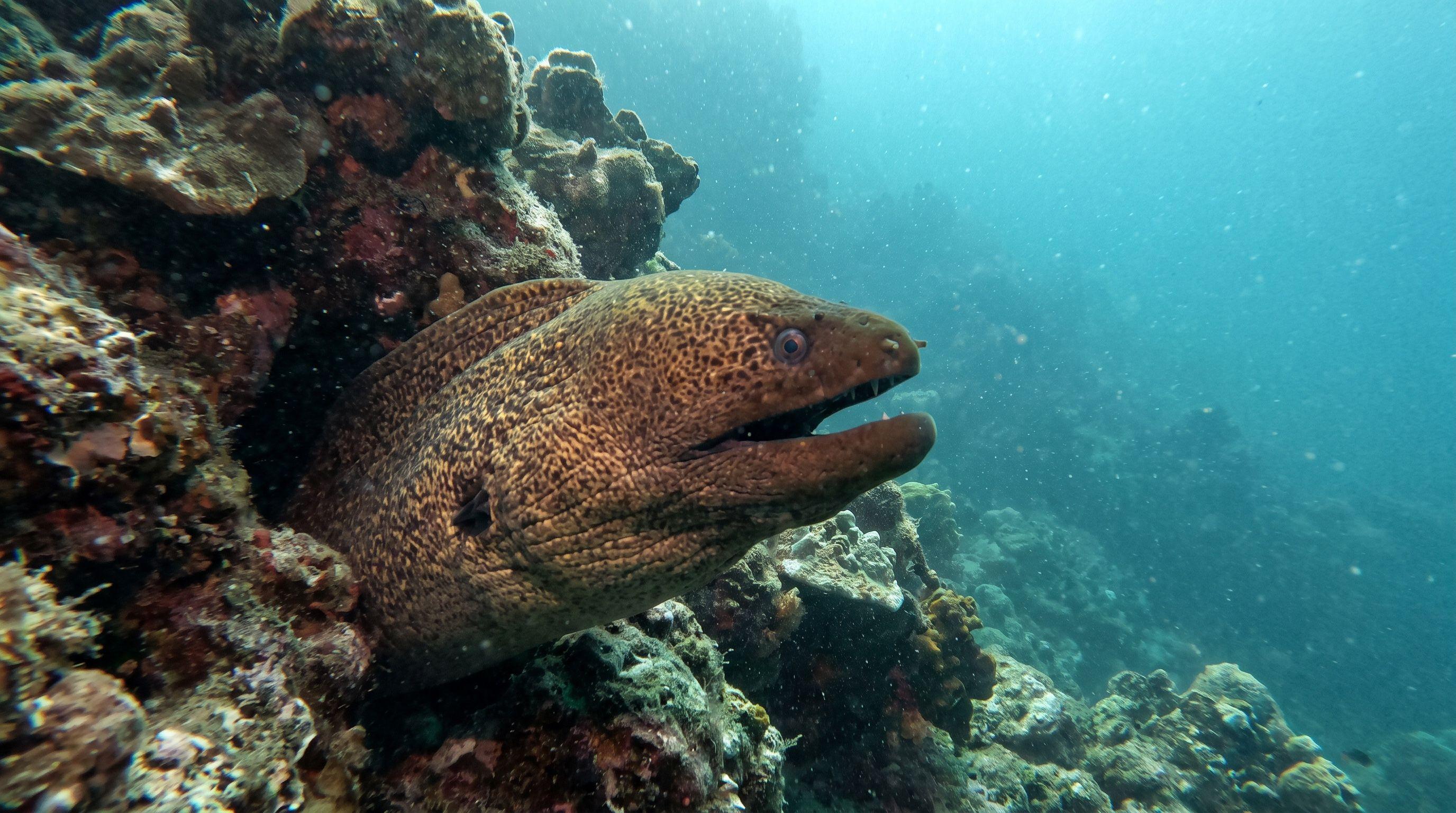 AI-generated
AI-generated illustration
Image credit: AI-generated illustration · License unspecified · Source unspecified