Octopus (assorted)
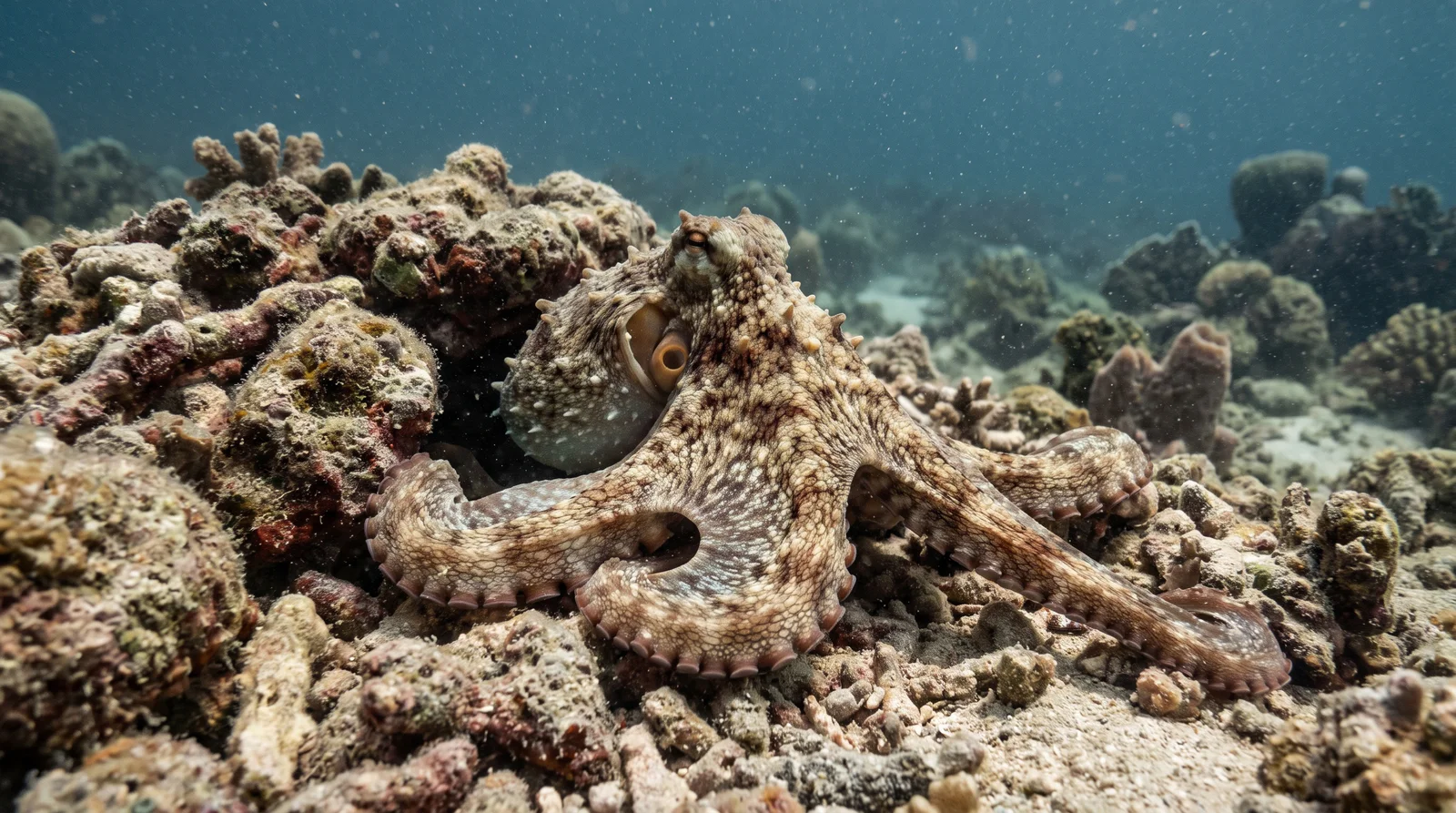 AI-generated
Image credit: AI-generated illustration · License unspecified · Source unspecified
Octopodidae spp.
About Octopus (assorted).
"Octopus (assorted)" is a group entry for the bottom-living octopuses of the family Octopodidae, used when a sighting or source records an octopus without naming the species. The family includes the common and reef octopuses as well as the blue-ringed octopuses. Where the animal can be identified, use the single-species entries for Common Octopus, Reef Octopus (Day Octopus), Mimic Octopus, Blue-ringed Octopus, Wonderpus or Caribbean Reef Octopus instead.
Octopuses are cephalopod molluscs. They have eight sucker-lined arms, no external shell and a hard, parrot-like beak, which in many species is the only hard part of the body and lets them squeeze through very small gaps. They have three hearts, two pumping blood through the gills and one to the rest of the body, and their blood is blue because it carries oxygen with copper-based haemocyanin.
Identification
- Body plan: A soft, rounded body behind the eyes and eight arms; unlike squid and cuttlefish, these octopuses have no fins along the body.
- Size: Varies widely by species, from small species such as the blue-lined octopus, at up to about 4.5 cm, to the common octopus, at about 30–90 cm in length.
- Colour and texture: Pigment cells (chromatophores), reflective cells and muscular skin papillae let octopuses change colour, pattern and skin texture in a fraction of a second, so colour alone is a poor guide to species.
- Warning colours: Blue-ringed octopuses are normally brownish and show vivid blue rings when disturbed.
Safety
Blue-ringed octopuses are highly venomous and must never be handled. Their venom, tetrodotoxin, can cause numbness, breathing difficulty and paralysis of the breathing muscles within minutes of a bite that may not even be felt, and several people have died after bites in Australia. Small octopuses are hard to identify underwater, so the safest approach is not to touch any octopus.
Conservation
Conservation status varies by species, and no single category applies to the whole family. The references consulted for this entry did not give species-level IUCN categories, so check the single-species entries for individual assessments.
Where it lives.
Octopuses of the family Octopodidae are found widely in tropical and temperate seas, from intertidal rock pools to deep water. Divers mostly meet them on reefs and the surrounding seabed. The family covers a wide size range, from small species of a few centimetres to the common octopus, which can approach a metre in length.
Reef octopuses are bottom dwellers that depend on shelter. The common octopus, for example, lives in structured habitats such as rock, rubble, shells, coral, sponge, algae or seagrass, may use man-made structures, and is typically found from 0 to 200 m. The blue-lined octopus is found on intertidal rocky shores and in coastal waters down to about 15 m.
Places worth checking include:
- Reef crevices and holes: Gaps in coral and rock serve as dens, and often only an eye or an arm tip is visible at the entrance.
- Rubble and mixed bottoms: Broken coral, shells and stones offer hiding places.
- Sand and mud: Some octopuses cross or live on open sand, relying on camouflage.
- Seagrass and algae beds: These provide cover and hunting grounds.
- Rocky shores and shallows: Several small species, including blue-ringed octopuses, live in very shallow water.
- Artificial structures: Man-made objects on the seabed can also be used as shelter.
Prey remains discarded outside a den, such as crab shells and empty mollusc shells, form piles called middens. Scientists use them to study what octopuses eat, and for divers they are a useful sign that an octopus may be living nearby. Look at a midden without moving it or disturbing the den entrance.
How it behaves.
Octopuses spend much of their time sheltering in a den. Activity patterns vary by species: the common octopus, for example, is active both by day and at night, and its activity can be influenced by predators and other octopus species.
Feeding
Octopuses are predators. The common octopus feeds mainly on crustaceans, bivalves and gastropods, and blue-ringed octopuses use venom to kill crabs and small fish. Leftover shells are discarded outside the den.
Defence
Their main defence is camouflage. Octopuses can change colour, pattern and texture in a fraction of a second, and the common octopus can cross sand in a "moving rock" disguise in which it looks like an inanimate object. Most can also release ink to confuse predators and escape by jet propulsion, drawing water into the mantle and forcing it out through a muscular siphon. Most cephalopods appear to be colourblind, yet they still match their background closely.
Intelligence and Life Cycle
Octopuses have a high brain-to-body ratio for invertebrates and show problem-solving, tool use and learning; about two-thirds of their neurons are in the arms. Most live only one to two years and reproduce once. Males pass sperm packets to the female with a specialised arm, and many females guard their eggs without eating until they hatch, then die. One deep-sea octopus was recorded brooding its eggs for about four and a half years.
Diver Tips
- Look, do not touch: Never handle an octopus; blue-ringed species are highly venomous, and handling stresses any octopus.
- Stay off the den: Hover nearby with good buoyancy rather than kneeling on the reef or reaching into holes.
- Do not chase: Following an octopus that is moving away can drive it out of shelter.
- Leave brooding females alone: A female guarding eggs in her den should not be disturbed.
- Light gently: Avoid shining strong lights into a den for long periods.
Where to see it.
Evidence for mactan · 1 dive site
General range is not evidence of occurrence at a specific dive site.
Gallery.
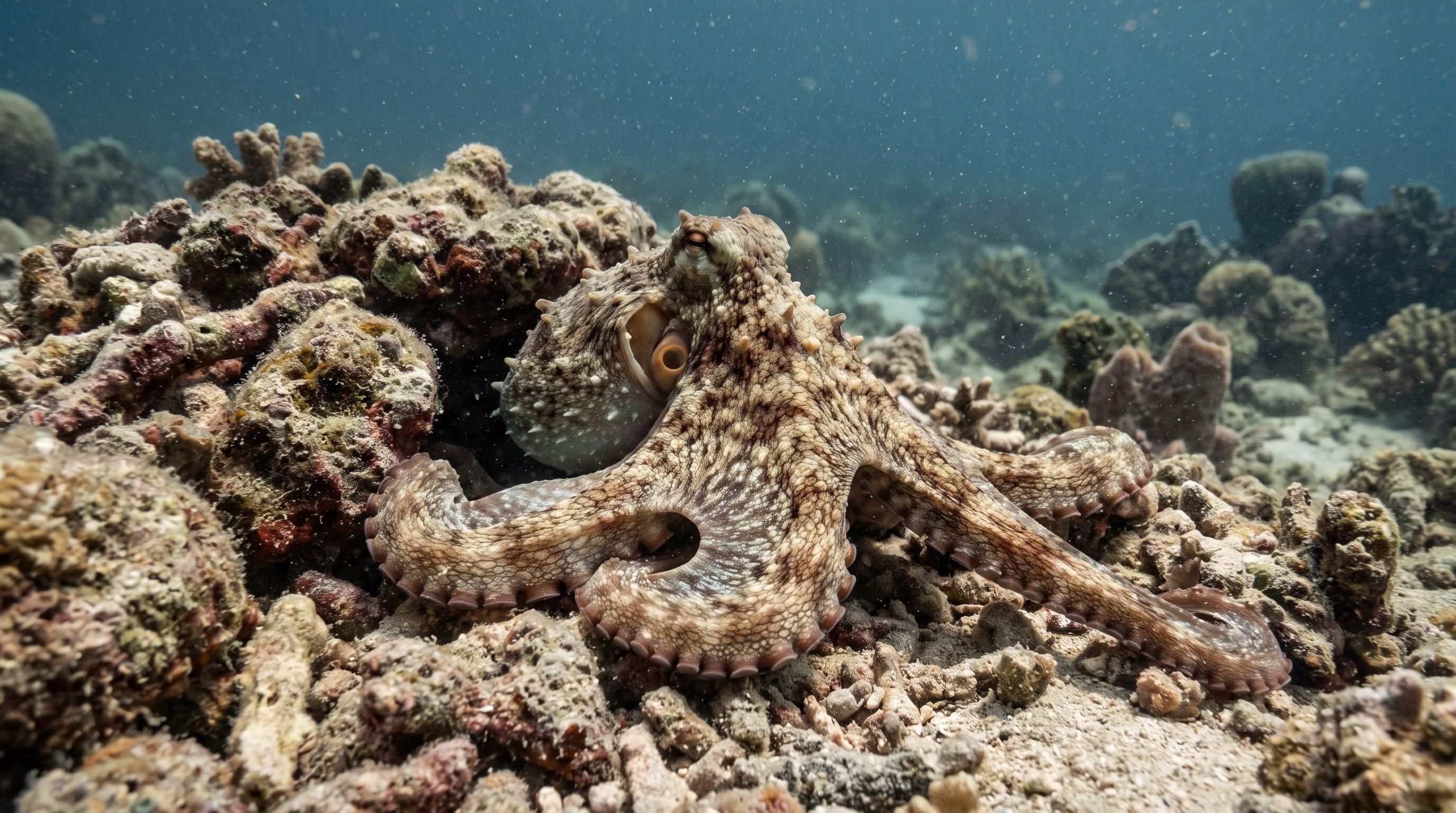 AI-generated
AI-generated illustration
Image credit: AI-generated illustration · License unspecified · Source unspecified