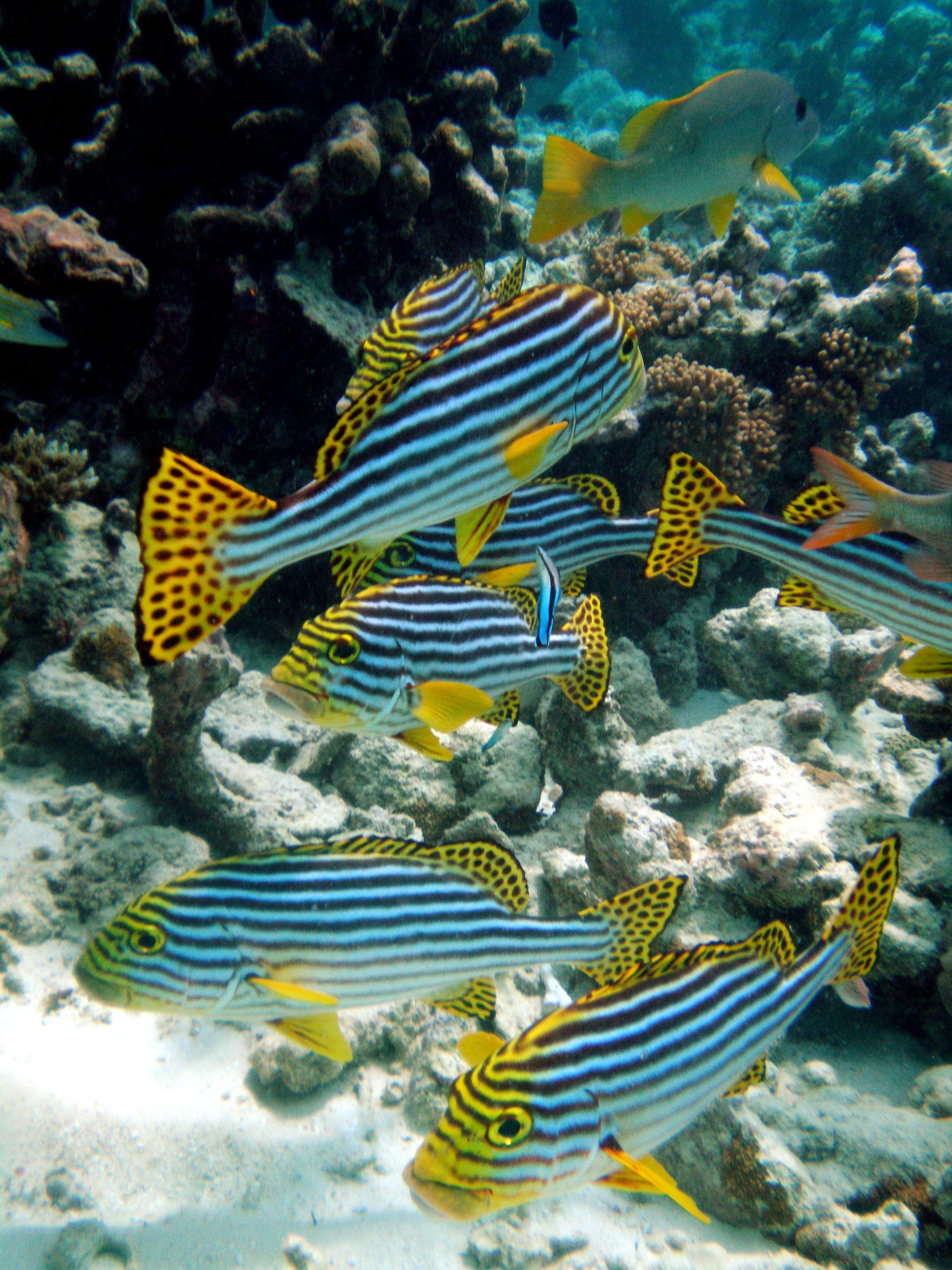
Oriental Sweetlips
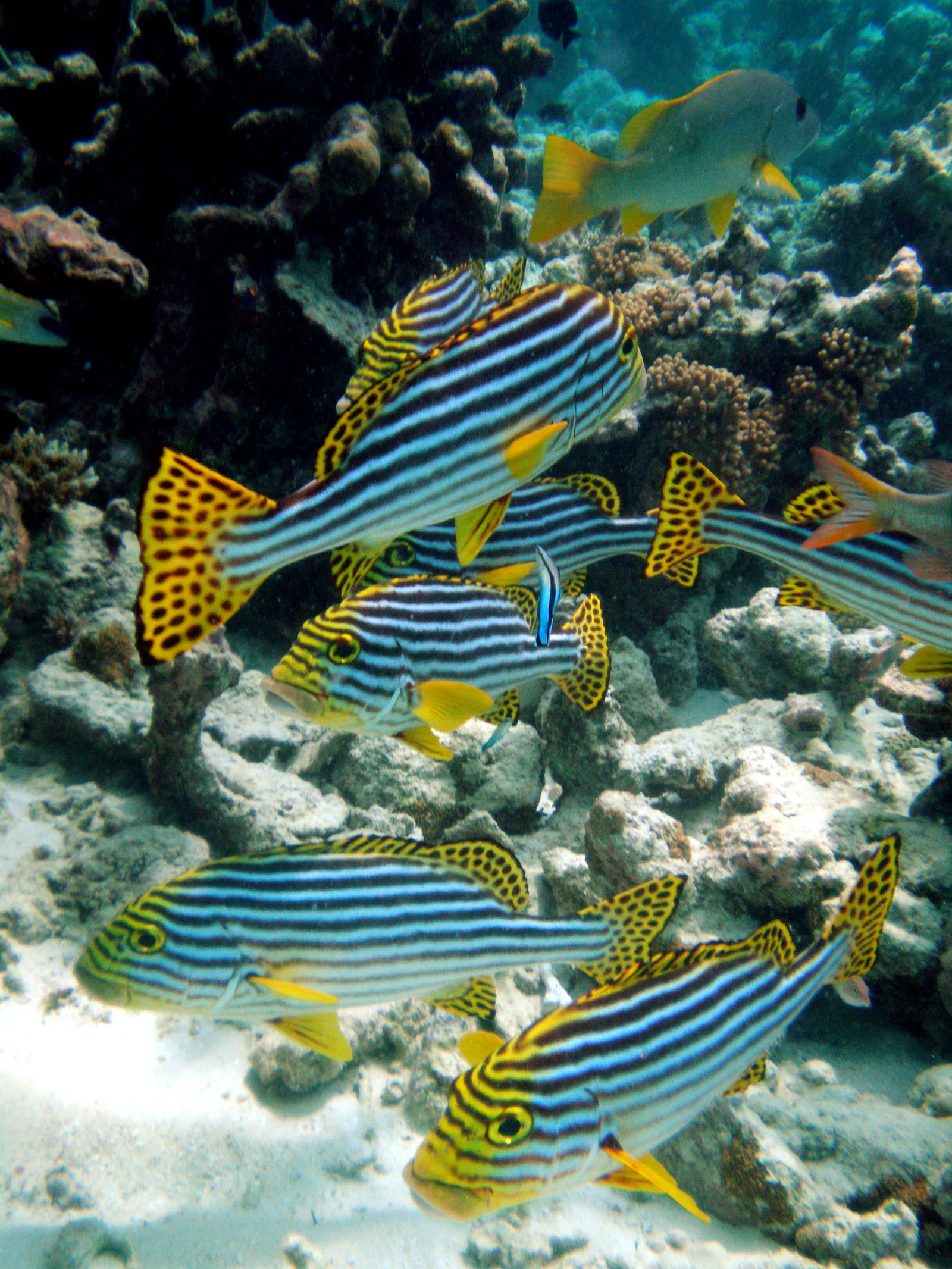
Plectorhinchus vittatus
About Oriental Sweetlips.
Oriental Sweetlips (Plectorhinchus vittatus)
The Oriental Sweetlips, scientifically known as Plectorhinchus vittatus, is a captivating and easily recognizable marine fish belonging to the Haemulidae family, commonly known as grunts. This species is a favorite among divers for its striking patterns and often docile behavior. It is also known by other common names such as Indian Ocean Oriental Sweetlips or Oriental Blubberlips.
Found throughout the Indo-Pacific region, its extensive range stretches from the East African coast, including Djibouti and South Africa, across the Indian Ocean to the western Pacific, encompassing areas like Micronesia, Samoa, the Society Islands, Guam, Western Australia, Papua New Guinea, and New Caledonia.
Oriental Sweetlips typically inhabit shallow, coastal coral reefs, lagoons, and seaward reefs, usually found at depths of 2–45 m. During the day, adults are often observed resting solitarily or in small aggregations, hovering under ledges, in caves, or near coral bommies. They are nocturnal feeders, foraging at night for a diet primarily consisting of small invertebrates such as crustaceans, gastropods, annelids, and worms, as well as smaller fishes. Juveniles, in contrast, prefer shallower waters, often found in tidepools, seagrass beds, or sheltered lagoons, where they seek refuge among coral formations and rocky areas. This species is currently listed as "Least Concern" by the IUCN, indicating a stable population.
This species is commonly observed at numerous dive sites, including Banana Reef, Melissa's Garden, Manta Sandy, Olympia Maru, Mainit Point, Boo Windows, Tatawa Besar, Manta Point (Rannalhi), Kudarah Thila, and Broken Rock.
Identification
The Oriental Sweetlips is renowned for its distinctive appearance, which undergoes a dramatic transformation from its juvenile to adult stages, making both forms memorable for divers.
- Size: Adults can reach an impressive maximum size of 85 cm (33 inches).
- Adult Coloration and Pattern:
- Adults display a basic light grayish body color that fades to white on the abdomen.
- The most striking feature is the alternating pattern of bold black and white (or pale grey) horizontal stripes that run along the entire body, from snout to tail, including the belly. The black stripes are typically broader on the upper body.
- Their characteristic "sweetlips" are fleshy and become noticeably swollen with age.
- All fins (dorsal, anal, caudal, pectoral, and pelvic) are a vibrant yellow.
- The snout and forehead also exhibit a bright yellow hue.
- The dorsal, anal, and caudal fins are adorned with distinct blackish spots. Pectoral and pelvic fins are generally plain yellow, sometimes with a dark red or black patch at their base.
- The eye is often yellow.
- The caudal fin of adults is typically truncate (straight-edged).
- Juvenile Coloration and Behavior:
- Juveniles look remarkably different from adults, often displaying a brown-and-white mottled pattern with yellow accents. Some descriptions note connected black blotches and spots that gradually break up into horizontal stripes as they mature.
- They are typically much smaller, ranging from 4–8 cm.
- A notable behavior of juvenile Oriental Sweetlips is their curious wriggling or undulating swimming style, which can give the impression of a swimming flatworm, a potential mimicry defense strategy against predators.
- Juvenile pectoral fins are black, transitioning to uniform yellow in adulthood.
Where it lives.
Habitat and Distribution
The Oriental Sweetlips is widely distributed throughout the Indo-Pacific region, spanning from the eastern coast of Africa, including Djibouti, South Africa, Madagascar, the Seychelles, and Mascarene Islands, across the Indian Ocean to Micronesia, Samoa, the Society Islands, Guam, and extending from Western Australia to Papua New Guinea and New Caledonia.
This species is primarily associated with diverse reef environments, including:
- Shallow, coastal coral reefs
- Inshore rocky reefs
- Lagoon bommies and protected lagoons
- Seaward reefs
- Ledges
Adult Oriental Sweetlips are typically found at depths ranging from 2 to 25 m. They are often observed resting singly or in small aggregations near or over reef structures during the day, seeking shelter in caves, crevices, and coral heads.
Juvenile Oriental Sweetlips exhibit different habitat preferences, often inhabiting shallower waters such as tidepools and seagrass beds, or staying close to coral bommies and crevices on the reef for hiding spots.
While primarily reef-associated, they are nocturnal carnivores, foraging at night for small invertebrates like crustaceans, gastropods, and annelids, as well as smaller fishes.
How it behaves.
The Oriental Sweetlips (Plectorhinchus vittatus) is a striking and often-sought-after species for divers, known for its distinctive patterns and calm demeanor. These fish, belonging to the grunt family (Haemulidae), are commonly encountered on coral and rocky reefs across the Indo-West Pacific, from East Africa to Papua New Guinea and New Caledonia.
Underwater Encounter Behavior
Oriental Sweetlips are generally considered shy and docile, making them approachable for divers who move slowly and respectfully. During the day, divers will typically find adult Oriental Sweetlips resting in groups, often in small clusters under overhangs, ledges, or within crevices on the reef. They can be observed at depths ranging from 2 to 25 meters, in waters with temperatures between approximately 23°C and 31°C. Juveniles, with their dramatically different coloration and a unique wriggling swimming style, may be found solitary in shallower protected lagoons or seagrass beds. This undulating movement is thought to mimic poisonous flatworms or nudibranchs as a defense mechanism against predators.
Feeding Habits
Oriental Sweetlips are primarily nocturnal feeders. As bottom-dwelling predators, they forage at night for a diet consisting mainly of small benthic invertebrates such as crustaceans (like prawns), worms (including bristle worms), and mollusks. They are known to use jets of water to blow prey out of the sand.
Social Structure
While juveniles are often solitary, adult Oriental Sweetlips typically form small to medium-sized aggregations or schools during the day. These groups can be seen gliding gracefully along coral slopes or congregating in sheltered areas of the reef. They are considered social creatures, and their schooling behavior is a notable characteristic for divers to observe.
Notable Seasonal Patterns
Information on distinct seasonal patterns for Oriental Sweetlips relevant to divers is limited. They are generally observed year-round in their tropical habitats. Reproduction involves distinct pairing during breeding, and they are an oviparous species, but specific seasonal spawning aggregations are not well-documented for divers.
Divers frequently encounter Oriental Sweetlips at popular dive sites such as Banana Reef, Melissa's Garden, Manta Sandy, Olympia Maru, Mainit Point, Boo Windows, Tatawa Besar, Manta Point (Rannalhi), Kudarah Thila, and Broken Rock.
Where to see it.
Evidence for philippines · 3 dive sites
General range is not evidence of occurrence at a specific dive site.
Mainit Point
Anilao
Site occurrence not yet documented
Season not yet documented
No dated observations available.
Olympia Maru
Coron
Site occurrence not yet documented
Documented site seasonality: Mar, Apr, May
No dated observations available.
Royal Garden
Panglao
Site occurrence not yet documented
Season not yet documented
No dated observations available.
Gallery.