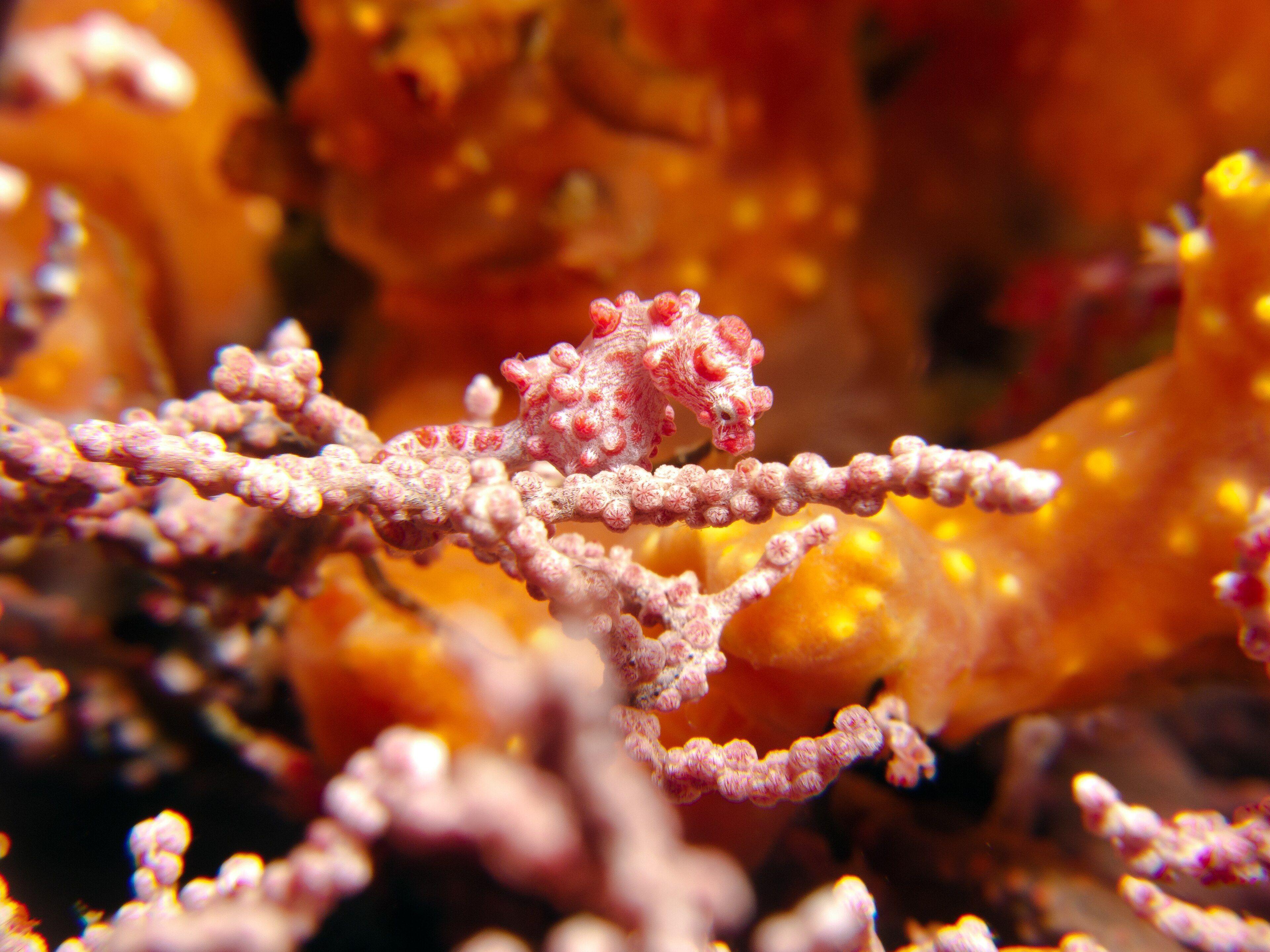
Pygmy Seahorse
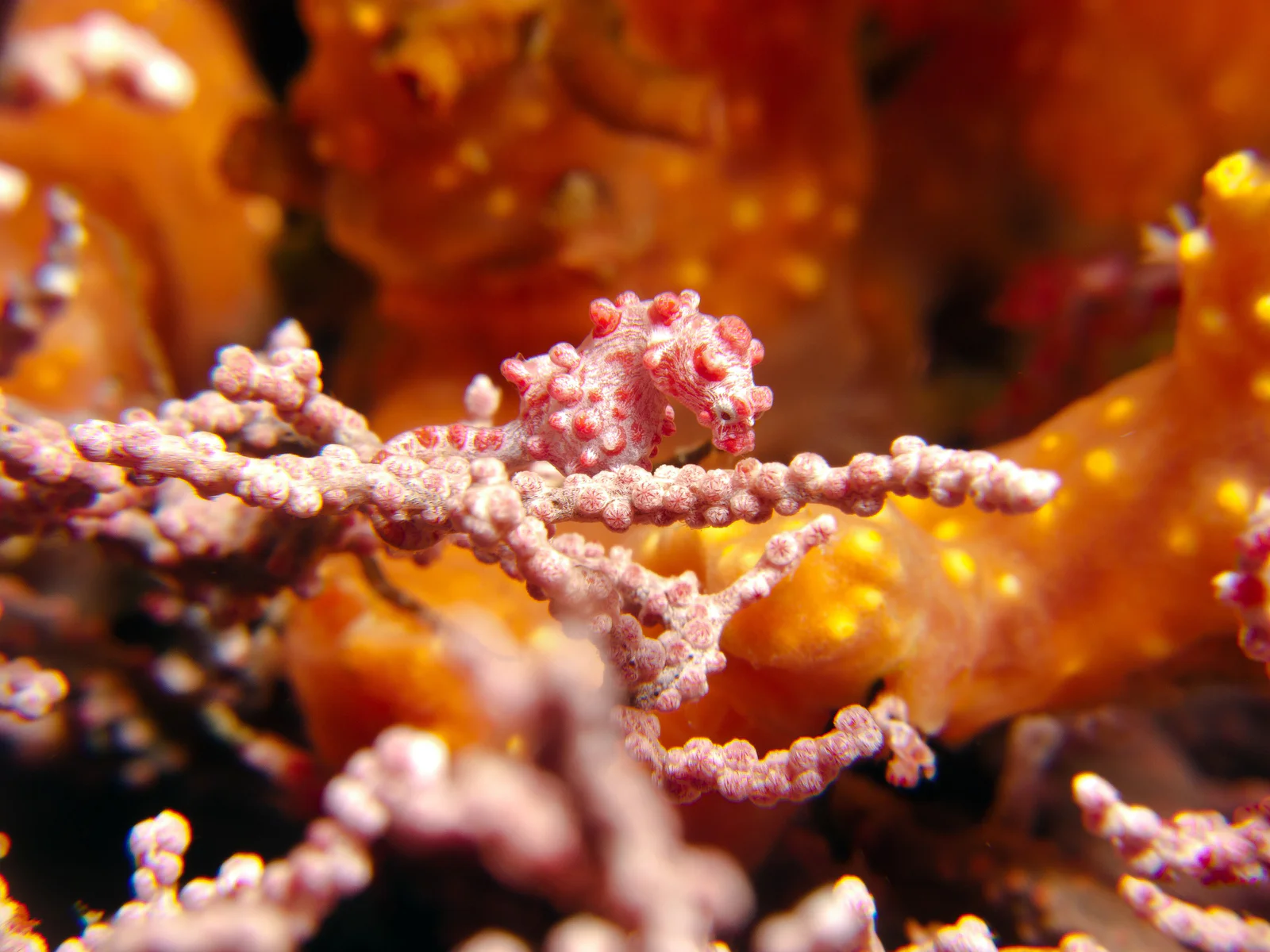
Hippocampus bargibanti
About Pygmy Seahorse.
The Pygmy Seahorse, scientifically known as Hippocampus bargibanti, is a captivating member of the Syngnathidae family, which includes seahorses and pipefishes. This tiny macro species is renowned for its extraordinary camouflage, making it one of the most sought-after subjects for underwater photographers and a true marvel for divers to discover. It was only formally identified in 1970 after being accidentally discovered on a gorgonian coral specimen in a laboratory.
Found exclusively living on gorgonian corals, primarily of the genus Muricella, the Pygmy Seahorse spends its entire adult life attached to a single host. Its distribution spans the Indo-West Pacific, encompassing the biodiverse Coral Triangle region, from southern tropical Japan down to Australia's Great Barrier Reef, and eastward to Vanuatu. These diminutive creatures typically inhabit depths of 16–40 m in tropical waters, thriving in temperatures of 24–28°C. They are visual planktivores, feeding on tiny crustaceans and other small planktonic organisms, which they slowly suck into their tubular snouts.
The conservation status of the Pygmy Seahorse is currently listed as "Data Deficient" by the IUCN Red List, indicating a lack of sufficient scientific information to properly assess its population trends and threats. However, its extreme habitat specialization and dependence on healthy coral reefs make it particularly vulnerable to the impacts of climate change and coral reef degradation.
Identification
- Size: The Pygmy Seahorse is one of the smallest seahorse species in the world, reaching a maximum size of just 2.4 cm (0.94 in).
- Camouflage: Its most distinctive feature is its unparalleled camouflage, which allows it to blend seamlessly with its host gorgonian coral, making it incredibly challenging to spot.
- Body Structure: It possesses a fleshy head and body, a very short snout, and a prehensile tail used for clinging to the coral branches. The body is covered in rounded, wart-like protuberances called tubercles, which perfectly mimic the polyps of the gorgonian coral.
- Coloration: The coloration of the Pygmy Seahorse is a direct match to its host coral. Two primary color morphs are recognized:
- Pale grey or purple with pink or red tubercles, typically found on gorgonian coral species like Muricella plectana.
- Yellow with orange tubercles, commonly found on gorgonian coral species such as Muricella paraplectana.
- Eyes: Despite its tiny size, it has relatively large eyes that can move independently, aiding in prey detection.
Where it lives.
The Pygmy Seahorse (Hippocampus bargibanti) is a master of camouflage, making it one of the most sought-after macro subjects for divers across its range. This diminutive species is an extreme habitat specialist, living exclusively on specific gorgonian corals, primarily those of the genus Muricella, such as Muricella plectana or Muricella paraplectana.
Its remarkable ability to perfectly mimic the texture and coloration of its host gorgonian, including developing bulbous tubercles that resemble the coral's polyps, renders it incredibly difficult to spot. Divers often spend considerable time searching for these tiny creatures, which cling to the coral branches with their prehensile tails, blending seamlessly into their surroundings.
Habitat and Depth:
- Ecosystem: Pygmy Seahorses inhabit vibrant coral reef ecosystems.
- Substrate: They have an obligate relationship with gorgonian sea fans, meaning they cannot survive without their chosen coral host.
- Depth Range: These seahorses are typically found at depths ranging from 10–40 m, with many observations occurring between 16–40 m.
Distribution:
The geographic distribution of Hippocampus bargibanti spans the Indo-West Pacific Ocean. It is most commonly found within the biodiverse Coral Triangle region, encompassing countries such as Indonesia, the Philippines, Papua New Guinea, the Solomon Islands, Fiji, Vanuatu, and Timor-Leste. Its range extends northward to southern tropical Japan and southward to northern Australia, including the Great Barrier Reef and New Caledonia. Dive sites where this species has been observed include USAT Liberty Wreck, Blue Magic, Batu Bolong, Cabilao Shark Point (Lighthouse), Sogod Bay (Pintuyan / Padre Burgos), Coral Cove, Dungon Wall, Siaba Besar, Turtle Point, and Cannibal Rock.
Pygmy Seahorses are often observed in pairs or small clusters, with a single gorgonian host sometimes supporting up to 28 individuals. Their reliance on specific gorgonian corals makes them particularly vulnerable to habitat degradation and the impacts of climate change on coral reefs.
How it behaves.
Underwater Encounter Behavior
Encountering a Pygmy Seahorse is a testament to a diver's keen eye or the expertise of a local dive guide. Their remarkable camouflage is so effective that the species was only discovered by accident when a host gorgonian was being examined in a laboratory. Their bodies are adorned with rounded tubercles that perfectly mimic the color and shape of the gorgonian's polyps, while their body coloration matches the coral stem. Depending on their host, they can be purple with pink tubercles or yellow with orange tubercles.
Pygmy Seahorses are largely sedentary, using their prehensile tails to firmly anchor themselves to a gorgonian branch. This adaptation is crucial as they are poor swimmers and too small to withstand strong currents without an anchor. When observed, they typically remain motionless, blending seamlessly into their environment. Divers should maintain excellent buoyancy control and avoid touching the delicate gorgonian coral, as these corals grow very slowly and are easily damaged, which directly impacts the seahorse's survival. They are typically found at depths of 16–40 meters (52.5–131 feet), though some have been recorded deeper.
Feeding Habits
Pygmy Seahorses are visual planktivores, feeding on very small crustaceans and other planktonic organisms that drift by. Due to their small size and lack of a true stomach, food passes through them quickly, requiring them to feed frequently throughout the day. They are patient hunters, waiting motionlessly for prey to come within striking distance, then rapidly sucking it into their tubular mouths with their short snouts.
Social Structure
Pygmy Seahorses are not solitary creatures; they live in small clusters on a single gorgonian coral. A single gorgonian can host up to 28 individuals, often in pairs or clusters of pairs. While some research suggests they are possibly monogamous, other observations indicate more complex social dynamics, including social polygamy and sequential polyandry in instances where sex ratios are skewed. Males compete for access to females, and daily courtship rituals involving synchronized movements and tail entwining help pairs synchronize their reproductive cycles.
Notable Seasonal Patterns
Reproduction in Pygmy Seahorses can occur year-round, provided stress levels are low and food is plentiful. Like all seahorses, the male carries the eggs in a specialized brood pouch located in his trunk, not his tail. The female transfers her eggs into the male's pouch, where he fertilizes and broods them for approximately two weeks. After gestation, the male gives birth to dozens of tiny, fully formed juveniles, each about 2 mm (0.07 inches) long. These newborns are immediately independent and receive no further parental care. The water temperature can influence the development time of the eggs, with warmer temperatures leading to faster development. While a breeding season from March to November has been noted, particularly in depths over 20 m, year-round breeding is common in stable conditions.
Where to see it.
Evidence for philippines · 8 dive sites
General range is not evidence of occurrence at a specific dive site.
Cabilao Shark Point (Lighthouse)
Cabilao Island
Site occurrence not yet documented
Season not yet documented
No dated observations available.
Coral Cove
Puerto Galera
Site occurrence not yet documented
Season not yet documented
No dated observations available.
Dry Dock
Puerto Galera
Site occurrence not yet documented
Season not yet documented
No dated observations available.
Dungon Wall
Puerto Galera
Site occurrence not yet documented
Season not yet documented
No dated observations available.
Gorgonian Wall
Cabilao Island
Site occurrence not yet documented
Documented site seasonality: Dec, Jan, Feb, Mar, Apr, May, Jun
No dated observations available.
Snappers
Anda
Site occurrence not yet documented
Documented site seasonality: Nov, Dec, Jan, Feb, Mar, Apr, May
No dated observations available.
Sogod Bay (Pintuyan / Padre Burgos)
Southern Leyte
Site occurrence not yet documented
Season not yet documented
No dated observations available.
Turtle Point
Anda
Site occurrence not yet documented
Documented site seasonality: Nov, Dec, Jan, Feb, Mar, Apr, May
No dated observations available.
Gallery.