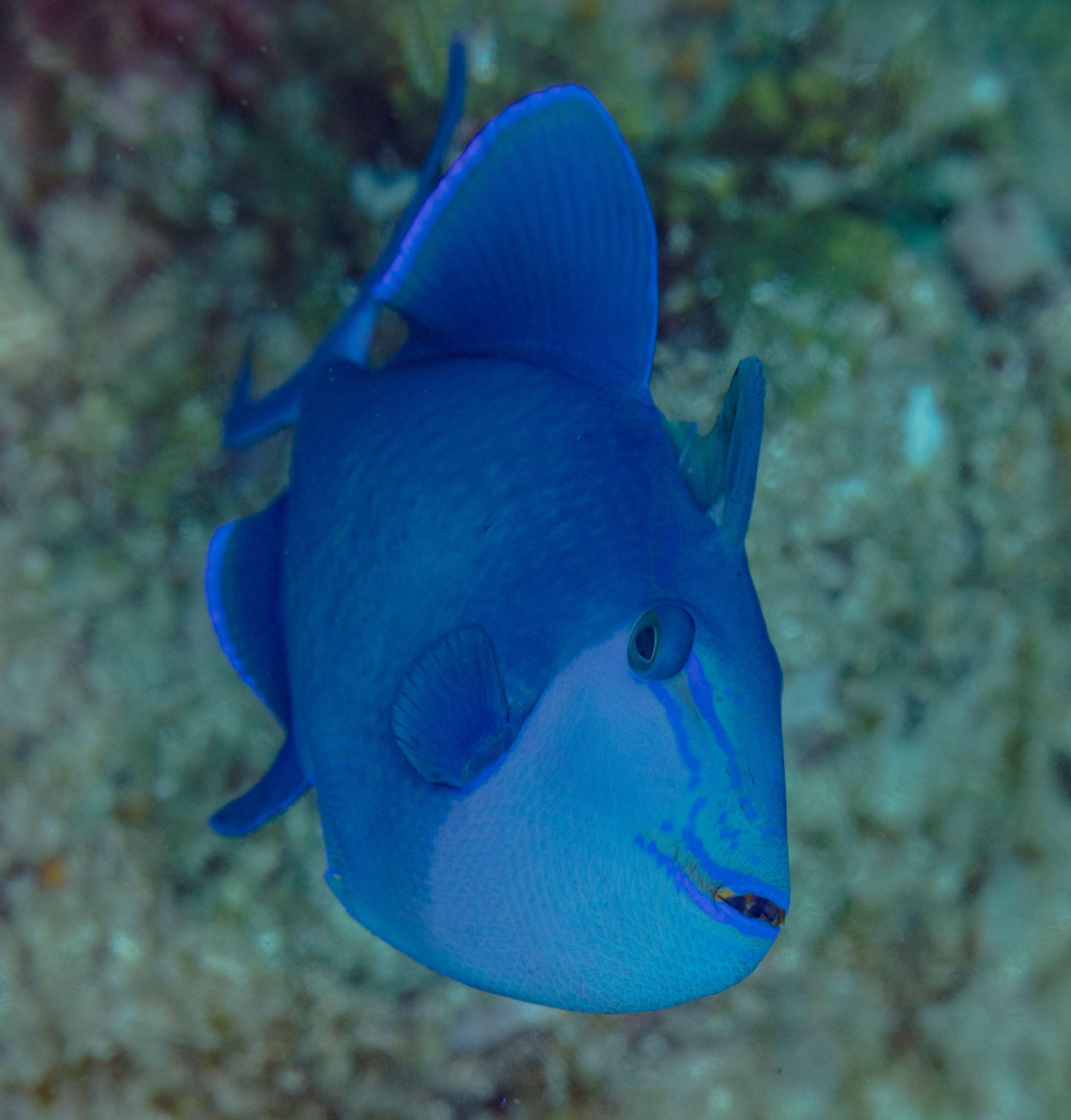
Redtoothed Triggerfish
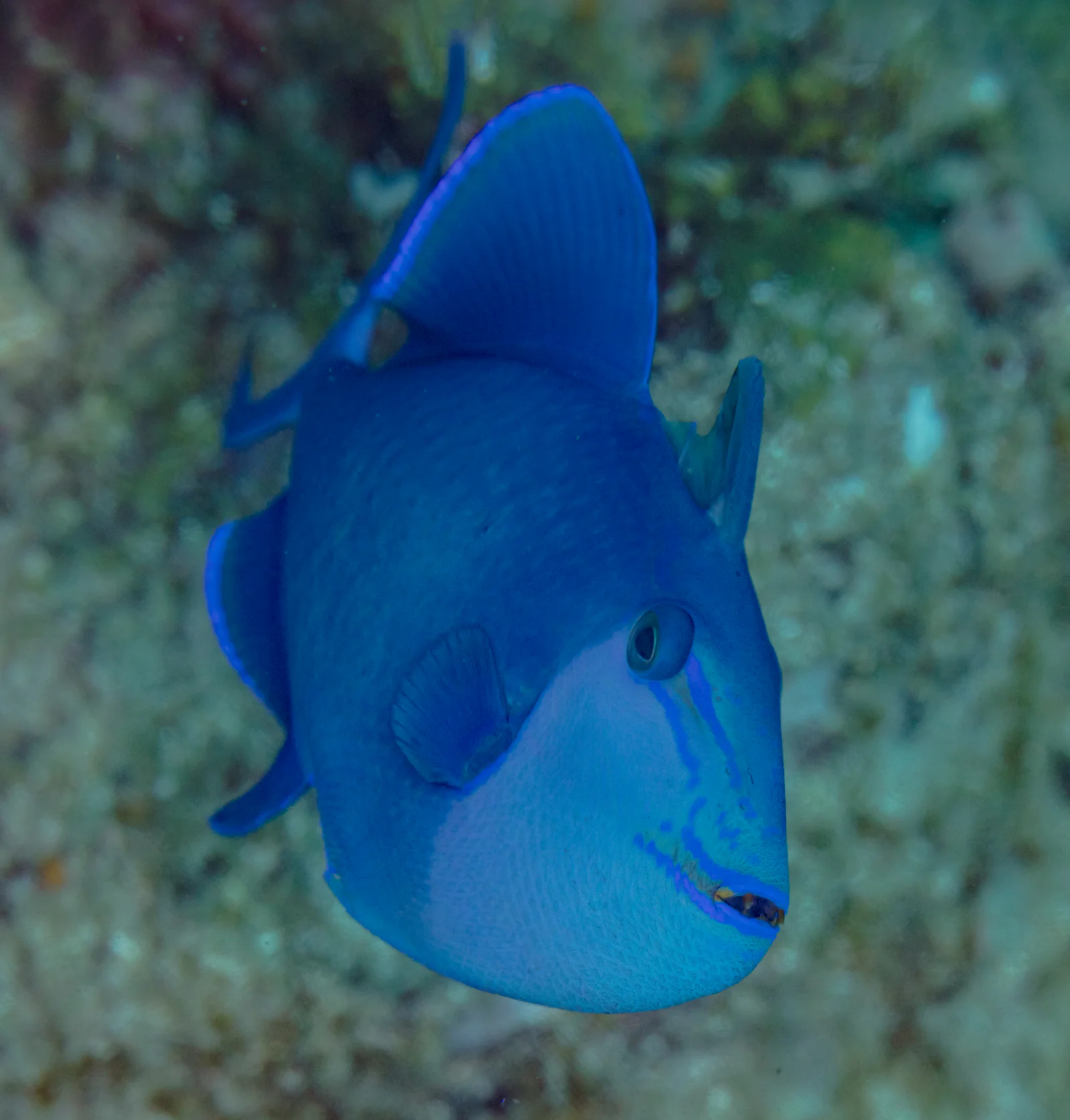
Odonus niger
About Redtoothed Triggerfish.
The Redtoothed Triggerfish (Odonus niger) is a captivating member of the Balistidae family, renowned for its striking coloration and distinctive dental features. Unlike many of its more solitary triggerfish relatives, this species is often observed forming dense, swirling aggregations in the water column, particularly above exposed reef slopes and channels where strong currents prevail.
Found throughout the vast Indo-Pacific region, from the Red Sea to the Society Islands and from southern Japan to the Great Barrier Reef, the Redtoothed Triggerfish thrives in tropical and subtropical waters. Divers commonly encounter these active swimmers at depths of 5–55 m, though they can range from as shallow as 3 m to as deep as 110 m, preferring waters of 22–31°C. Their diet primarily consists of zooplankton, which they expertly filter from the currents, but they are also opportunistic feeders, consuming crustaceans, sponges, algae, and even small fish. The species is currently listed as "Least Concern" in terms of conservation status.
This species is a common sight at dive sites such as Beatrice Rock and Boulders, where their vibrant presence adds to the underwater spectacle.
Identification
The Redtoothed Triggerfish is easily identifiable by several key physical characteristics:
- Size and Shape: It possesses a moderately deep, compressed body, typical of triggerfish, and can reach a maximum size of 50 cm (20 in).
- Coloration: The body is typically a deep blue to purplish-blue, often with a paler blue or yellowish head. The coloration can sometimes shift to blue-green depending on the fish's mood or environmental conditions.
- Distinctive Teeth: As its name suggests, the most striking feature is its prominent, chisel-like red teeth, with two upper teeth often visible even when the mouth is closed, giving it a characteristic "grinning" appearance.
- Fins: The caudal fin is distinctly lunate (lyre-shaped) with elongated lobes in adults. The margins of the second dorsal, anal, and caudal fins are typically lined with an electric or light blue. The anterior portions of the second dorsal and anal fins are also notably elevated.
- Dorsal Spine: Like other triggerfish, it has a retractable first dorsal spine that can be locked upright, allowing it to wedge itself into reef crevices for protection.
- Skin Texture: Its skin is rough to the touch, covered in non-overlapping scales, and features rows of small spines on the posterior sides of its body.
- Facial Markings: Two dark blue lines often run from the front of the eye towards its upturned mouth.
Where it lives.
- Habitat and Environment: The Redtoothed Triggerfish primarily inhabits current-swept seaward coral reefs, reef channels, and slopes. It is frequently found around pinnacles and drop-offs where strong water currents prevail, providing abundant zooplankton for feeding. While juveniles may be found alone near crevices and isolated patches of rubble, adults commonly form large schools, often seen swimming well off the bottom on steep outer reef slopes. They prefer clear waters with abundant coral formations.
- Depth Range: This species is typically found at depths ranging from 5 to 110 m. More commonly, divers encounter them between 5 and 40 m, though some sources indicate a range of 9–30 m in coastal shallow inshore waters to outer reef drop-offs.
- Substrate Preference: Redtoothed Triggerfish are strongly associated with rocky and coral reef substrates, utilizing crevices and caves for shelter, especially during the night or when threatened. They can wedge themselves securely into these spaces by locking their dorsal spine. While they are not considered "reef safe" in aquarium settings due to their habit of overturning live rock and using coral rubble to sharpen their teeth, they do not typically eat corals.
- Ecosystem Associations: As planktivorous feeders, Redtoothed Triggerfish play a role in the pelagic-benthic coupling of reef ecosystems, primarily consuming zooplankton, copepods, and sponges. They also consume krill, clams, squid, sea urchins, and small fish. Their feeding habits, particularly their predation on sea urchins, contribute to the overall health and growth potential of coral reefs. They are a non-migratory, reef-associated species.
- Geographic Distribution: The Redtoothed Triggerfish has a wide distribution across the tropical Indo-Pacific Ocean and the Red Sea. Their range extends from the east coast of Africa (south to Durban, South Africa) eastward to the Marquesas and Society Islands, northward to southern Japan, and southward to the Great Barrier Reef in Australia and New Caledonia. They thrive in tropical waters with temperatures typically between 22–31°C.
How it behaves.
Underwater Encounter Behavior
Divers frequently encounter Redtoothed Triggerfish in large, shimmering schools, often in current-swept areas near outer reef slopes and drop-offs. These active swimmers are typically observed in midwater, gracefully undulating their dorsal and anal fins for propulsion. While generally peaceful, like all triggerfish, they possess a unique defense mechanism: a dorsal spine that can be locked into an erect position, allowing them to wedge themselves securely into reef crevices when threatened. This behavior is often observed when they retreat from perceived danger. They can also communicate through body movements and changes in color, which may indicate mood or stress levels. Some individuals may even produce grunting sounds. While most encounters are benign, divers should always maintain a respectful distance, especially during breeding seasons when parental fish can become protective of their nests.Feeding Habits
The Redtoothed Triggerfish is primarily a planktivore, distinguishing it from many other triggerfish species that feed on benthic invertebrates. They actively feed on zooplankton, small crustaceans, and algae, often in areas with strong water currents that concentrate their food source. Their specialized red teeth, which are visible even when their mouth is closed, are adapted for capturing and manipulating these soft-bodied planktonic organisms. They are sometimes observed in large aggregations while feeding, demonstrating cooperative feeding behavior to efficiently exploit patchy plankton distributions. While their primary diet is plankton, they are also considered omnivorous and have been noted to consume sponges, krill, clams, squid, urchins, and small fish.Social Structure
Redtoothed Triggerfish are highly social, a characteristic that sets them apart from many of their more solitary triggerfish relatives. They are frequently observed forming impressive schools, sometimes numbering hundreds or even thousands of individuals, as they move through open water in search of planktonic prey. Despite their schooling behavior, males can be territorial, especially during the breeding season. They may maintain harems of up to ten females.Notable Seasonal Patterns
Reproduction in Redtoothed Triggerfish occurs in warm waters during specific seasons, with peak activity often coinciding with warmer months when zooplankton productivity is highest. Spawning can occur throughout much of the year in tropical regions, but may be more seasonal in temperate areas. They are demersal spawners, with males preparing nests—shallow depressions in sandy or coral rubble substrates—where females deposit adhesive eggs. Both males and females exhibit parental care, guarding the eggs until they hatch. During this nesting period, which can be timed to lunar cycles (e.g., full or new moon), the fish, particularly the females, can become highly aggressive and protective of their nests. Divers should be particularly cautious during these times, typically summer months (e.g., June through August in some regions), and avoid approaching nesting sites to prevent defensive charges. If a triggerfish displays warning signs like erecting its dorsal spine or giving a sideways glare, it is advisable to swim horizontally away from the area.Where to see it.
Gallery.