Spotted Snake Eel
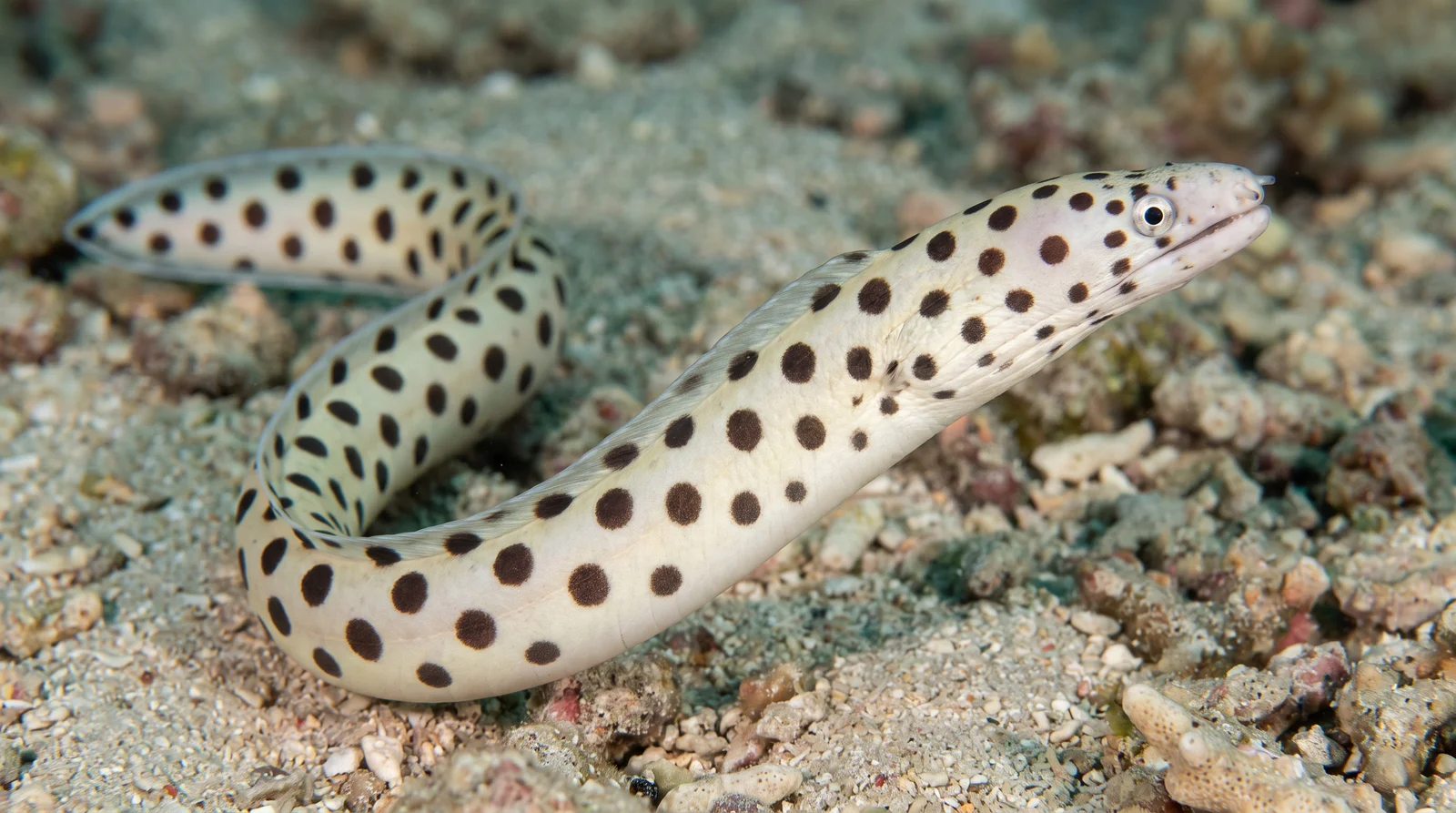 AI-generated
Image credit: AI-generated illustration · License unspecified · Source unspecified
Myrichthys maculosus
About Spotted Snake Eel.
The Myrichthys maculosus, commonly known as the Spotted Snake Eel, Tiger Snake Eel, or Ocellate Snake Eel, is a fascinating member of the Ophichthidae family, known for its distinctive appearance and intriguing behavior. This species is widely distributed across the tropical and warm temperate waters of the Indo-Pacific region, ranging from the Red Sea and East Africa to the central Pacific, including French Polynesia and the Galápagos Islands, and extending from Japan to eastern Australia.
Typically found at depths of 0–262 m, though more commonly observed between 1–25 m, the Spotted Snake Eel inhabits sandy areas of reef flats, lagoons, seagrass beds, and seaward reefs. It thrives in waters with temperatures ranging from 21.4–30.3°C. While primarily nocturnal, divers often encounter this eel foraging openly over sand and rubble during the day. It spends its daytime hours buried tail-first in the sand, using its hard, pointed tail to burrow for protection and to ambush prey. Its diet consists mainly of small fish and crustaceans, which it locates using its well-developed sense of smell.
A remarkable aspect of the Spotted Snake Eel is its Batesian mimicry of venomous sea snakes, particularly sea kraits. By imitating the appearance and movement of these dangerous reptiles, the harmless eel deters potential predators. This mimicry is particularly effective in areas like the Red Sea, where true sea snakes are absent. The species is currently listed as Least Concern by the IUCN, indicating a stable population.
Identification
Recreational divers exploring dive sites such as Bethlehem, where this species is commonly observed, can identify the Spotted Snake Eel by the following physical characteristics:
- Size and Body Shape: It possesses an elongated, snake-like, and cylindrical body, reaching a maximum length of 1 m, though individuals are more commonly observed around 50 cm.
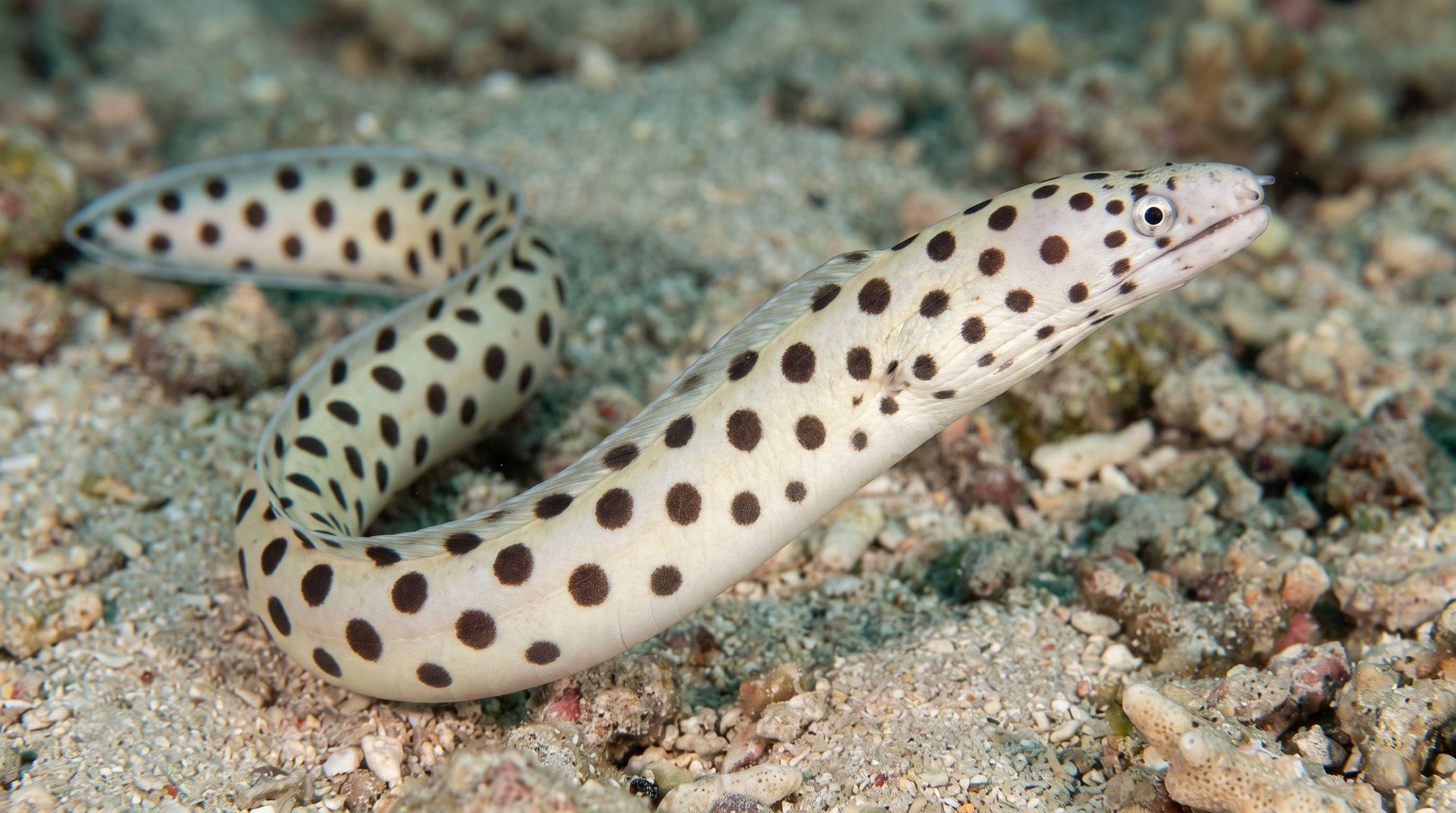
- Coloration and Pattern: The body is typically a pale cream or yellow, adorned with bold, large, circular or oval brown to black spots. The arrangement of these spots changes with age; juveniles may exhibit a single longitudinal row of spots or black saddles, while larger adults can display two or three rows of spots on their upper sides, with smaller spots along the lower surface.
- Head Features: It has a small head with a short snout and distinctive long, tubular nostrils that point downwards. The mouth contains two rows of teeth on each jaw and two additional rows on the palate.
- Fins: The dorsal fin originates just behind the head, and the anal fin begins midway along the body; both extend nearly to the tip of the tail. Notably, the Spotted Snake Eel lacks pelvic and caudal fins, and its pectoral fins are small.
- Skin: Its skin is smooth and lacks scales.
- Tail: The tail is hard and pointed, a key adaptation for its burrowing behavior.
Where it lives.
The Spotted Snake Eel (Myrichthys maculosus) is a fascinating inhabitant of tropical and warm temperate waters across the vast Indo-Pacific and Eastern Pacific regions. Its extensive range stretches from East Africa and the Red Sea, eastward through French Polynesia, and as far as the Galápagos Islands, with observations also noted from Japan to eastern Australia.
This species thrives in a variety of coastal marine environments, making its home in:
- Sandy Plains and Flats: The Spotted Snake Eel has a strong preference for soft substrates, such as sandy or muddy bottoms, where it can readily burrow. It often buries itself tail-first into the sediment, leaving only its head exposed to ambush unsuspecting prey.
- Coral Reef Ecosystems: It is commonly found in association with coral reefs, particularly in sandy areas adjacent to reef flats, lagoons, and seaward reefs. Divers may spot them near reef edges or in calm lagoons.
- Seagrass Beds: These eels also utilize seagrass beds, which provide both cover and hunting grounds.
Typically, the Spotted Snake Eel is found at depths ranging from shallow coastal waters, often just a few meters, down to approximately 260 meters. While primarily nocturnal, spending daylight hours hidden within its burrow, it can sometimes be observed swimming openly over sandy or vegetated areas, especially at dusk or during night dives. At night, they are known to aggregate in large numbers in areas with artificial lighting.
How it behaves.
- Underwater Encounter Behavior
The Spotted Snake Eel is often observed on sandy bottoms, seagrass beds, and reef flats, typically encountered at dive sites between 1 and 25 meters, though it can inhabit depths up to 262 meters. Divers frequently mistake this eel for a venomous sea snake due to its striking banded or spotted pattern and serpentine movements, a form of Batesian mimicry that deters potential predators. While primarily nocturnal, it can sometimes be seen actively swimming over sandy or vegetated areas during the day, a behavior facilitated by its mimicry. During daylight hours, it often remains buried in the sand, using its firm, pointed tail to burrow backward, with only its head or a portion of its body exposed. This eel is generally shy and not aggressive towards humans unless provoked. - Feeding Habits
As a carnivore, the Spotted Snake Eel preys on small fish and various invertebrates, including crustaceans like shrimp and crabs, as well as worms and occasionally cephalopods such as squid and octopus. It is an ambush predator, often lying hidden in the sand, waiting for unsuspecting prey. The eel possesses a well-developed sense of smell, utilizing its downward-pointing tubular nostrils to locate food buried in the sediment or within crevices. While it is primarily a nocturnal hunter, its mimicry allows it to forage openly during the day without significant harassment from predators. It actively searches sandy flats and seagrasses, probing holes with its head and sometimes using its tail to flush out hidden prey. - Social Structure
The Spotted Snake Eel is largely a solitary creature, rarely interacting with other marine organisms. Individuals typically maintain their own burrows and do not share hiding spots or hunt cooperatively, though their burrows may occasionally be found a few meters apart. - Notable Seasonal Patterns
Reproduction in Spotted Snake Eels typically occurs during the spring and summer months, when adults are observed to spawn. Mating behavior has been rarely documented but is generally observed during the summer, often around dusk. The eggs hatch into distinctive leaf-shaped larvae, known as leptocephali, which drift with ocean currents as plankton before developing into juvenile eels and settling into sandy habitats.
Where to see it.
Evidence for philippines · 2 dive sites
General range is not evidence of occurrence at a specific dive site.
Gallery.
 AI-generated
AI-generated illustration
Image credit: AI-generated illustration · License unspecified · Source unspecified