Sweetlips (assorted)
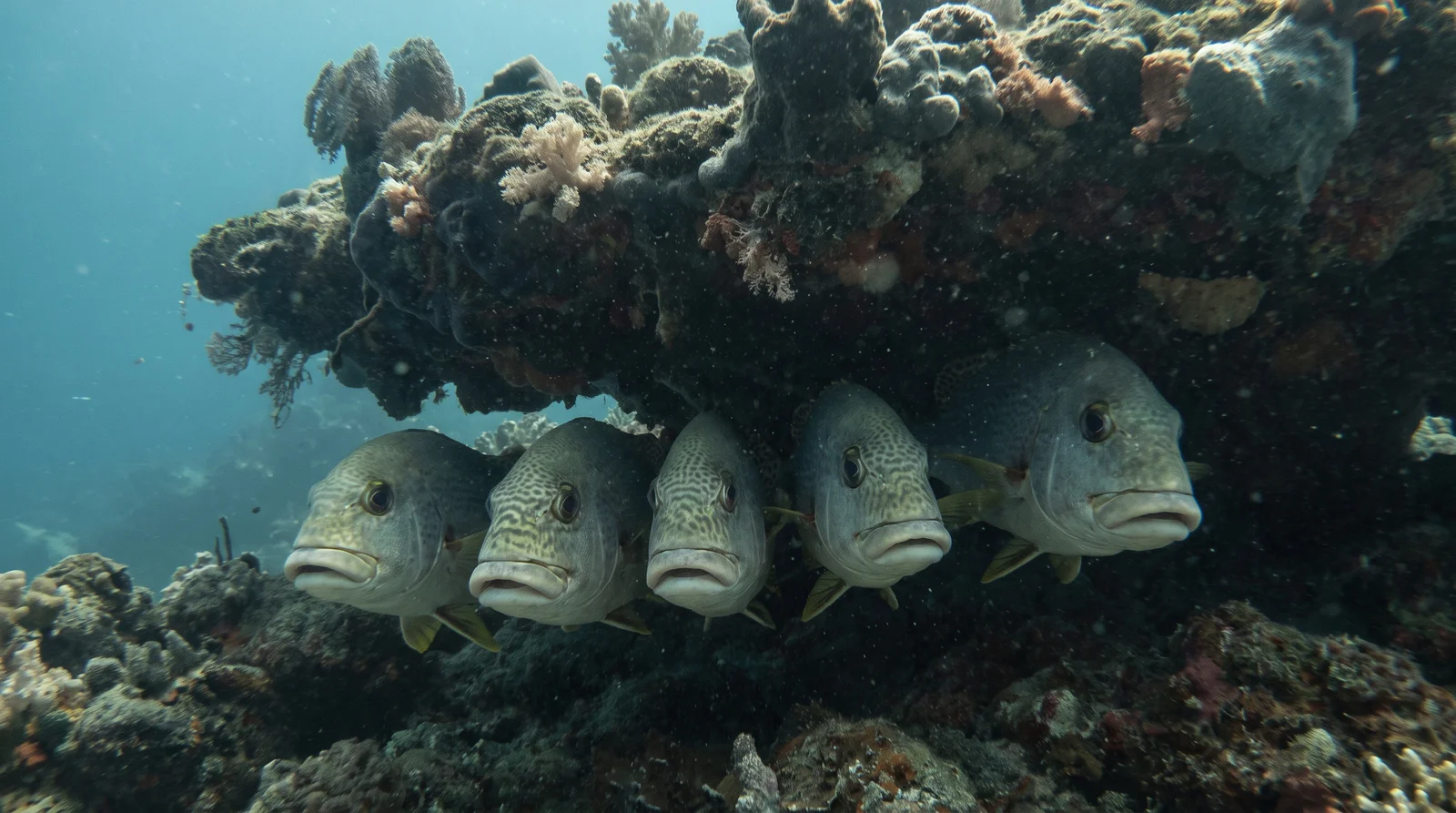 AI-generated
Image credit: AI-generated illustration · License unspecified · Source unspecified
Plectorhinchus spp.
About Sweetlips (assorted).
Sweetlips are reef fishes of the genus Plectorhinchus, part of the grunt family Haemulidae. FishBase lists 138 species in 23 genera for the whole family, which lives in tropical and subtropical coastal waters of the Atlantic, Indian and Pacific Oceans; sweetlips are among its Indo-Pacific reef members. This group entry covers sweetlips that cannot be confirmed to species from a sighting or photo. If you can identify the fish more precisely, separate entries exist for Diagonal-banded, Giant, Oriental and Ribboned Sweetlips.
The common name refers to the thick, fleshy lips that give these fishes a pouting look. FishBase describes the family as having a small mouth with thick lips and a single continuous dorsal fin. Size differs widely between species: Harlequin and Oriental Sweetlips reach about 72 cm, while Giant Sweetlips grow to about 1 m.
Identification
- Lips: Thick lips on a small mouth are the most useful feature for recognising the group.
- Fins: One continuous dorsal fin with 9-14 spines, as described for the family.
- Adult colour: Varies by species, from spotted to striped to mottled. Adult Giant Sweetlips, for example, are mottled grey to brown with black pectoral, pelvic and anal fins, while adult Harlequin Sweetlips are grey with large deep brown spots.
- Juvenile colour: Juveniles often look very different from adults. Young Giant Sweetlips are black with yellow stripes, young Harlequin Sweetlips are brownish with large creamy white blotches, and the black blotches of young Oriental Sweetlips break up into horizontal stripes as they grow.
- Juvenile mimicry: FishBase notes that small Harlequin Sweetlips juveniles may mimic a toxic flatworm.
Conservation status varies by species. Harlequin Sweetlips (P. chaetodonoides) and Oriental Sweetlips (P. vittatus) are both assessed as Least Concern on the IUCN Red List. Because adults and juveniles can look like different fish, record the life stage with any sighting.
Where it lives.
Sweetlips live on tropical coral and rocky reefs of the Indo-Pacific. Published ranges for individual species stretch from East Africa and the western Indian Ocean east to Fiji and New Caledonia, and north to southern Japan and the Ryukyu Islands. The family as a whole is chiefly marine, with some species entering brackish water.
- Reef zones: Adults are recorded from clear lagoons, seaward reefs and outer reef slopes, and Oriental Sweetlips also use inshore rocky reefs.
- Depth: Recorded ranges differ by species: about 1-30 m for Harlequin Sweetlips, 2-25 m for Oriental Sweetlips and 2-50 m for Giant Sweetlips, so most of their range lies within recreational diving depths.
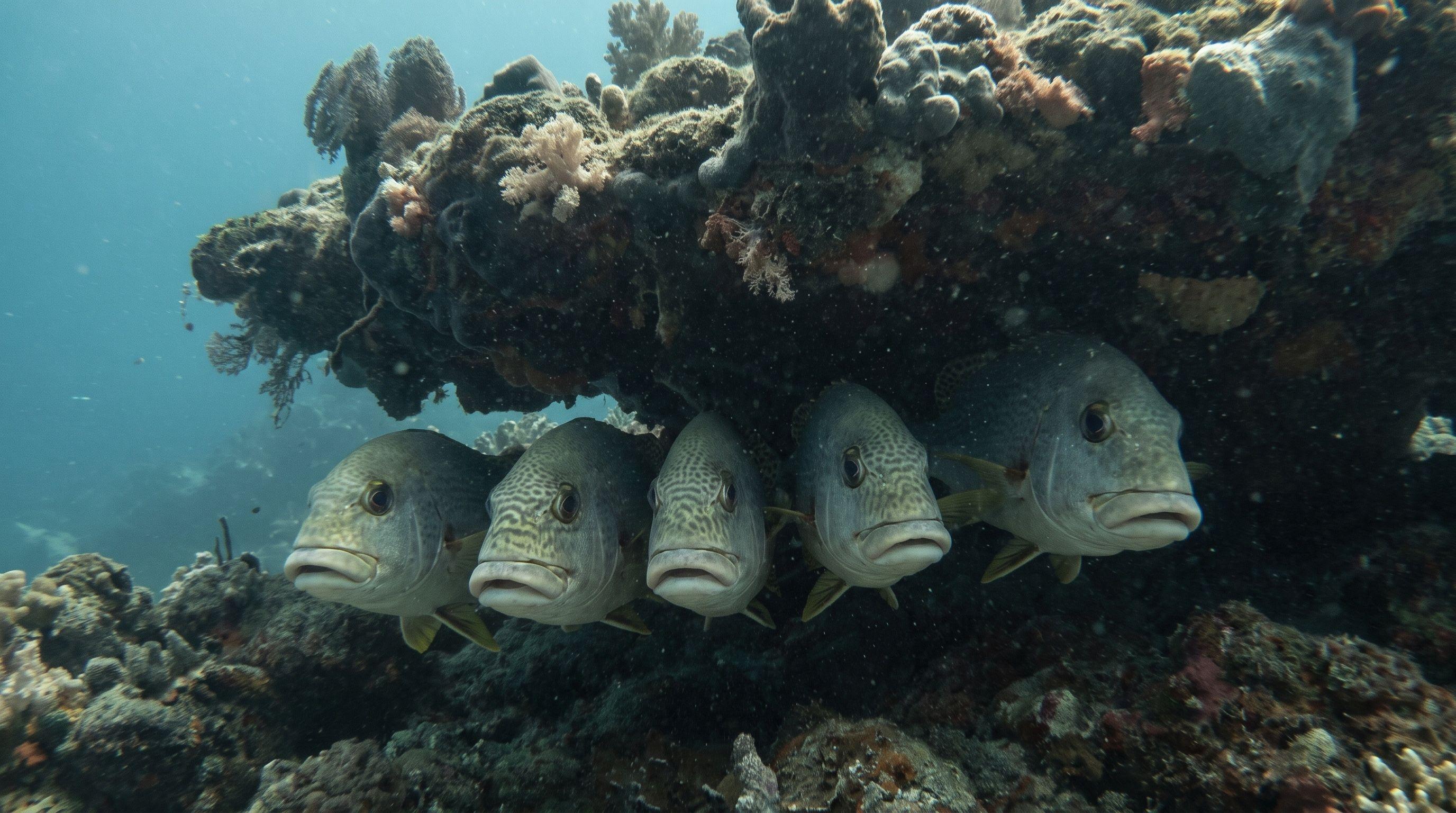
- Daytime shelter: Adults typically rest near ledges, overhangs or caves during the day, in line with the family habit of sheltering by day and dispersing at night to feed.
- Juvenile habitat: Juveniles often use different places from adults. Young Harlequin Sweetlips stay among corals, young Oriental Sweetlips live in clear, shallow, protected lagoons, and young Giant Sweetlips are usually found near the lower reaches of rivers and adjacent reefs.
- Water type: FishBase lists Harlequin Sweetlips from both marine and brackish water, while the other referenced species are recorded from marine reefs.
- Range examples: Harlequin Sweetlips are recorded from the Maldives and the Cocos Islands east to Fiji and New Caledonia, Giant Sweetlips from East Africa to Japan, Australia and Fiji, and Oriental Sweetlips from East Africa to Papua New Guinea and New Caledonia.
For divers, the most productive places to look are coral-rich reef sections with ledges, overhangs and caves for adults, and sheltered shallow areas for juveniles. Coverage of individual species varies, so always check the species entries for local detail.
How it behaves.
Sweetlips are mainly nocturnal. FishBase describes members of the family as sheltering near or under ledges during the day and dispersing at night to feed. This makes them easy fish to watch on daytime dives, because resting adults often stay in one place beneath an overhang.
The family feeds mainly on bottom-dwelling invertebrates and sometimes small fishes, and young may eat mostly plankton. Harlequin Sweetlips, for example, feed at night on crustaceans, molluscs and fishes.
Underwater Encounter Behavior
- Social grouping: Varies by species. Adult Harlequin Sweetlips are solitary, adult Giant Sweetlips occur alone or in pairs, and adult Oriental Sweetlips may be solitary or form aggregations.
- Daytime resting: Expect to find adults hanging near ledges and caves rather than actively swimming across the reef.
- Juveniles: Juvenile Harlequin and Oriental Sweetlips are solitary, and small Harlequin juveniles may mimic a toxic flatworm.
- Reproduction: Members of the family are pelagic spawners that pair during breeding; their eggs drift in open water and no parental care is known.
- Changing patterns: Colour patterns change gradually as juveniles grow, so mid-sized fish can show a mix of juvenile and adult features.
- Pairing: FishBase records distinct pairing during breeding in Oriental Sweetlips.
Diver Tips
- Approach: Move slowly and stay low so you do not push resting fish out of their shelter.
- Where to look: Check beneath ledges and inside caves on daytime dives.
- Night dives: Because sweetlips feed at night, night dives can show them away from their daytime shelters.
- Identification photos: A side-on photo showing body pattern and fin colour helps narrow a sighting to species; note whether the fish was a juvenile, because juvenile and adult patterns differ.
- Buoyancy: Resting sweetlips are often close to coral and overhangs, so good buoyancy control protects both the fish and the reef.
- Patience: Resting adults often stay in place, so a slow, patient approach gives the best chance of good views and photos.
Where to see it.
Evidence for philippines · 7 dive sites
General range is not evidence of occurrence at a specific dive site.
Angol Point
Boracay
Documented site occurrence
Season not yet documented
Source reviewed on 2026-10-14 · Source: DiveGurus Boracay · Observation date not documented
Crocodile Island
Boracay
Documented site occurrence
Season not yet documented
Source reviewed on 2026-10-14 · Source: DiveGurus Boracay · Observation date not documented
Hilutungan Island Sanctuary
Mactan
Documented site occurrence
Season not yet documented
Source reviewed on 2026-10-14 · Source: Green Sea Divers, Hilutungan Marine Sanctuary page (2011) · Observation date not documented
Nalusuan Island Sanctuary
Mactan
Documented site occurrence
Season not yet documented
Source reviewed on 2026-10-14 · Source: Scotty's Dive Center (live page retrieved 2026-10-07) · Observation date not documented
Santa Rosa
Mactan
Documented site occurrence
Season not yet documented
Source reviewed on 2026-10-14 · Source: Asia Dive Site, Olango Island page · Observation date not documented
Talima Marine Sanctuary
Mactan
Documented site occurrence
Season not yet documented
Source reviewed on 2026-10-14 · Source: Bohol-Philippines.com, Olango Island dive sites (Polaris Dive Center text; Wayback snapshot 2024-11-08) · Observation date not documented
Yapak
Boracay
Documented site occurrence
Season not yet documented
Source reviewed on 2026-10-14 · Source: New Wave Divers Boracay (dive-site page) · Observation date not documented
Gallery.
 AI-generated
AI-generated illustration
Image credit: AI-generated illustration · License unspecified · Source unspecified