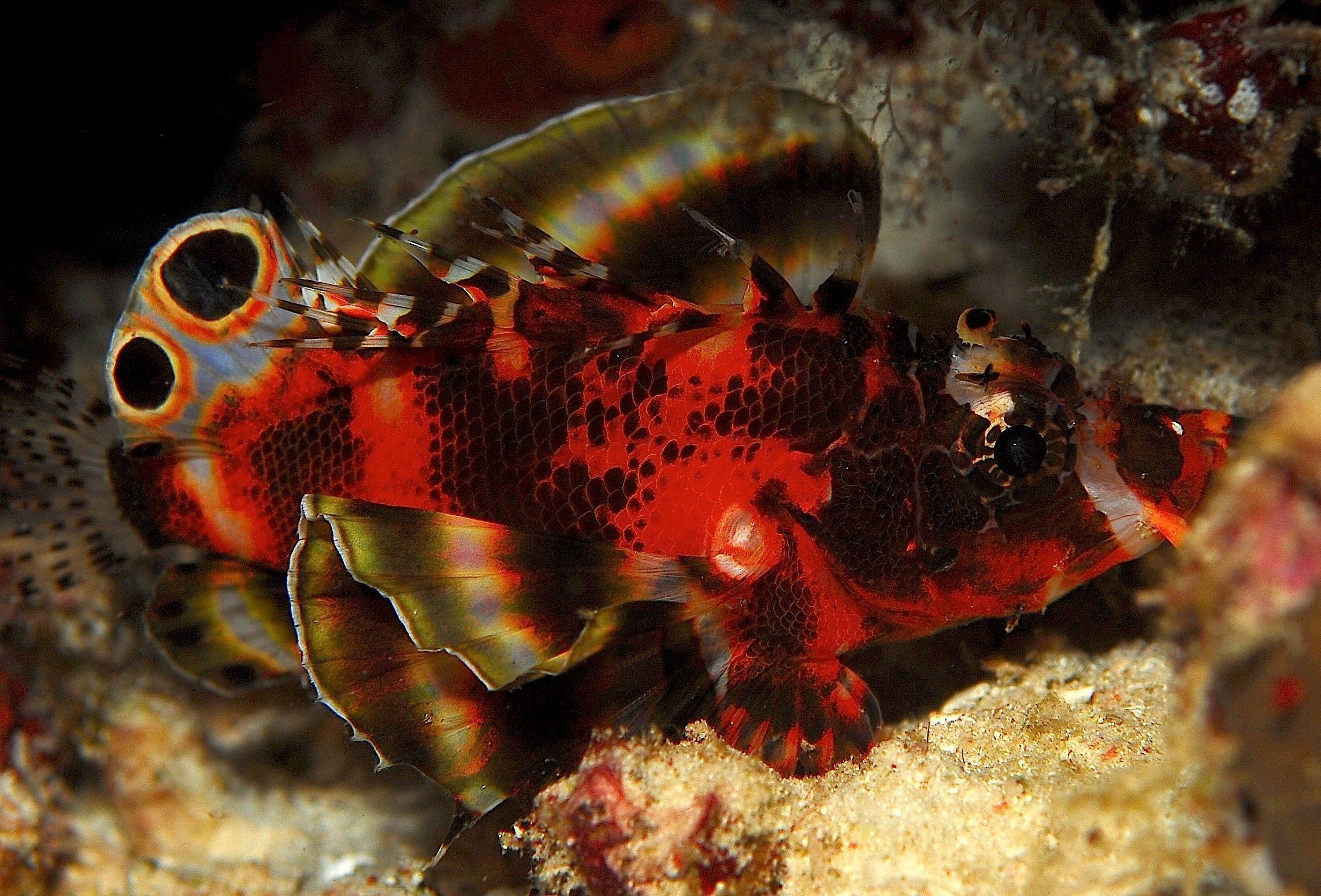
Twin-spot Lionfish
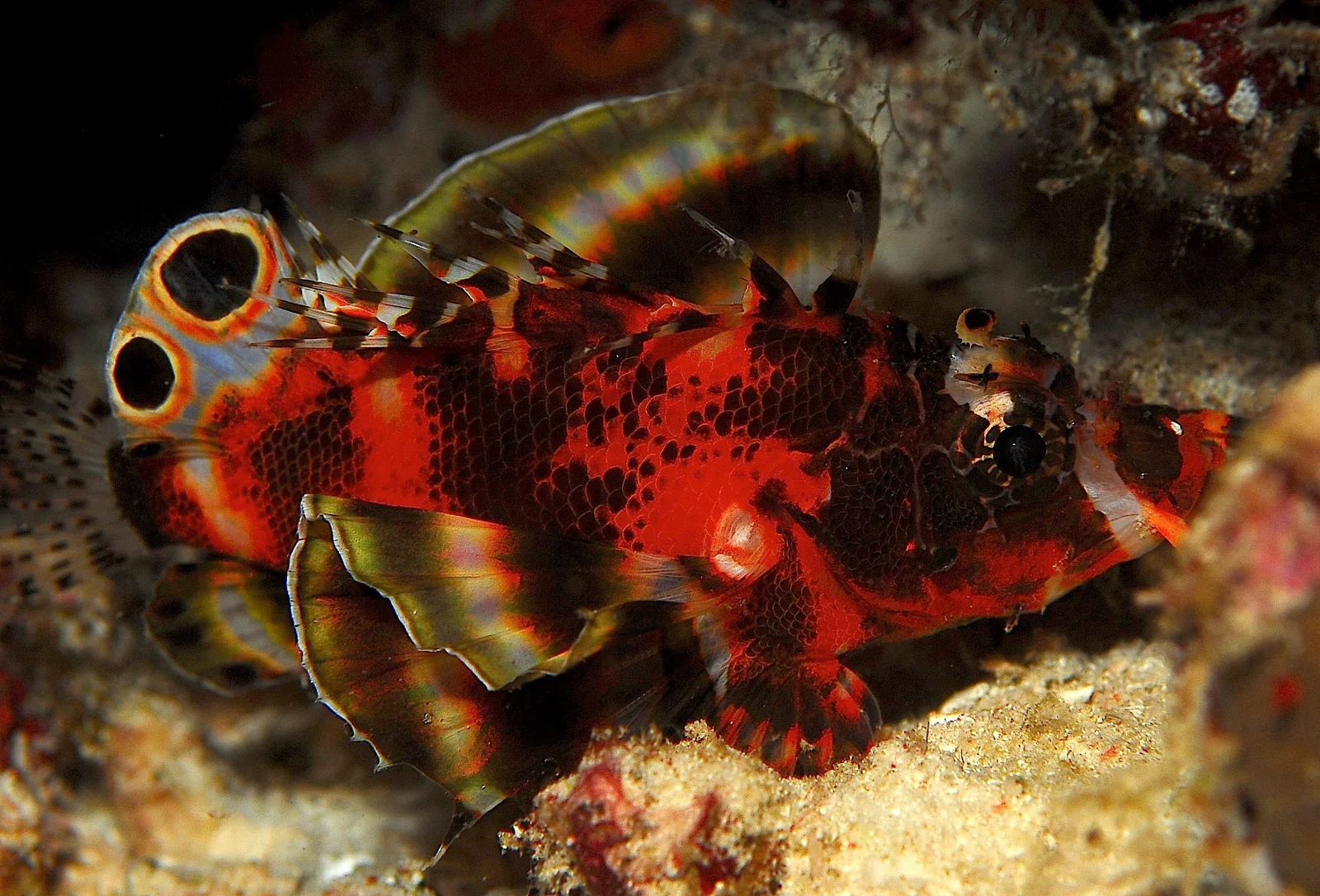
Dendrochirus biocellatus
About Twin-spot Lionfish.
The Twin-spot Lionfish, Dendrochirus biocellatus, is a captivating member of the Scorpaenidae family, commonly known as scorpionfishes. Also recognized by names such as Fu Manchu Lionfish, Ocellated Lionfish, or Twospot Turkeyfish, this species is a favorite among divers for its striking appearance and secretive nature. Native to the tropical Indo-Pacific, its distribution spans from the western Mascarene Islands to the Tuamotu Islands, extending north to southern Japan and south to Australia. It thrives in clear, coral-rich reef environments, including lagoons, coastal fringing reefs, outer reef slopes, and rubble zones, typically found at depths of 1 to 40 m in waters of 26.6–28.9°C. The Twin-spot Lionfish is primarily nocturnal, spending its daylight hours concealed in caves, crevices, or under ledges, often hanging upside down, before emerging to hunt small fish and crustaceans at night. Despite its relatively small size, it possesses venomous spines, a common trait among lionfishes, used for defense. Currently, the Twin-spot Lionfish holds a conservation status of Least Concern by the IUCN.
Identification Features:
- Size: This is one of the smaller lionfish species, reaching a maximum size of approximately 14 cm (5.5 inches).
- Body Coloration: Its body typically displays a reddish-brown to bright red-orange hue, often adorned with indistinct vertical stripes or smudges of black, red, and white.
- Pectoral Fins: The Twin-spot Lionfish is distinguished by its large, fan-like pectoral fins, which feature prominent red, black, and white stripes. The rays of these fins are branched and largely connected by membranes, not extending to the caudal fin base.
- Dorsal Fin Ocelli: A key identifying characteristic is the presence of two prominent, eye-like spots (ocelli) located on the soft-rayed portion of its dorsal fin. While typically two, some individuals may exhibit three or even four spots. These ocelli can change color, from black to faded gray or even turquoise, depending on the fish's mood or during social interactions.
- Facial Appendages: Another unique feature is the elongated, fleshy barbels or tentacles that extend from its lower jaw or in front of its face, giving it a distinctive "mustache-like" appearance, which contributes to its common name, "Fu Manchu Lionfish." Some individuals also have a long tentacle in front of each eye.
- Habitat Preference: When diving, look for this species hiding under ledges, in caves, or within sandy shallows adjacent to reef walls, such as those found at Anilao's Sepok Wall. It often positions itself upside down beneath overhangs.
- Venomous Spines: Like all lionfishes, it possesses venomous dorsal, anal, and pelvic spines, which serve as a defense mechanism. Divers should maintain a respectful distance.
Where it lives.
The Twin-spot Lionfish (Dendrochirus biocellatus) is a captivating inhabitant of the tropical Indo-Pacific, known for its secretive nature and striking appearance. This species has a wide distribution, stretching from the western Mascarene Islands, including Mauritius and Reunion, across the Maldives and Sri Lanka, eastward to the Society and Tuamotu Islands in French Polynesia. Its range extends northward to southern Japan and southward to New Caledonia, Tonga, and various Australian waters such as Scott Reef, Ashmore and Hibernia reefs, and Christmas Island.
Divers can typically encounter the Twin-spot Lionfish in clear tropical waters, often associated with vibrant coral reef ecosystems. It thrives in environments characterized by prolific coral growth, including:
- Lagoon reefs
- Coastal fringing reefs
- Patch reefs
- Outer reef faces and slopes
- Sandy shallows and rubble zones, particularly near reef bases and coral plates
This species is generally found at depths ranging from 1 to 40 m. During daylight hours, the Twin-spot Lionfish is predominantly nocturnal and secretive, preferring to shelter in caves, crevices, and under ledges or coral overhangs. It is often observed hanging upside down in these protected spots, emerging at night to hunt. Optimal water temperatures for this species typically fall between 26.6°C and 28.9°C.
How it behaves.
Underwater Encounter Behavior
The Twin-spot Lionfish is primarily a nocturnal species, spending its daylight hours hidden within crevices, caves, and under coral overhangs, often hanging upside down. Divers are most likely to spot them during night dives when they emerge to hunt. During the day, they are secretive, but a keen-eyed diver might occasionally catch a glimpse of one moving between hiding spots. When threatened, the Twin-spot Lionfish will flare its fan-like pectoral fins and erect its venomous dorsal spines as a defensive display. These spines contain potent neurotoxins, and while stings are rarely fatal to humans, they can cause intense pain, swelling, and discomfort. Divers should maintain a respectful distance to avoid accidental contact. The two prominent ocelli (eye-like spots) on its soft dorsal fin can change color depending on the fish's mood or social status, often fading during aggressive interactions or courtship.Feeding Habits
As a carnivorous ambush predator, the Twin-spot Lionfish primarily feeds on small fish and crustaceans, including shrimp and crabs. It possesses a proportionally large mouth, enabling it to swallow surprisingly large prey whole. Its hunting strategy involves patiently stalking its quarry by slowly slinking along the bottom or around reef structures. It may also use an unusual feeding behavior, snapping its dorsal spines and shaking its head from side-to-side, which may serve to distract or attract prey. The fleshy barbels extending from its upper jaw are thought to act as sensory organs or lures, attracting prey into striking distance. When prey is within about half a body length, it lunges forward with remarkable speed to ingest it. They often position themselves upside-down beneath coral overhangs to ambush prey from unexpected angles.Social Structure
The Twin-spot Lionfish is generally encountered solitarily in the wild. While typically peaceful, they can exhibit semi-aggressive behavior, especially towards conspecifics (members of the same species) if they are of similar size, or if one individual is introduced to another's established territory. Aggressive displays can include lateral displays, gill cover flaring, and head shaking. During reproduction, they are known to form groups, with one male typically spawning with a few females in a harem-like structure.Notable Seasonal Patterns
The Twin-spot Lionfish is found throughout the Indo-Pacific, from Mauritius to the Society Islands, north to Japan, and south to Australia. They inhabit clear tropical waters with abundant coral growth, typically found at depths of 1 to 40 m (3.3 to 132 ft) in lagoons, coastal fringing reefs, patch reefs, and outer reef faces and slopes. Optimal water temperatures for this species range from approximately 22°C to 28.9°C. While specific seasonal breeding patterns for *Dendrochirus biocellatus* are not extensively documented for divers, lionfish in general are known to reproduce year-round in some areas, releasing gelatinous egg masses that float to the surface. Divers are likely to encounter this species consistently throughout the year in suitable habitats, such as Sepok Wall, where they are occasionally observed.Where to see it.
Evidence for philippines · 1 dive site
General range is not evidence of occurrence at a specific dive site.
Gallery.