Yellow Boxfish
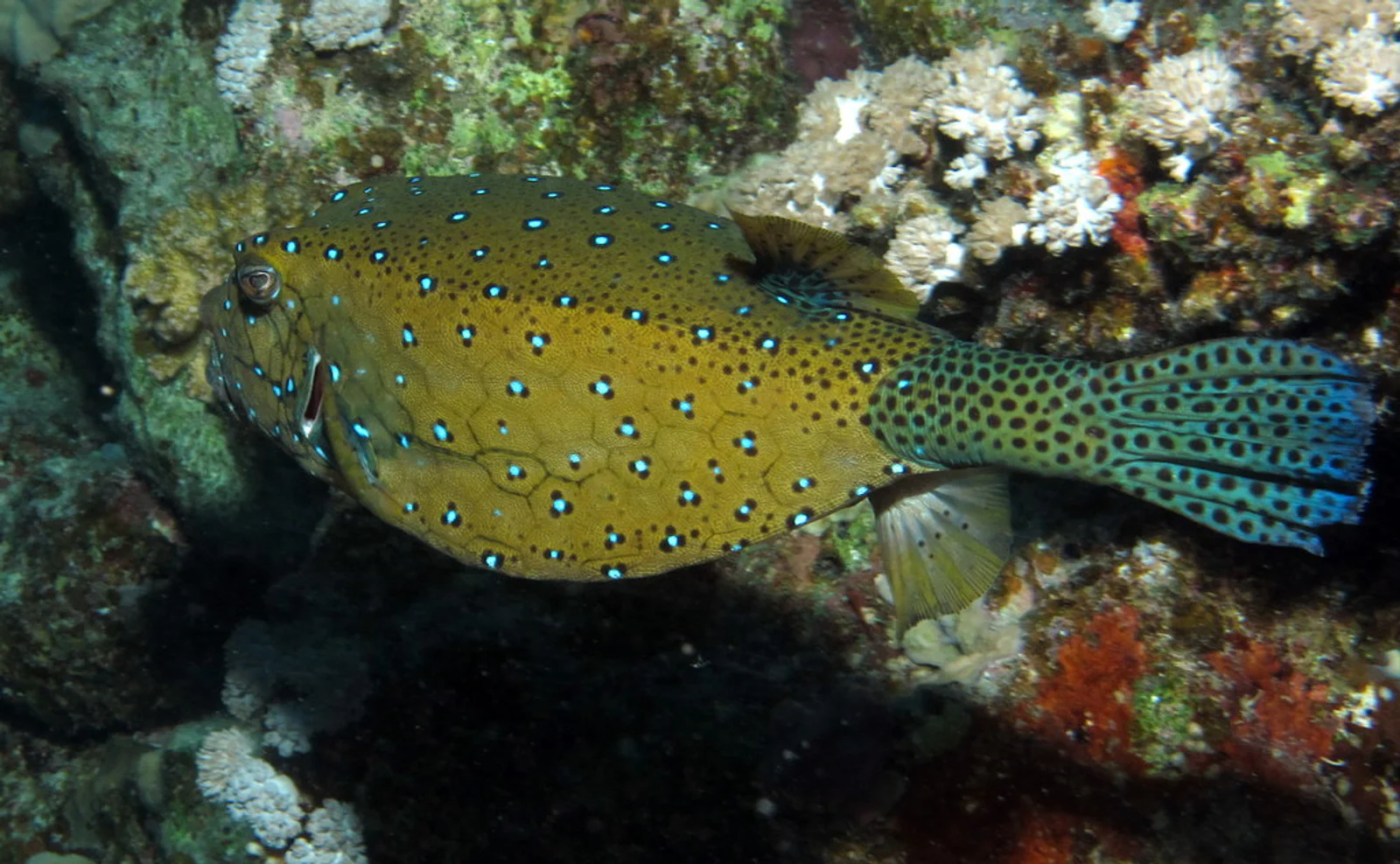
Image credit: Source unspecified · License unspecified
Ostracion cubicus
About Yellow Boxfish.
The Yellow Boxfish, scientifically known as Ostracion cubicus, is a distinctive and captivating member of the Ostraciidae family. Renowned for its unique morphology and striking coloration, this species is a favorite among divers. It holds a conservation status of Least Concern, indicating a stable population across its wide range.
Found throughout the Indo-Pacific, from the Red Sea and East Africa to Hawaii, and extending north to Japan and south to northern New Zealand, the Yellow Boxfish inhabits sheltered coastal and offshore coral reefs. Divers can typically spot them at depths of 1–75 m, often navigating lagoons, semi-sheltered seaward reefs, and areas rich with ledges and crevices. While generally solitary, these omnivorous grazers spend their days methodically picking at algae, small invertebrates such as sponges, crustaceans, mollusks, and worms, as well as detritus.
A fascinating aspect of the Yellow Boxfish is its defense mechanism: when stressed, it can release ostracitoxin, a potent neurotoxin, from specialized mucus glands in its skin. Its vibrant coloration also serves as a form of aposematism, a warning to potential predators. Despite its rigid, box-like body, the Yellow Boxfish is surprisingly agile, utilizing its pectoral and anal fins for precise maneuvering and its caudal (tail) fin for stability. This species has been observed at dive sites such as Pillarsteen (occasionally) and Monkey Wreck (commonly).
Identification
- Body Shape: The most defining characteristic is its rigid, box-shaped or cuboid body, encased in an armored carapace made of hexagonal scale plates. This bony structure covers its head and body, with openings for the mouth, nostrils, gill, anus, and fins.
- Size: The Yellow Boxfish can reach a maximum length of 45 cm (18 in).
- Coloration and Pattern (Age-Dependent):
- Juveniles: Are strikingly bright yellow with prominent, pupil-sized black spots covering their head and body. This vivid warning coloration is thought to be an early defense mechanism.
- Immature/Sub-adults: As the fish matures, the intensity of the yellow coloration begins to fade, and the black spots may become smaller, brownish, or even develop a honeycomb pattern around them and over the face.
- Adults: Older specimens undergo a significant color transformation, often appearing pale yellowish-grey, bluish, or purplish-brown, sometimes with a metallic blue or mustard hue. They typically retain a yellow tail base and may exhibit yellow markings between body plates, with remnants of dark spots or even white spots with black margins.
- Other Features: They possess a small, pouting mouth and high-set, prominent round eyes. Large adults may also develop a bony bump above the mouth.
Where it lives.
The Yellow Boxfish (Ostracion cubicus) is a captivating inhabitant of the Indo-Pacific's vibrant underwater world, boasting a wide distribution that spans from the Red Sea and East Africa across to the Hawaiian and Tuamotu Islands, extending north to Japan and south to northern New Zealand. It has also been observed in the eastern Mediterranean Sea, likely having traversed the Suez Canal.
This species thrives in a variety of reef-associated environments, making it a common sight for divers across numerous dive sites. Its preferred habitats include:
- Lagoons: Often found in the calm, sheltered waters of lagoons, where juveniles and adults can forage and seek refuge.
- Coral and Rocky Reefs: The Yellow Boxfish is strongly associated with both coral and rocky reef ecosystems, navigating among the intricate structures.
- Reef Ledges and Crevices: Adults frequently utilize ledges and crevices within the reef for shelter, while small juveniles are known to be secretive in narrow crevices.
- Rubble Patches: These areas provide foraging grounds and additional hiding spots within the reef environment.
- Seagrass Meadows: They can also be found in seaweed or seagrass meadows, particularly in sandy areas of lagoons.
Typically, the Yellow Boxfish is found at depths ranging from 1 to 50 meters, though some records indicate occurrences down to 75 meters or even 280 meters. Juveniles are often observed amongst *Acropora* corals, benefiting from the protection these branching structures offer. As an omnivorous species, it plays a role in the reef ecosystem by feeding on a diverse diet of benthic organisms, including marine algae, sponges, crustaceans, molluscs, polychaete worms, and small fishes, which it gleans from rocks, corals, and sandy substrates.
How it behaves.
- Underwater Encounter Behavior
The Yellow Boxfish is typically a slow, hovering swimmer, gracefully maneuvering through coral reefs using its dorsal and anal fins. They are commonly observed in lagoons and semi-sheltered seaward reefs, navigating among corals and rocky structures in search of food. Juveniles, characterized by their bright yellow bodies adorned with black spots, are particularly secretive, often seeking refuge among branching Acropora corals or in narrow crevices. While generally peaceful, Yellow Boxfish possess a potent defense mechanism: when stressed, threatened, or injured, they can secrete ostracitoxin, a powerful neurotoxin, from specialized mucus glands in their skin. In the vastness of the open ocean, this toxin disperses harmlessly, posing no threat to divers, but it serves as a critical deterrent to predators. Their striking coloration acts as a warning (aposematism) to potential predators. Divers may encounter these fish at depths ranging from 1 to 75 m, though they tend to frequent shallower, warmer waters. - Feeding Habits
As omnivorous grazers with a notable herbivorous tendency, Yellow Boxfish spend much of their day methodically foraging across coral reefs. Their diet primarily consists of marine algae, which makes up 40-50% of their intake, supplemented by a variety of small invertebrates such as crustaceans, worms, mollusks, sponges, tunicates, bivalves, snails, polychaete worms, and foraminiferans. They are known to use their puckered lips to blow small bursts of water at corals and sand, dislodging and revealing hidden prey. - Social Structure
Yellow Boxfish are largely solitary animals outside of the breeding season. During reproduction, they form small groups, typically consisting of one male and 2-4 females, creating a harem-based social structure. This species exhibits protogynous hermaphroditism, meaning individuals are born female and some transition to male as they mature. - Notable Seasonal Patterns Relevant to Divers
The breeding season for Yellow Boxfish generally occurs during the spring, spanning from April to October. During this period, spawning events take place near the surface, typically before nightfall. Divers might observe males engaging in courtship displays, flashing bright colors and "dancing" around females. Following fertilization, eggs are released into the open water, where currents disperse them. While breeding is seasonal, Yellow Boxfish can be observed year-round at appropriate dive sites.
Where to see it.
Evidence for philippines · 1 dive site
General range is not evidence of occurrence at a specific dive site.
Gallery.
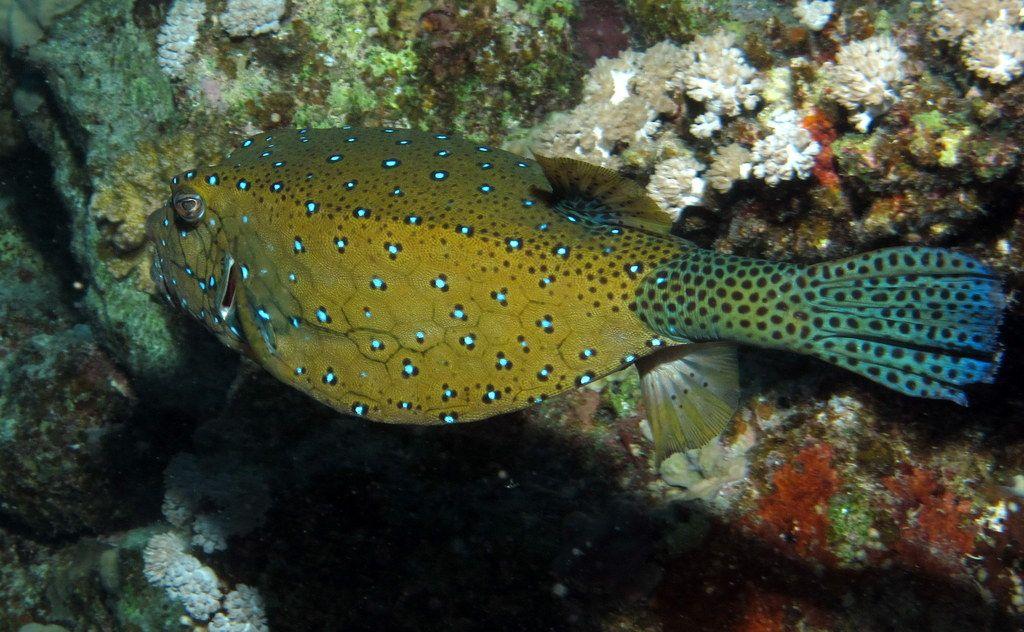
Photo: Derek Keats from Johannesburg, South Africa / CC BY 2.0 via Wikimedia Commons
Image credit: Source unspecified · License unspecified