The SS Thistlegorm in Egypt's Red Sea is the best wreck dive in the world for most certified divers, followed by the SS Yongala in Australia and the SS President Coolidge in Vanuatu. This ranking weighs recreational depth access, wreck condition, marine life and travel logistics rather than fame alone.
How Did We Rank These Wrecks?
A wreck earns its place here by what a certified recreational diver can experience on it within standard depth limits, without a technical qualification. Four factors decide the order: how much of the wreck sits above 30 m, how intact and readable the ship still is, the marine life that has claimed it, and how realistic the trip is to organize. Famous wrecks that demand trimix and a support team are covered separately near the end.
What Are the 10 Best Wreck Dives in the World?
1. SS Thistlegorm, Egypt
No other dive lets you hover over a cargo hold packed with 1941 Bedford trucks and BSA motorcycles, then swim past two steam locomotives lying in the sand. The Thistlegorm was a British armed freighter, bombed by German aircraft on 6 October 1941 while waiting to deliver that cargo to Allied forces in North Africa; The Thistlegorm Project at the University of Nottingham has surveyed and documented most of what remains. Jacques Cousteau located the wreck in the early 1950s and kept the position quiet. The deck sits at roughly 16–20 m, the seabed around 30–32 m, and nearly everything worth seeing fits inside recreational limits. Current on the site can be stiff, which is why most operators want an Advanced Open Water card. Liveaboards out of Sharm El Sheikh and Hurghada run here all year; spring and autumn bring calmer seas and fewer thermoclines.
2. SS Yongala, Australia
The Yongala is a fish dive that happens to be a shipwreck. A century of sitting alone on open sand near Townsville has turned this 109 m steamer into the only structure for kilometers, and everything gathers on it: giant trevally, marble rays, sea snakes, the occasional bull shark. The ship went down in a cyclone on 23 March 1911 and none of the 122 people aboard survived, a story the Queensland Museum tells well. Because the wreck is both a grave and a legally protected zone under Australia's Underwater Cultural Heritage Act 2018, penetration is banned and you dive it with permitted operators only. Expect current; the site has no reef to hide behind. Depths run about 15–28 m. Diveity has a Yongala dive site page with conditions and operators, and a full Yongala guide.
3. SS President Coolidge, Vanuatu
You put your fins on standing at a beach on Espiritu Santo, follow a line down the slope, and arrive at a 199 m ocean liner lying on her side. The Coolidge, a luxury liner converted to a troopship, struck two American mines on 26 October 1942; the US National Archives holds footage of her final 78 minutes. All but two of the roughly 5,340 men aboard walked or swam ashore. It is the largest wreck in the world you can dive this easily, and also one of the deepest on this list: the bow starts near 20 m and the stern falls away to about 70 m. Recreational depths cover the promenade deck and forward holds. The famous "Lady" porcelain relief sits deeper, in decompression territory. Our Coolidge wreck guide covers the dive plans; the site page lists local operators.
4. USAT Liberty, Bali
The easiest dive on this list. The Liberty lies 25 m off Tulamben beach in 5–30 m of water, so snorkelers see the top of the wreck and a brand-new Open Water diver can cover most of the rest. She was torpedoed by the Japanese submarine I-166 in January 1942 and beached for salvage; the 1963 eruption of Mount Agung shook her off the beach and into the sea, where coral has been claiming her since. Come at dawn, before the day-trip crowds arrive from the south, when the resident school of bumphead parrotfish moves across the hull. Start with the USAT Liberty site page; our Liberty wreck guide and Tulamben diving guide cover the rest of the coast.
5. Fujikawa Maru, Chuuk Lagoon, Micronesia
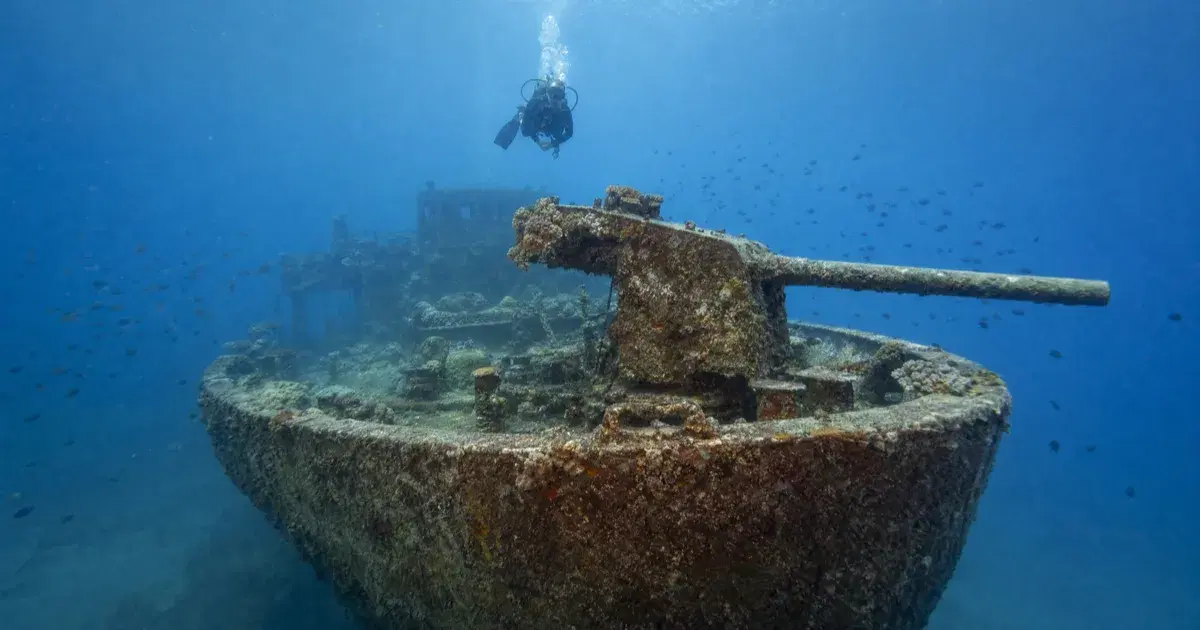
In February 1944, Operation Hailstone put a Japanese fleet anchorage on the bottom of Truk Lagoon in two days. The Fujikawa Maru is its signature wreck: an armed aircraft ferry sitting upright with her deck at 12–18 m, bow gun still mounted, and disassembled Zero fighter fuselages stacked in hold two. Sand is at about 34 m. Getting to Chuuk usually means island-hopper flights through Guam or Manila, and that remoteness has kept the lagoon's several dozen wrecks intact and uncrowded. Plan a week; nobody flies that far for three dives.
6. Okikawa Maru, Coron, Philippines
Coron Bay holds around a dozen ships from a single day's carrier raid, 24 September 1944, and the Okikawa Maru is the one to start with. She's a roughly 170 m oil tanker (her movement history is reconstructed at CombinedFleet) whose deck lies at just 12–16 m in warm, usually calm water. An Open Water certification covers her and several of her neighbors, and Philippine dive pricing means a multi-wreck day costs less than a single boat dive in most of the Caribbean. The Okikawa Maru site page has the details, and our Coron wreck diving guide maps the whole fleet.
7. MS Zenobia, Cyprus
Inside the Zenobia's cargo deck, articulated trucks still hang from their lashing chains. The Swedish ferry capsized off Larnaca on 7 June 1980, weeks into her maiden voyage, taking 104 of them down with her; no one died. She lies on her port side in 16–42 m, a few minutes by boat from Larnaca's shore, which makes her one of the few genuinely big wrecks you can dive twice before lunch. The depth profile suits Advanced Open Water divers, and trained wreck divers can work through the vehicle decks for years without repeating a line.
8. USS Spiegel Grove, Florida, USA
The Spiegel Grove sank wrong. Scuttled off Key Largo in May 2002 as an artificial reef, the 155 m landing ship rolled and settled on her side, and stayed that way until Hurricane Dennis stood her upright in July 2005, finishing what the salvage crews couldn't. The superstructure starts around 18–25 m with sand at 40 m. Bring nitrox: at these depths air gives you barely 15–20 minutes of no-deco time on the deeper decks, and the ship is far too big for that. Prepared corridors make her a sane place to learn wreck penetration before attempting it anywhere historic.
9. Um El Faroud, Malta
Nine dockyard workers died when this Libyan tanker exploded during maintenance in Valletta in February 1995, and Malta scuttled the repaired hull three years later off Wied iż-Żurrieq as a memorial and dive site. The 115 m wreck sits upright on sand at 36 m, main deck between 15 and 25 m, reachable from shore on a calm day. Mediterranean visibility and an open, uncluttered layout have made her many divers' first big wreck after finishing an Advanced course.
10. Sweepstakes, Tobermory, Canada
Fresh water changes everything. The Sweepstakes is an 1867 Canadian schooner that sank in Big Tub Harbour in September 1885, and after 140 years in cold Georgian Bay water she still looks like a ship: masts stepped, hull planked, bow windlass in place. She rests in about 6 m inside Fathom Five National Marine Park, shared by Open Water divers, snorkelers and glass-bottom boats. Parks Canada prohibits penetration to protect the fragile wooden hull. Water temperature rarely passes the mid-teens Celsius even in August, so pack a thick wetsuit or a drysuit.
Which Wreck Dives Can Beginners Do?
Four of the ten suit newly certified Open Water divers: the USAT Liberty, the Coron wrecks, the Sweepstakes and the shallow decks of the Spiegel Grove with a guide. The rest reward an Advanced Open Water certification, mostly for depth and current rather than any wreck-specific skill.
Wreck | Minimum sensible certification | Depth range | Penetration allowed? |
|---|---|---|---|
SS Thistlegorm | Advanced Open Water | ~16–32 m | Yes, guided |
SS Yongala | Advanced Open Water | ~15–28 m | No (protected zone) |
SS President Coolidge | Advanced Open Water | ~20–70 m | Yes, guided |
USAT Liberty | Open Water | ~5–30 m | Limited swim-throughs |
Fujikawa Maru | Advanced Open Water | ~12–34 m | Yes, guided |
Okikawa Maru | Open Water | ~10–26 m | Yes, guided |
MS Zenobia | Advanced Open Water | ~16–42 m | Yes, with training |
USS Spiegel Grove | Advanced Open Water | ~18–40 m | Prepared corridors |
Um El Faroud | Advanced Open Water | ~15–36 m | Yes, with training |
Sweepstakes | Open Water / snorkel | ~6 m | No (park rules) |
Going inside any wreck beyond the light zone is overhead-environment diving. That calls for wreck or cavern training, redundant lights and a guide who knows the layout. The table reflects what operators typically permit, which is a different question from what's safe for you on a given day.
When Should You Dive Each Wreck?
Wreck | Best months (typical) |
|---|---|
SS Thistlegorm | March–May, September–November |
SS Yongala | August–December |
SS President Coolidge | April–October |
USAT Liberty | April–November |
Fujikawa Maru | December–April |
Okikawa Maru | November–May |
MS Zenobia | May–October |
USS Spiegel Grove | Year-round, calmest May–September |
Um El Faroud | May–October |
Sweepstakes | June–September |
These windows are planning defaults, and weather overrides them. Yongala operators cancel trips outright during Queensland's cyclone season, and Maltese shore entries depend on which way the wind blew that morning. Confirm with a local operator before booking flights.
Which Famous Wrecks Didn't Make the List?
The HMHS Britannic and the Andrea Doria, mainly. Britannic, Titanic's sister ship, lies at about 120 m in Greece's Kea Channel: trimix, expedition logistics and Greek cultural-heritage rules that route dives through an authorized operator, as Divers Alert Network describes. The Andrea Doria sits in roughly 50–75 m of cold, dark Atlantic water and has killed more than 15 divers since the 1980s, per Britannica; divers call her the Mount Everest of wreck diving, and the name is earned. Both are extraordinary. A list built for recreational certifications has no honest place for either.
FAQ
Do You Need a Wreck Certification for These Dives?
No, not for the exteriors. Every wreck here can be dived outside the hull on a standard recreational certification. A wreck specialty course matters when you want to go inside; it teaches line-laying, silt management and light protocols for overhead environments.
What Is the Deepest Wreck on This List?
The SS President Coolidge, whose stern reaches about 70 m. Recreational divers stay in the 18–40 m sections; the deep stern is decompression diving.
Are Artificial Reefs Like the Spiegel Grove Real Wreck Dives?
Yes, and they're the right place to learn. A scuttled ship is stripped and prepared, with cut access corridors and no cargo, so you get the scale of a big wreck with far less of the risk. What you don't get is history. Once the skills are solid, the Thistlegorm is where they were pointing all along.
Can You Snorkel Any of the Best Wrecks?
Two of them. The USAT Liberty's shallowest structure sits within a few meters of the surface off Tulamben beach, and the Sweepstakes at about 6 m is fully visible from the surface on a calm day.
Why Is Penetration Banned on Some Wrecks?
Preservation and grave status. The Yongala took all 122 people down with her and is legally protected as an underwater cultural-heritage site. The Sweepstakes ban exists because exhaled bubbles and hand contact degrade a fragile wooden hull that fresh water has kept intact since 1885.
Plan Your Wreck Trip With Diveity
Nine of these ten wrecks have detail pages in the Diveity dive-site atlas, with depth, conditions, marine life and nearby operators for each. Create a free account to log your wreck dives and keep your certification details in one place.