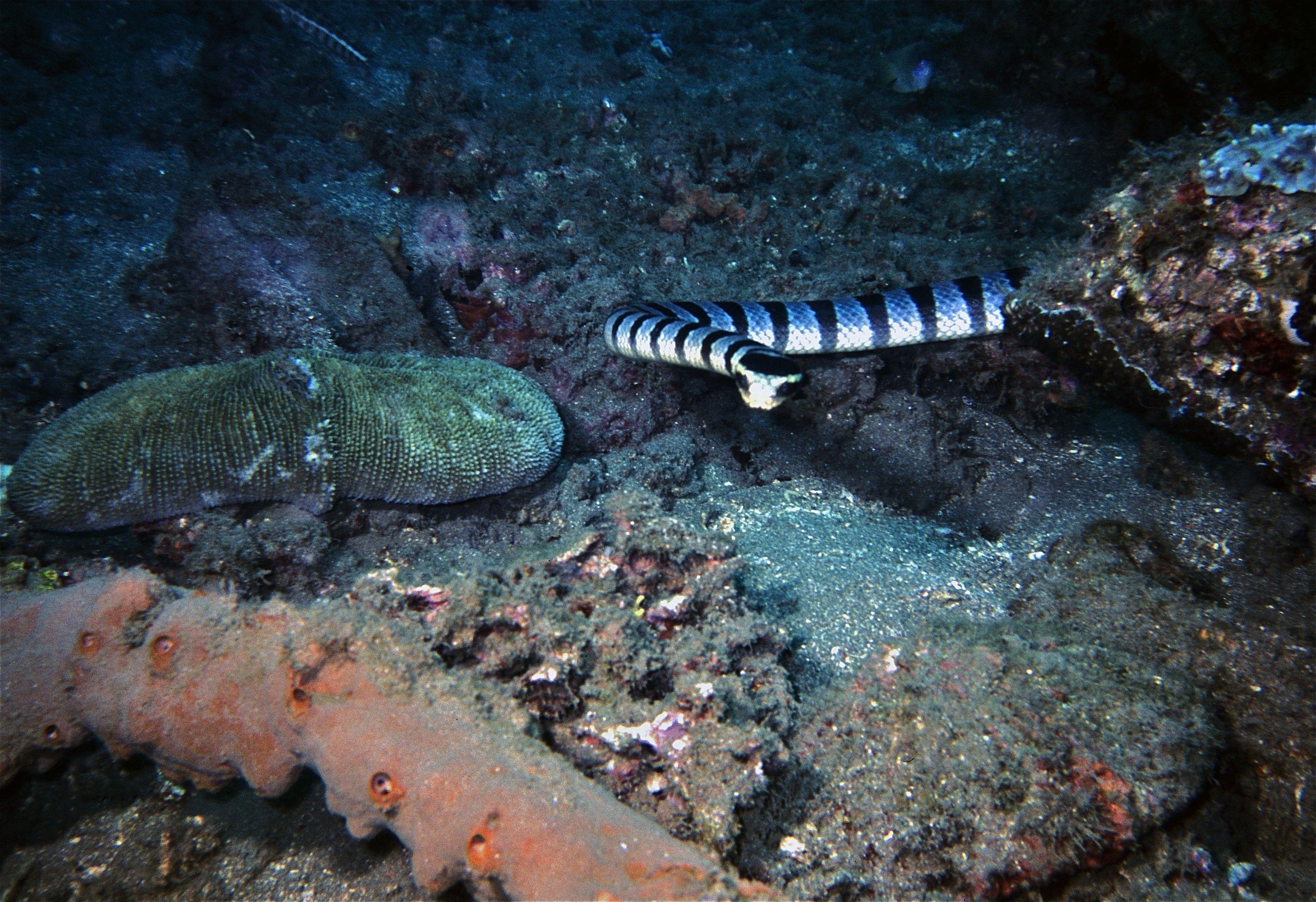
Banded Sea Krait
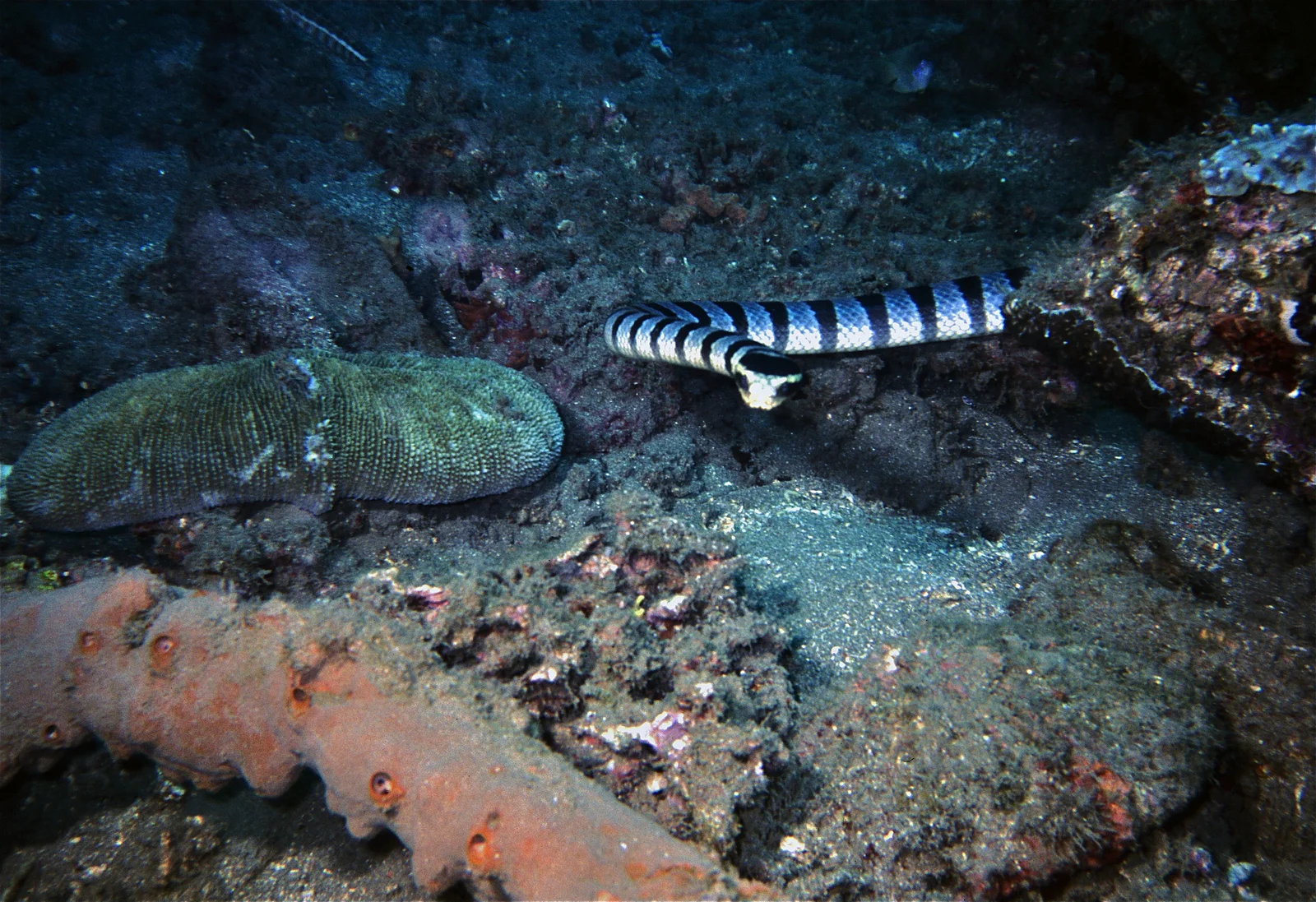
Laticauda colubrina
About Banded Sea Krait.
The Banded Sea Krait (Laticauda colubrina) is a captivating marine reptile belonging to the family Elapidae. Renowned for its striking appearance and amphibious lifestyle, this highly venomous yet generally docile species is a highlight for many divers across its range. Despite possessing potent neurotoxic venom, which is significantly more toxic than a rattlesnake's, bites to humans are extremely rare, as these kraits are non-aggressive and typically only strike if threatened or mishandled.
Unlike "true" sea snakes, the Banded Sea Krait is semi-aquatic, spending a significant portion of its life both in the ocean and on land. It frequents shallow tropical reef waters, where it hunts for its primary prey of eels and small fish, skillfully navigating coral crevices and mangrove roots. They are adapted for diving, capable of holding their breath for up to 30 minutes and possessing a saccular lung that aids in oxygen intake. After a successful hunt, especially for larger eels, the krait's swimming ability can be impaired, prompting it to seek safety on land to digest its meal, shed skin, drink freshwater, and lay eggs. Females return to land to lay clutches of 5-20 eggs, which hatch in about four months.
The Banded Sea Krait is widely distributed throughout the tropical and subtropical waters of the eastern Indian Ocean and Western Pacific, including Southeast Asia, the Indo-Australian Archipelago, and various Pacific islands. It is listed as "Least Concern" by conservation bodies, indicating a stable population. Divers frequently encounter this species at dive sites such as SS Yongala (common), Cervera Shoal (abundant), Dungon Wall (common), and Boulders (common), with occasional sightings at The Canyons, Twin Rocks, Sunken Cemetery, Verde Island Wall, Arco Point, and Tatawa Kecil.
Identification
- Size: Individuals can reach a maximum length of 1.4 m (4.6 ft), with females generally growing larger than males.
- Coloration: The body is distinctly marked by alternating bands of black and a lighter color, typically silvery-blue or greyish-blue, extending from the neck to the tail tip. There are usually 20 to 65 black bands.
- Head: The head is often a lighter, whitish color with a distinctive black circle or "crown" on top. It also features a characteristic yellow snout that extends backward along the upper lips and around the eyes, earning it the alternative name "Yellow-lipped Sea Krait". The head is slightly flattened, contributing to its hydrodynamic shape.
- Body Shape: The body is cylindrical and slender, allowing it to navigate through reef crevices efficiently.
- Tail: A key distinguishing feature is its flattened, paddle-like tail, which is highly adapted for efficient swimming and propulsion through water.
Where it lives.
The Banded Sea Krait (Laticauda colubrina) is a fascinating amphibious reptile, equally at home in the ocean and on land. This species exhibits a unique dual lifestyle, spending significant time in both marine and terrestrial environments, often dividing its time roughly 25% to 50% between the two.
Its habitat preferences are driven by the need for both foraging grounds in the sea and safe havens on land for essential biological activities, including digestion, shedding skin, drinking freshwater, mating, and laying eggs.
- Marine Environment: Banded Sea Kraits are predominantly found in warm, tropical, and subtropical coastal waters across the Indo-Pacific region. They are strongly associated with shallow marine environments, particularly vibrant coral reefs, rocky shores, and mangrove swamps. These ecosystems provide abundant hunting grounds, where they specialize in preying on eels and small fish found within reef crevices. While commonly observed in shallow waters, typically at depths of 0–10 m, their specialized saccular lung allows them to dive much deeper, with individuals capable of reaching depths of up to 60 m, and larger females even recorded at 80 m, in pursuit of prey.
- Terrestrial Environment: For their land-based activities, Banded Sea Kraits seek shelter on small islands, rocky islets, and sandy beaches. They often congregate in rock crevices, under beach debris, in caves, or amidst complex tree root structures and low-hanging trees, providing refuge from predators and suitable microclimates for thermoregulation. Access to freshwater sources on land is crucial for their survival, as they cannot hydrate from saltwater.
- Ecosystem Associations: As apex predators of eels, Banded Sea Kraits play a vital role in regulating eel populations within the coral reef ecosystems they inhabit. Divers may occasionally observe them engaging in cooperative hunting behaviors, flushing prey from reef crevices alongside predatory reef fish such as goatfish or trevally. Their presence is often an indicator of a healthy and diverse coastal ecosystem, encompassing both thriving coral reefs and intact terrestrial habitats.
How it behaves.
The Banded Sea Krait (Laticauda colubrina), a striking reptile with a maximum size of 1.4m, is a common and fascinating encounter for divers in tropical Indo-Pacific waters, including dive sites like SS Yongala and Cervera Shoal. Despite being highly venomous, these creatures are generally docile and non-aggressive, making bites to humans rare.
Underwater Encounter Behavior
- Curiosity and Calmness: Banded Sea Kraits are often indifferent or mildly curious towards divers, continuing their normal activities even in the presence of humans. They may approach slowly, investigate elongated objects like fins or dive hoses, and then move away without hesitation.
- Breathing: As air-breathers, they must regularly surface to breathe, offering divers a chance to observe their rhythmic, undulating swimming pattern as they ascend and descend. They can hold their breath for extended periods, typically 15-30 minutes, but have been recorded submerged for over 50 minutes, and even up to two hours.
- Habitat: While they spend a significant portion of their lives on land for digestion, breeding, and shedding skin, they are frequently observed foraging in shallow coral reef waters, often near small islands or rocky islets. They can dive to depths of up to 60 m in search of food.
- Diver Protocol: Divers should maintain a respectful distance, avoid sudden movements, and never attempt to touch, grab, corner, or block the animal's path. If a krait approaches, remain calm and allow it to pass naturally.
Feeding Habits
- Specialized Diet: Banded Sea Kraits are feeding specialists, with their diet consisting almost entirely of eels, primarily moray and conger eels. They also occasionally consume small fish.
- Hunting Strategy: They use their elongate bodies and small heads to probe cracks, crevices, and small openings in coral reefs to flush out prey. They paralyze their prey with potent neurotoxic venom before swallowing it whole.
- Sexual Dimorphism in Foraging: Females, which are typically larger, tend to hunt in deeper waters for larger conger eels, while males feed on smaller moray eels in shallower areas.
- Cooperative Hunting: Remarkably, they have been observed engaging in cooperative hunting behaviors, where groups of sea kraits flush prey from reef crevices while working alongside predatory reef fish such as trevallies and goatfish.
- Digestion: After a large meal, which can include eels much larger than themselves, they return to land to digest, a process that can take weeks.
Social Structure
- Generally Solitary but Aggregations Occur: While often observed individually, Banded Sea Kraits may congregate in small groups during the day, seeking shelter in rock crevices, tree roots, or under beach debris.
- Mating Behavior: During the breeding season, males may be seen swimming around the shore to locate females, often relying on pheromonal cues. Mating occurs on land, and groups can involve a female with multiple males, though typically only one male actively courts the female.
- Homing Behavior: They exhibit philopatry, meaning they often return to the same beach to rest, digest, and lay eggs, even after being displaced several kilometers.
Notable Seasonal Patterns Relevant to Divers
- Amphibious Lifestyle: Banded Sea Kraits are amphibious, spending anywhere from 25% to 50% of their lives on rocky islets or land to digest food, shed skin, drink freshwater, court, mate, and lay eggs. Their movement to land becomes more frequent during the breeding season.
- Breeding Season: The breeding interval for Banded Sea Kraits can vary geographically. Some populations, such as those in the Philippines, breed aseasonally. However, in other regions like Fiji and Sabah, breeding is seasonal, typically occurring from September to December or January.
- Egg Laying: Females lay clutches of 4 to 20 eggs on land, often in rock crevices, caves, or under sand, after which the eggs hatch in approximately four months. Juveniles are fully capable of surviving in the ocean upon hatching.
Where to see it.
Evidence for philippines · 11 dive sites
General range is not evidence of occurrence at a specific dive site.
Arco Point
Panglao
Site occurrence not yet documented
Season not yet documented
No dated observations available.
Boulders
Puerto Galera
Site occurrence not yet documented
Season not yet documented
No dated observations available.
Cervera Shoal
Panglao
Site occurrence not yet documented
Season not yet documented
No dated observations available.
Dungon Wall
Puerto Galera
Site occurrence not yet documented
Season not yet documented
No dated observations available.
Paradise Beach
El Nido
Site occurrence not yet documented
Season not yet documented
No dated observations available.
Siete Pecados
Coron
Site occurrence not yet documented
Documented site seasonality: Mar, Apr, May
No dated observations available.
Snappers
Anda
Site occurrence not yet documented
Documented site seasonality: Jan, Feb, Mar, Apr, May, Jun, Jul, Aug, Sep, Oct, Nov, Dec
No dated observations available.
Sunken Cemetery
Camiguin Island
Site occurrence not yet documented
Season not yet documented
No dated observations available.
The Canyons
Puerto Galera
Site occurrence not yet documented
Season not yet documented
No dated observations available.
Twin Rocks
Anilao
Site occurrence not yet documented
Season not yet documented
No dated observations available.
Verde Island Wall
Verde Island
Site occurrence not yet documented
Season not yet documented
No dated observations available.
Gallery.